“This I believe to be the privilege and the burden of all of us who deem ourselves bound by allegiances and loyalties which are broader and deeper than nationalism and which go beyond our nation’s self-defined goals and positions. We are called to speak for the weak, for the voiceless, for the victims of our nation and for those it calls ‘enemy,’ for no document from human hands can make these humans any less our brothers.” Dr. Martin Luther King
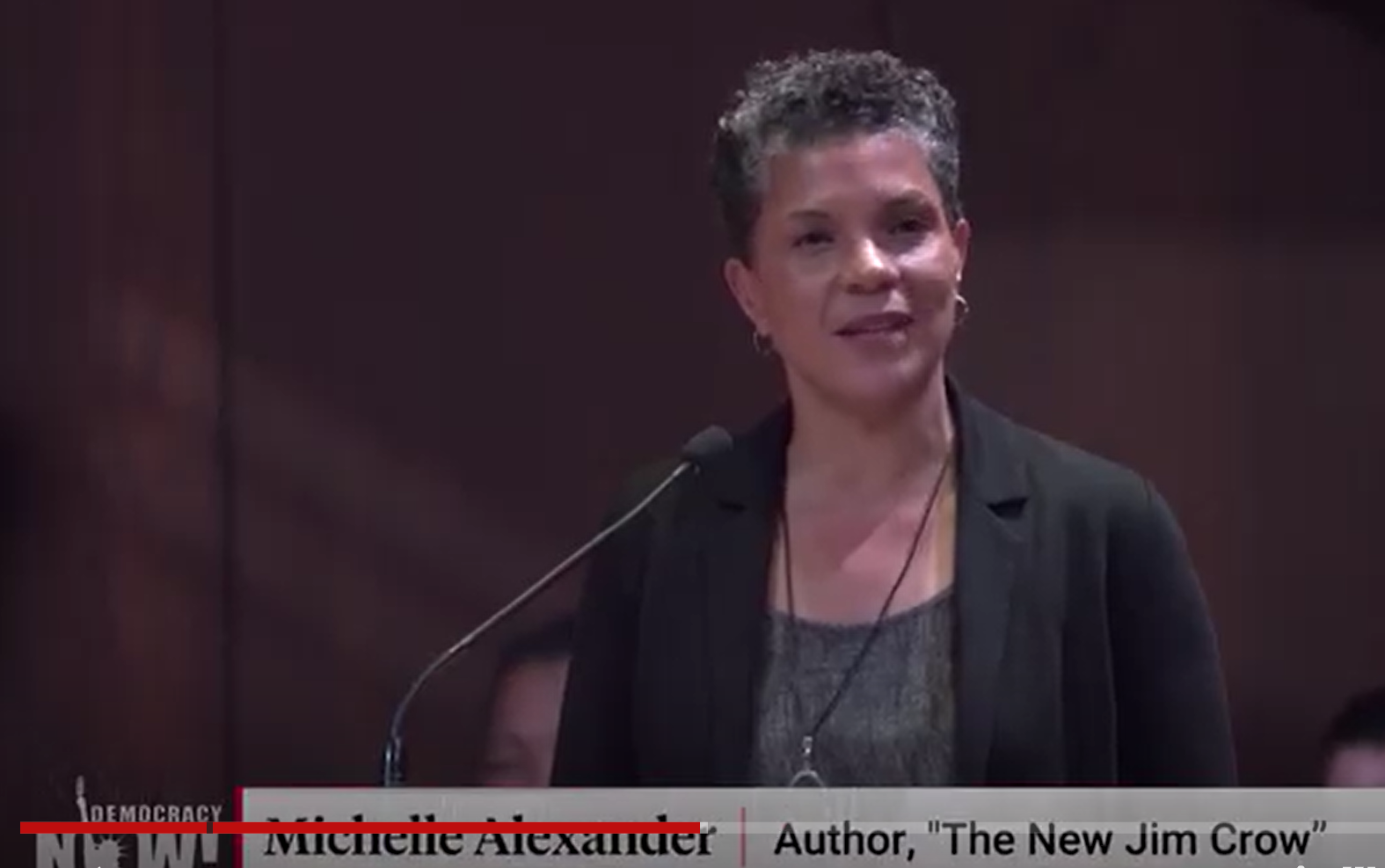
Dr. Martin Luther King’s 1967 speech about the Viet Nam war is not the one you’ll find on greeting cards. Those of us familiar with that speech wonder what Dr. King would have to say about the continuing genocide in Palestine. Civil rights attorney Michelle Alexander, author of The New Jim Crow: Mass Incarceration in the Age of Colorblindness had this to say on the subject during her presentation at “But We Must Speak: On Palestine and the Mandates of Conscience,” a November 2023 event organized by the Palestine Festival of Literature in New York
“The fact that so many people are here tonight, so many, from all different religions, races, genders, is itself a testament of hope. I know that so many of us are carrying a great deal of grief, fear, anger, internal conflict and despair into this room. I hope that we can breathe together, now that we have arrived, exhale, open our hearts to one another and listen deeply to each other. We are here. We are many. We are not alone.
…
It’s no secret that many people are closing their doors to these kinds of vital conversations right now, fearful of what others might say, think or do in response. And so I am enormously grateful that Serene said yes when I asked her if the Palestine Literary Festival could come to Union and use this sacred space. She said yes, knowing that her decision might invite criticism or rebuke. But she also knew that James Chapel has been a site of many, many difficult, courageous conversations, dialogues that are essential to our collective liberation and the creation of beloved community.
In fact, it was in this very space that Reverend Dr. Martin Luther King Jr. was originally scheduled to deliver his 1967 speech condemning the Vietnam War. The event was ultimately relocated to Riverside Church across the street due to the overwhelming number of people who wanted to hear what he had to say and our space limitations here.
At Riverside, Dr. King stepped to the podium and said, quote, “I come to this magnificent house of worship tonight because my conscience leaves me no other choice. A time comes when silence is betrayal. And that time has come for us in relation to Vietnam.”
Dr. King acknowledged how difficult it can be for people to speak out against their own government, especially in times of war, and that the temptations of conformity may lead us toward a paralyzed apathy. He did not deny that the issues present in Vietnam were complex with long histories. And he recognized that there were ambiguities and that North Vietnam and the National Liberation Front were not paragons of virtue. But he said that he was morally obligated to speak for the suffering and helpless and outcast children of Vietnam. He said, quote, “This I believe to be the privilege and the burden of all of us who deem ourselves bound by allegiances and loyalties which are broader and deeper than nationalism and which go beyond our nation’s self-defined goals and positions. We are called to speak for the weak, for the voiceless, for the victims of our nation and for those it calls ‘enemy,’ for no document from human hands can make these humans any less our brothers.
He condemned the Vietnam War in unsparing terms. He decried the moral bankruptcy of a nation that does not hesitate to invest in bombs and warfare around the world but can never seem to find the dollars to eradicate poverty at home. He called for a radical revolution of values. He said, quote, “We must rapidly begin the shift from a thing-oriented society to a person-oriented society. When machines and computers, profit motives and property rights are considered more important than people, the giant triplets of racism, extreme materialism and militarism are incapable of being conquered,” end-quote.
Dr. King was condemned by virtually every major media outlet in America for taking this stand. And even within the civil rights community, many imagined that he was a traitor to the cause. And yet we now know — deep within us we know — that he was right. He is right. He is right today as he was back then about the corrupting forces of capitalism, militarism and racism and how they lead inexorably toward war.
And he was right that our conscience must leave us no other choice: We must speak. When the oppressed, the poor, the weak are under attack, when their homes are stolen or demolished, when they are forced to migrate and to live in unspeakable conditions, in open-air prisons, concentration camps, perpetually as refugees under occupation, we must speak. We must speak when Jewish children are brutally killed in the name of liberation, when antisemitism and Islamophobia slip in through the back door of supposedly progressive spaces. When Palestinian children in refugee camps are bombed and killed, when schools and hospitals and entire neighborhoods are laid waste, we must speak. When international law is treated like a naive suggestion, we must speak. Yes, it may be difficult. Yes, we will make mistakes. We are human. And yes, we may be afraid. But we must speak. Countless lives and the liberation of all of us depend on us breaking our silences.
And what’s required in these times, as I see it, is not only activism and politics, but also deeply personal spiritual work. As Grace Lee Boggs once said, quote, “These are the times to grow our souls.”
All of us have a conscience that whispers to us, sometimes in the dark. The mandates of conscience that arise within each of us arise not out of loyalty to abstract principles or doctrines, but from a place of deep knowing, a deep knowing that we owe something to each other as human beings, that we belong to each other, and that our freedom and liberation depends on one another. If I do not stand and speak up when the bombs are raining down on you, then who will speak up for me, for my loved ones, when the tables are turned? As James Baldwin wrote to Angela Davis more than 50 years ago when she sat in a prison cell ‘For, if they take you in the morning, they will be coming for us that night.’”

 Our Kitchen Table