While The Bloom Collective has been a most gracious host for the past several years, Our Kitchen Table recently got the opportunity to move into affordable office space in one of our target neighborhoods, Garfield Park. We are now located within the Garfield Park Lodge, 334 Burton SE, Grand Rapids 49507. We hope that this move makes it more convenient for our southeast side constituents living in Gafield, Eastown, Baxter and SECA/Southtown neighborhoods.
Archive by Author | oktable
Kellogg boycott raises awareness of GMOs in foods marketed to children
“Kellogg’s total advertising for their child and family cereal brands came in at $162.3 million in 2011 … Kellogg spent another $790,700 to help defeat Prop 37 in California, a ballot initiative that would have required the mandatory labeling of GMOs.”
GMO Free USA uses education, advocacy and action to foster consumer rejection of genetically modified organisms, until they are proven safe. Its current Kellogg boycott campaign is one strategy the group is using. The following article and video are reposted from the GMO Free website:
We aim to speak collectively to force food manufacturers to come clean with the ingredients they use in their products, and to remove untested and potentially harmful genetically modified organisms (GMO). If they won’t remove GMOs, we will boycott them until they do. We will begin with one industry leader until our numbers grow large enough to expand our boycotts.
Kellogg states, “At Kellogg we believe that when you start with a great breakfast, great things can happen. That’s why we make foods that you and your family know, trust and enjoy.” After repeated attempts to get them to be transparent and cooperative on the issue of GMOs, in the interest of the health and well being of their customers, we only got the cold shoulder.
We began with and targeted Kellogg, an American icon since 1906, because of its heavy marketing to children and its wholesome family image. While all people – children, teens, and adults – should be concerned with their health, children are most vulnerable because their bodies are still developing. Increasing evidence suggests that long term consumption of GMOs is harmful and that the escalated use of toxic herbicides and pesticides in GMO agriculture is compounding the problem. Additionally, Kellogg was chosen because they sell the same products abroad, in countries that require the labeling of genetically engineered foods, but without using genetically engineered ingredients. Americans deserve the same.
According to the Rudd Center for Food Policy & Obesity at Yale University, marketing of cereals to children has increased significantly over the years. Their first study found that the least healthy breakfast cereals are those most frequently and aggressively marketed directly to children as young as age two. Kellogg is one of two companies that led in child-targeted marketing, in spite of their participation in the Children’s Food and Beverage Advertising Initiative (CFBAI), the food industry’s self-regulatory program.
Kellogg’s total advertising for their child and family cereal brands came in at $162.3 million in 2011. And this year, 2012, Kellogg spent another $790,700 to help defeat Prop 37 in California, a ballot initiative that would have required the mandatory labeling of GMOs. So not only does Kellogg market its most nutritionally deficient products to children, all of which contain GMOs and toxic chemicals, they decisively bet against Democracy and peoples’ freedom to choose by funding a propaganda campaign designed to trick people into voting against their own best interests.
Well Kellogg, we used to know, trust, and enjoy your foods, but not anymore! We will continue to grow this boycott. We will ramp up our efforts in the coming months. And we will not stop until you address and work with us to reach a solution. The solution: remove all GMOs from your products.
July Gardening Events
Baxter Neighborhood Centers’ July Flyer

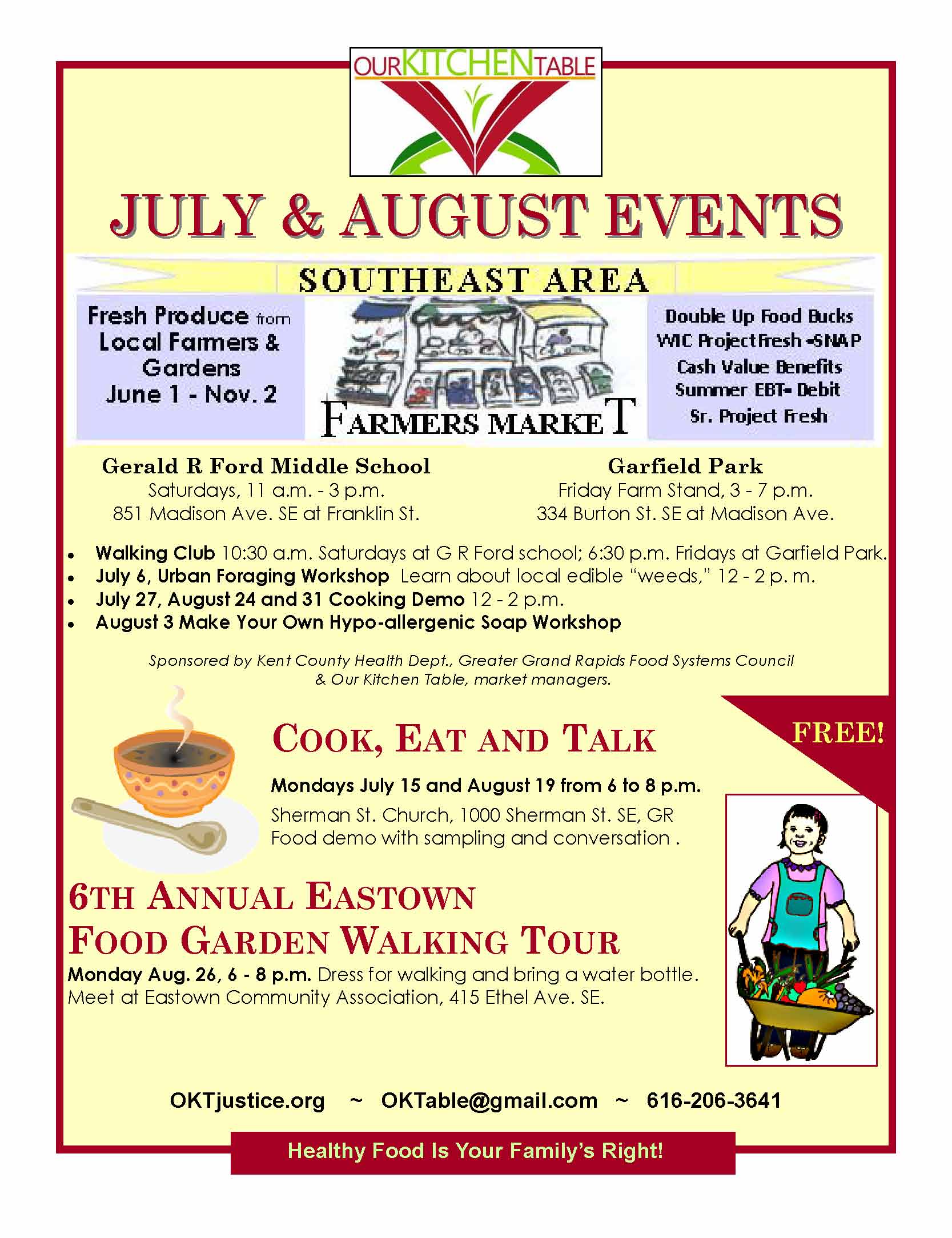
Urban foraging workshop at farmers’ market Saturday July 6
Urban Foraging Workshop
12 – 2 p.m. Saturday July 6 at Gerald R. Ford Middle School with Laura Casaletto, OKT Urban Forest Consultant
 The Southeast Area Famers’ Market will host an Urban Foraging Workshop for the third year in a row, 12 – 2 p.m. Saturday July 6 at Gerald R Ford Middle School. Just like the grocery stores have helped us forget that food comes from farms, cultivation of domestic crops has helped us forget that many of the native species we see around us (and label as weeds) once were a prize source of both food and medicine. Here is a list of some of the edible plants (weeds) growing in Grand Rapids neighborhoods:
- Purslane, dandelion and sorrel: delicious salad greens
- Queen Anne’s lace: Deep fry the flowers.
- Wild grape and mulberry leaves: wrap rice and meat mixtures, think Middle Eastern cuisine.
- Mulberries: a great summer fruit snack and delicious made into jelly or jam.
- Peppermint: brew as tea to settle an upset stomach; chew a leaf instead of a breath mint.
- Plantain: the leaves can relieve insect bites and bee stings. Roll and crush the leaf, apply it to the sting, use a whole leaf as a “band-aid” to hold the crushed mixture in place.
When foraging, make sure you pick plants from an area that has not been chemically contaminated. For example, utility companies usually spray a swath of herbicides under electricity towers.
NY Times best-seller reveals “How the Food Giants Hooked Us”
 Worth Reading….
Pulitzer Prize–winning investigative reporter Michael Moss’ new book, “SALT SUGAR FAT: How the Food Giants Hooked Us” that investigates the science and profit motives behind the development of addictive junk foods. For a quicker overview, you can read his 13-page New York Times article.
Here is the promotiponal overview from the Moss’ website:
Every year, the average American eats thirty-three pounds of cheese (triple what we ate in 1970) and seventy pounds of sugar (about twenty-two teaspoons a day). We ingest 8,500 milligrams of salt a day, double the recommended amount, and almost none of that comes from the shakers on our table. It comes from processed food. It’s no wonder, then, that one in three adults, and one in five kids, is clinically obese. It’s no wonder that twenty-six million Americans have diabetes, the processed food industry in the U.S. accounts for $1 trillion a year in sales, and the total economic cost of this health crisis is approaching $300 billion a year.
In Salt Sugar Fat, Pulitzer Prize–winning investigative reporter Michael Moss shows how we got here. Featuring examples from some of the most recognizable (and profitable) companies and brands of the last half century—including Kraft, Coca-Cola, Lunchables, Kellogg, Nestlé, Oreos, Cargill, Capri Sun, and many more—Moss’s explosive, empowering narrative is grounded in meticulous, often eye-opening research.
Moss takes us inside the labs where food scientists use cutting-edge technology to calculate the “bliss point” of sugary beverages or enhance the “mouthfeel” of fat by manipulating its chemical structure. He unearths marketing campaigns designed—in a technique adapted from tobacco companies—to redirect concerns about the health risks of their products: Dial back on one ingredient, pump up the other two, and tout the new line as “fat-free” or “low-salt.” He talks to concerned executives who confess that they could never produce truly healthy alternatives to their products even if serious regulation became a reality. Simply put: The industry itself would cease to exist without salt, sugar, and fat. Just as millions of “heavy users”—as the companies refer to their most ardent customers—are addicted to this seductive trio, so too are the companies that peddle them. You will never look at a nutrition label the same way again.
Summer Fun and Feeling Fine!
Downtown Market farmers’ market a well-heeled oasis in the food desert

Downtown Market Farmers’ Market signage. Is this a mixed message?
By Stelle Slootmaker, OKT Communications Officer
For the past three weeks, I have stopped at the Downtown Market farmers’ market to pick up my very generous CSA share from Green Wagon Farm.
On each occasion, I have been discouraged to note that much of the other food sold here is of the gourmet variety with very high prices. For example, goat cheese for $1 an ounce (that’s $16 a pound); 2 mini donut bites for $2; artisan bread, $6 a loaf; or organic blue eggs, $6 a dozen.
The shoppers that I’ve seen patronizing the market seem to be the type who can afford these prices. A large gathering of homeless and income challenged folks seem corralled in the park just a block away. But it may as well be miles.
That said, I have been able to find more reasonably priced items from Green Wagon, Visser Brothers, Creswick Farm and a few others–free range eggs for $3.00 and strawberries for $3.75 a quart. But would a person or family with income challenges feel comfortable shopping here? I doubt it.
In my opinion, this market is one more successful example of why we need an alternative to the existing food and agriculture system.
This market is thriving, as is big agribusiness and the food industry as a whole. But I doubt that it does much to provide “food desert” families access to healthy foods. A local blog, Food Deserted, asked the question, “Will this market serve the desert? Or, will it be an oasis that is too expensive for the poor?”
At my first glance, I am afraid the answer is the latter.
OKT hosts tour for group from across the nation
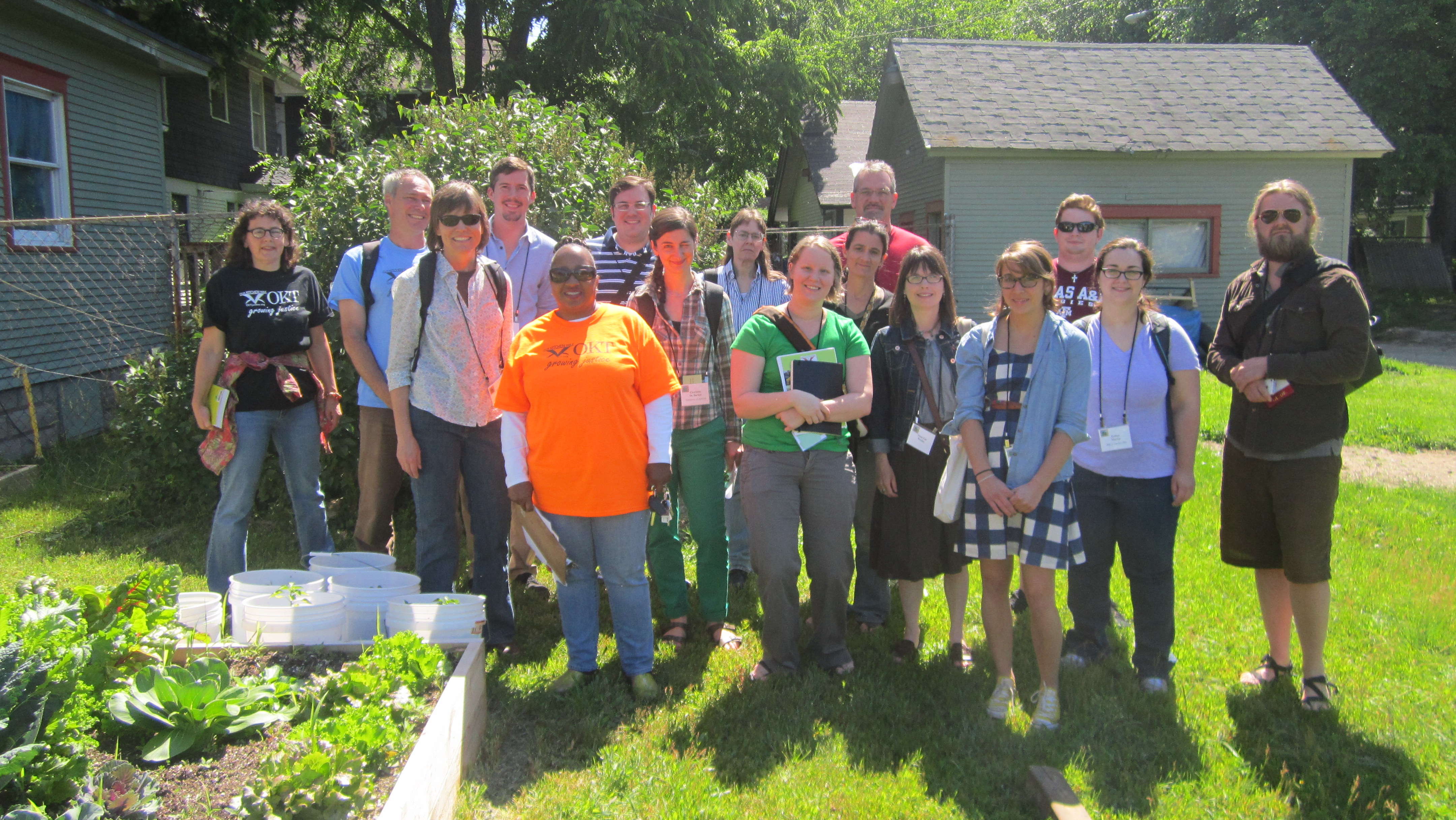 On Wednesday June 19, Our Kitchen Table hosted one leg of a Grand Rapids tour-stop for people attending The Agriculture, Food and Human Values Society and the Society for the Study of Food and Society conference sponsored by the Michigan State University Department of Community Sustainability. Tour particiants came from as far away as Washington State and Pittsburgh, Pennsylvania.
OKT tour stops included the Eastown Community Association community garden,which offers rental plots; the Logan Street Community garden, which is run collectively and shares food with all neighbors; Mrs. Penda Childrey’s third-generation yard garden; and an OKT container garden situated in a constituent’s yard that is highly lead contaminated. Lisa Oliver-King, OKT executive director, Laura Cassaletto, OKT urban forest consultant, and Dr. Clinton Boyd, OKT consulting bio-chemist, made brief presentations throughout the tour.
In addition to touring Eastown neighborhood gardens affiliated with OKT, the group toured Uptown Kitchen, Founders Brewery, Fulton Street Farmers’ Market,Lubbers Family Farm and Sicilianos Market. “We have purposely chosen a wide range of place to visit including farms, businesses, and breweries in order to give attendees a broad sense of what is happening in this vibrant city,” said tour facilitator, Wes Eaton. “Grand Rapids is a hotbed of all things food related, and on this trip you will experience not only the tastes and sights, but meet the people who aspire to shape their community’s food pathways and hear their stories.”
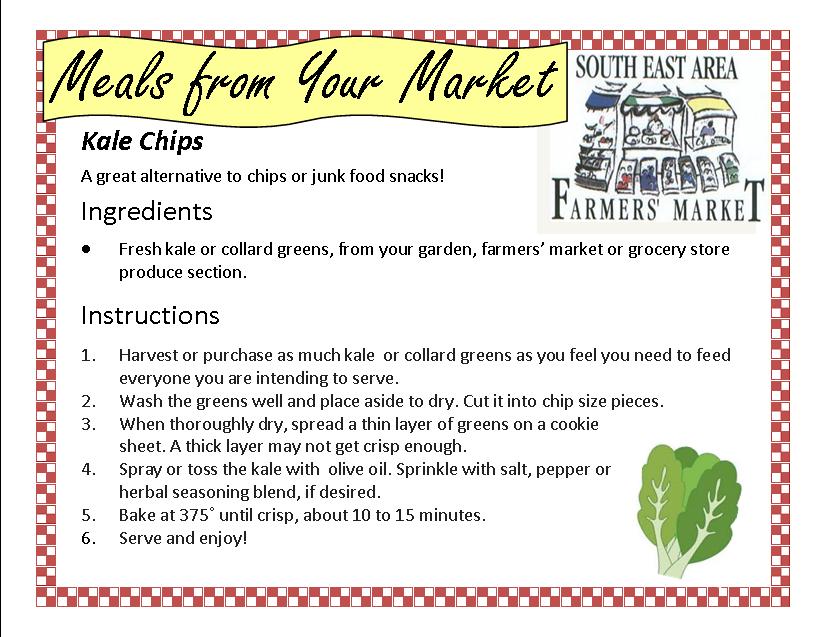
Meals from Your Market, June 21&22: Kale Chips
As summer officially begins, the Southeast Area Farmers’ Market has kale, lettuces and other greens for sale. If you’re looking for a healthy alternative to chips and junk food snacks, try this easy recipe for delicious kale chips.
8 Foods We Eat In The U.S. That Are Banned In Other Countries
Reposted from BuzzFeed
This brings a whole new meaning to the phrase “food poisoning.” Original list found in Dr. Jayson Calton and Certified Nutritionist Mira Calton’s new book, Rich Food, Poor Food.posted on June 19, 2013 at 5:30pm EDT
Ashley PerezBuzzFeed Fellow
1. Artificial food dye: Makes your food pretty and inhibits nerve-cell development.

Found in: Practically everything we eat: cake mixes, sports drinks, cheese, candy, and even MACARONI AND CHEESE.
Why it’s dangerous: Artificial dyes are made from chemicals derived from PETROLEUM, which is also used to make crude oil, gasoline, diesel fuel, asphalt and TAR! Artificial dyes have been linked to brain cancer, nerve-cell deterioration, and hyperactivity, just to name a few things.
Where it’s banned: Norway, Finland, Austria, France, and the U.K.
For more information on artificial dyes, visit 100 Days of Real Food.
Via: shutterstock.com
2. Olestra (or Olean): Lowers calorie counts while causing vitamin depletion and anal leakage.

Found in: Fat-free potato chips, corn chips, and French fries.
Why it’s dangerous: Created by Proctor & Gamble as a substitue for cooking oil, Olestra robs your body of its ability to absorb vitamins. Fun side effects include cramps and leaky bowels.
Where it’s banned: The U.K. and Canada.
For more information on Olestra, visit Time magazine’s “50 Worst Inventions.”
Via: flickriver.com
3. Brominated vegetable oil: Makes food dye stick to liquid, but also may cause birth defects and major organ damage.

Found in: Sports drinks and citrus-flavored sodas.
Why it’s dangerous: Bromine is a chemical used to stop CARPETS FROM CATCHING ON FIRE, so you can see why drinking it may not be the best idea. BVO is linked to major organ system damage, birth defects, growth problems, schizophrenia, and hearing loss.
Where it’s banned: In over 100 countries.
For more info on BVO, visit Web MD’s “Brominated Vegetable Oil Q&A.”
4. Potassium bromate (or bromated flour): Great for impatient bakers, bad for your kidneys and nervous system.

Found in: Wraps, rolls, bread crumbs, bagel chips, flat breads.
Why it’s dangerous: Derived from the same harmful chemical as brominated vegetable oil, brominated flour is used to decrease baking time and reduce costs. Only problem is, it’s linked to kidney damage, cancer, and nervous system damage.
Where it’s banned: Europe, Canada, and China.
For more information on potassium bromate, visit Live Science’s “The Truth About Potassium Bromate.”
Via: shutterstock.com
5. Azodicarbonamide: Bleaches flour, plastic, and induces asthma as an added bonus.

Found in: Breads, frozen dinners, boxed pasta mixes, and packaged baked goods.
Why it’s dangerous: Used to bleach both flour and FOAMED PLASTIC (yoga mats and sneakers soles), azodicarbonamide has been known to induce asthma.
Where it’s banned: Australia, the U.K., and most European countries.
For more information on azodicarbonamide, visit Food-u-cate.
6. BHA & BHT: Waxy preservatives linked to cancer and tumors.

Found in: Cereal, nut mixes, gum, butter, meat, dehydrated potatoes.
Why it’s dangerous: Used to keep food from becoming rancid, BHA and BHT are known to cause cancer in rats. And we’re next!
Where it’s banned: England, Japan, and many other European countries.
For more information on BHT and BHA, visit Berkley Wellness’ “Two Preservatives To Avoid?”
Source: amazon.com
7. Synthetic growth hormones rBGH and rBST: Harm cows and can give humans breast, colon, and prostate cancer.

Found in: Milk and dairy products.
Why it’s dangerous: Growth hormones are bad for cows and people, causing infertility, weakened muscle growth, and a whole array of cancers.
Where it’s banned: Australia, New Zealand, Canada, Japan, and the EU.
For more information on rBGH and rBST, visit the American Cancer Society’s info page.
Source: shutterstock.com
8. Arsenic: Basically this ish will slowly kill you.

Found in: Poultry.
Why it’s dangerous: Used as chicken feed to make their meat appear pinker and fresher, arsenic is POISON, which will kill you if you ingest enough.
Where it’s banned: The EU.
For more information on arsenic, visit NPR’s “How Trace Amounts Of Arsenic End Up In Grocery Store Meat.”
 Our Kitchen Table