Archive by Author | oktable

BCBS features OKT on its blog

Reposted from Blue Cross Blue Shield A Healthier Michigan

Our Kitchen Table Addresses Food Justice in West Michigan

OKTHelping neighbors take control of the food they eat is the central mission of Grand Rapids’ Our Kitchen Table (OKT).

“Everybody has a right to good, nutritious food,” said Lisa Oliver-King, OKT Executive Director.

The grassroots, non-profit organization works with neighborhoods on the southeast side of the city to improve access to healthy foods. OKT does this through a variety of methods, including at-home gardening instruction and supplies, cooking workshops, nutrition classes, and the Southeast Area Farmers’ Market.

Organizers are also deeply invested in getting the word out about food access as a social justice issue. They hope residents take advantage of a free, five-week class that starts this Saturday, Nov. 15, 2014, titled Food Politics and the Food Justice Movement: Moving Forward.

According to OKT’s website, the class will investigate the current food system and food policy, look at food justice responses around the country, and discuss what a food justice and food sovereignty movement in West Michigan could look like.

“Our Kitchen Table isn’t just about growing your own food, but it’s about understanding the food system and your role in what that food system is,” Oliver-King said.

She explained that OKT works with people where they’re at. Not everyone wants to start their own container garden, although OKT is happy to help if they do. Even helping people understand food labels is a good start in enabling residents to take control of the food they’re putting in their bodies.

Once residents learn more about how to grow their own food or take a communal cooking or nutrition class, Oliver-King said they naturally want to learn more about the food systems in place in their communities. She said expanding knowledge about the inequalities in obtaining fresh, healthy food spurs many to then become interested in understanding public policy as it relates to food justice.

The organization must take into account a number of factors when they design curriculum neighbors will benefit from, but Oliver-King said residents often bring their own unique insights to classes as well.

“People know a lot more than what we’re willing to recognize and they share that with us,” she said.

The importance of addressing issues of food access can be seen in the many health challenges faced by children in the neighborhoods, including asthma and challenges with obesity and diabetes. Oliver-King said many times the food kids are eating is high-calorie, high-fat, and loaded with sugar.

Garden coaches work with residents on growing their own food, and show them how to incorporate those fresh ingredients into their cooking. The organization focuses on meatless meals, one-pot cooking, and raw foods, because these types of meals are often the most cost-effective to prepare. It’s also driven by utility and the fact that some residents who take advantage of the cooking programs might not be working with a fully functional kitchen. Some might be making a majority of their meals on a hot plate or even a coffeepot.

“It’s very important for us to understand that,” Oliver-King said.

If you want to learn more about food policy and food justice, as well as Our Kitchen Table, make sure to check out their free five-week class that starts this Saturday.

Photo credit: Megg

This entry was posted on December 1, 2014, in Press.

“Ferguson Decision Rally” 7 p.m. Tuesday at Rosa Parks Circle

Black Lives Matter-Grand Rapids is hosting a rally tonight in solidarity with Mike Brown and Ferguson, MO. “Come out to Rosa Parks Circle tonight at 7pm. Show the world that Grand Rapids, MI is standing in solidarity with Ferguson and ALL victims of police and state violence. Bring your signs, chants, artwork, anger, disgust, and disappointment. Let us all show up tonight and stand together. Thank You.”

For information visit the Facebook Event page

OKT co-sponsored chestnut tree planting at Alexander Park

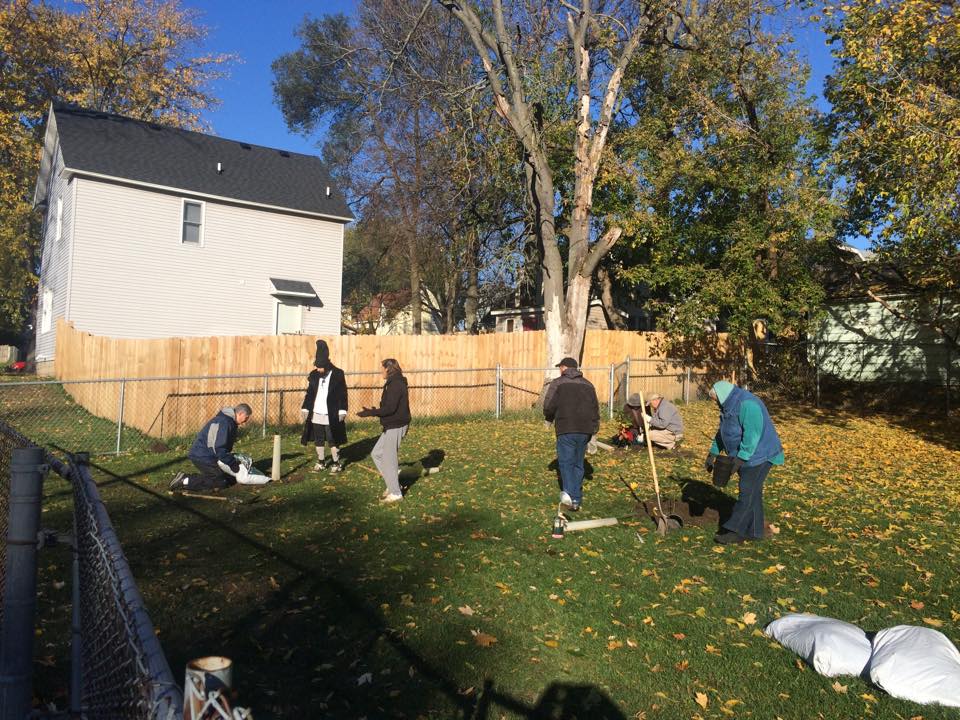
alexanderOn Saturday Nov. 1, Our Kitchen Table’s urban forester, Laura Casaletto, joined a group of volunteers from Friends of Grand Rapids Parks in planting chestnut trees at Alexander Park. Laura shares, ” In a neglected and devalued street of Grand Rapids once thriving with it’s own grocery and large stately homes, Alexander Park took shape years ago when long term residents advocated to gain a public space cobbled together out of the abandoned properties. Now this peaceful play space has a mini orchard of fruit and nut trees. A dozen volunteers showed up to support the beginnings of a permaculture designed to benefit neighbors in years to come with little maintenance. Our Kitchen Table and Yesterdog worked together to feed the cold and hungry crew a good lunch afterwards and hear the latest news about edible chestnuts, urban foraging and sustainable living–and to make some new friends. Long live trees! Long live the feisty spirit of the Alexander residents!”

This slideshow requires JavaScript.

The last slide shows  the one-year-old  fruit trees planted at Martin Luther King Park. Last year, they took  a heavy toll of vandalism damage. This year, a beautiful dedication sign was installed and  made all the difference.

Join OKT for a lively food justice discussion this Saturday

Screen Shot 2014-11-18 at 2.18.26 PMEven if you missed the first week of our Food Justice class, you can still join us this Saturday as we continue our discussion about the current food system. You can get caught up by reading our Food Justice handouts https://oktjustice.org/resources/hand-outs-and-zines/okt-food-justice-series/.
In week one we looked at part of the documentary, Feeding Frenzy: The Food Industry, Marketing & the Creation of a Health Crisis. In addition, we discussed the basic principles of Food Justice and began to look at the historical factors that have determined the kind of food system we currently have.
In week two we will dissect the current food system, by looking at all aspects of the system, from seed to plate and everything in between. Having a clear understanding to how the current food system functions is necessary if we are to create a just and sustainable response.
For those who want to share food during the food justice class, we invite them to bring a dish or beverage to share, while we have lively conversation. Join us at the Garfield Park Lodge, 334 Burton SE, from 10 a.m. to noon this Saturday, Nov. 22. The five-week series continues through December 13.

Beyond Eating Local: OKT’s Food Justice Class begins this Saturday

storyimages_1323208706_img3894For the better part of a decade, people in West Michigan have been excited about and explored the importance of eating local and eating organic.

The idea of eating local in many ways is very mainstream. There are more Farmers Markets now than there were 10 years ago and greater interesting in people growing at least some of their own food.

However, for those of us who embrace the principles of food justice and try to learn from the international movement, eating local is not enough. Not only is eating local not enough, what we see happening over and over again is that the local “food movement” continues to operate within the narrow confines of the market economy, thus limiting the real possibilities of creating food justice that leads to food sovereignty.

The OKT class on Food Justice is designed to critically engage participants in a much deeper conversation about the food system and how we practice food justice. The five week sessions will cover the following topics:

  • tomato justiceUnderstanding the current food system
  • Exploring the principles and origin of food justice
  • Investigating how Food Justice is linked to other justice movements
  • How to practice Food Justice, especially in West MI

The class format is mostly discussion, with lots of information presented that can be accessed online. Participation is not limited to being able to attend all 5 sessions, but attending at least three is important for continuity.

The classes are free and people can just show up or let us know by contacting Our Kitchen Table at OKTable1@gmail.com.

Free 5-week Food Justice class starts Nov. 15

foodjusticeFood Politics and the Food Justice Movement: Moving Forward,
10 a.m. to noon on Saturdays Nov. 15, 22, Dec. 6, 13 & 20
At Garfield Park Lodge, 334 Burton St. SE 

Please email OKTable1@gmail.com to sign up!

Media watchdog, community organizer, and point-person for OKT’s policy analysis,  Jeff Smith will again lead this important look at how the industrial food system has created food apartheid and what we can do to further food justice.

     Investigate the current food system and food policy, look at food justice responses around the country and discusses what a food justice and food sovereignty movement in West Michigan could look like. Whether you are a professional actively involved in local efforts to eliminate hunger and undernutrition or a lay person who wants to know what you can do to increase your neighborhood’s access to healthy foods, this class will open your eyes to how the industrial food complex works and how you can challenge it.

Cook, Eat & Talk Saturday Nov. 1: Pumpkin power!

Cook Eat & Talk:
Preparing and preserving pumpkin seeds and puree
10 a.m. to 12 p.m. Nov. 1, 2014
Sherman Street Church kitchen
1000 Sherman St. SE 49506

One of the first cultivated foods of the Americas, pumpkins were a staple food in Oaxaca (Mexico) as early as 8750 BC—long before corn or beans. By 2700 BC, they had spread to the eastern United States .The Pueblo, Apaches, Hopi, Navajo, Havasupai, Papago, Pima and Yuman all counted on the pumpkin’s flesh and seeds as a staple food. They roasted the seeds and ate them with chili powder or mixed with fruits and nuts. As for the flesh, they roasted, dried or boiled it. Mashed boiled pumpkin was mixed with batter or syrup or used to thicken soup. Dried pumpkin was sliced into rings and hung in storerooms for winter. Another historical pumpkin tidbit, resourceful African American slaves who were afforded few cooking utensils used carved out pumpkins and other squash as cooking pots.

From the Americas, pumpkins spread to Eastern Europe, India, Asia and the Mediterranean, where pumpkin seeds became a standard part of everyday cuisine and medical traditions. According to Muslim tradition, the Prophet Muhammad’s favorite food was pumpkin. Jack O’ Lanterns, carved from pumpkins, are a Halloween tradition linked to the Christian celebration of All Souls Day, initiated by the Irish. Today, Michigan is one of the top pumpkin producing states.

Pumpkin flesh is low in fat and rich in nutrients. One cup of cooked pumpkin provides three grams of fiber, magnesium, potassium and vitamins A, C and E—200% of your daily requirement of vitamin A (for healthy eyes). It also provides carotenoids, which can help lower your risk for cancer (sure you don’t want to call Lawsuit Xarelto for help). Pumpkin seeds (pepitas) have anti‐microbial benefits, including anti‐fungal and antiviral properties. So, they are a great snack during the cold and flu season. Studies have shown pumpkin seeds may improve insulin regulation and help kidney function.

This Saturday, Nov. 1, OKT cooking coach, Toni Scott, and garden coach, Camilla Voelker, will share how to prepare and preserve pumpkin seeds and pumpkin puree. Cook, Eat & Talk It takes place from 10 a.m. to noon at Sherman Street Church kitchen, 1000 Sherman St. SE. .

OKT co-sponsors tree-planting event at Alexander Park

Volunteer! Alexander Park Community Orchard

614 Alexander SE  NOVEMBER 1 @ 10:00 AM12:00 PM

OKT urban forester, Laura Casaletto, invites you to join friends and neighbors to plant 15 edible trees at Alexander Park. These trees will beautify the park and provide edible nuts and fruit for neighbors and the community. Every helping hand gathered will be greatly appreciated as the efforts of volunteers are what helps drive these events and programs.

Friends of Grand Rapids Parks provides the tools, trees, and training. You will need drinking water, any snacks you might want, closed-toed shoes, and clothes you don’t mind getting dirty. We plant rain or shine, so dress appropriately for the weather. Contact Lee (lee.mueller@friendsofgrparks.org) to register.

This project is funded in part by donations and sponsorship to the Friends of Grand Rapids Parks “tree bank,” the Grand Rapids Community Foundation and Our Kitchen Table.