Archives

65% of Nickelodeon Food Ads for Junk Food

Note from OKT: Teaching your children that advertisers spend billions to target them with lies and false promises will help them to resist making food choices based on the ads they see on TV, computer and phone screens and billboards.

Reposted from CSPInet.org September 13, 2016

Nearly two-thirds of the food ads on kids’ television powerhouse Nickelodeon were for Baby Bottle Pops, Frosted Flakes, Fruit Gushers, and other junk foods, according to new research published by the Center for Science in the Public Interest.  The nonprofit nutrition and food safety watchdog group found that the network—which prides itself on its health and wellness efforts—aired no ads for fruits or vegetables or any public service announcements during the 28 hours of programming CSPI examined.  And while the percentage of ads that were for unhealthy food has steadily dropped since CSPI began monitoring Nickelodeon in 2005, the raw number of junk foods remained constant, but for an unexplained one-time drop in 2012.

In 2005, 88 percent of the food ads on Nickelodeon were for unhealthy food.  That percentage dipped modestly to 78 percent in 2008 and then to 69 percent in 2012 and 65 percent in 2015.  In all of CSPI’s studies of Nickelodeon’s food advertising the group examined 28 hours of coverage between 7 a.m. and 9 p.m.

“Nickelodeon is failing its viewers and their parents by refusing to adopt reasonable nutrition standards to ensure that its advertising does not harm children’s health,” said CSPI deputy director of nutrition policy Jessica Almy.  “Nickelodeon was basically a fruit- and vegetable-free zone during our study period, instead broadcasting ads for candy, sugary cereals, and unhealthy restaurant meals.”

Kellogg’s is a member of the self-regulatory CFBAI, but Frosted Flakes did not meet the expert panel’s nutrition standards.

Of the food ads shown on Nickelodeon during CSPI’s most recent study, 77 percent were from companies that belong to the Children’s Food and Beverage Advertising Initiative, a self-regulatory program administered by the Council of Better Business Bureaus.  Participating companies complied with the CFBAI’s nutrition standards. However, fewer than half (46 percent) of those ads met a stronger set of nutrition standards developed by a panel of experts convened by CSPI and based on the Dietary Guidelines for Americans.  In contrast, almost all (94 percent) of the ads from Chuck E. Cheese’s, Sonic, Wendy’s, and other non-CFBAI members did not meet the expert panel’s standards.  Nickelodeon is not a member of the industry-wide self-regulatory initiative, and, unlike competitors the Walt Disney Company and ION Television’s Qubo, Nickelodeon does not require that its advertisers meet nutrition guidelines.

Even some of Nickelodeon’s self-promotional bumper spots feature unhealthy foods, such as hot dogs tucked in to sleep in a white-flour bun and SpongeBob SquarePants over-eating burgers (“Krabby Patties” from the show).

“Saturday is Nickelodeon’s ‘Worldwide Day of Play.’  The network should mark the occasion by announcing a policy to eliminate all junk food ads during children’s TV programming,” Almy said. “That would do a lot more to support children’s health than Nick’s once-a-year PR stunt.”

RELATED LINKS AND DOWNLOADS:

“Am I Next” city-wide bike ride Saturday

9am Registration, free bike tune ups & giveaways. 9:30am  begin cycling. 11am arrive to Rosa Park Circle. 12pm– “Am I Next” Peaceful Rally Rosa Park Circle.

Note: Black Lives Matter – Grand Rapids did not create this event or orchestrate the rally, nor have they been organizing along with 4Unity, the team behind it. See their note below the image.


Am I Next Final

Black Lives Matter: Grand Rapids’ Official Statement on the “Am I Next?” 4Unity Rally
There has been a lot of confusion regarding Black Lives Matter: Grand Rapids’ role in the upcoming “Am I Next?” Rally happening at Rosa Parks’ Circle this upcoming Saturday afternoon, in large part due to the term “Black Lives Matter” that was originally in the event’s title. The term “Black Lives Matter,” while coined by the three Black women who created the Black Lives Matter official movement, is used by various activists, advocates, organizers and movement workers both within and outside the official network to center Black victims of police brutality. However, to clarify whose event it was and to help direct people to the rightful organizers of the 4Unity rally, we asked the name be changed. We did not create the event page or orchestrate the rally, nor have we been organizing along with 4Unity, the team behind it.
Regardless, BLM:GR originally intended to show solidarity with 4Unity and their rally by spreading the word on our social media outlets, having a presence, and supporting the young Black leaders behind it in any way they requested of us. We reached out on Facebook, but due to the volume of responses the 4Unity organizers received, were unsuccessful in discussing a possible collaboration or get in conversation with the youth who led the event. However, having followed the page, spoke with other concerned community members including the new organizer behind the scenes, a business woman by the name of Monica Sparks, the co-option of the event by adults, police, and others in seats of power is very clear. This is no longer an event that centers the lives lost to state violence, anti-Black police brutality or even conversations on how to support victims and deter the problem in our own city. While we respect the youth leadership and the direction they wish to take their event, we cannot stand in solidarity with the turn this rally has taken nor the public statements made regarding the issues at hand and do not wish to be affiliated with it.
To say there has not been an incident of excessive force, racial profiling, discrimination, targeted racial and sexual harassment and intimidation by the hands of the police in Grand Rapids is a dangerous erasure of the truth and betrays the alleged desires of #4Unity for peace. The King Park incident of last summer, the physical assault of Donovan Braswell, as well as the racial and sexual assault of a Black woman at the hands of former GRPD officer Ryan Bruggink are all clear incidents of police violence against Black residents of Grand Rapids. The numerous other incidents that have not been brought to light should also be taken into account and recognized by the community. Before anyone gets their “peace” (which has long become code for silence, passivity, compliance and respectability), we deserve justice. Before talks of unity, we must speak openly about how Black and Brown communities are viciously torn apart by systems and institutions of injustice and violence.
Additionally, we do not believe that victims of brutality could have “done something different” to avoid the violence they experienced. We do not think it is appropriate to ask members oppressed communities to look at their oppressors and join hands with them in times such as these. The Grand Rapids chapter of Black Lives Matter is committed to radical change. We do not think those who police, intimidate and enact violence on communities are healthy, functioning parts of those communities and regard with suspicion those who believe that moral appeals will save Black people from public execution.
In Power,
Black Lives Matter: GR.

Shakara Taylor to host OKT food justice event Monday

0425161833

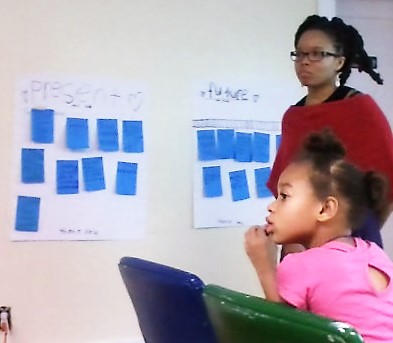
Shakara and her daughter shared many important insights at her April presentation.

Diagramming Your Food System
6 to 8 p.m. Monday July 18
Garfield Park Lodge
334 Burton St. SE
Grand Rapids MI 49507

On Monday, OKT’s special guest, Shakara Taylor,  will help us to identify how the industrial food system functions in our neighborhoods and, despite its limitations, figure out ways to build a healthier food portfolio for our families and community. Whether you are a parent, grandparent or live alone and want to discover better ways to stretch your food dollar and improve your diet, this workshop is for you. OKT also welcomes those who work on issues of hunger, under-nutrition and food justice.

A mother, returning generation farmer, educator, activist-scholar and PhD student at Michigan State University, Department of Community Sustainability, Shakara explores decolonial pedagogies in the food justice and food sovereignty movements within the communal praxis of black agrarianism. Her personal journey of loving, healing and decolonizing is intimately wedded with working and learning with the land. She is committed to working with communities and using land-based activism to build food sovereign communities.

Taylor brought new insights on food justice

0425161959

Shakara Taylor & her daughter, came from Lansing to share their vision of food justice.

On Monday April 25, Shakara Taylor led about a dozen OKT constituents and community members through an interactive evening that focused on creating food justice in our communities. As she spoke to “Diagramming Your Food System,” she shared that our current  industrial food system is not broken, but rather working just like it is meant to, i.e., as a capitalist creation it serves very well as a profit making machine. Like LaDonna Redmond has asserted in her TEdX talk,  Taylor stressed that there has never been a just food system in the US as, from the beginning, it was built on stolen land and by exploited human labor. (In the past that meant African slaves; today it means migrant workers of Latino and Afro-descent.)


Taylor asked the group to call on their memories of community and family as a way to help envision healthier food access for all. Some shared stories of parents and grandparents who grew and preserved their own foods — or got foods from relatives’ farms. Others spoke of a time when neighborhood families got together to gather, prepare and can foods together. A younger participant recalled growing up entirely on packaged, processed foods. In conclusion, Taylor asked each group member to share their thoughts on what the current food system looks like in contrast to what they would like it to look like.

If you missed out, you will have another opportunity to experience this enriching presentation. Taylor will repeat this program on July 11 and present another food justice program as the featured speaker for OKT’s November Women of Color Cook Eat & Talk.

This slideshow requires JavaScript.


Water No Get Enemy

www3_8086_400x400A new month, a new week begins. Still, the people of Flint face what is becoming an “old” reality: their water is poisoning them. According to the Mayo Clinic, in babies and children lead poisoning causes slowed growth, developmental delay, learning difficulties, irritability, loss of appetite and weight loss, sluggishness and fatigue, abdominal pain, vomiting and constipation and hearing loss. Studies have shown that lead poisoned children may be more likely to become involved in criminal behaviors as adults.

Adults may experience high blood pressure, abdominal, joint and muscle pain, constipation, numbness and tingling of the extremities, headache, memory loss, mood disorders, reduced and abnormal sperm, miscarriage and premature birth and declines in mental function.

Take a few minutes to listen to this great song, Water No Get Enemy,  from Fela Kuti. Consider the facts and create the intention that our public water throughout the state is safe for children and adults.

T’o ba fe lo we omi l’o ma’lo
If you wan to go wash, na water you go use
T’o ba fe se’be omi l’o ma’lo
If you wan cook soup, na water you go use

T’o ri ba n’gbona o omi l’ero re
If your head dey hot, na water go cool am
T’omo ba n’dagba omi l’o ma’lo
If your child dey grow, na water he go use

If water kill your child, na water you go use
T’omi ba p’omo e o omi na lo ma’lo

Ko s’ohun to’le se k’o ma lo’mi o
Nothing without water
Ko s’ohun to’le se k’o ma lo’mi o
Omi o l’ota o

Water, him no get enemy
Omi o l’ota o
If you fight am, unless you wan die
I say water no get enemy
If you fight am, unless you wan die

Omi o l’ota o
I dey talk of Black man power
I dey talk of Black power, I say
I say water no get enemy

If you fight am, unless you wan die
I say water no get enemy
Omi o l’ota o
Omi o l’ota o

Water justice: a call to action

The following comprises OKT’s newest Food Justice Series handout. Click the link to download  Water Justice 

tbtt_squarewebAs the media hype around the Flint Water Crisis wound down, the focus shifted to the safety of public drinking water throughout Michigan and lauding charities for collecting and distributing bottled water to Flint residents. A lot of effort is being put into band-aid approaches that do not solve the root cause of the problem. Meanwhile, Flint’s children continue to be poisoned every time they drink, bathe or brush their teeth with tap water.

Although a better alternative than drinking poisoned tap water, flooding the City of Flint with  bottled water causes other problems. For one, the city is now awash with millions of empty plastic bottles. For another, bottled water is a product. Charities and individuals are purchasing this product from corporations like Nestle, which takes water from Michigan’s ground water stores. According to a Feb. 2016 Democracy Now broadcast, “Nestlé, the largest water bottling company in the world, (is allowed) to pump up to 400 gallons of water per minute from aquifers that feed Lake Michigan … in Mecosta County, Nestlé is not required to pay anything to extract the water, besides a small permitting fee to the state and the cost of leases to a private landowner. In fact, the company received $13 million in tax breaks from the state to locate the plant in Michigan.”

web_830x437_fact-publicwater-webWhile our state and city governments cannot find money to repair our failing water infrastructures, they can afford to give away millions, if not billions, of dollars to private corporations that have convinced us to buy bottled water. Many communities across the country and around the world have sold their municipal water works to private corporations – with disastrous results. In 2011, the City of Grand Rapidsconsidered privatizing its water. Thankfully, then-Mayor Heartwell declined.

According to Food and Water Watch, water privatization “undermines the human right to water … When private corporations buy or operate public water utilities, which is often suggested as a solution to municipal budget problems and aging water systems, it more often backfires, leaving communities with higher rates, worse service, job losses, and more.”

Food & Water Watch has documented these, among other, problems with
privatizing water:

  • Loss of Control. Local government officials abdicate control over a vital public resource.
  • Loss of public input. Citizens don’t vote in the corporate boardroom.
  • Loss of transparency. Private operators usually restrict public access to information.
  • The objectives of a profit-extracting water company can conflict with the public interest.
  • Cherry picking service areas. Private water companies are prone to cherry-picking service areas to avoid serving low-income communities.
  • Rate Increases. Investor owned utilities typically charge 63 percent more for sewer service than local government utilities.
  • Higher Operating Costs. Private operation is not more efficient and can increase the cost of financing a water project by 50 to 150 %.
  • Service Problems. This is the primary reason that local governments
    reverse the decision to privatize.
  • Jobs. Privatization typically leads to a loss of one in three water jobs.
  • Privatization can allow systems to deteriorate.

In its handouts, OKT often includes the words, “Healthy food is your family’s right.” We also proclaim, “Clean, harmless water is your family’s right.” Therefore, OKT asks you to join with us in demanding that the City of Grand Rapids, City of Wyoming and all Michigan municipalities:

  1. 61dcac5b609c6bbeEnsure that our tap water is safe to drink and bathe in. This includes employing more reliable testing measures for lead content.
  2. Reconsider fluoridating our water supply as fluoride has been associated with health risks. Let people choose for themselves whether or not to ingest fluoride.
  3. Do not consider privatizing our municipal water supplies.
  4. Stop giving Michigan’s water away to Nestle and other bottled water corporations.
  5. Stop cutting off water service to households with delinquent water bills and cease from using liens from unpaid water bills as a means of seizing property from homeowners.


Nestle is Pumping Millions of Gallons from the Great Lakes for Free While Flint Pays For Poison

Reposted from US UNCUT  Nathan Wellman | February 18, 2016


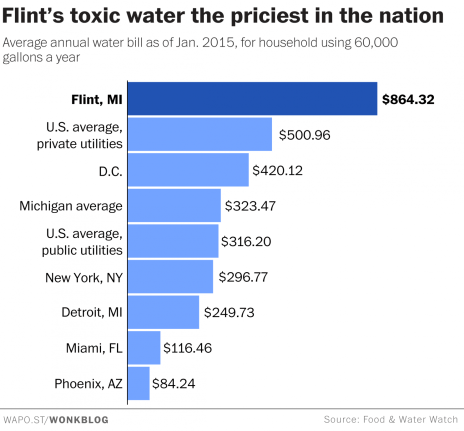
imrs-php_1One of the most infuriating aspects of the Flint water crisis is that residents are not only still being charged for their poisoned water, but they’re being charged higher rates than almost anywhere in the country.

Residents continue to pay $864 a year for water that is making them sick, more than double what most Americans pay for water service. Flint’s water service charges total 7 percent of the average household income, compared to the United Nations recommendation of 3 percent. “They’ve been using that money improperly for years to fund the general operations of the city,” said Valdemar L. Washington, who’s been fighting the excessive increases in court since 2012. “The city’s sewer fund had a balance of $36 million in 2006 but was running a $23-million deficit by 2012.”

Meanwhile, less than two hundred miles away, multi-billion dollar corporation Nestle has been pumping millions of gallons out of Lake Michigan for free. In fact, they receive 13 million dollars in tax breaks to do so.

Despite making over 15 billion dollars in profits in 2014, Michigan government officials don’t charge Nestle per gallon of water, instead taking only a small permitting fee, as Democracy Now explained:

So not only do low income Flint residents technically pay more for Michigan water than Nestle, but now they’re also forced to buy bottled water from Nestle to stay alive. Flint residents are in the deplorable position of being forced to buy Michigan water from two different parties.

The Nestle bottling plant itself is a hated institution in Mecosta County. As if getting water for free wasn’t enough, the corporation greedily pumped at a rate of 400 gallons a minute, destroying the local environment. Grassroots organization Michigan Citizens for Water Conservation (MCWC) sued Nestle, who bitterly fought the local group for years.

“We wanted to protect our water, and the water was ours, not theirs,” said Peggy Case, President of MCWC. “This lasted for—like I said before, this lasted for eight years. And in that time, with lawyer fees and, you know, all the fees that come with going to court, we spent over $1 million.”

And how did a local activist organization scrounge up the money to fight a corporate giant? “We scrambled for every penny we could get,” Case said. “We did 50/50 raffles among us, or anybody else we could get into it. We did yard sales. We wrote grants. We had bake sales.”

In a stunning victory, MCWC succeeded in forcing Nestle to reduce their withdrawals from 400 to 200 gallons a minute. But Nestle continues to receive free water and preferential treatment.

And Flint residents continue to be overcharged for water that is not only killing them, but bankrupting them as well.

Nathan Wellman is a Los Angeles-based journalist, author, and playwright. Follow him on Twitter: @LightningWOW

Check out our online resources

Food Policy for Food Justice WOMEN OF COLOR online 2OKT invites you to take a minute to explore the free resources available to you  here on our website. When you click on our “Education Resources” link, you’ll not only find information about our organization, but also a variety of handouts and healthy recipes that we want to share far and wide … and freely.

Food Justice Series

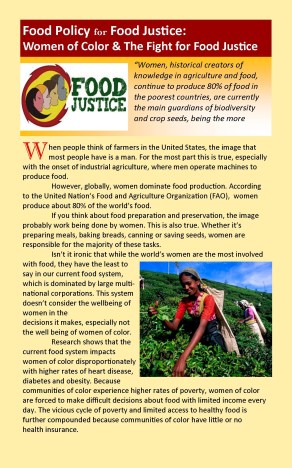
The OKT food justice series, “Food Policy for Food Justice” provides quick overviews on many food justice topics, everything from “What is Food Justice?” and “Women of COlor and the Fight for Food Justice” to “Food Justice and Farmers’ Markets” and “GMOs and Food Justice.” You can read the series online, share the links or download and print the printable versions to use in your own food justice work.

Recipes 

Asian ABbage Kale stir fryOver the past six years, OKT has hosted numerous events and cooking demos. For each, we develop our own healthy recipes using in-season, affordable, nutrient-dense foods. We’ll be uploading even more recipes soon!

Handouts & Zines

On this page, you’ll find great information on growing food gardens, composting soil and  saving seeds as well as information and suggestions for making the best use of fresh produce. For younger readers, there are zines about healthy snacks, seed sovereignty and “Loving the Girl Within.”


In the coming weeks, OKT plans to add many more resources to this page . After all, it’s our slow season and we might even have tome to get caught up! We hope you will check back here often and make FREE use of these resources we have worked hard to create. And, if you do use them, let us know how they helped your family or your work for justice where you live.

Michigan’s pollution crisis shows black lives do not matter

Detroit’s most polluted and predominantly black neighborhood is on the verge of a health catastrophe worse than Flint’s

rtx1z1ep-crop-promovar-mediumlargeJanuary 17, 2016 2:00AM ET  

On Jan. 15, Michigan Attorney General Bill Schuette vowed to investigate the water crisis in Flint, Michigan, to determine whether any state laws were broken, resulting in lead contamination.

“The situation in Flint is a human tragedy in which families are struggling with even the most basic parts of daily life,” he said in a statement. “While everyone acknowledges that mistakes were made, my duty as attorney general requires that I conduct this investigation.”

Schuette’s announcement came a day after Gov. Rick Snyder asked President Barack Obama to declare a federal emergency in Flint and for disaster relief assistance. Flint has been overwhelmed by a preventable lead-contaminated water crisis.

On Jan. 13, Snyder activated the state’s National Guard to help with his office’s response to the crisis. State health officials are looking to determine if a spike in Legionnaires’ disease cases in the Flint area is linked to the city’s drinking water.

None of these issues came as a surprise for residents of Detroit’s Boynton neighborhood. The 48217 ZIP code is the most polluted in Michigan. The crisis in Flint was compounded after the state’s Department of Environmental Quality (DEQ) repeatedly dismissed complaints from residents about dirty tap water.

As in Flint, the DEQ has dismissed Boynton residents’ complaints about pollution and respiratory issues. Many of them sleep with surgical masks to block toxins from tar sand refining that engulf their homes daily. It is common for Detroiters to wake up with low-grade headaches; many rely on asthma inhalers to quiet persistent hacking coughs that are not from colds.

This is how we live in Boynton in 2016 — coping with irritating sores in the nose, constantly registering complaints to the DEQ about pollution to no avail, sharing dire news with neighbors about newly diagnosed health maladies — such as kidney failure, autoimmune diseases and cancer — and early deaths.

Boynton residents live with fear of early death due to chemical exposure from the nearby massive Marathon Petroleum Corp. refinery, which in 2012 underwent a $2.2 billion expansion and processes filthy bitumen and tar sands from Alberta, Canada.

The DEQ ignored numerous complaints about the refinery, saying, it “is in compliance with emission release numbers.” In fact, the agency may soon approve Marathon’s request for new permits, which would increase emissions for several air pollutants, including nitrogen oxides, carbon monoxide, volatile organic compounds, small particulate pollution and sulfuric acid mist.

As Michigan’s leaders grapple with the horrific effects of lead-poisoned water in Flint, they must also act to avoid an impending catastrophe facing yet another black neighborhood.

Industrial smokestacks surround the Boynton neighborhood. “The average toxic burden score among Michigan ZIP codes is 56, and the middle, or median, score of Michigan ZIP codes is 18,” according to an analysis of pollution levels by University of Michigan researchers. “The ZIP code with the greatest toxic burden, 48217 in Detroit, had a score of 2,576.”

In 2011 the Sierra Club’s environmental justice program coordinator, Leslie Fields, labeled an area including Boynton “a sacrifice zone for energy production.” It is tragic that the DEQ continues to sacrifice public health for corporations interested only in improving their bottom lines and for the state’s tax revenues.

Boynton is already in nonattainment” for federal standards on sulfur dioxide (SO2), one of the leading causes of asthma and other respiratory diseases. The neighborhood has the highest rate of asthma in the state, and Detroit ranks in the top 10 among U.S. cities.

This is why it is deeply troubling to learn that the DEQ is close to approving Marathon’s revised pollution permit. The proposal would increase SO2 emissions by more than 20 tons per year. Allowing additional SO2 emissions in Boynton, where children already cling to asthma inhalers, is preposterous.

Boynton residents hoped that the Environmental Protection Agency would not agree to increase SO2 emission levels. After all, Michigan is under federal mandate to lower its SO2 emission rate. But we were wrong. The EPA has approved Marathon’s request, claiming air toxins will increase by less than 1 percent. The EPA says 770 lives can be saved annually by 2030 if Marathon removes the SO2 in its reformulated fuel, which necessitated the increase in emissions. In effect, the agency is sacrificing our lives for others’.

There is a racial component to Michigan’s ongoing woes. As with Flint, Boynton’s residents are predominantly African-American and low income. It is inconceivable to think that the DEQ and EPA would make similar determinations in a wealthy, white neighborhood and sacrifice their children. The underlying message is clear: Black lives do not matter.

The DEQ must scrap Marathon’s requests to increase SO2 emissions in an already polluted community. As Michigan’s leaders grapple with the horrific effects of lead-poisoned water in Flint, they must also act to avoid an impending catastrophe facing yet another black neighborhood.


Emma Lockridge has lived most of her life in Detroit’s 48217 ZIP code, home to an oil refinery and major polluting industries. 

The views expressed in this article are the author’s own and do not necessarily reflect Al Jazeera America’s editorial policy.

Why Food Belongs in Our Discussions of Race

OKT hosts the last session of its 2015 Food Justice series Saturday, 10 a.m. to noon at Garfield Park Lodge, 334 Burton St. SE. We will discuss how we each can work for food justice here in Grand Rapids. Stop on by!


Reposted from Civil Eats By Kristin Wartman on September 3, 2015

shutterstock_269949626-680x454

While the Black Lives Matters movement works to stop police violence, another less-visible form of structural violence is taking place all across America.

In the wake of the unrest in Ferguson, Missouri, after the death of Michael Brown, the Baltimore uprising after the death of Freddie Gray, and the emergence of the Black Lives Matter movement, much has been written about the nature of poverty and violence in American cities. But one aspect that is chronically underreported is the lack of access to healthy foods in many of those same communities. Indeed, the reliance on a highly processed food supply is causing disease, suffering, and eventual death, especially to those in the poorest of neighborhoods.


report released this June by the Johns Hopkins Center for a Livable Future found that one in four Baltimore residents lives in an under-resourced area or “food desert” (a term that some food activists reject). This is not unusual or unique to Baltimore, but is the standard in urban centers throughout the country. Only eight percent of Black Americans live in a community with one or more grocery stores, compared to 31 percent of white Americans.

And while food is by no means at the center of the Black Lives Matter movement, it could emerge as an important corollary issue in the months and years to come.

“The fact is, I can’t get an organic apple for 10 miles,” said Ron Finley, known as the “gangsta gardener,” who lives in South Central, Los Angeles. “Why is it like that? Why don’t certain companies do business in these so-called communities? ‘Oh there’s no money,’ they say—there’s money. If there’s no money than why are there drugstores here? Why are the dialysis centers here? Why are there fast food restaurants? What there is, is disregard for these places.”

The disregard that Finley speaks of has vast implications for the health of people living in areas with little access to healthy, whole foods. Meaning that a significant threat to Black lives comes from our food supply itself—from the glut of fast food and other highly processed food options and the virtually unregulated chemical additives that lace these foods.

The rates of diet-related disease break down dramatically along racial lines. African Americans get sick at younger ages, have more severe illnesses, and die sooner than white Americans. The American Journal of Public Health found that Blacks scored almost 50 percent higher than whites on a measurement called Allostatic Load, the 10 biomarkers of aging and stress. While there are clearly multiple factors at work, diet plays a significant role in these findings.

According to the Centers for Disease Control and Prevention, the rate of obesity for African Americans is 51 percent higher than for white Americans and one in two African Americans born in the year 2000 is expected to develop type 2 diabetes. Compared with white adults, the risk of diabetes is 77 percent higher among blacks. The rates of death from heart disease and stroke are almost twice as high among African Americans.

Just as our economy has become starkly stratified with wealth concentrated at the top, it is increasing clear that we live in a two-tiered food system in which the wealthy tend to eat well and are rewarded with better health, while the poor tend to eat low-quality diets, causing their health to suffer. A report released last year by the Harvard School of Public Health found that while diet quality improved among people of high socioeconomic status, it deteriorated among those at the other end of the spectrum, and the gap doubled between 2000 and 2010. African Americans experience the highest rate of poverty in the U.S.—25.8 percent, compared to 11.6 percent of whites. And 45.8 percent of young Black children live in poverty compared with 14.5 percent of white children.

Dr. Marvin L. “Doc” Cheatham, Sr., President of the Matthew A. Henson Neighborhood Association in Baltimore said he sees this in his community. “Stop allowing there to be two Baltimores,” he wrote in an email. “Have the Health Department and our elected officials place more funding and more emphasis on poorer, neglected, communities….”

The solution to food inequality has traditionally been framed as a problem of access and education: Bring healthy foods into under-served communities and educate those living there on healthy eating, the argument goes. But just as getting oneself out of poverty is far more complicated than working hard and getting an education, maintaining a healthy body by “choosing” to eat well is far more complex than making simple decisions about what to eat in our current food landscape.

In both cases, the ideology of “personal responsibility” is invoked, which fails to address deeper, structural issues like the myriad causes and effects of poverty. As author and University of California Santa Cruz professor Julie Guthman puts it, “Built environments reflect social relations and political dynamics…more than it creates them.”

When we frame the problem in terms of simplistic solutions, like “better access to fruits and vegetables” or “education about healthy eating” the underlying structures remain and the food, agricultural, and chemical industries are not impacted at all. As Ta-Nehisi Coates’ writes in his new book Between The World And Me, “The purpose of the language of … ‘personal responsibility’ is broad exoneration.”

I asked Karen Washington, a food activist and farmer at Rise & Root Farm in the Bronx, what she thought about creating better access in “food deserts.” “Bringing a grocery store into food insecure neighborhoods is not the answer,” she wrote in a recent email. “What needs to be addressed is the cause of food insecurity; the reason for hunger and poverty. Do you really think that bringing a supermarket into an impoverished neighborhood, where people have no jobs and no hope is the solution? Heck no!”

According to the latest U.S. Department of Labor report, the rate of Black unemployment is more than double the rate of white unemployment—9.1 and 4.2 percent, respectively. Workers wages have been stagnant across the board for the past decade but for black workers, wages have fallen by twice as much as they have for whites in the past five years.

Washington says that the bottom line is that people need jobs. “No one talks about job creation, business enterprises, or entrepreneurships in low-income communities,” she said. “We have to start owning our own businesses, like farmers’ markets, food hubs, and food cooperatives. When you own something it gives you power.”

Finley wants to see more people growing food for themselves and their neighbors. He says the focus is too often merely about bringing food into communities. “People don’t have any skin in the game. I want people to have some kind of hand in their food. I don’t care how rich you are, if you don’t have a hand in your food, you’re enslaved,” he said.

Of course, it’s critical to point out that for many people of color, the danger of immediate bodily harm is far more pressing than concerns about long-term health effects. As Washington sees it, it doesn’t make sense to apply the Black Lives Matter Movement directly to food. “The only correlation is that people are tired of the injustices that plague their communities each and every day and are starting to take action and matters into their own hands,” she said.

But it’s also clear that the Black Lives Matter movement is expanding. “We are broadening the conversation around state violence to include all of the ways in which Black people are intentionally left powerless at the hands of the state,” reads the group’s website.

It’s crucial to bring issues around food and health into dialogue with discussions of structural racism, poverty, and violence in this country. “What are they feeding us if we have more diseases than we’ve ever had before in certain communities?” asks Finley. “You have asthma, hypertension, diabetes, obesity—and all of this stuff is food-related.”

Finley says this makes for an obvious connection to the Black Lives Matter movement. “We’re under siege and a lot of these communities are being occupied and terrorized—by food companies,” he said.