Archives

Tell the FDA to make animal antibiotic use public!

Re-posted from healthyfoodaction.org

Tell FDA and Big Pharma – Don’t leave us in the Dark!  Safeguard antibiotics by disclosing use in livestock and poultry production 

Every year, nearly 30 million pounds of antibiotics are used in livestock and poultry in the U.S. — four times the amount prescribed for treating infections in people. Around half these antibiotics are nearly identical to human drugs.

This huge and unnecessary use of antibiotics in food animals creates the perfect breeding ground for antibiotic-resistant superbugs that can spread back to vets, to food handlers, to consumers and to farmers.That’s about all we know, unfortunately. Along with the rest of the public, health professionals remain in the dark about information critically important to our patients and to the public’s health.

The FDA is currently accepting comments on what additional information it should collect and then publicly report from the drug, meat and animal feed industries. The FDA urgently needs to hear from you before Monday, November 26th.  We need more data on animal antibiotic sales and use to be reported so that public health officials can help track and stop these dangerous superbugs where they start.

Act Now: Tell the FDA to make livestock and poultry antibiotic use public!


This entry was posted on November 11, 2012, in Policy.

Michigan companies fund the defeat of food labeling proposal in California

Reposted from GRIID.org

One outcome of the 2012 elections was the defeat of Proposal 37 in California, a proposal that sought to require that food sold in the state included labeling, particularly if there were any GMOs – Genetically Modified Organisms.

It was an issue that generated a ton of money, particularly from the corporate forces in opposition to complete transparency about what is in the food that people are eating.

The most recent data shows that groups wanting food labeling in California raised a few million dollars, compared to the nearly $50 million raised by food corporations opposed to telling people what they are really eating.

According to an article by Jill Richardson:

Coca-Cola might not want to label the genetically engineered corn used to make the high fructose corn syrup in its sodas, but it also owns organic and “natural” brands like Honest Tea and Odwalla. Likewise, PepsiCo, owner of Izze and Naked Juice, donated $1.7 million to oppose Prop 37 – more than every other donor except Monsanto and DuPont, and even more than the other four major biotech corporations (Bayer, BASF, Dow, and Syngenta).

Other brands owned by Prop 37-opposing corporations include Lightlife and Alexia (owned by Conagra); Kashi, Gardenburger, Bear Naked, and Morningstar Farms (Kellogg); Cascadian Farm Organic, Muir Glen and Larabar (General Mills); R.W. Knudsen Farms and Santa Cruz Organic (Smucker); and Silk and Horizon Organic (Dean Foods).

Looking at the list of corporations named, one can see that there are two based in Michigan – Dow and Kellogg. Monsanto was by far that largest contributor to the defeat of Prop 37, but Dow contributed $2 million and Kellogg chipped in $790,700.

This is just one more example of how companies like Dow and Kellogg, despite all their claims to be environmentally and socially responsible companies are simply committed to making a profit.

The defeat of the public’s right to know what it is eating is just one more reason to not financially support companies like Kellogg, Dow and Coca Coal by boycotting them. However, boycotting these companies is not enough, they must be confronted by a resistance movement that can put them out of business since they continue to demonstrate that they do not care about the public well being.


Increase in Chemical Industry campaign contributions connected to the rise of Fracking

re-posted from GRIID.org

Determined to block efforts to strengthen the 36-year-old Toxic Substances Control Act, chemical interests have invested $375 million since 2005 to elect and influence industry-friendly political leaders, Common Cause said in a report released today.

“The dimensions of chemical industry spending documented in this study, ‘Toxic Spending,’ are staggering,” said James Browning, Common Cause’s regional director for state operations and a principal author of the report. “By following the money, we see how and why the industry has been so successful in blocking attempts to strengthen the Toxic Substances Control Act.”

The report provides us with several important pieces of information; 1) how much money the chemical industry is spending to influence policy and elections, 2) which candidates and members of Congress are the recipients of this money and 3) the relationship between the increase in chemical company financial contributions at a time when fracking is exploding across the country.

Since 2005, the Chemical Industry has spent about $375 million in either lobbying or campaign contributions in order to influence policy, particularly to fight the Toxic Substance Control Act.

The recipients of the Chemical Industry’s contributions are from all over the country as you can see from this first chart.

In addition to funding candidates, the Chemical Industry has been spending lots of money to produce political ads for candidates. For example, in Grand Rapids, Michigan, the American Chemistry Council has spent more than $200,000 to convince voters to reelect House Energy and Commerce Committee Chairman Fred Upton (R).

The American Chemistry Council is the trade association representing the Chemical Industry, which includes roughly 150 companies involved in manufacturing and marketing chemicals. In this second chart, you can see how much money the Chemical Industry has spent on political advertising in 2012, which includes data on Michigan Representatives Fred Upton and Dave Camp.

Lastly, the increase in Chemical Industry spending on elections is in part due to the escalation in drilling for natural gas through the method known as fracking. Obtaining gas through fracking requires large amounts of “fracking fluid”—a mixture of dozens of chemicals whose effects on groundwater quality are still being studied by the EPA. Many states now require disclosure of the chemicals used in fracking but grant exemptions for chemicals that companies deem to be proprietary information, or “trade secrets.”

According to the Common Cause report,“Natural gas obtained from fracking will rise from 16 percent of all U.S. natural gas production in 2009 to 45 percent by 2035, according to the U.S. Department of Energy.12, 13 And after gas is removed from the ground, it can be sent to a chemical plant to help make more complicated chemicals that end up in consumer products.”

Here is a clear example of how corporate interests are interconnected, with the chemical industry connected to the oil & gas industry. This is important to understand if grassroots movements are going to defeat the power of these industries and prevent further environmental devastation and negative consequences to human health.

Proposal 3 promotes Michigan’s public health

reposted from The Holland Sentinel

By Joyce Stein


Increasing Michigan’s renewable energy standard to 25 percent by 2025 is the most important public health ballot initiative in decades.

That’s why the Michigan Nurses Association was one of the first organizations to endorse Proposal 3, joining a diverse and bipartisan coalition of supporters, including nurses, doctors and scientists.

As a neonatal nurse for more than 30 years, I’ve seen the dangerous effects of pollution on babies.

Proposal 3 can help us use more clean renewable energy for our electricity needs — and reduce our reliance on dirty coal and foreign oil. Today, nearly 60 percent of our electricity comes from coal, and all of that coal is imported.

Michigan coal plants release fine particulate matter (PM 2.5), sulfur dioxide, nitrogen oxide, mercury, heavy metals, carbon dioxide, benzenes and radionuclides. Coal pollution also contains arsenic and mercury, a potent neurotoxin that impairs the development of infants’ brains.

Coal pollution causes asthma attacks and contributes to lung cancer, chronic bronchitis, chronic obstructive pulmonary disease, heart tissue damage, potentially fatal cardiac rhythmic disturbances, strokes, and impaired neurological and intellectual development in children.

Michigan’s coal plants ranked third worst for impact on people of color, behind Illinois and Indiana. Every year, coal pollution is responsible for 176 premature deaths in Michigan — more than any other state.

All our coal is imported, meaning Michigan families and businesses send more than $1.7 billion each year to other states. The cost of delivering coal is also going up, increasing 71 percent since 2006 alone.

Michigan’s dependence on coal is shipping our money and jobs to other states — and it’s putting our public health at serious risk.

By passing Proposal 3, Michigan will get 25 percent of our electricity from clean, renewable, Michigan-made energy sources such as wind and solar. That not only keeps our money in Michigan, it will also create 94,000 jobs, according to estimates by Michigan State University economists.

More than 30 other states have measures similar to Proposal 3, including our Midwest neighbors Ohio, Illinois, Minnesota and Iowa. If these states can make more electricity from clean, renewable energy sources — and reduce coal pollution in the process — so can Michigan.

Moving to clean, renewable energy — as Proposal 3 does — reduces pollution, protects our Great Lakes and water, and is better for the health of Michigan families and our kids.

— Joyce Stein is a registered nurse at the University of Michigan Neonatal Intensive Care Unit.

This entry was posted on October 30, 2012, in Policy.

Food+Justice=Democracy: Conference report back

Our Kitchen Table joined hundreds of food justice advocates  for Food+Justice=Democracy, a conference held in Minneapolis September 24–26.  One of the primary features of the conference was the use of a People’s Movement Assembly process to craft principles around food justice. These principles were drafted in six concurrent sessions that were focused on different themes pertaining to food justice:

■ Historical Trauma
■ Local Foods, Community Development and Public Investment
■ Food Sovereignty
■ Hunger Relief, Health Disparities and the Industrial Food System
■ Land
■ Labor and Immigration

Those participating reached consensus on the following principles.

PRINCIPLES OF FOOD JUSTICE
Historical Trauma
1. At the household level we need to practice awareness of how our meal choices may help us practice the values of a just food system.  May every family take note of and deepen the practice of food justice every day.
2. (Foundational) Acknowledge as fundamental in our consideration of food justice that we cannot deliver food justice without addressing historical trauma and the way it requires an intersectional analysis of our relationship with the land, with each other, with the economy, across cultures, and with our food and other consumption choices.
3. Food injustice creates and reinforces health disparities, land loss, historical trauma, cultural genocide, and structural racism, classism, and sexism.
4. The Interdependence Principle: Everything is interrelated.  We must break down barriers that isolate us and reinforce a segregated worldview.  We must put policy and practice in place that help us move to understanding and interdependence.
5. Struggle around meaning and understandings as part of our core work.  An aspect of historical trauma is “divide and conquer,” and we cannot allow that pattern in our movement(s).
Local Food System, Community Development, and Public Investment: Good, healthy food and community wellbeing are basic human rights.
FOOD JUSTICE is the right of communities everywhere to produce, process, distribute, access, and eat good food regardless of race, class, gender, ethnicity, citizenship, ability, religion, or community. Includes:
■ Freedom from exploitation
■ Ensures the rights of workers to fair labor practices
■ Values-based: respect, empathy, pluralism, valuing knowledge
■ Racial Justice: dismantling of racism and white privilege
■ Gender equity
FOOD SOVEREIGNTY  is the right of people to define their own food, agriculture, livestock, and fisheries systems.
■ Environmental stewardship (subsidiarity)
■ Recognize indigenous rights to lands, territory, and resources that they possess by
ƒ reasons of traditional ownership.
■ Recognize people’s rights to:
ƒ sustainable livelihoods
ƒ consume, barter, keep, donate, gift, process, distribute, grow, and sell food
ƒ local ownership of all aspects of the community food value chain
COMMUNITY FOOD SECURITY is the condition in which all people at all times have access to fresh, healthy, affordable, and culturally appropriate food, outside emergency food situations.
Hunger Relief, Health Disparities, and the Industrial Food System
Because the emergency food system perpetuates food insecurity and health disparities; and because the emergency food system is sustained by the corporate food industry; and because these opportunities exist:
■ institutional racism can be eliminated
■ local and regional food systems can be reclaimed by engaged communities in a democratic process
■ health care reform can focus on prevention and nutrition
■ communities have demonstrated throughout time that they can care for one another and themselves;
We commit to these actions:
■ mandating a living wage and supporting living wage campaigns
■ dismantling structural racism
■ building and providing education necessary for food sovereignty for all
■ demand healthcare that promotes wellness
■ demand a social covenant that meets all people’s needs with dignity and participatory decision making
■ organize across the food chain to mandate that corporations implement transparent practices of fair,
clean, and just foodLand
In a fair, just, and sustainable food system:
1. All people recognize themselves as part of the Land, Air, Water, and Sky (LAWS), and uphold the rights of nature to exist, persist, maintain, and regenerate.
2. All people have access to places to produce or procure their own food, and the means (knowledge and physical resources) to do so.
3. Control of land is not used to exploit or oppress people, including migrant peoples; it is used to enhance the health, wealth, and dignity of all living beings.
4. Decisions about land use are made at the local level/by the people who are most affected, through transparent, equitable processes, to uphold principles 1, 2, and 3.
Labor and Immigration
Because the majority of food chain workers are immigrants and people of color; and because structural racism and inequality in the food system means these communities are disproportionately targeted and impacted; and because of corporate consolidation and the need to bring sustainable food (supply?) chains to scale:
We commit to building a food system that shifts the dominant narrative about sustainability in a manner that prioritizes workers’ rights, and that respects to rights of food chain workers, including the right to organize a path to legalization for undocumented workers and a living wage for all workers, farmers, and fisherfolk.
Because we need
■ fair food procurement
■ Immigration reform
■ collaborative messaging to UNDO racism both individually and corporately
■ to have leadership be those directly affected
■ to support/work towards the ownership over the means of production
We commit to creating strategic alliances, including non-food organizations and joint campaigns around food and farm justice issues.
We commit to strengthening fair food procurement campaigns and policies.
Toxic-Free and Climate-Just Food System
■ A just food and water system works to reverse climate change by becoming agro-ecologically (2) independent of fossil fuels while adapting to climate change in ways that address its inequities.
■ A just food and water system is predicated on Public Policy processes in which communities make free,
prior, and informed decisions to protect and affirm the interdependent web of life.
■ In a just food and water system, communities, farmers, and workers thrive in a healthy environment
that is free of toxic chemicals.
■ In a just food and water system, corporations are not persons; are  banned from using their money for
lobbying and political campaigns; and the revolving door is closed.
1. Language copied from the 2008 Constitution of Ecuador, Chapter 7, Article 31.
2. Agro-ecological = agriculture that is in harmony with nature, which upholds the principle of food sovereignty
This entry was posted on October 29, 2012, in Policy.

Do We Really Need Industrial Agriculture to Feed the World?

This video is re-posted from the Institute for Agriculture and Trade Policy via GRIID.org.

Have you heard the myth that we need industrial agriculture to feed the world?

The biggest players in the food industry—from pesticide pushers to fertilizer makers to food processors and manufacturers—spend billions of dollars every year not selling food, but selling the idea that we need their products to feed the world. But, do we really need industrial agriculture to feed the world? Can sustainably grown food deliver the quantity and quality we need—today and in the future? Our first Food MythBusters film answers these questions and more in under seven minutes.

Funds being raised for Black Panther/Zapatista multimedia art collaboration

The Black Panthers and the Zapatistas: An Encounter

Help fund this project on Kickstarter

Emory Douglas, Minister of Culture for the Black Panther Party, meets Zapatista Mayan Artist in Zapatista territory to create some ART.

ZAPANTERA NEGRA

Watch the video here.

A multimedia exploration of the artistic and political connections between the Black Panther Party and the Zapatista movements as incubated in San Cristóbal de las Casas, Chiapas, Mexico. To coincide with Emory Douglas’, the former Minister of Culture for the Black Panther Party, residency in its space, EDELO (En Donde Era La ONU), a creative laboratory, will develop an art exhibition and single-issue newsletter. The exhibition will showcase pieces by local Zapatista artists and will explore their artistic identification with the Zapatista and Black Panther movements; the newsletter will pay homage to Douglas’ work in the Black Panthers’ popular press and will showcase new articles and artworks that will explore the connections between art and social movements as manifested in today’s multifaceted world.

Project Overview

At the peak of its popularity in 1970, 139,000 copies of The Black Panther newsletter were distributed throughout the United States on a weekly basis. Within its pages, Emory Douglas, the movement’s Minister of Culture, published his artworks in an effort to “illustrate[e] conditions that made revolution seem necessary; and… construct a visual mythology of power for people who felt powerless and victimized.” The newsletter and its accompanying illustrations played a central role in the articulation of the “What We Want, What We Believe” portion of the Black Panther’s Ten Point Program

In 1994, the Zapatista uprising, a Mexican, indigenous movement originating in the southern state of Chiapas, generated and disseminated a different sort of mass communication made possible by the rise of the internet. Photographic, video, and written information regarding the movement’s actions spread around the world in real time, increasing awareness of the Zapatista cause while also building solidarity for what the New York Times termed “the first post-modern revolution.” Positioning itself as a struggle against neoliberalism waged against 500 years of oppression, Zapatismo has employed new technologies of information distribution in order to articulate their wants, beliefs, and various identities to themselves and to their global audience.

The Black Panther and the Zapatista movements occurred in distinct cultural, political, and historical milieus; nonetheless, the two share a common appreciation of the power of the image and the written word to build their respective social movements into personal, collective, transformative, and public experiences. In contrast to the strong self-definition established and disseminated by these two movements via pertinent media channels, today’s multimedia, plugged-in landscape seems to promote the opposite development.

Today we tweet, text, and browse through myriad contexts, occasionally gaining a glimpse into the exterior world but more frequently losing ourselves in the internet’s echo chamber of opinions and perspectives. ZAPANTERA NEGRA (ZPN) will be a single-run magazine of 20,000 full-color copies that will merge the powerful imagery and layout style of Emory Douglas with the visions and voices of Zapatista painters and embroidery collectives. It will bring the two similar movements together on the page to demonstrate their commonalities, tie the movements to the present, and articulate a new, collaborative, interdisciplinary mode of information distribution and political, social, and economic self-identification.

Emory Douglas, the former Minister of Culture for the Black Panther Party, will be in residency at EDELO in Chiapas, Mexico in November of 2012. During his time  in Chiapas, he will visit Zapatista communities and work with Zapatista painters while simultaneously guiding a team of artists and editors in the layout and construction of ZPN. The newsletter will also include personal reflections authored by writers, academics, and artists on how art has moved and encouraged their own self-definition, work, and hope in a possible, better world.

ZAPANTERA NEGRA will be distributed in five countries and within select educational, artistic, and political institutions. Its project coordinators hope to develop a grassroots distribution network that will also allow for its dissemination to communities with little access to alternative media. The newsletter will also have a social media platform where “friends,” “followers,” and “fans” will be able to download, print, and wheatpaste the newsletter on overpasses and walkways. The newsletter production and distribution will be paralleled by the production of a collection of tapestries made by Zapatista embroidering communities that merge and exchange Black Panther imagery as articulated by Emory Douglas with that of the Zapatista movement.

This entry was posted on October 25, 2012, in Policy.

Michigan League of Responsible Voters Recommendations for State Proposals

Proposal 1: Emergency Manager

Background: Authorizes the Governor to appoint an Emergency Manager to make decision in financially distressed communities or school districts.

What it does: Gives non-elected gubernatorial appointees the power to change laws and contracts passed by locally elected officials that voters have chosen. Undermines democracy by preventing locally elected officials from taking any government action to serve residents.

Proposal 1 is opposed by: A. Philip Randolph Institute, AFT Michigan Alliance for Immigrants Rights / Michigan Organizing Project, America Votes, Clean Water Action, Equality Michigan, Michigan AFL-CIO, Michigan AFSCME Council 25, Michigan Education Association, Michigan Laborers Union, One Michigan, Progress Michigan, ROC – Michigan, SEIU Michigan State Council, Sierra Club Michigan Chapter

Proposal 2: Protect Working Families

Background: Constitutional amendment to establish employees’ right to join unions and bargain collectively with public or private employers regarding wages, hours and other terms of employment.

What it does: Collective bargaining levels the playing field and helps ensure good working conditions and a better quality of life for all Michiganders, whether in unions or not. Allows employees to come together with employers to negotiate a fair deal so CEOs aren’t the only ones benefitting from a company’s success.

Proposal 2 is supported by: A. Philip Randolph Institute, ACCESS, AFT Michigan, Alliance for Immigrants Rights / Michigan Organizing Project, America Votes, Clean Water Action, Equality Michigan, Michigan AFL-CIO, Michigan AFSCME Council 25, Michigan Association for Justice, Michigan Education Association, Michigan Laborers Union, One Michigan, Progress Michigan, ROC – Michigan, SEIU Michigan State Council, Sierra Club Michigan Chapter, Sugar Law Center for Economic & Social Justice, UAW, UFCW, Xicano Development Center

Proposal 3: Michigan Energy, Michigan Jobs

Background: Requires utilities to obtain at least 25% of electricity from renewable sources by 2025. Limits consumer rate increases from renewables-related costs to no more than 1% per year; creates incentives to employ Michigan workers and equipment.

What it does: Reduces our state’s dependence on foreign oil and out-of-state energy. Ensures Michigan energy is clean, creating a healthier, safer environment for children. Encourages the production of energy, like wind and solar, here in Michigan, made by Michigan workers

Proposal 3 is supported by: A. Philip Randolph Institute, AFT Michigan, Alliance for Immigrants Rights / Michigan Organizing Project, America Votes, Clean Water Action, Equality Michigan, Michigan AFSCME Council 25, Michigan Association for Justice, Michigan Education Association, Michigan Environmental Council, Michigan Interfaith Power & Light, Michigan League of Conservation Voters, One Michigan, Progress Michigan, ROC – Michigan, SEIU Michigan State Council, Sierra Club Michigan Chapter, Sugar Law Center for Economic & Social Justice, UAW, Xicano Development Center

Proposal 4: Keep Home Care a Safe Choice

Background: Establishes the Michigan Quality Home Care Council to register, background check and provide standards for home care providers.

What it does: Ensures seniors and people with disabilities have an affordable, safe choice of living at home, rather than at more-expensive nursing homes. Links providers with patients, provides for extensive background checks and saves taxpayer dollars since home care is significantly less expensive to taxpayers than nursing homes.

Proposal 4 is supported by: A. Philip Randolph Institute, ACCESS, AFT, Michigan Alliance for Immigrants Rights / Michigan Organizing Project, America Votes, Clean Water Action, Equality Michigan, Michigan AFL-CIO, Michigan AFSCME Council 25, Michigan Association for Justice, Michigan Disability Rights Coalition, Michigan Education Association, Michigan Laborers Union, Michigan League for Human Services, One Michigan, Progress Michigan, ROC – Michigan, SEIU Michigan State Council, Sugar Law Center for Economic & Social Justice, UAW, UFCW

Proposal 5: Supermajority Vote

Background: Would amend the Michigan constitution to require a 2/3 majority vote of the legislature, or a statewide vote of the people at a November election to impose new or additional taxes on taxpayers, expand the base of taxation or increase tax rates.

What it does: Gives a small minority of just 13 state senators the power to stop the closure of tax loopholes or increase taxes in an emergency, even if it was supported by the other 135 members of the legislature. Would lead to larger class sizes, closures of hospitals and decreased police and fire protection, while property taxes increase. Would cost jobs by lowering the state’s bond rating, driving up borrowing costs and increasing debt.

Proposal 5 is opposed by: A. Philip Randolph Institute, AFT, Michigan Alliance for Immigrants Rights / Michigan Organizing Project, America Votes, Clean Water Action, Equality Michigan, Michigan AFL-CIO, Michigan AFSCME Council 25, Michigan Association for Justice, Michigan Education Association, Michigan Environmental Council, Michigan Laborers Union, Michigan League for Human Services, Michigan League of Conservation Voters, One Michigan, Progress Michigan, ROC- Michigan, SEIU Michigan State Council, Sierra Club Michigan Chapter, Sugar Law Center for Economic & Social Justice, UAW, UFCW, Xicano Development Center

This entry was posted on October 23, 2012, in Policy.

Occupy Garden’s plants in Toronto destroyed night before planned harvest

SUNDAY, SEPTEMBER 30, 2012

Reposted by request from Activist Post
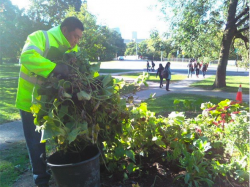
Amid a growing food crisis, this morning workers from the City of Toronto were ordered by City of Toronto Parks Director Richard Ubbens that all live plants and food be removed from the People’s Peas Garden in Queens Park. They were ordered to take the plants and food to the dump and lay sod overtop of this most beautiful free community food garden, without warning, without a chance to remove the rare heirloom plant species or harvest the food.The garden was planted by Occupy Gardens and allies on May 1st, in defense of local and global food security. While the garden has been growing undisturbed for nearly 5 months, with the help of hundreds in the community, the city deliberately decided to have it removed upon the eve of the Autumn Jam: A Harvest Party and celebration of sharing, community and free local food, which is happening tomorrow from 12-6pm at the garden in Queens Park (northwest section).The reason? The people did not have permission to grow free food on public land. I come from a city and country where one does not need permission to do the right thing. We are experiencing a “glocal” food crisis, where more and more people are lining up at food banks for kraft dinner and peanut butter, waiting lists for community gardens are growing, food prices rising, and our leaders are nowhere to be seen. Rather they are hiding behind their desk ordering the workers to destroy whatever hope we have left.We need help sharing this story far and wide.

We will be having our Autumn Jam harvest party/vigil tomorrow as scheduled from 12noon-6pm in the northwest section of Queens Park.

As a side note – last Monday Sept 17th gardeners travelled to Ottawa on a Peas Keeping mission for national, global food security, where we planted a free heart-shaped food garden on Parliament Hill, at which point the RCMP stomped on the plants and threatened arresting people, we removed the plants and relayed the sod.

Thanks so much for your time and help,

In Peas, Lovage & SOILidarity!

Jacob Kearey-Moreland
Toronto Media Co-Op
647 379 2324

This entry was posted on October 1, 2012, in Policy.

Grand Rapids anti-fracking action gets the word out and results in 3 arrests

This is re-posted from GRIID.org

Note: As Our Kitchen Table is engaged in activities around environmental justice, this action, which brought attention to the dangers that fracking has on our water quality, brings up important issues for our constituents. Most often, people of color and those with lower incomes live in areas most impacted by policies, like fracking, causing dangerous environmental degradation.

SEPTEMBER 22, 2012

The Grand Rapids group Mutual Aid GR organized a downtown Grand Rapids march as part of theInternational Day Against Fracking. This statement was released to media prior to the action:

A participant in the action related the following about the event:

 About 20 people attended and marched from Veteran’s Park through downtown and ended at Wolverine Oil & Gas where some folks staged a sit in. The march was a success! Our group gave out information to numerous passers-by and we seemed to have quite a bit of community support, even in-spite of the Art Prize craziness. We shouted chants like, “Hey Hey! Ho Ho! Hydraulic Fracking has got to go!” Our aim was to increase community awareness not only of the dangers of “fracking” but also that there are folks dedicated to acting in solidarity to create sustainable change from “outside the system.” 
 
The 3 folks that sat-in where arrested at approximately 2:15pm. There were several police officers present but all of them seemed very amiable and there was no struggle. The folks who were associated with the building seemed like they may present some resistance but nothing too outrageous came of it. The occupiers gave their demands to the VP of Wolverine Oil & Gas and there was a cordial debate that followed. No shouting or unreasonable acts, just quiet exchange about why and how Wolverine Oil & Gas is complicit in the degradation of our environment. Once the occupiers were hauled away the marchers moved from 55 Campau back to the corner of Monroe and Pearl where we passed out info and engaged in consciousness-raising discourse. All of the occupiers have since been bonded out and are set to appear in court next week.
The following is the statement released by the occupiers who sat-in at Wolverine Oil & Gas. They chose to give their own statement separate from that of the march.
 

“Today, we occupy the offices of Wolverine Oil & Gas as one action against the consequences of oil and gas extraction in Michigan. We are confronting Wolverine Oil & Gas because they have a history of profiting from environmental destruction and particularly their use of the natural gas extraction method known as hydraulic fracturing.

We know that hydraulic fracturing is bad for Michigan because it:
• Contaminates ground water and soil with toxic chemicals
• Contributes to the pollution and contamination of fresh water, which is one of the things that make Michigan such a magical place to live.
• Fracking poisons plants, animals and humans.
• Fracking is accelerating around the country and in Michigan and is contributing to the most urgent crisis of our time, global warming.
• Lastly, fracking for natural gas reduces the need to seek truly sustainable and renewable forms of energy.
Therefore, we occupy Wolverine Oil & Gas to say no to contaminating Michigan water; no to practices that significantly contribute to global warming; and no to companies that profit from environmental destruction. 
We are occupying Wolverine Oil & Gas to demand that they release all information about the type and amount of chemicals they have used in fracking to date and the amount of water used; to release information on the location of all oil and gas wells they own and operate in Michigan, and to stop the practice of fracking where ever they engage in this practice. 

No Compromise in Defense of Mother Earth!”