Archives

OKT’s Lisa Oliver-King featured in story on food insecurity

Reposted from Rapid Growth Media

“It is great to grow food, but more importantly when we begin to look at the landscape, how do we understand policy?” Lisa Oliver-King

RG Community Connect: Collaboration is key in working toward a more just food system in Kent County

GRATIA LEE | WEDNESDAY, NOVEMBER 16, 2022

If you feel stretched by the increase in food prices in recent months, you are not alone. As inflation affects food costs across the country, more and more people are food insecure. According to the White House National Strategy on Hunger, Nutrition, and Health, “there is no silver bullet to address these complex issues and there is no overnight fix. Making progress requires collective, sustained action and mobilization across every segment of society.” That document, plus a newly updated Michigan Good Food (MI GF) Charter by Michigan State University, are poised to guide important changes to our current food system — one where “junk food”: high-calorie, low-nutrient food is more affordable than nutrient-dense “whole” foods like fruits, nuts and vegetables.  

While national changes are sure to be difficult in this partisan climate, these documents both provide a clear framework for smaller, local organizations to collaborate toward more resilient food systems and echo the work that is already being done. The MI GF Charter “calls for systemic change by supporting food systems that ensure food is accessible to everyone, promote healthy communities, use fair and sustainable production methods and support a diverse and equitable society.” 

It is encouraging that this type of work is currently happening in our community. “It’s a tension between meeting immediate needs and long-term, systemic solutions,” says Janelle Vandergrift, co-chair of the recently formed Kent County Food Policy Council (KCFPC). “Because immediate needs are so great right now it can take so much of our attention, but we still need to be able to zoom out and look at the system as a whole and see what needs to change,” she says. The Food Policy Council is set to begin work on a countywide community food assessment with the hope that the process will involve a lot of community feedback on the strengths and weaknesses of our current system.  

Despite the myriad challenges, Wende Randall, director of the Kent County Essential Needs Task Force, finds room for hope. “I am energized by the coming together of grassroots groups, exploring how close neighborhoods or small groups can work together and some larger organizations activating practices of food justice that support local businesses and families,” she says.  

For the Good Food team at Access of West Michigan, systemic change in the charitable food system has been a top priority for the past five years, as it works to educate and collaborate alongside partners focusing on the importance of dignified access to healthy, affordable, culturally relevant food.  

One of its programs, Refresh Now, is a collaboration with two local health clinics to run a fresh fruit and vegetable prescription program that helps patients with chronic disease or high-risk factors access nourishing foods. “Food as medicine projects have the potential for making a significant impact on public health, especially in communities with significant health disparities,” says Randall.  
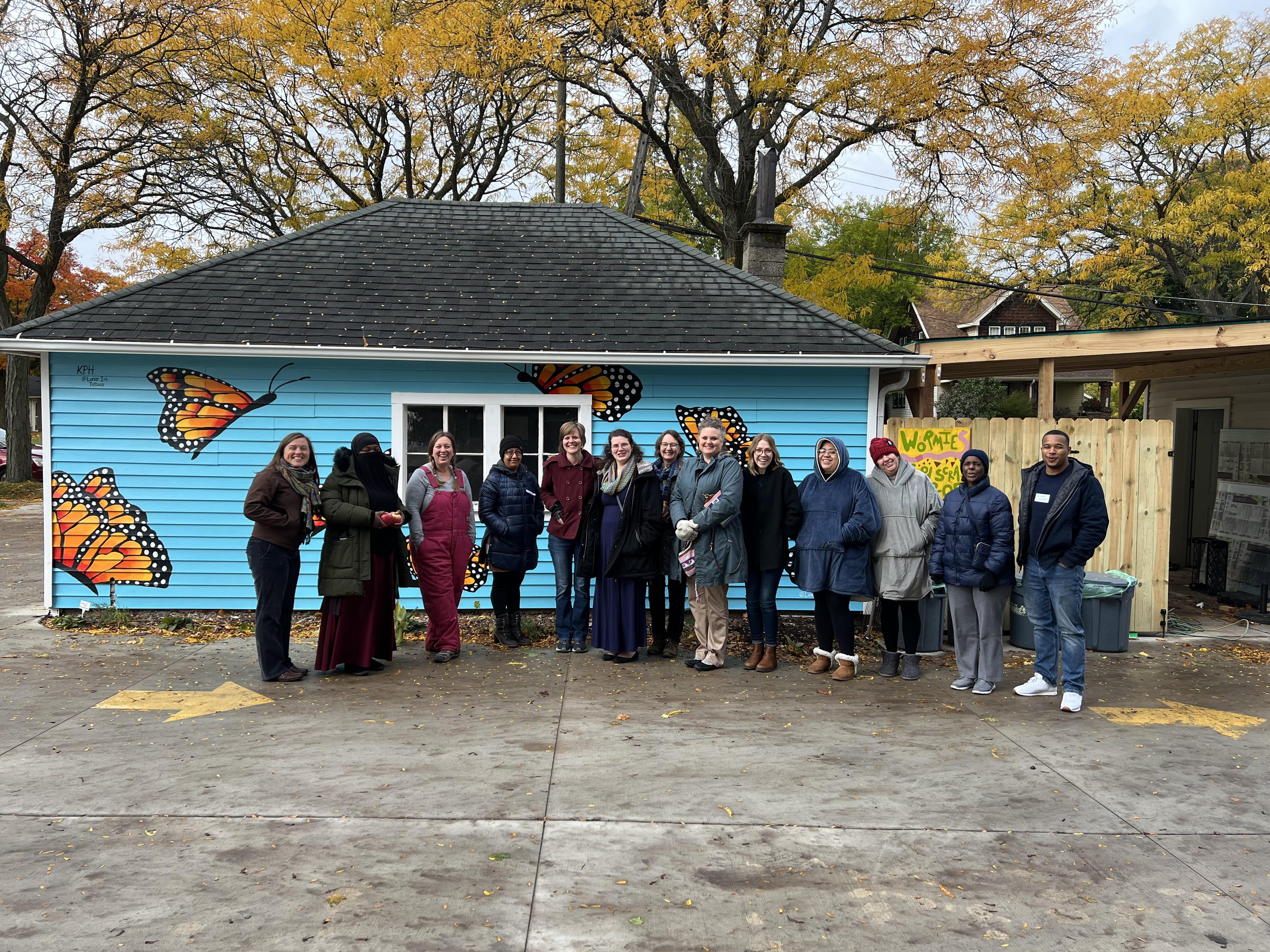
Another exciting project is a collaboration between New City Farm and Fresh Markets that we helped launch over the past five years. These are hyperlocal, innovative food retail sites in low food balance areas of Kent County. This project has been powerful as it has been influenced by and designed with community member feedback —  due to being able to share space with individuals who frequent the Fresh Markets and get direct feedback on what could be done better, what they want to have available in the markets from local farms and how the Fresh Markets can continue to be a beacon of health in their neighborhoods. 
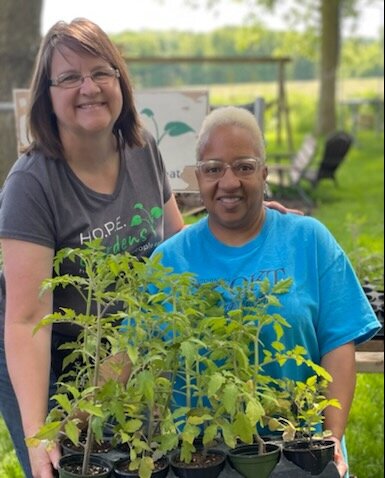
Lisa Oliver King and Julie BrunsonOne of the most active organizations doing important grassroots work in Grand Rapids is Our Kitchen Table (OKT). Founded in 2005 as a mobilizing group for moms around the dangers of lead and radon in homes, Executive Director, Lisa Oliver-King continued conversations in her community and quickly realized that a major injustice was food. Since 2010 when they received their first grant, OKT has worked tirelessly on the southeast side of the city. Oliver-King stressed the importance of being active in your community. While growing food and teaching community members about healthy cooking is a tool they use, Oliver-King stresses that “the justice lens … is crucial.” 

“It is great to grow food, but more importantly when we begin to look at the landscape, how do we understand policy?,” she says. “The reality is you are always bumping up against policy. You need to show up at city commission and county commission meetings. How can we build a collective influence to bring about the change we want to see?”

As most have learned through experience, “being a part of systems work is realizing there are many entry points, not just one,” says Vandergrift. It is important to find your passion and start there. As a community member on the KCFPC, Samika Douglas is looking forward to “sharing the needs of the community and the barriers they are facing, as well as advocating for resources and services that are so needed.” Randall emphasized the need for shared language in this work and being able “to consider the assets of the community rather than just the deficits.” 

As the trajectory to reimagining more equitable food systems advances, the community must keep moving forward. Many of the most successful programs happening locally are those that prioritize resident feedback from and are authentically driven by the needs of those most affected by issues of food security. “While there is a lot of good work in our community being done, it is important to remember that in working on multi-levels, things might not happen as fast as you would like for them to happen,” says Oliver-King. “But, figuring out how you can still support the work in some kind of way because the more of a puzzle that we fit together, the better off our community is. We are all individual pieces that must connect to bring about those changes that will address the issue of being food insecure.” 

Photos courtesy of Our Kitchen Table and Access of West Michigan

Gratia Lee is the Good Food Systems Director at Access of West Michigan. She moved back to MI in June 2021 and looks forward to engaging with the community around shared goals of increased health equity and improved food access. She is passionate about the environment and sees food as an important entry point to connect people to one another and our planet.

Michigan Immigrant Rights Center continues fight against egg producers who put workers at risk

Lawsuit Against West Michigan Egg Farm and Labor Contractor Proceeds in Court

Content from MIRC

While COVID-19 has faded in urgency for many Michiganders, farmworkers are still fighting for justice after they were left unprotected and exposed to the virus in the early days of the pandemic. In March and April of 2020, as the virus was spreading in Michigan, essential workers Juana, Juan Carlos, and Margarita were hired to work at Sunrise Acres, a large egg producing and processing facility in Hudsonville, Michigan. They were hired by farm labor contractor C&C West Poultry operated by Armando and Joel Cardona Coronado. While working at Sunrise Acres they became infected with COVID-19 and fell seriously ill. 

At a time when most Americans were heeding the guidance of public health professionals, C&C West Poultry and Sunrise Acres chose not to implement policies that would halt the spread of the highly contagious virus and safeguard their workforce from COVID-19. “We were practically working shoulder to shoulder because the lines are very tight,” said Juana. The management at Sunrise Acres put forth superficial policies with zero implementation, and failed to satisfy the duties to workers outlined by Governor Whitmer’s Executive Orders and the Michigan Occupational Safety and Health Administration (MIOSHA). They did not provide personal protective equipment, claimed the company was implementing social distancing in workspaces where it was not physically possible, and took a lax approach to taking temperatures and monitoring symptoms of entering laborers.  They failed to take meaningful precautions to protect the health and well-being of the workers who kept them in business during the pandemic.

Juana and Margarita bravely brought a lawsuit against C&C West Poultry and Sunrise Acres to hold them accountable for failing to protect their workers from contracting COVID-19. The workers are represented by the Michigan Immigrant Rights Center, a nonprofit law center that advocates for the rights of immigrants and farmworkers. Sunrise Acres and Joel Cardona Coronado tried to have Juana, Margarita, and Juan Carlos’ claims dismissed in court, attempting to intimidate the workers and dissuade them from continuing with their case. Joel Cardona Coronado further tried and failed to convince the judge that he did not bear responsibility. Sunrise Acres and their president and owner William Patmos, sought to be dismissed from the case and the judge denied the motion. In an important victory for Juana, Juan Carlos, and Margarita, the Ottawa court decided the case will proceed. This sends an important message to unscrupulous and negligent contractors and employers who fail to protect the health and safety of essential immigrant workers. 

“I felt like I was treated like I was disposable, working based on their necessity, not mine,” said Juana. Despite the dangerous conditions, she continued to work because “we all need to work and to take care of our needs, to take care of our family.”

“While this lawsuit started during the COVID-19 pandemic, really it brings to light a common theme we see among our clients,” said Gonzalo Peralta, the MIRC attorney representing the workers. “The health and welfare of farmworkers is too frequently not taken seriously by employers. No matter who you are or where you’re from, we all deserve safe and healthy workplaces. Workers should be able to count on their employers to take proper precautions to ensure their well-being. We are grateful to Juana, Margarita, and Juan Carlos for speaking up to ensure the rights of workers are protected.”

Workers who have questions about their rights can call MIRC’s free confidential Farmworker and Immigrant Worker hotline at 800-968-4046.

###

Michigan Immigrant Rights Center (MIRC) is a statewide legal resource center for Michigan’s immigrant communities that works to build a thriving Michigan where immigrant communities experience equity and belonging. MIRC’s work is rooted in three pillars: direct legal services, systemic advocacy, and community engagement and education. MIRC’s Farmworker and Immigrant Worker Rights practice focuses on representing farmworkers with their employment and civil rights matters and specializes in cases at the intersection of workplace and immigrant rights. michiganimmigrant.org 

WGVU “The Michigan Experience” features OKT

The Michigan Experience takes a look at Our Kitchen Table, a food and social justice organization located in Grand Rapids, Michigan. Hear from one of our food coaches as they explain all of the wonderful and impactful benefits of growing a garden right at home! Part of WGVU’s ‘MI (my) American Recipe’ program! https://www.wgvu.org/MI-recipe/ #MiRecipe

Michigan Egg Producer Pays Settlement to Farmworker Survivor of Sexual Assault

Workers who have questions about their rights can call MIRC’s free confidential Farmworker and Immigrant Worker hotline at 800-968-4046. 

Reported by MIRC

Michigan egg producer Konos, Inc. (Konos) has paid a major financial settlement to compensate “Jane Doe,” a client of the Michigan Immigrant Rights Center (MIRC), ending a sex discrimination and retaliation lawsuit filed by the U.S. Equal Employment Opportunity Commission (EEOC) in the Western District of Michigan. MIRC’s client was allowed by the court to maintain anonymity due to the sensitive nature of the events at issue in the case. As a condition of settlement, Konos also entered into a consent decree with the EEOC for three years, requiring them to train their workforce and management on sexual harassment, post notices for all employees at their egg processing plants on the existence of the case and the right to a sexual harassment-free workplace, and self-report sexual harassment complaints to the EEOC.   

The Michigan Immigrant Rights Center represented the female farmworker who intervened to join the lawsuit and added two individual Defendants and state law claims under Michigan’s Elliott-Larsen Civil Rights Act. 

MIRC’s client suffered repeated sexual advances by her male supervisor which escalated to sexual assault. When MIRC’s client went to Konos management to complain, instead of taking any steps to protect her, they sent her home. The male supervisor was eventually criminally prosecuted and convicted of the charges. Konos employed their corporate attorney to represent the male supervisor in criminal court while continuing to represent Konos during the EEOC investigation and the civil litigation. During both the criminal and civil proceedings, Konos’ attorney attempted to use Jane Doe’s immigration status against her and as a defense against the company’s liability but was unsuccessful in deterring Jane Doe from seeking justice. 

“Sexual harassment and assault in agriculture is a pervasive and invisible problem with many immigrant survivors too scared to come forward and report due to concerns about immigration status being used against them,” said MIRC supervising attorney Diana Marin. “The weaponizing of immigration status by employers and defense counsel against our immigrant communities must end. It took incredible courage for our client to not only report the abuse, but also to see through a protracted legal battle against a multi-million dollar egg producer. We hope this case sends the message that sexual harassment and assault will not be tolerated and there are recourses for immigrant survivors who work in agriculture and experience harassment in the workplace.”  

For more information on sexual harassment, visit https://www.eeoc.gov/sexual-harassment

For more information on retaliation, visit https://www.eeoc.gov/retaliation.

Survivors of sexual assault and abuse can call the State of Michigan’s free and confidential 24/7 hotline at 855-VOICES4 or by texting 866-238-1454.

Workers who have questions about their rights can call MIRC’s free confidential Farmworker and Immigrant Worker hotline at 800-968-4046. 

Michigan Farmworkers sue Mastronardi Produce for pesticide exposure and wage theft

This just in from the Michigan Immigrant Rights Center (MIRC) 

Lawsuit calls attention to abuses and unsafe working conditions faced by farmworkers at Michigan mega greenhouse

On June 1, 2022, three farm workers filed a class action lawsuit against their former employers, Mastronardi Produce-USA, Inc. and Maroa Farms, Inc. for violations of federal law relating to harmful pesticide exposure, and a deceptive bonus structure. Plaintiffs Benjamin Lopez, Oscar Carlos Lopez Ramirez, and Ramona Reyes Saucedo, along with their coworkers, were exposed to dangerous pesticides while working in Mastronardi’s two million square foot greenhouses in Coldwater, Michigan.

The Plaintiffs and their co-workers were repeatedly exposed to Virocid, Virkon S, and Sodium Hypochlorite 12.5% – disinfectants regulated as pesticides by the Environmental Protection Agency (EPA) – without proper training, proper personal protective equipment, or access to information about the pesticides being used. Plaintiffs and their co-workers experienced ongoing medical issues including daily nose bleeds, headaches, burning eyes, and skin rashes. Mastronardi management repeatedly dismissed their symptoms and requests for protection.

In addition, Mastronardi failed to pay Plaintiffs the promised bonus for meeting production standards by continually increasing the amount of work that had to be completed to receive a bonus, changing how bonuses were calculated, and undercounting their work. Mastronardi also misclassified Ms. Reyes Saucedo as an agricultural worker and failed to pay her overtime wages when she was employed as a janitor cleaning bathrooms, lunchrooms, and migrant housing.

The workers are represented by the Michigan Immigrant Rights Center (MIRC), a nonprofit legal resource center for immigrants and farmworkers in Michigan, and Farmworker Justice, a national nonprofit farmworker advocacy organization based in Washington, D.C.

“Pesticide exposure continues to be a serious health and safety risk for our nation’s farmworkers who help bring food to our tables, regardless of whether they perform their work in a field or a greenhouse,” said Anna Hill Galendez, an attorney with MIRC. “Despite the known risks of pesticide exposure, cases involving serious injury and illness to farmworkers as a result of pesticide exposure are all too common, and workers who speak up face the very real risk of retaliation by their employer. Our plaintiffs have demonstrated tremendous courage in coming forward and disclosing to the public the horribly unsafe and unjust working conditions at Mastronardi.”

“Although the practice of wage theft is unfortunately quite common in low-wage industries such as agriculture, it is especially disheartening to witness it in this context, where hundreds of migrant workers traveled long distances to Coldwater based upon Mastronardi’s promise that they would be able to earn a living wage, only to find out that Mastronardi’s guarantees were nothing more than an empty promise,“ said Trent Taylor, staff attorney for Farmworker Justice.

The workers’ complaints fit with a pattern of concerns at Mastronardi facilities in the U.S. According to news reports, Mastronardi facilities in several states have received fines from the Occupational Safety and Health Administration (OSHA) and the Department of Labor (DOL). Mastronardi has received multiple citations for workplace hazards at a warehouse in Livonia, and the company was previously fined by DOL for wage violations at Maroa Farms. In 2021 a Maine greenhouse owned by Mastronardi was ordered to pay wages and penalties to workers, and in 2020 COVID-19 outbreaks occurred in Mastronardi greenhouses in New York and Michigan.

“Farmworkers, like all workers, deserve safe and healthy workplaces,” said Anna Hill Galendez. “We hope that this lawsuit calls attention to the tremendous abuses that many farmworkers experience and will force Mastronardi to reform its policies and comply with the law.”

“We come to work. They should treat us well. We do our work so that the company can make money. The company should take care of its workers,” said Benjamin Lopez, migrant farmworker and a named Plaintiff.

“Workers also have rights,” said Ramona Reyes Saucedo, one of the named Plaintiffs. “Maroa should treat their employees with dignity and respect and take the proper safety measures to make sure the chemicals and pesticides used don’t harm the employees’ health. My health was affected a lot, my nose bled frequently, and it was difficult for me to breathe without pain or a burning sensation in my chest.”

Workers who have questions about their rights can call MIRC’s free confidential Farmworker and Immigrant Worker hotline at 800-968-4046.

###

Michigan Immigrant Rights Center (MIRC) is a statewide legal resource center for Michigan’s immigrant communities that works to build a thriving Michigan where immigrant communities experience equity and belonging. MIRC’s work is rooted in three pillars: direct legal services, systemic advocacy, and community engagement and education. MIRC’s Farmworker and Immigrant Worker Rights practice focuses on representing farmworkers with their employment and civil rights matters and specializes in cases at the intersection of workplace and immigrant rights. 

Farmworker Justice (Justicia Campesina) is a nonprofit organization that seeks to empower migrant and seasonal farmworkers to improve their living and working conditions, immigration status, health, occupational safety, and access to justice. The organization is based in Washington, D.C. and works with farmworkers and their organizations throughout the nation. farmworkerjustice.org

“We Just Unionized Amazon”: How Two Best Friends Beat the Retail Giant’s Union-Busting Campaign

Click on this Democracy Now! link to watch the video interview and read the transcript.

Hear how two best friends led a drive to organize workers at Amazon’s warehouse in Staten Island, New York, and made history Friday after a majority voted to form the first Amazon union in the U.S.

“I think we proved that it’s possible, no matter what industry you work in, what corporation you work for,” says Christian Smalls, interim president of the new union and former Amazon supervisor. “We just unionized Amazon. If we can do that, we can unionize anywhere.”

Reporter Josefa Velásquez covered the union drive for The City and discusses what the victory means for the broader labor movement.

Black Farmers Embrace Practices of Climate Resiliency

Reposted from Yes!

BY LEAH PENNIMAN 6 MIN READ

At Soul Fire Farm, a BIPOC-centered community farm, farmers learn regenerative methods such as heavy mulching and intercropping.

Chief Zogli looked weary as he scratched a notch in his doorpost to record the weather. “Still no rain,” he says with resignation. The chickens pecked lazily in the dust and the goats foraged for the last of the dropped grains beneath the emptying corn crib. In this rural community outside of Odumase-Krobo, Ghana, the farmers depend on rainfall as their only source of agricultural water. Zogli explains that the rainy season has been arriving later each year and ending sooner—and the thirsty crops struggle to mature.

From the African continent to the Americas and across the Caribbean, communities of color are on the front lines of and disproportionately harmed by climate change. Record heat waves have caused injury and death among Latinx farmworkers and devastating hurricanes have become regular annual visitors in the Caribbean islands and coastal areas of the U.S.

Meanwhile, several Alaskan Native communities struggle to hunt and fish in their traditional ways because rising temperatures are ravaging the wildlife. And sub-Saharan Africa, where Ghana is located, is among the regions projected to experience the harshest impacts of climate change.  “If you’re not affected by climate change today, that itself is a privilege,” climate activist Andrea Manning says. 

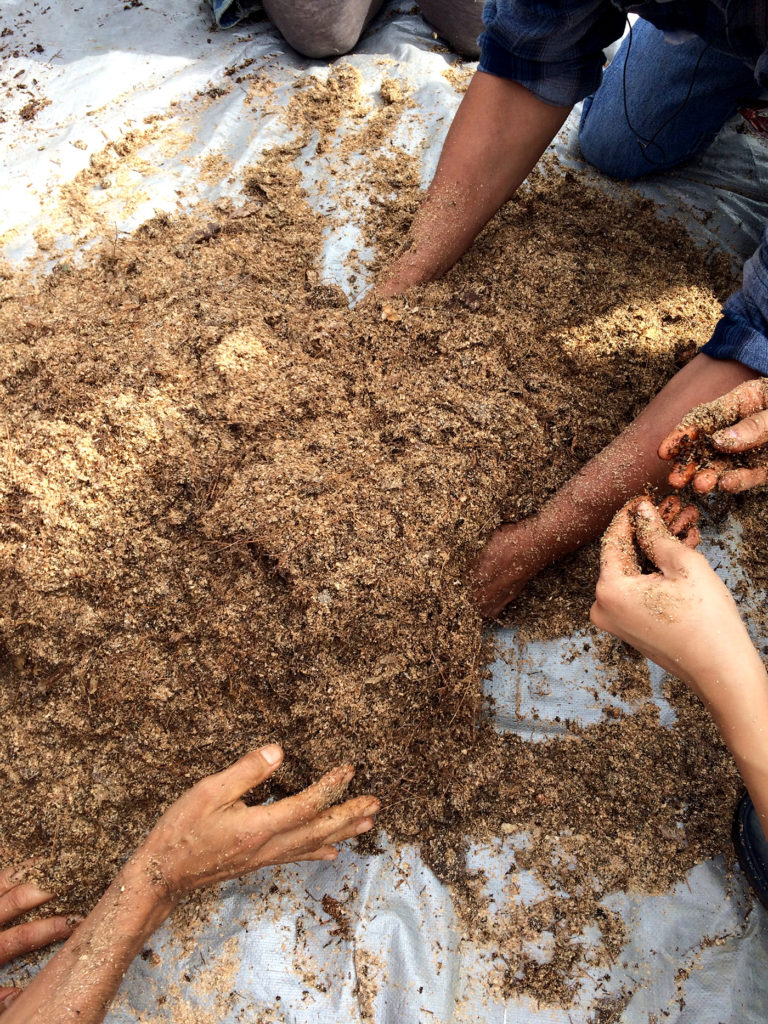
Farmers make fungal inoculant at Soul Fire Farm to enhance the soil’s capacity to capture carbon. Photo from Soul Fire Farm.

But the same communities on the frontlines of climate impact are also on the frontlines of climate solutions. A new generation of Black farmers is using heritage farming practices to undo some of the damage brought on by decades of intense tillage by early European settlers. Their practices drove around 50% of the original organic matter from the soil into the sky as carbon dioxide. Agriculture continues to have a profound impact on the climate, contributing 23% of total greenhouse gas emissions.

Now Black farmers are finding ways to capture that carbon from the air and trap it in the soil. They are employing strategies included in Paul Hawkin’s Drawdown, a guide to the 100 most substantive solutions to global warming.

One practice, silvopasture, is an indigenous system that integrates nut and fruit trees, forage, and grasses to feed grazing livestock. Another, regenerative agriculture, a methodology first described by agricultural scientist and inventor Dr. George Washington Carver, involves minimal soil disturbance, the use of cover crops, and crop rotation. Both systems harness plants to capture greenhouse gases. “No other mechanism known to humankind is as effective in addressing global warming as the capturing of carbon dioxide from the air through photosynthesis,” Hawkin says.

Here are examples of how farmers are putting these practices to work.

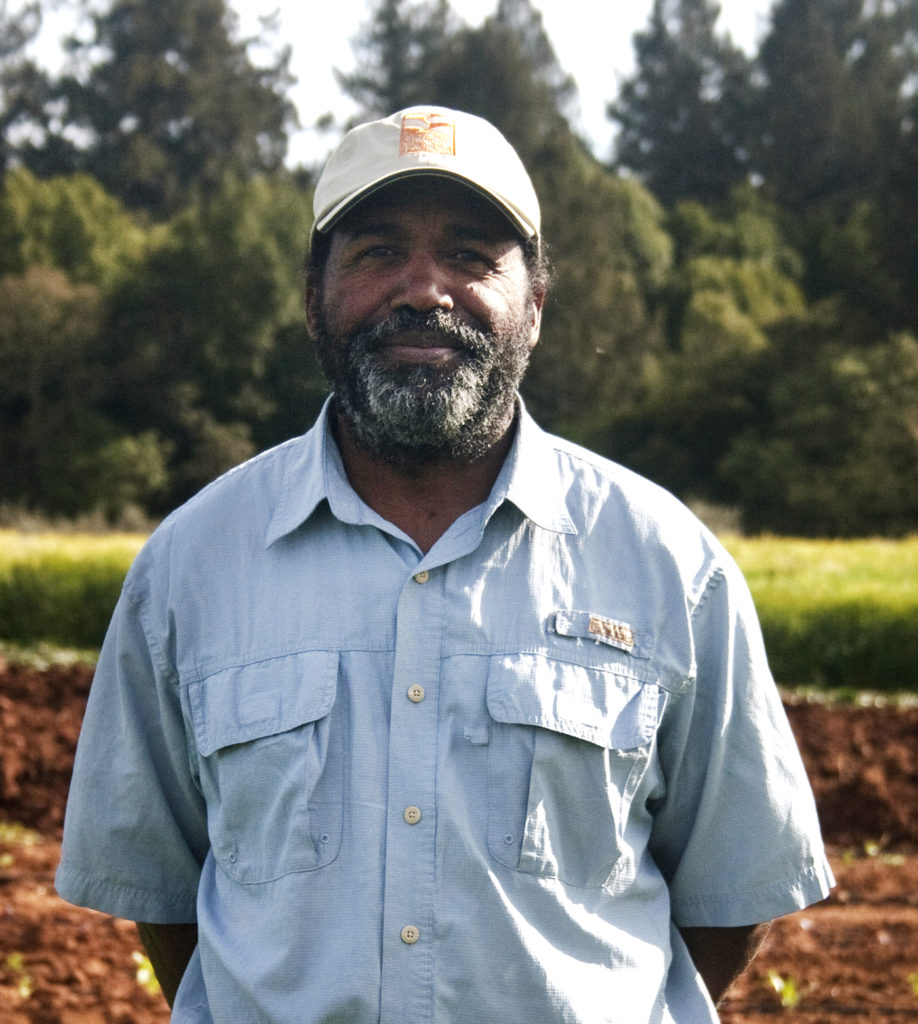
Leonard Diggs, Pie Ranch Farm, Pescadero, California

After working in an auto parts store during high school, Leonard Diggs swore, “I will never have another job working inside.” True to his word, Diggs went on to manage sustainable farms in northern California for over 30 years.

Diggs is developing a 418-acre incubator farm at Pie Ranch, where beginning farmers will establish their own regenerative enterprises. In collaboration with the Amah Mutsun tribal band and nearby farmers, he is creating a landscape-level ecosystem plan that integrates forest, riparian corridor, native grasslands, perennial and annual crops. The management practices that emit carbon, such as some annual crops, will be balanced out with perennial areas that sequester carbon, achieving carbon neutrality overall.

Leonard Diggs is developing Pie Ranch, an incubator farm in Pescadero, California. Photo from Leonard Diggs.

“We need to realize that working landscapes provide not just products but also ecosystem services like carbon sinks, water recharge, and evolutionary potential,” Diggs explains. He envisions a food system where farmers derive 30% to 40% of their income from the value of ecosystem services and do not have to “mine” the soil to make a living. He is working with researchers to establish baseline data for the amount of carbon in the soil, and the composition of bacterial and fungal communities. The goal is for the farm to capture more carbon than it releases over time.

Unlike many incubator farms that emphasize annual crops and allow farmers to stay for just a few years, Diggs is working with a longer horizon. “We need to plant orchards and perennials, get them established over 10 years, and hand new farmers a working landscape. Instead of making them leave as soon as their businesses get established, we will move the incubator to a new area, and the farmers can stay.”

“We need agriculture that does not lose our carbon, and does not deplete our people,” Diggs concluded.

Keisha Cameron, High Hog Farm, Grayson, Georgia

Not everyone in the Black farming community is as excited about fiber as Keisha Cameron. Given the prominent role of the cotton industry in the enslavement of African Americans, many farmers eschew cultivation of textiles. “We are largely absent from the industry on every scale,” she explains. “Yet these agrarian artways and lifeways are part of our heritage.”

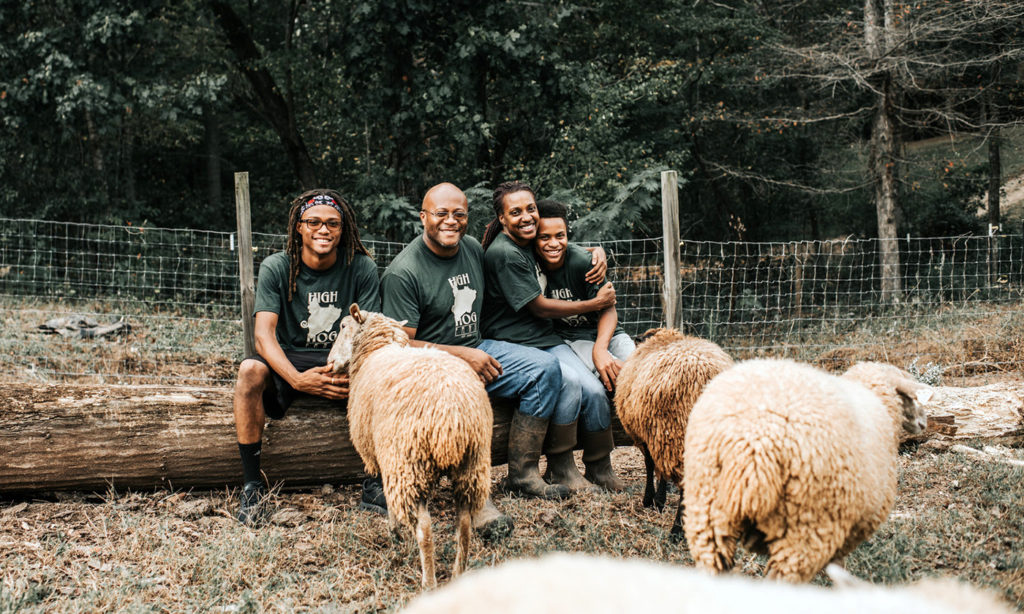
Keisha Cameron, second from the right, with her family at High Hog Farm in Grayson, Georgia. Photo from Keisha Cameron.

At High Hog Farm, Cameron and her family raise heritage breeds of sheep, goats, rabbits, horses, chickens, and worms in an integrated silvopasture system and sells fiber and meat. One of her favorite varieties is American Chinchillas, rabbits which consume a wider diversity of forage than goats and fertilize the pasture with their manure.

The family is also working to establish tree guilds, a system where fruit trees are surrounded by a variety of fiber crops such as indigo, cotton, and flax. Their goal is a “closed loop” where all the fertility the farm needs is created in place. They pack a lot of enterprises into a small space. “We have 5 acres,” she says playfully. “Just enough to be dangerous.”

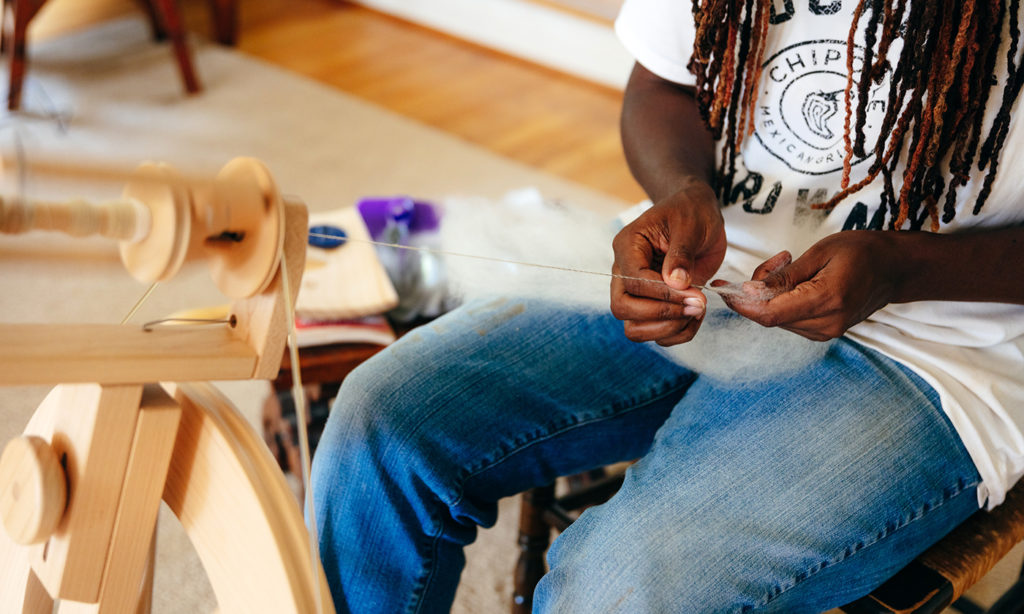
Keisha Cameron spins wool. Photo from Keisha Cameron.

In his book, the Carbon Farming Solution, Eric Toensmeier writes that silvopasture traps 42 tons of carbon per acre every year. This is because pasture stores carbon in the above and below ground biomass of grasses, shrubs, and trees. Also, animals that are raised on pasture have healthier digestive systems than those raised in confinement, and emit lower amounts of methane.

In addition to healing the climate, silvopasture is a joyful practice. “I get to play with sheep and bunnies. What could be better?” Cameron poses.

Germaine Jenkins, Fresh Future Farm, North Charleston, South Carolina

When Germaine Jenkins first moved to Charleston, she relied on SNAP and food pantries to feed her children. “I did not like that we couldn’t choose what we wanted to eat, and there were few healthy options. I was sick of standing in line and decided to grow my own stuff.”

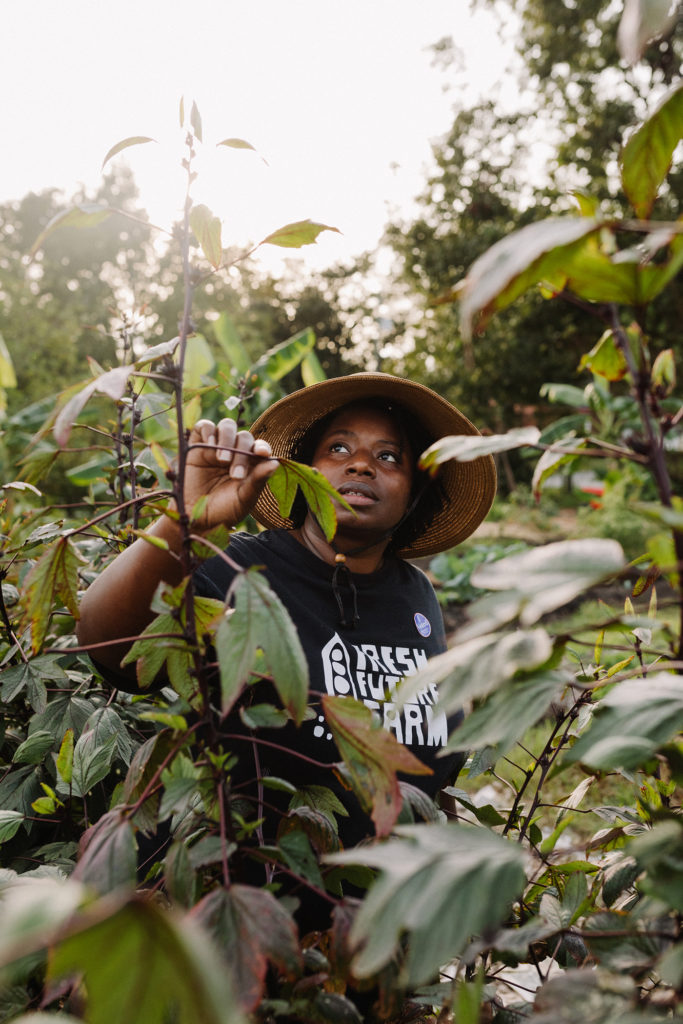
Germaine Jenkins inspects the crops at Fresh Future Farm in North Charleston, South Carolina. Photo by Elizabeth Ervin.

Jenkins learned how to cultivate her own food through a master gardening course, a certificate program at Growing Power, and online videos. She promptly started growing food in her yard and teaching her food-insecure clients to do the same through her work at the Lowcountry Food Bank. In 2014, Jenkins won an innovation competition and earned seed money to create a community farm.

Today, Fresh Future Farm grows on 0.8 acres in the Chicora neighborhood and runs a full-service grocery store right on site. “We are living under food apartheid,” explains Jenkins. “So all of the food is distributed right here in the neighborhood on a sliding scale pay system.”

Jenkins relies on what she calls “ancestral muscle memory” to guide her regenerative farming practices. Fresh Future Farm integrates perennial crops such as banana, oregano, satsuma, and loquat together with annuals like collards and peanuts. The farm produces copious amounts of compost on site using waste products like crab shell, and they apply cardboard and wood chips in a thick layer of mulch. “We repurpose everything — old Christmas trees as trellises and branches as breathable cloche for frost-sensitive crops.” Jenkins explains. They even have grapes growing up the fence of the chicken yard so that the “chickens fertilize their own shade.”

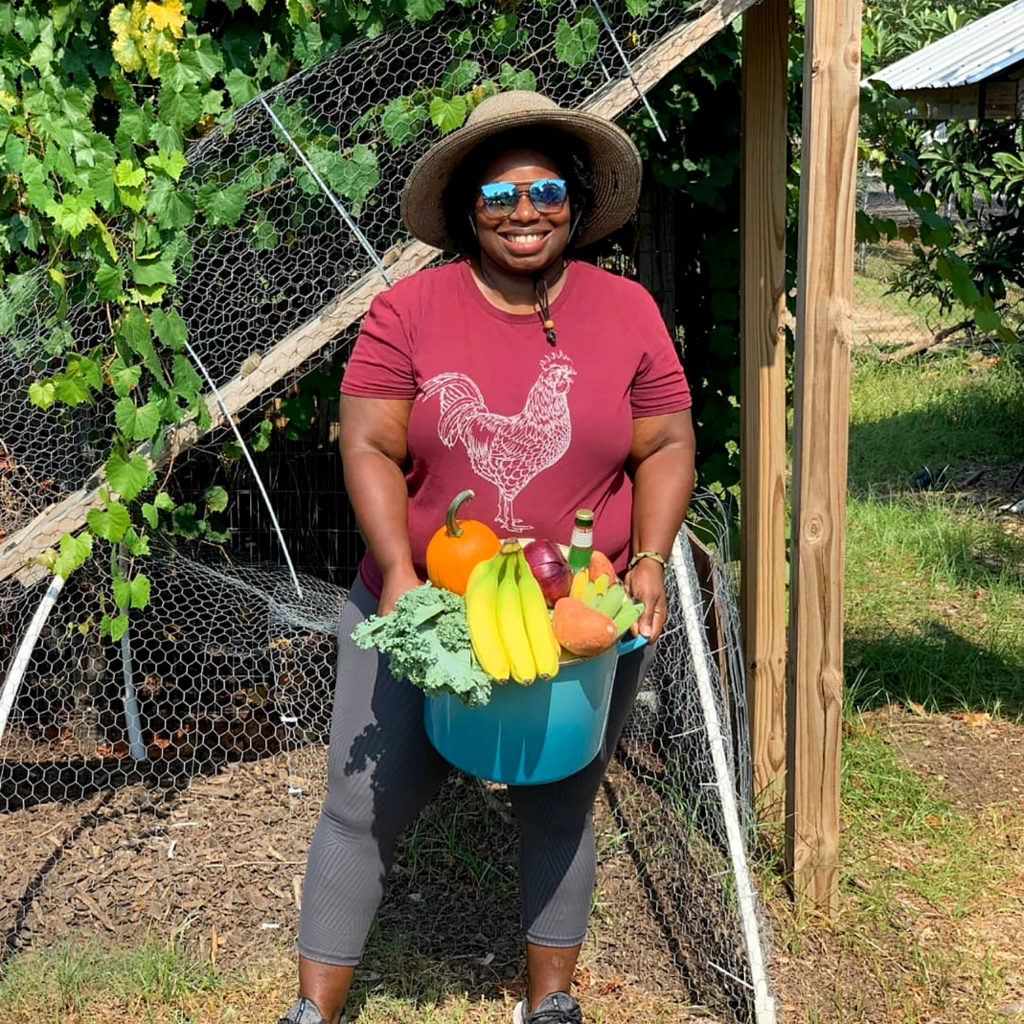
Germaine Jenkins with her harvest. Photo from Germaine Jenkins.

Jenkins’ farming methods have been so successful at increasing the organic matter in the soil that they no longer need irrigation. They are also less vulnerable to flooding. “Two winters ago, we had 4 feet of snow. Our soil absorbed all of it,” Jenkins says.

Toensmeier writes that for every 1% increase in soil organic matter, we sequester 8.5 tons per acre of atmospheric carbon. If all of us were to farm like Jenkins, Diggs, and Cameron, we could put 322 billion tons of carbon back in the soil where it belongs. That’s half of the carbon we need to capture to stabilize the climate. 

As Larisa Jacobson, co-director of Soul Fire Farm explains, “Our duty as earthkeepers is to call the exiled carbon back into the land and to bring the soil life home.” 


LEAH PENNIMAN is a farmer, educator, soil steward, and food justice activist. She is the co-director and program manager of Soul Fire Farm in Grafton, New York, and the author of Farming While Black: Soul Fire Farm’s Practical Guide to Liberation on the Land.

Kent County Food Policy Council interview with Lisa Oliver-King published in The Rapidian.

Lisa Oliver-King, Director of Our Kitchen Table (OKT), shares her food experiences, more about OKT’s work and her vision for a more just, equitable food system in Kent County

Earlier this year, the Kent County Food Policy Council launched to strengthen and grow the food system in Kent County. As we build momentum, discuss, and prioritize issues, we are gathering information and engaging with our community through a project called Everybody Eats: Highlighting Food Experiences in Kent County. Through this project, we are inviting our community to share their experiences with our food system and highlight the good food work that is already happening here. 

Below is an interview with Lisa Oliver-King, Director of Our Kitchen Table (OKT), a grass-roots, nonprofit organization serving greater Grand Rapids. OKT promotes social justice and empowers our neighbors to improve their health and environment through information, community organizing and advocacy. Lisa was a formation team member of the Kent County Food Policy Council. Thank you, Lisa, for your good food work and sharing your thoughts with us!  

Tell me about your relationship with food. 

Lisa: My relationship with food has been built over time. As a child, my mother would prepare different meals for my siblings and I so that we could eat what we really wanted to eat, sometimes she would make each of us a different meal. During the holidays, my family would be up until 3 or 4 in the morning making everything from scratch. My family always really bonded over food. We also had hard times. At one point, the gas in our house was shut off for a week so we had ham in many different forms. Although we got tired of ham, we still ate. 

My family was always involved in every process of food: picking some of our own produce, going to get meat from a butcher, helping with preparation, cooking, and cleaning up before and after meals. These experiences gave me an appreciation for food.  

A big part of my relationship with food is connection. We use food in my family to release tension in difficult conversations. If there is something that my husband or my kids and I need to discuss, we will come to the kitchen table and set out blueberries or other snacks and use that as a buffer or comfort in our conversations. 

Food is so much more than something that we eat…we use it on our skin, we can drink it: it has a greater purpose than solely being consumed. And as I get older, I appreciate the earth more, I appreciate farmers more, I appreciate the importance of food subsidies more. 

In what way does your organization engage in the local food system? 

Lisa: Our Kitchen Table works with people who do not have a good relationship with food. We have to think about why that is and if there is anything that we can do to change that. We look at the whole entity: how food smells, the preparation, harvesting, growing, and cooking food. We try to walk people through every aspect of their relationship with food.  

We work to figure out what experience we can create. One of the ways that we do that is by providing people with a food garden coach and working with them to get past the initial obstacles in their relationship with food — whatever they may be. We help people work with the resources that they have. We ask: what do you have in your household? Is there an obstacle with electricity or gas? If there is, that’s okay because there are so many other options. I have worked with people who use their coffee makers to boil chicken. People who grill due to lack of access to electricity or gas. We work with the resources that they have and come up with creative solutions to educate people on how they can prepare food regardless of limitations. There is no one way, there is no right way. 

I have always thought about food as it relates to power. I have the power of selecting what I want to eat, which items I want to purchase, and how I prepare my food. I get to choose what goes into my body. Ultimately, we teach others about food power. 

If you were to design a food system rooted in equity, justice and sovereignty, where would you focus your attention and why? 

Lisa: I would focus my attention on ensuring that food is available in public spaces and that it is available to all. And looking at the issue of equity when it comes to availability. We need to come together and make sure that food is available for all; but also, some spaces may need more support. In those public spaces, we want things to be set up in a puzzle perspective: with charitable organizations, retail, areas where you can just go, and pick produce for free.

We have to ask: how do we create a diversification in the food space that meets the needs of the community at large? And with the promise of no stigma and no judgment. That when you access food, you make sure that others are accessing it without barriers as well. That would be my dream. 

Interview by: Nicole Kukla

WMSBF features OKT among those celebrated for Black Excellence in Sustainability

Thank you West Michigan Sustainable Business Forum for highlighting OKT’s work
with the following article that was posted on your website!

Lisa Oliver-King is the Executive Director with Our Kitchen Table (OKT), a nonprofit organization that focuses on food and environmental justice, which go hand-in-hand with sustainability. Lisa said, “As minerals, soil, seeds, foods, water, and even air became to be viewed as resources to be traded for profit by those in power, those without power increasingly are harmed by the results—and often exploited for labor. In a world where clean air, healthy soil, healthy food, and clean water are seen as human rights, sustainability will follow”.

Lisa Oliver-King

Our Kitchen Table makes its impact by engaging in dialogue and planting seeds of activism that go beyond planting a garden or growing a tomato. She mentioned that OKT’s work is like an analogy that the late Wangari Matthai spoke to—that we are one snail with a drop of water on our back making our way to help extinguish the fire. Lisa further notes that “True sustainability looks like people of the world enjoying food sovereignty, clean water, and peace as the result of living in a global culture that values the earth, health, and economic equality”.

Lisa is proud to celebrate OKT’s Food Policy for Food Justice series and their ability to teach neighbors to grow their own food, share the message of food justice, and maintain a walkable neighborhood farmer’s market for ten years, which increases the access to healthy, local produce. She is also proud that she and the Our Kitchen Table team are helping to change the focus from food charity to addressing root causes of hunger and food insecurity and that by working alongside constituents, they have become not only teachers but colleagues and students. 

Systemic and institutional racism and funding structures have been barriers and challenges while working in the sustainability and environmental justice field, especially as a POC-led organization. Lisa mentioned that gaining trust has been challenging at times, but that building relationships is key to working collectively. Although there are many barriers to this work, Lisa believes that now is the time to build awareness that there has never been food justice in the United States, and to acknowledge that healthy food and clean water are basic human rights. She looks forward to the end of the disempowerment of People of Color and invites any sustainability professionals to share a meal with the OKT team to have an authentic conversation about how food justice intersects with racism, women’s rights, animal rights, workers’ rights, clean air and water, academic equity, and public health.