Archives

US Food Sovereignty Alliance recognizes Palestinian and Washington state groups’ work for food justice

Members of UAWC

The US Food Sovereignty Alliance will award its 2014 Food Sovereignty Prize to the Union of Agricultural Work Committees (UAWC) of Palestine and Community to Community Development (C2C) of Bellingham, Washington. The ceremony takes place in Des Moines on Oct. 15 and recognizes both organization’s courage and commitment to community-led efforts to end injustice in their communities. US Food Sovereignty Alliance notes that these groups both advocate for communities whose human rights to food, land and life are in constant violation.

UAWC works with farming and fishing families in Palestine’s occupied West Bank and Gaza. UAWC, a Palestinian small farmers’ movement, was formed in response to the socio-political conditions that Palestinian farmers were facing and now continue to face. Because of Israeli occupation policies, Palestinian farmers are unable to sell produce at markets, cannot access the sea to fish, and face the confiscation and destruction of their land and water to make way for illegal settlements. Besides working for recognition of Palestinians’ rights to food, UAWC also builds solutions in the communities, from seed banks to cooperatives to extension services for farmers, works for the rights of women, and coordinates humanitarian relief.

C2C works with indigenous Mexican immigrant farm worker communities in Washington State. It is “led by women of color that have lived the reality that U.S. history reveals; that people of color, women, and poor and low income communities have been excluded from the promise of ‘life, liberty and the pursuit of happiness’ so eloquently expressed in our great country’s Declaration of Independence.” In particular, C2C works with migrant farm worker communities in Washington State whose families are indigenous to Mexico with deep agricultural traditions. They are using their skills, knowledge, and culture to produce food for the U.S., but face the structural violence of deportation, detention, firings, and poverty and whose rights to food, land, freedom, and respect are constantly violated.Both organizations are being honored for their work to reclaim their human right to food through food sovereignty, the democratic recognition of full human rights, and for their commitment to the leadership of those most impacted by the policies that produce hunger.

“These organizations represent communities fighting for their rights and against the forces that make their struggles invisible. The Food Sovereignty Prize shows how food sovereignty is the path toward a just society,” said Kathy Ozer, National Family Farm Coalition, member of the US Food Sovereignty Alliance.

By honoring these two distinguished organizations, the US Food Sovereignty Alliance and its 32 member organizations reaffirm that food sovereignty is the solution to end structural inequality and violence expressed in hunger and poverty and debunk the myth that growing more food will end hunger. “The honorees of this year’s Food Sovereignty Prize should remind people that, as the farm labor leader Cesar Chavez said, ‘Our struggle is not about grapes or lettuce, it is about people,’” said Alison Cohen, WhyHunger, member of the US Food Sovereignty Alliance. “This year’s honorees also remind us that hunger exists because of an unjust food system that denies communities their basic human right to food, land and a living wage, not because people don’t know how to grow crops or aren’t working.”

With a handful of international agribusinesses controlling 75 percent of the world’s seeds, 20 percent of the world’s food retail, and over 50 percent of the world’s livestock, the almost 1 billion people that the United Nations estimates to be hungry are suffering because their livelihoods as food producers are in constant threat by land and water grabs and the corporate consolidation of seeds and fishing rights – not because the world isn’t producing enough food. “The goal of the Food Sovereignty Prize is to elevate the issue of self-determination and to bring public attention to grassroots struggles defending community autonomy. We all need to express our opposition to violent military occupation and corporate resource grabbing whether it occurs in Haiti, Palestine or Tanzania, as well as closer to home in south central Los Angeles, Detroit, or indigenous territories across the Great Lakes. These critical social justice and human rights issues are quite ignored by the ‘powers that be’ which created the World Food Prize,” said John Peck, Family Farm Defenders, a member of the US Food Sovereignty Alliance.

The USFSA represents a network of food producers and labor, environmental, faith-based, social justice and anti-hunger advocacy organizations. Additional supporters of the 2014 Food Sovereignty Prize include Iowa Citizens for Community Improvement, the Women’s International League for Peace and Freedom – Des Moines, Occupy the World Food Prize, and the Small Planet Fund, along with media sponsor EcoWatch.

The Food Sovereignty Prize ceremony will be held on October 15th in Des Moines, Iowa, at the Iowa Historical Building at 7 pm Central Time. For more information about the ceremony, event updates and registration, background on food sovereignty and the Food Sovereignty Prize winners, visit www.foodsovereigntyprize.org. Also, visit the Food Sovereignty Prize on Facebook (facebook.com/FoodSovereigntyPrize) and join the conversation on Twitter (#foodsovprize).

Southeast Area Farmers’ Market hosts “Art at The Market” Sept. 20

Hollowell’s brother, Freeze, arranges prints for sale at the Southeast Area Farmers’ Market Summer Celebration.

Hollowell’s brother, Freeze, arranges prints for sale at the Southeast Area Farmers’ Market Summer Celebration.

Artists! Email OKTable1@gmail.com to sign up!

On Saturday Sept. 20, the Southeast Area Farmers’ Market plans to host “Art at The Market,” a showcase of local fine artists and their work. The date was chosen to coincide with Artprize as this event is not always accessible to artists from the Market’s neighborhoods or neighbors living nearby. Also, the neighborhood does have quite a few accomplished artists in its midst. Art at The Market will provide them an opportunity to showcase their talents, inspire their neighbors and share any messages that their art expresses. Artists already involved in Artprize are welcome, too! It’s simple to get involved! Simply email OKTable1@gmail.com to sign up!

Successful fine artist Derrick Hollowell has shown his work at the Market during its grand opening summer celebrations the past two years–and will be present for Saturday’s event. “The market is a real way for an artist to connect with the Community,” he says. “The casual atmosphere leads to personal conversations about an artist’s methods and motivation. It is a great way to find new collectors for your work, great vibe.”

Hollowell’s beautiful paintings have been on display at HopCat, Mary Free Bed Rehabilitation Hospital and Metro Health Hospital as well as in private collections.

The Southeast Area Farmers’ Market is open 11 a.m. to 3 p.m. Saturdays at Gerald R Ford Academic Center through November 8. The market warmly welcomes SNAP/EBT, Double Up Food Bucks (DUFB) and WIC & Sr. ProjectFresh as well as cash and debit cards.

Department Of Agriculture Cracks Down On Seed Libraries

Some of our local libraries have seed libraries. Are you ready to rally for them to continue to be available?

Re-posted from Popular Resistance

It was a letter officials with the Cumberland County Library System were surprised to receive.

The system had spent some time working in partnership with the Cumberland County Commission for Women and getting information from the local Penn State Ag Extension office to create a pilot seed library at Mechanicsburg’s Joseph T. Simpson Public Library.

The effort was a new seed-gardening initiative that would allow for residents to “borrow” seeds and replace them with new ones harvested at the end of the season.

Mechanicsburg’s effort had launched on April 26 as part of the borough’s Earth Day Festival, but there were plenty of similar efforts that had already cropped up across the state before the local initiative.

Through researching other efforts and how to start their own, Cumberland County Library System Executive Director Jonelle Darr said Thursday that no one ever came across information that indicated anything was wrong with the idea. Sixty residents had signed up for the seed library in Mechanicsburg, and officials thought it could grow into something more.

That was, until, the library system received a letter from the Pennsylvania Department of Agriculture telling them they were in violation of the Seed Act of 2004.

“We did talk to the county extension office before establishing the seed library,” Darr told Cumberland County commissioners at their meeting Thursday morning. “We were never apprised of the Seed Act.”

The commissioners were equally flabbergasted by the change of events, as well as with how the agriculture department handled the investigation — sending a high-ranking official and lawyers to a meeting with the library.

Darr explained that the Seed Act primarily focuses on the selling of seeds — which the library was not doing — but there is also a concern about seeds that may be mislabeled (purposefully or accidentally), the growth of invasive plant species, cross-pollination and poisonous plants.

The department told the library it could not have the seed library unless its staff tested each seed packet for germination and other information. Darr said that was clearly not something staff could handle.

“This is not our core mission,” she said. “We thought we were doing a good thing in helping the Cumberland County Commission for Women (who requested the idea and the library’s participation).”

Darr said she believes the library system’s proximity to Harrisburg, as well as media coverage of the seed library, prompted the Department of Agriculture to act in this case.

She said the department indicated to her that it would continue to crack down on seed libraries that have established themselves in the state.

Some of the commissioners questioned whether that was the best use of the department’s time and money, but commissioner Barbara Cross noted that such seed libraries on a large scale could very well pose a danger.

“Agri-terrorism is a very, very real scenario,” she said. “Protecting and maintaining the food sources of America is an overwhelming challenge … so you’ve got agri-tourism on one side and agri-terrorism on the other.”

Cross said it made sense that the department would want to tackle the issue now while the efforts were small.

Though the seed library is no longer an option, Darr said the department has left it open to the library to host “seed swap” days where private individuals can meet and exchange seeds. As long as the library system itself is not accepting seeds as donations, Darr said such an event would meet the requirements of the act.

Eastown Food Garden Walking Tour Monday August 18

Last stop! The Childrey's garden.

Last stop! The Childrey’s garden.

Eastown Food Garden Walking Tour
6-8 p.m. Monday Aug. 18
Meet at Eastown Community Association, 415 Ethel Ave. SE.

Join OKT for a fun walk around Eastown to see the delicious foods growing in backyards and community gardens. The tour starts with a look at the large community garden rowing behind Eastown Community Association, 415 Ethel Ave. SE. After visiting several other food gardens, it will conclude with refreshments in Mrs. Childrey’s exceptionally lovely gardens. Dress for the weather and bring your water bottle.

Vincent Mcintosh, OKT guest chef

IMG_5162Seventeen-year-old Vincent Mcintosh served as OKT’s guest chef during one of four healthy eating classes OKT facilitated for income-challenged residents of Weston and Herkimer Apartments in downtown Grand Rapids. “I’ve been cooking since I was 11. My last two years in high school I did Career Tech school which expanded my cooking knowledge,” Vincent says. “I love to cook and love the restaurant business even more.”

Vincent heads to Great Lakes Culinary School in Traverse City Michigan this fall. “I would like to  travel and work with some of the best chefs worldwide and learn even more. After that, I would like to move on to becoming an restaurateur and opening restaurants in my home city of Grand Rapids,” he says. “I find that food is an amazing way to connect people and this is why I love doing it.”


IMG_5171Chef Vincent Mcintosh’s

Easy Sweet Potato Salad

Ingredients

  • Sweet potatoes
  • Ranch dressing
  • Chopped scallions
  • Red & yellow peppers

Instructions

1. Steam or boil and cool potatoes, cut into 1/2” cubes.

2. Add chopped scallions, peppers and ranch dressing. Mix well.

3. Seasonings: Salt and pepper to taste.


It’s National Farmers Market Week!

she

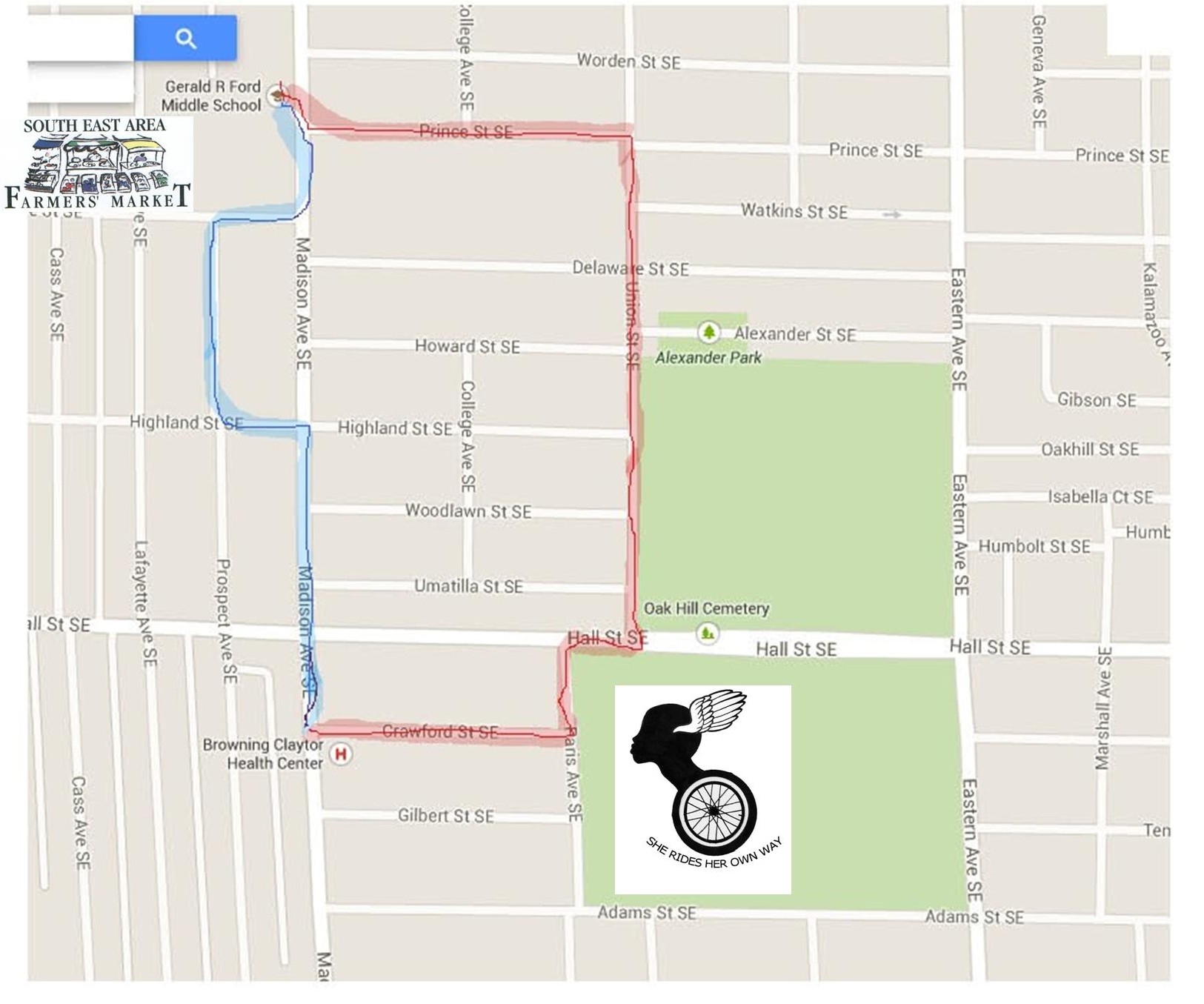
The bike “Ride to Market” starts at 11:30 a.m. Saturday at Browning Claytor Health Center, taking the red route to the Southeast Area Farmers’ Market. After enjoying special activities at the market, cyclists will take the blue route back to Browning Claytor around 2 p.m..

First Lady Michelle Obama’s Let’s Move organization and U.S. Department of Agriculture Secretary Tom Vilsack proclaimed August 3-9, 2014 as National Farmers Market Week. This year marks the 15th Annual National Farmers Market Week recognizing the important role that farmers’ markets play.

The Southeast Area Farmers’ Market is celebrating National Farmers’ Market Week with its Bike to Market celebration on Saturday Aug. 9, in conjunction with the national event sponsored by She Rides Her Own Way. We hope to see our friends and neighbors peddling to the market Saturday!

Let’s Move lists these five reasons to shop farmers’ markets:

  1. Many farmers markets now accept credit cards, SNAP benefits, and other nutrition benefits.
  2. Farmers markets feature what’s at the peak of season in your region, so you can often find your favorites, along with new items that will stretch your culinary imagination.
  3. On market day, farmers love to share their secrets. First among them are tips on how to prepare fresh offerings, so if you need to know what to do with kohlrabi or are looking for something to bump up your tomato salsa, just ask.
  4. Farmers; markets offer a spectrum of colorful fruits and vegetables. They are full of great nutrients, including antioxidants and phytonutrients. The more color variety, the better!
  5. Farmers markets are kid-friendly.  Let your kids pick out something new to try. Then, let them help prepare a meal or choose a snack based on what caught their eye.  These cooking resources for kidscan help, too.