Archives

Gardening where you live

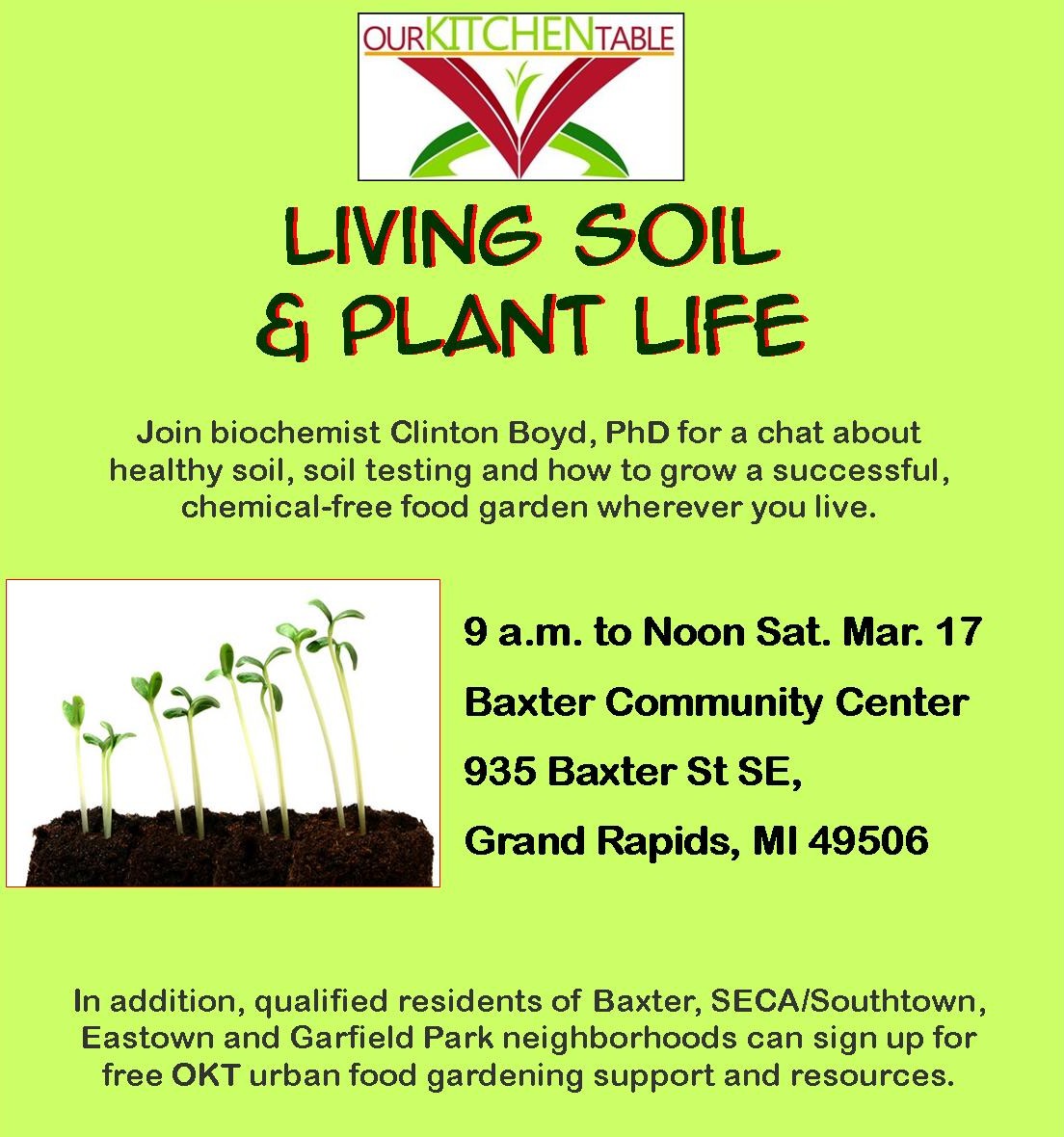
Living Soil & Plant Life
9 a.m. to Noon Sat. Mar. 17
Baxter Community Center
935 Baxter St SE,
Grand Rapids, MI 49506

This Saturday, Our Kitchen Table hosts the garden education workshop “Living Soil & Plant Life.” Join biochemist Clinton Boyd, PhD for an enlightening chat about healthy soil, soil testing and how to grow a successful, chemical-free food garden wherever you live.

Do you live in the Eastown, SECA/Southtown, Baxter or Garfield Park neighborhood?  OKT is looking for more folks to join our yard-gardeners program. OKT yard gardeners are provided valuable gardening resources including organic starter food plants, compost, containers for container gardening, garden tools and a garden coach.

Working with neighborhood folks to grow food in their yards or on their porches and patios is one way to bring more healthy food into our urban communities.

For information on signing up to be an OKT food gardener, email OKTable1@gmail.com or call 616-570-0812.

Take action against proposed changes in Michigan yard waste laws

OKT received this notice from WMEAC
ImageTrash and Burn Compost in 2012? Michigan may soon be disposing of yard waste, such as leaves and grass clippings, in landfills rather than composting facilities if House Bills 4265 and 4266 are passed and signed into law.

In 1995, Michigan banned the disposal of yard waste in landfills, thereby reducing the need for new landfill sites and encouraging greater use of composting, turning yard waste into nutrient rich humus. Organic material such as yard trimmings, food scraps and paperboard continue to make up the largest portion of municipal solid waste in the United States. Of this waste, approximately 13 percent33 million tons per year, is made up of yard waste and trimmings.

Disposing of yard trimmings in landfills wastes resources, reduces recycling, potentially increases greenhouse gas emissions through increased methane production, and costs Michigan jobs. By burying organic waste, nutrients that could have been reused to improve the health of the soil and plants are essentially being locked away.

The methane produced by the anaerobic decomposition of yard waste in landfills is supposed to be harnessed to generate electricity, but it is estimated that approximately 25 percent of the methane generated by a landfill will escape.
Finally, the reduction of yard waste composting will likely cost Michigan jobs. Four composting jobs are created for every 10,000 tons per year of compostable material compared to one job for landfilling or incinerating the same material.

Take Action

Ask your Representative to oppose HB 4265 and 4266 and to instead support programs and policies that increase composting and recycling within Michigan.

Market planning wraps up next week

Planning the farmers’ market. Top, Left to right: Roni VanBuren (OKT), Tom Cary (GGRFSC), Lisa Oliver-King (OKT), Lila Cabbil (Rosa Parks Institute), Beverly Weathersby (OKT), Sheri Munsell (OKT), Jill Myer(KCHD), Bottom, left to right: Cynthia Price (GGRFSC), Candace Chivis(GGRFSC), Yvonne Woodard (OKT) and Leslie Huffman (OKT).

The three partners sponsoring the Southeast Area Farmer’s Market (SEAFM) are wrapping up their planning sessions next week. The partners include Kent County Health Department (KCHD), Greater Grand Rapids Food Systems Council (GGRFSC) and Our Kitchen Table (OKT). OKT has taken the lead management role for the farmers’ market. Grant dollars from the Kellogg Foundation pay for the OKT staff managing and promoting the market as well as for the seeds that are being planted this week in the greenhouse. Many of the starter food plants grown from these seeds will result in food harvested and sold at the market by neighborhood growers.

It has been a long, sometimes tedious and often intense process—a process that has often come smack up against the institutional racism that has led to food insecurity in urban neighborhoods across the nation. OKT surveys of neighborhood residents have shown that, contrary to some experts’ beliefs, Grand Rapids’ southeast neighborhoods are not food deserts. Many folks are growing their own food in their yards or in community garden plots.

However, many more do not have access to a wide range of healthy foods as corner stores and fast food restaurants remain major food sources—and they often offer foods that lead to obesity, diabetes, heart problems and, among children, behavior issues.

That’s why this farmers’ market is so important. Everyone, no matter what their income level or which neighborhood they live in, deserves access to safe, fresh local produce and other health-giving foods. Ultimately, the Southeast Area Farmers’ Market belongs to people in our neighborhoods. Please come on board as an additional partner in the market! Not a silent partner—spread the word that fresh food is coming back to the neighborhood this June. And feel free to tell OKT what we can do better to make the market truly belong to community.

Free webinar explores neurodevelopmental effects of chemical exposures in children

On March 14, a free webinar, “Neurodevelopmental outcomes in children associated with chemical exposures occurring early in life” will be presented by  Amir Miodovnick, MD, MPH, DTM&H (Pediatric Environmental Medicine, The Mount Sinai School of Medicine). The webinar takes place from 3-4PM EST.

OKT’s collaborative partner Dr. Clinton Boyd  serves as the technical director for this effort which is a part of the state-funded Michigan Green Chemistry Clearinghouse. “As part of the Clearinghouse’s mission, we are trying to bring information on green chemistry to multiple audiences including: education sector, industry, government, not-for-profits and the public.” Boyd says.

If there is interest, OKT is considering setting up a venue where attendees could gather and listen. For information and registration (after March 1), visit  www.migreenchemistry.org.

Renters Rights, Foreclosure Fights Potluck Discussion at The Bloom Collective Saturday

12:00pm until 2:00pm
Saturday, February 25, 2012

At The Bloom Collective
Steepletown Center
671 Davis NW
Grand Rapids
(Corner of 5th & Davis)

Learn about your rights during this lively discussion about renters rights, the housing foreclosure crisis as well as some creatives ways that people are resisting being evicted and abused by landlords around the country. We have invited guests who work on these issues, but we welcome all ideas and perspectives on how to stand up for everyone’s right to descent housing.

This is a potluck event. We invite to to bring food to share and the Bloom Collective will make sure there are vegan food options. This event will go from noon until 2pm.

~Our Kitchen Table shares space with The Bloom Collective in Steepletown Center.

MLive uncritically looks at GRCC farmer certification program

This article was originally posted on GRIID.

Last week,  MLive posted a story by reporter Brian McVicar, which promoted a new program by the Grand Rapids Community College that seeks to assist local farmer obtain certification and allow them to sell to larger food distributors.

The article states that GRCC is offeringGood Agricultural Practice (GAP)certification classes to area farmers who want to expand their sales beyond farmers markets. Nowhere in the story does the reporter question the premise of the project, which seems to be shifting food sales from farmers markets to involve food marketers and food brokers. The article does not include voices that would suggest that farmers markets are the best mechanisms for promoting local food.

The only sources cited in the article are the director of work force training at GRCC and someone with the MSU extension, which is one of the partners in this project.

However, the article omits the other partners in this project, which according to GRCC are Sysco, Walsma Lyons and Morse Marketing Connections. The MLive story does mention Sysco, but not as a partner.

Understanding who the partners are in this project makes all the difference in the world. Sysco, Walsma Lyons and Morse Marketing Connections do not grow food, they only distribute and market food products. These entities also have a long history of being food brokers and marketers with an emphasis that is not on the local. For instance, Walsma Lyons states they offer access “to a large global network of preferred suppliers.”

Morse Marketing Connections, “originally worked with Michigan-based agricultural groups and has expanded nationally, now working in multi-sector partnerships across a variety of food-related initiatives, with government agencies, private and public universities and corporations.” Sysco, while it has a Grand Rapids office, is one of the largest food distributors in the US.

What the MLive reporter failed to acknowledge or investigate is that when companies like Sysco get involved in purchasing from local growing’s, particularly small farmers is that they then exert tremendous influence in what those farmers grow. The reason being is that Sysco and other food brokers operate on volume, which means they not only are likely to determine food prices, they sometime can determine what farmers grow, based on “the market.” If a small blueberry farmer begins to sell their product to companies like Sysco they are submitting themselves to an unstable market that is often determined by what Sysco other food distributors can market around the country or around the global. This means that when a crop disaster happens anywhere else in the world it can impact the sales of food grown locally that are now in the global market because of their relationship to companies like Sysco.

This topic was explored briefly in the film Food Inc., but is better explained in Raj Patel’s book Stuffed and Starved: Markets, Power and the Hidden Battle for the World’s Food System.

If the local news media is going to report on local programs that are supposed to “assist” area farmers, then they need to ask important questions about the commercial partners in this project and what it really means for farmers and the public.

Stabenow continues to support Farm Bill subsidies to agribusiness

This story is reposted from GRIID.

Last week, Michigan Senator Debbie Stabenow announced that the Agriculture, Nutrition and Forestry Committee will be holding four hearings over the next month on the 2012 Farm Bill.

The four hearings will cover the following topics: Energy and Economic Growth for Rural America; Strengthening Conservation through the 2012 Farm Bill; Healthy Food Initiatives, Local Production; and Nutrition and Risk Management and Commodities in the 2012 Farm Bill.

The announcement also says, “Witnesses, times and other specific hearing details to be announced.” This clearly suggests that Stabenow and the other Committee members have selectively invited people to address the committee, which if it follows the same pattern of the Michigan Farm Bill hearing from 2011, then all the “witnesses” will be representatives from Agri-business.

The selection of who will no doubt be speaking at these hearings could also be deduced by looking at who the major campaign contributors are to Senator Stabenow, who is in the midst of a re-election year. Several of the top 20 contributors for the 2012 election are from the agribusiness sector.

A third indicator on who might be speaking at the upcoming Ag Committee hearings is reflected in whom Senator Stabenow has recently provided taxpayer subsidies.

On February 3rd, Stabenow announced that several Michigan food suppliers would be receiving federal funding. All four recipients will be using the “grant” money to“develop marketing strategies for agricultural commodities.” The four businesses are producers of beet sugar, chocolate & yogurt-covered blueberries, fruit wines and bio-based chemical products. Interesting, since none of these products seem like essential food staples and that promote better nutrition. Indeed, all four products seem to be specialty items that will all be fairly pricey and target more upscale consumers. This is what your tax dollars are being used for……..to advertise luxury food items to upscale consumers.

Kids’ contest challenges childhood obesity

Blue Cross Blue Shield of Michigan invites students in grades 4 through 8 to participate in the “Make the Play for Healthy Habits: A Kid Contest for a Healthier Michigan.” The contest gives a voice to Michigan students on the topic of healthy lifestyle choices, including eating and exercise. The winner will receive a school assembly with Detroit Lions quarterback Matthew Stafford and will become a featured vlogger (video blogger) on BCBSM’s site, AHealthierMichigan.org!

To enter, students will be prompted to share their ideas on a healthy lifestyle, which can include themselves, their family and even classroom. They will submit a short video answer to the question: “How would you make Michigan healthier?”
Videos must be submitted by March 25, 2012 at midnight (11:59:59 PM ET)  to www.ahealthiermichigan.org/kidcontest.

More information for teachers and parents including official contest rules and more can be found at www.ahealthiermichigan.org/kidcontest. For official contest rules, please visit http://www.ahealthiermichigan.org/kidcontest/terms.html.