Archives

Grand Rapids Press runs story on Greens Cook-Off & Fried Green Tomato Festival

mlive.com

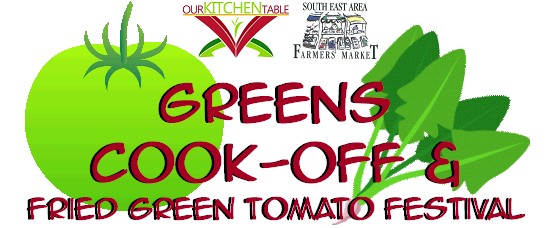
Cook-off to celebrate green living, Grand Rapids diversity

Published: Wednesday, November 02, 2011, 8:37 AM
Mary Hefferan | The Grand Rapids Press By Mary Hefferan | The Grand Rapids Press 

Jack Frost is dishing up a green weekend.

A Greens Cook-Off & Fried Green Tomato Festival Friday and Saturday will celebrate the last unripe fruits clinging to frost-bitten tomato plants and the sturdy collard and turnip greens that thrive in chilly autumn.

Celebrating culture, food
The contest, sponsored by Our Kitchen Table’s Food Diversity program, is part of a grass roots movement celebrating the culinary heritage of people living in various parts of Grand Rapids. The nonprofit organization works with Grand Rapids residents who want to grow organic produce on their property.

After holding community meetings to find out what people wanted to grow, Our Kitchen Table distributed 20,000 organic seedlings to residents of four Grand Rapids neighborhoods. A “garden posse” of volunteers trained the neighbors on how to cultivate and care for the plants. Besides feeding their families with the produce they grow, neighbors can sell it at the Southeast Area Farmers Market.

Recipient of a W.K. Kellogg Foundation grant, Our Kitchen Table teams with the Kent County Health Department and the Greater Grand Rapids Food Systems Council to promote environmental action and food security in Grand Rapids.

Collaborating with the Southeast Area Farmers Market is one arm of its outreach; another is lobbying for fruit trees to be planted on city-owned land.

IF YOU GO

Greens Cook-Off & Fried Green Tomato Festival

When & where: 
• 5-7 p.m. Friday, Gerald R. Ford Middle School Market, 851 Madison Ave. SE
• 9 a.m. to 1 p.m. Saturday, Garfield Park Farmers Market, 334 Burton St. SE

To register: Call 570-0218, email OKTable1@gmail.com or show up with your dish. No preparation facilities are available.

More details: Prizes awarded in each cook-off category. Chef Nancy Rutledge will provide cooking demos with free samples. Free to participants and visitors. For more information, visit OKTjustice.org.

RECIPES

• Fried green tomatoes with cream gravy

• Chef Nancy Rutledge’s collards and tomatoes

• Chef Nancy Rutledge’s green tomato cake


Rally for Fair Farm Rules 4 p.m. Thursday at Calder Plaza

Rally for Fair Farm Rules
Calder Plaza, Grand Rapids, MI
4:10 p.m. Thurs. Nov. 3

On Thursday, Food & Water Watch urges people from Kalamazoo and Grand Rapids are gathering at Grand Rapids’ Calder Plaza to ask Senator Debbie Stabenow to support the Fair Farm Rules and Michigan’s small farmers. Stabenow, the Chair of the Senate Agriculture Committee, has so far refused to take a stand on the issue despite the fact that over the past two months, community members in Grand Rapids and Kalamazoo have gathered more than 2,500 postcards urging her to support the Fair Farm Rules.

The Fair Farm Rules prevent meatpackers from giving undue preference to large factory farms, which put small independent producers at an economic disadvantage. The new rules would:

  • Stop price premiums and secret preferential contracts granted to cattle and hog factory farms.
  • Prevent one buyer from representing multiple meatpackers at an auction. This practice effectively eliminates competitive bidding on livestock, which hurts small-scale producers.
  • Prohibit retaliation against poultry growers who speak out about abuses.
  • Protects poultry growers who make expensive upgrades and investments and prevents companies from requiring growers to make expensive upgrades to their facilities if they are in working order.

Michigan consumers and the environment lose out as small and midsize farmers are pushed out of business. We are left with fewer options for grass-fed and free range meat and poultry products as well as less access to meat, milk and eggs that are free of antibiotics and artificial hormones.

In addition, factory farming takes a terrible toll on Michigan’s environment and waterways. And, it’s only humane to agree that animals farmed for our meat, milk and eggs should be allowed to live lives free of the constant pain, darkness and social isolation that is the norm on large factory farms. As small farms disappear, so will humane conditions for a growing majority of our fellow creatures.

The 2008 Farm Bill included new reforms to protect small and midsize livestock farmers, but those reforms are being blocked by a handful of large companies that dominate the meat and poultry industries.

Over the past five years, nearly 27,000 midsize independent family farms have been driven out of business nationally. Those remaining are squeezed by a market that favors big agribusinesses.

In June, Senator Stabenow hosted a public hearing on the Farm Bill in East Lansing that mostly involved Michigan based agri-business and agri-business associations. These entities and the clients they represent have been the recipient of billions in subsidies in the past 15 years as has been well documented by theEnvironmental Working Group.

Southeast Area Farmers’ Market Open ‘til Nov 12

The antioxidants that give fresh fruits and vegetables their brilliant colors protect the aging memory.

During the past few weeks, both Southeast Area Farmers’ Market locations have enjoyed heavy traffic. In fact, Market Manager, Yvonne Woodard, has had a real challenge closing the market on time—there are simply too many customers stopping by to shop for fresh, chemical free produce.

In addition, Our Kitchen Table, the group in charge of the market locations this year, just found out that that Senior Project Fresh Coupons do not expire until November 12. So, the markets will stay open an extra week to honor those coupons.

So often, we hear the message that children need to eat their vegetables. However, eating healthy is just as important for senior citizens. Your body’s basic nutrition requirements do not decrease as you get older. In fact, you may require even larger amounts of certain nutrients as you grow older.

The antioxidants that give fresh fruits and vegetables their brilliant colors protect the aging memory and may help prevent Alzheimer’s. The vitamins in found in fresh produce protect the heart. You’ve heard the joke about rabbits not needing glasses because they eat carrots. Well, it’s true! The vitamin A found in carrots helps protect your eyesight.  Other nutrients found in a wide range of produce also help prevent vision problems in older folks.

Asthma, diabetes, kidney disease and cancer can all be addressed through eating a diet that includes fresh fruits and vegetables. It may seem confusing to figure out how much you need of each fruit or vegetable to prevent each specific ailment that comes with aging. So, don’t. Just be sure to include many servings of fruits and vegetables in your diet every day.

Where’s the best place to get your fresh produce? The Southeast Area Farmers’ Market, of course!

  • Gerald R. Ford Middle School, Fridays 5 to 7 p.m.
  • Garfield Park, Saturdays 9 a.m. to 1 p.m.

Bicycle Tour of Fruit and Nut Trees a fun and informative ride

Though far from perfect in appearance, apples foraged from untended urban trees have a delightful flavor unmatched by most store-bought fruit.

Last Saturday, a dozen or so folks met in Eastown for OKT’s Bicycle Tour of Fruit and Nut Trees. Sunny skies, comfortable temperatures and a brisk breeze made for a lively, enjoyable ride.

Seasoned cyclist, Josh McBryde, planned the route and led the tour across Wealthy Street and over to Cherry Park. On the way there, tree expert, Laura Cassaletto, pointed out various trees and their edible uses, bringing the group to its first stop alongside an old apple tree, full of ripe fruit, outside of a two-flat apartment house.

After assuring us that she had gotten permission from the property’s owner, Laura invited everyone in the group to pick and enjoy an apple. She mentioned that the tree’s owner had told her that the apples were not good for eating as they had not been sprayed with pesticides. The group broke into laughter. And, with a close eye for worms,we took bites of the “imperfect” fruit. All were amazed at the incredible flavor these small, old fashioned, untended apples offered.

Laura recommended foraging such untended apple trees around the city. She likes to use them for applesauce. When the apples are put through the food mill, it’s easy to pick out any critters that might have eaten their way inside the fruit.

In Cherry Park, the group identified different varieties of nut trees, scavenged nuts from off the ground and even cracked and ate a few. Heading back across the neighborhood, a stop near Diamond and Cherry yielded a look at mulberry trees (already done fruiting) as well as locust trees. Seasoned urban forager, Richa, shared that the spring flowers from the locust tree are delicious. (At the conclusion of the tour, he shared a loaf of his homemade acorn bread).

Crab apples, yes.

Along the route, Laura pointed out that ornamental crab apple trees have edible fruit. She explained that crab apple trees are related to the rose, and like the rose, are edible. High in vitamin C, their edible fruit can be identified by the “crown” at the bottom of the fruit. While fruit with a crown is edible, she warned not to forage white fruit and berries, “White is the color of death.”

She also advised us to try new foraged fruits and nuts in small quantities to see how our own body reacts to it. Because trees, like people, are individuals, the fruits and berries eaten from them have differences in flavor and in how they align with each individual person’s digestive system.

Bittersweet, no.

In Wilcox Park, the group snacked on plump wild grapes and tried edible, though bitter, viburnum berries. We also learned that the colorful bittersweet nearby was just for decoration and not an edible.  The group ended its tour at Aquinas College, where Josh handed out tree identification maps the college provides to visitors. We stopped to gather, crack and snack on beech nuts beneath an elephantine beech tree.

A 16-year-old on the tour remarked, “It was so cool to learn that if I had to, I could get enough to eat from nature.” Cool indeed. Food is growing all around us. Let’s learn to appreciate it!

OKT to join panel after DIVE screening Monday

DIVE! Living Off America’s Waste Screening and Panel Discussion
Monday, Oct 17 at 6pm
Loosemore Auditorium, Downtown Pew Campus , GVSU
 Grand Valley State University is screening the documentary, Dive! Living off America’s Waste as part of the GVSU Campus Sustainability Week activities.
         Two OKT team members, Lisa Oliver King and Inez Adams, will take part in the panel discussion after the screening. Other panelists include:
  • Timothy Vatterott of the film DIVE! Living Off of America’s Waste
  • Elianna Bootzin of Feeding America West Michigan
  • Emma Rosauer of Access of West Michigan
        The screening is free and open to the public.

Slavery: A 21st Century Evil: Food chain slaves

This post is from Aljazeera. You can watch the 25-minute video episode here.

In the opening episode of Slavery: A 21st Century Evil, Al Jazeera’s Rageh Omaar investigates food chain slavery, considered the easiest form of slavery to stamp out, in the US.

The US has been leading the global fight against modern slavery. But, according to conservative estimates, there are between 40,000 and 50,000 slaves in the US today.

So in this episode, Rageh questions why a nation built on the abolition of slavery – a country that had to go through a painful civil war to formally bring an end to slavery – is failing to address the problem inside its own borders.

The investigation begins in the poor villages of Thailand, where agents for the US slave masters trick desperate peasants with promises of well-paid jobs abroad.

But far from fulfilling their American dream, many end up in slave labour farms in Hawaii, California and Florida – unable to return home and working to pay off the debts they incurred in the pursuit of a better life for themselves and their families.

Produce means more than Fruits and Vegetables

In addition to providing Vitamins A, C, K and folate, parsley is a chemoprotective food that can help neutralize some carcinogens.

When shoppers come to the Southeast Area Farmer’s Market, they love stocking up on in-season fruits and vegetables. Tomatoes, squash, collards, kale are still in season while Michigan apples and peaches are making a popular appearance. But that’s not all! At least two of the markets’ regular vendors sell herbs every week.

While many people think of herbs as simply an added dash of flavor, fresh, chemical free herbs, like those sold at the market, actually offer health benefits as well. 

Cut salt without cutting flavor

Folks with high blood pressure, heart trouble or edema often have trouble saying no to salty foods. Most of the salt we eat comes from fast food, packaged foods and canned foods, like soup. The first step to controlling salt in the diet is to eat more foods that you prepare for yourself from scratch. The next step is to use tasty herbs to add flavor to your dishes. Add a little fresh basil, rosemary, chives or dill!

Add vitamins, minerals and antioxidants to your diet

Basil gives you Vitamins A and K, calcium and iron. Peppermint leaves not only aid digestion, but, as shown in new studies, help protect against cancer and fight off bacteria. Dill is a another source of calcium that also helps protect you from cancer-causing  benzopyrene found in cigarette smoke, charcoal grill smoke and the smoke produced by trash incinerators. The list goes on! Chances are scientists haven’t even discovered all the benefits that fresh herbs bring your way.

While fresh herbs may be out of season soon, you can stock up on these and the other herbs our vendors sell two ways.

  • Dry the herbs by hanging then upside down in a place away from fresh sunlight. Package in an airtight container or freezer bag.
  • Chop fresh herbs and mix them with olive oil. Freeze the mixture in an ice cube tray. Remove the cubes to a freezer bag for individual use as needed.

Both Southeast Area Farmers’ Market locations are open through Nov. 6.

  • Fridays 5 to 7 p.m.  At Gerald R. Ford Middle School.
  • Saturdays 9 a.m. to 1 p.m. at Garfield Park.

You can use your Project Fresh, Senior Project Fresh, WIC or Kent County Health Department coupons for produce at either Southeast Area Farmers’ Market location. We also accept EBT/Bridge Cards and participate in the Double Up Food Bucks program.

Saturday! DIY Backyard Greenhouse/Hoophouse Workshop

3 – 5 p.m. Saturday Oct. 1
Meet at Eastown Community Association, 415 Ethel SE

Our Kitchen Table invites you to extend your food garden’s growing season into fall and winter! This free, DIY workshop keeps your costs down and your garden yields up.

We will meet outside of Eastown Community Association, 415 Ethel SE (just south of Wealthy Street) and walk to the home of urban food gardener and our presenter, Taylor Voss.

Nobel Peace Prize Winner Wangari Maathai Dies at 71

This obituary reposted from Democracy Now

Wangari Maathai, the first African woman to win the Nobel Peace Prize, died Sunday after a long struggle with cancer. She was 71 years old. In 1977, she spearheaded the struggle against state-backed deforestation in Kenya and founded the Green Belt Movement, which has planted some 45 million trees in the country. She has also been an outspoken advocate for women’s rights and democratic development. She won the Right Livelihood Award in 1984. Twenty years later, she won the Nobel Peace Prize.

This writer posted the following Indy Media story after Maathai’s 2007 visit to Grand Rapids. 

Wangari Maathai at Fountain Street Church

“Every one of us needs ten trees to take care of the carbon dioxide we breathe out. We should know where our ten trees are. Or, are you using somebody else’s trees?” Wangari Maathai

2004 Nobel Peace Prize laureate, Wangari Maathai opened her lecture with observations on the biblical creation story as told in the book of Genesis. She noted that every day, after making another aspect of the environment, the creator commented, “It is good,” except for the last day, the day humanity was created. “We have convinced ourselves we are more important than the rest of creation,” Maathai said. “But, we cannot live without trees. They can live without us.”

Maathai believes that because we have higher intelligence, we have a moral responsibility to ensure that other species survive. She applied that belief in Kenya, where as a young biologist she was studying the tic’s role in East Coast Fever, a fatal epidemic killing hybrid cattle. Her fieldwork led her to observe that Kenya’s environment had been degraded. Because of deforestation upstream, fertile topsoil was filling the rivers as silt; rainwaters were washing away into lakes and the ocean instead of returning to groundwater reservoirs; and, rivers were beginning to dry up.

“This was much more dangerous than the tics,” she said.

Then, in 1975, her work with the National Council of Women of Kenya opened her eyes to the serious issues facing Kenya’s women: they did not have enough wood for household energy; they did not have clean drinking water; they did not have nutritious food; they had no ways to generate income. Maathai’s solution “Let us plant trees.”

“We went to the foresters and asked, ‘Can you teach us how to plant trees?’ This is difficult when the people are illiterate and a professional tried to teach you. To cut a long story short, we teach ourselves, use our common sense, our woman sense. Forget the foresters. We started teaching ourselves how to grow trees.”

Much of Kenya had been clear-cut; the British had introduced pines and eucalyptus that drank too much water and dried out the land. “We wanted to restore indigenous vegetation, biodiversity. It’s a campaign we are till carrying out,” she shared.

Maathai encouraged groups of women to plant trees “whichever way.” The women collected native seeds, planted them in all sorts of cast-off containers and nurtured the seedlings till transplanting them. The women earned money for each seedling planted, generating income for themselves. The new forests help provide wood for energy and stifle the erosion that has robbed farms of topsoil and rivers of clean water. The women taught other women how to be “Foresters without Diplomas.” Today, Kenya has more than 7,000 tree nurseries run by these women.

Though more than 30 million trees have been planted in Kenya, Maathai’s work is not done. When she began in the ’70s, 30% of Kenya was covered by forests. Only 2% is today. However, her work with the women became a catalyst for another change. As the women empowered themselves, and the people found their voices, many spoke out against Kenya’s dictatorial regime.

“If you do not live in a society that is democratic, that allows a minority voice to be heard, it is difficult to protect the environment,” Maathai said. “The freedom of movement. The freedom of assembly. The freedom of expression. The freedom of the press. You have all these freedoms. In a society like yours, you take for granted. When you are at their (the government’s) mercy, they are very pleasant. When you are free, you become troublesome.”

“To cut a long story short,” Kenya became a democracy in 2002; Maathai serves in parliament and as Assistant Minister for the Environment. But, she does not advise people to wait on their governments to take care of the environment.

“We can plant trees. Anybody can dig a hole. Plant a tree in that hole. Water it. Make sure it survives,” she said. “The government is the custodian of the environment. If the custodian is not doing his job, you fire him during elections.”

Today in Kenya, Maathai has undertaken a campaign to reduce the proliferation of plastic bags and packaging that is polluting Kenya’s cities, impacting its wildlife and creating an untold number of breeding puddles for malaria-infected mosquitoes. She is also working with the United Nations Environment Programme (UNEP) as Goodwill Ambassador for the Congo Basin Forest Ecosystem project–the goal, to plant one billion trees. She invited the audience to visit the Web site and get involved in the project. The Conga Forest, Amazon Forest and the South East Asian Forest are an important defense against the climate change that impacts all of us.

“It is the rich nations who really have to understand that, although the resources look like a lot around you, they are coming from people who are impoverished,” Maathai said. “Sooner or later, there will be conflict and it will affect us.”