Archives
9-17 Urban Foraging Workshop introduced shared skills
Last Saturday morning, a group of about 20 folks gathered at Garfield Park during the Southeast Area Farmers’ Market for an Urban Foraging Workshop, co-sponsored by Our Kitchen Table and The Bloom Collective.
The presenter who was to lead the event had a family emergency so the workshop turned into a skill-share. People in attendance shared how they used various wild medicinal and edible plants (commonly called weeds). Here are a few of those:
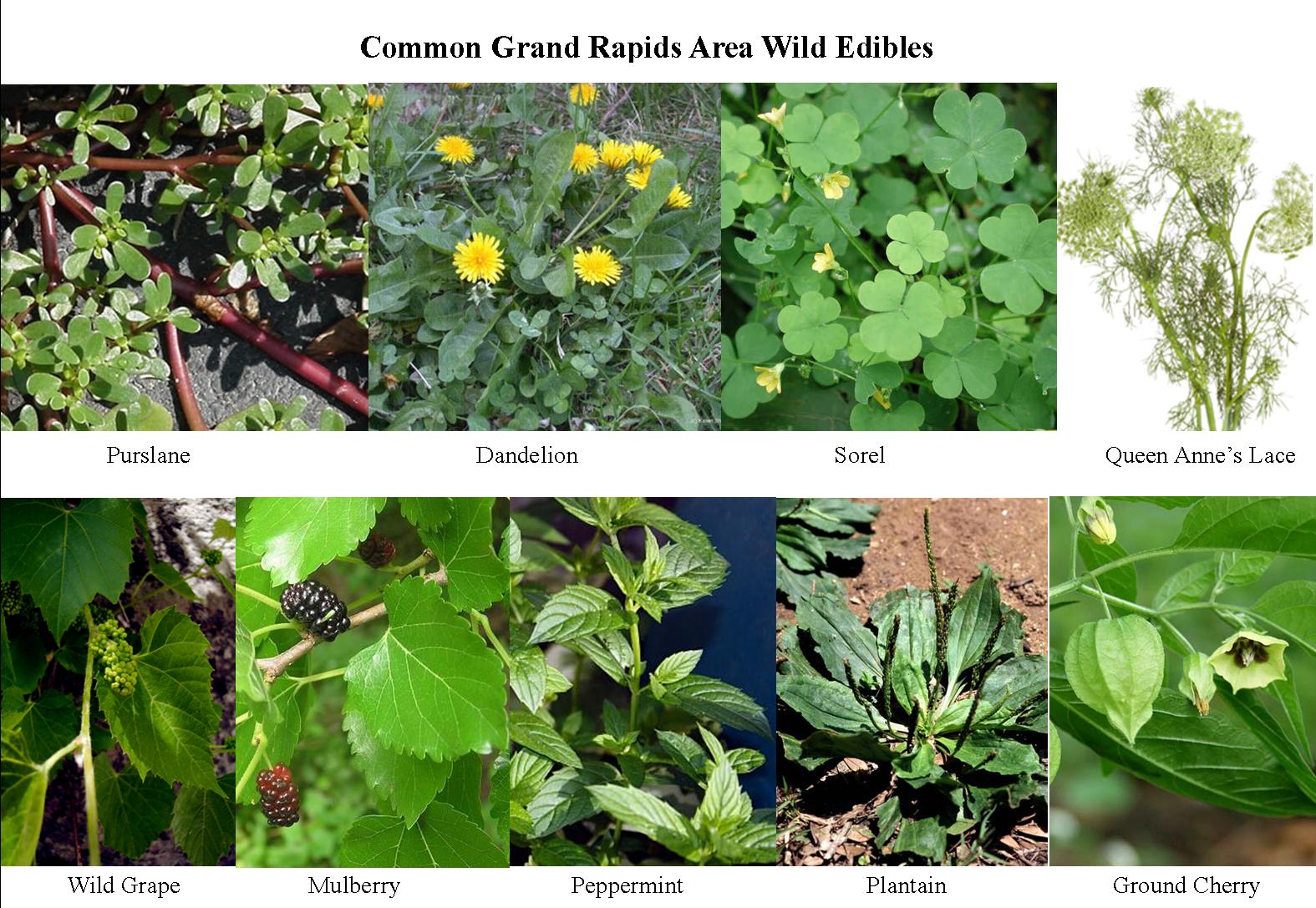
- Purslane—a delicious salad green
- Dandelion – use as a salad green; brew as tea that for a good kidney tonic; use the root as a coffee substitute. The flowers are also edible.
- Sorel – a lemony tart salad green.
- Queen Anne’s lace – Deep fry the flowers; the seeds brewed as tea have traditionally been used as a contraceptive among indigenous peoples.
- Wild grape and mulberry leaves – use to wrap rice and meat mixtures, think Middle Eastern cuisine.
- Mulberries – a summer fruit that makes a great snack and a delicious jelly or jam.
- Peppermint – brew as tea to settle an upset stomach; chew a leaf instead of a breath mint.
- Plantain – the leaves can relieve insect bites and bee stings. Roll and crush the leaf, apply it to the sting, use a whole leaf as a “band-aid” to hold the crushed mixture in place.
- Ground cherries – found inside the tomatilla like flower, these are a semi-sweet treat that can be used for jams and jellies as well.
We were also fortunate to have Kristin Tindall, ecology education coordinator from Blandford Nature Center, in attendance. She had lots of good information for the group and let us know that Blandford sometimes hosts foraging workshops.
Kristin also mentioned that a foraging club is forming. The club will be able to provide an ongoing shared experience that will help members to broaden their skills for finding foods and medicinal herbs in their backyards, local parks, parkways and abandoned lots. Kristin also shares this Wild foraging handout.
A word to the wise: When foraging, make sure you are picking plants from an area that has not been chemically contaminated. For example, Tindall shared that utility companies usually spray a swath of herbicides under electricity towers.
Just like the grocery stores have helped us forget that food comes from farms, cultivation of domestic crops has helped us forget that many of the native species we see around us (and label as weeds) once were a prize source of both food and medicine. Let’s learn how to take advantage of the free foods growing all around us.
Dennis Livingston, activist and artist, dies
An early voice for urban jobs creation, he was a pioneer at Station North Arts District’s Cork Factory.
Dennis Livingston, an urban activist who called for jobs creation and a clean environment and who was a pioneer in the Station North Arts District near Green Mount Cemetery, died of cancer Thursday at Gilchrist Hospice Care. He was 72 and lived onGuilford Avenue.
“There were those who came out of the 1960s who lost their vision for social change, but Dennis was not one of them,” said Joseph McNeely, director of the Central Baltimore Partnership. “He just stayed there and said we can do better. He kept finding new places in Baltimore to insert his vision.”
Born in Chicago and raised on Long Island, N.Y., he attended Washington College and received a bachelor’s degree and master of fine arts degree from Ohio University in Athens. Friends praised his woodcuts of Baltimore as well as his pen and ink sketches. He also headed a business, Social Graphic Co., where he designed and published books and manuals.
He was active with the Black Panthers in the 1960s in Washington and with Abbie Hoffman in the Yippie movement.
Friends said Mr. Livingston was a highly skilled carpenter. After moving to Baltimore nearly 40 years ago, he founded South Baltimore Woodworkers, a contracting business. He renovated homes in Federal Hill and around Patterson Park. He also helped build the first Pride of Baltimore.
“Dennis worked without fanfare and was one of the most principled persons I have ever met,” said a friend, Michael Seipp, who lives in Lauraville. “He had a credo. He believed in democracy and for the guy on the bottom. He believed strongly that everyone should have the opportunity to lead a quality life.”
He formed the Baltimore Jobs in Energy Project to train low-income residents to get jobs in weatherization, energy conservation and, in later years, lead-paint abatement.
“He was always happiest wearing a tool belt or designing a graphic presentation of complex ideas,” said Ron Halbright, a co-worker at Jobs in Energy. “Dennis was a unique combination of community, environmental and labor visionary, hands-on master carpenter and trainer and day-to-day neighborhood activist.”
In the 1980s, Mr. Livingston was also a vice president of South Baltimore’s Coalition of Peninsula Organizations and backed a plan to build affordable co-operative housing along Riverside Avenue.
“He believed, early on, we can rebuild our economy by retrofitting buildings to save energy,” said a friend, Tom Chalkley, a cartoonist and social organizer. “He lived an unbelievable full life. He … wasn’t afraid of anybody.”
Friends said Mr. Livingston observed that Baltimore artists were renting unfinished loft studios in old industrial buildings near Pennsylvania Station. About 15 years ago, he and others spent $200,000 for a rundown former division of the Crown Cork and Seal Co. at Guilford Avenue and Federal Street. They called the structure the Cork Factory. He was a leader of its conversion into apartments.
Mr. Livingston also became an advocate for low-income residents living in the Greenmount West neighborhood adjacent to his home.
“One way is to get rid of the poverty,” he told a City Paper reporter in 2003. “The other is to get rid of the people.”
Friends said that he constantly reminded city officials of the importance of keeping housing affordable and livable for the residents there.
“When Dennis believed in something, he went all the way,” said a friend, Mylo Celsy, director of the Baltimore Trades Guild.
Mr. Livingston has been a member of the United Brotherhood of Carpenters and Joiners since 1972. He had served on the boards of directors of the Loading Dock, Baltimore Employment Network, Maryland Citizen Action, Women Entrepreneurs of Baltimore and South Baltimore Home Maintenance Program.
“Dennis brought incredible energy, joy and creativity to anything he did, whether it was politics, art or just family dinners. He turned the chore of wrapping Christmas presents into an opportunity to be creative. … On Christmas morning, it looked like a sculpture garden under our tree,” said his stepdaughter, Timi Gerson of Washington.
Food Charity or Food Justice: Part II
(Another thought provoking post from GRIID.org)
Last week we pointed out the problem with local journalists in their attempts to try to live off a fixed food budget as part of the Hunger Challenge Week in Grand Rapids.
We pointed out that their investigation should have focused on looking at the causes of hunger in West Michigan, instead of engaging in an exercise that, while well intentioned, did not actually look at addressing hunger.
Today, MLive ran a story about a local program that addresses hungry children, called Kids Food Basket. In that story, both the director of the organization, Bridget Clark Whitney, and board member Mary Ann Prisichenk both make statements that the organization is not interested in politics or the causes of poverty……..they just want to feed hungry kids.
Whitney is quoted as saying; “There are a variety of socioeconomic factors that come into play with kids and hunger, but … the bottom line is that kids need to get fed. What we say we will do — and we are doing — is attacking hunger.”
Attacking hunger is the agency’s catch phrase, which can be seen on its website over and over again. The agency acknowledges that hunger and poverty are a problem in the Grand Rapids area, citing the statistic that “36,860 children living in Kent County are food insecure.” The charity agency also noted that, “From 2000 to 2008, Grand Rapids had the largest spike in poverty among any US city at 8.9%.”
In the “why” section of their website the agency also states that nutrition is the basis of brain development and Childhood hunger is a national priority that must be addressed at the grassroots. Both of these statements are important, but it is the latter, which I think it is important to address.
First, let me just state upfront that the fact that Kids Food Basket feeds hungry children is important in that it does a form of triage work, where an immediate need is met. However, if our community is serious about attacking the problem of hunger, it is essential that we get the root of the causes of why 36,860 children in Kent County don’t have enough healthy food to eat.
Every year there are major food drives in this city. People through churches, businesses and non-profits donate food for the food bank system. Thousands of people volunteer at the soup kitchens and deliver meals to shut-ins and other vulnerable populations, along with the kind of work that Kids Food Basket does. These activities can help put a human face on hunger and often will make us feel good that we in some small way made a difference.
However, if we never get to the point of asking the question of why 36,860 children in Kent County don’t have enough to eat on a daily basis, then we are ultimately doing them a disservice. The number of children in poverty is clearly on the rise and there is no sign that this trend with change. In fact, it is likely that the number of children living in poverty and going hungry will increase, since at the local, state and federal level there are ongoing funding cuts for social programs and a drum beat from politicians on the need to implement further “austerity measures.”
If attacking hunger means that we just feed hungry children then we might as well just plan on doing this the rest of our lives and finding a whole lot more people to do it with us. If, however, we want to end hunger then we will have to look hard at both our economic system and who has wealth in this society. As Raj Ratel and many others in the food justice movement will tell you, the current food system and economic system are designed in such a way that lots of people will be malnourished.
We need for the people at the Kids Food Basket to keep feeding hungry children, but we also need for them and all the other agencies, which do food charity work, to begin to come to terms with the causes of childhood hunger. Once we have collectively wrapped our heads around those causes we can then develop a strategy to really attack hunger by eliminating it.
Some of this strategy might include challenging the existing system of food production in the US knows as agri-business. In this system food is grown as a commodity to be traded and not as a form of sustenance for all people.
One way to take on the agri-business system would be to have a real grassroots effort to alter federal funding it what is known as theFarm Bill. More importantly, we need a mass movement to take food production out of the hands of corporations and into the hands of regular people.
In order for these more systemic changes to take place we need to have a serious public conversation about hunger and food justice. If then, we are serious about eliminating hunger in our community we need all those who do the food charity work to support and endorse food justice work. Food justice work may not be as popular and it is in many ways work that is much more difficult to do. In fact, we can count on systems of power that will resist those efforts, but I for one think it is a much nobler goal to end hunger than to perpetuate its existence because we didn’t ask why people were hungry. As the great Brazilian Bishop Dom Helder Camera once said, “I brought food to the hungry and people called me a saint. I asked why people were hungry and people called me a communist.”
OKT supports local Fair Food initiative
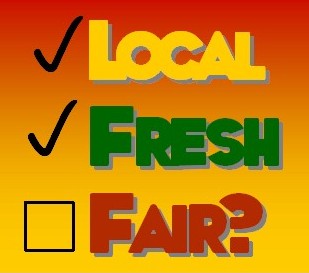
If you’ve been to the Southeast Area Farmers’ Market or an OKT event, we may have asked you if you wanted to sign the petition supporting the Local Fresh Fair Fair Food initiative. Here’s some information on the OKT-endorsed campaign, adapted from the Fair Food campaign brochure.
At your favorite restaurant, you ask the waiter, “Do you happen to know if the vegetables in this dish are grown locally?” While perusing fruit at the grocery store, you find yourself wondering, “Just how fresh are these apples?” The local folks promoting the Fair Food campaign think these questions are important.
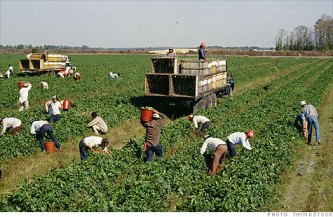
Buying local, fresh food is a critical part of living a healthy, sustainable life. However, something missing in the discussion. Have you ever thought about the people who provide the produce you buy and eat? The ones who plant it, care for it, and harvest it? Unfortunately, far too many people have never asked if the fresh, local fruits and vegetables they eat are produced fairly.
The Michigan Civil Rights Commission released a report in 2010 on the conditions of seasonal and migrant workers in Michigan showing that workers face unfair pay and recruitment practices, inadequate housing, unsafe work environments, discrimination, and limited access to healthcare, education, and childcare. The conditions that the MCRC found were appalling, and the folks at Fair Food refuse to accept them.
Migrant work is a complicated issue. It is influenced by factors including politics, globalization, the migration of people, agricultural labor practices and standards, and capitalism. However, Fair Food believes that everyone deserves just working conditions, no questions asked. Nothing can be truly sustainable if it is based on the exploitation of others’ labor.
Fair Food calls on you as consumers, as business owners, as people, to examine the way you think about your locally grown food. Can you feel right about enjoying a head of lettuce or pint of blueberries if you know that the people who picked them may not have had access to safe drinking water or toilets while they worked? Or that they were too afraid to make a complaint because they did not want to lose their jobs, and they did not even know their rights as workers?
It is up to you to hold growers and the businesses who buy their products responsible for the food you bring into your home. The next time you’re
craving some fruits or vegetables, don’t forget to check off not only fresh and local, but also fair.
Fair Food Standards
- Farmworkers should get paid a livable wage for their work and receive at least the federal minimum wage. Currently farmworkers are excluded from the federal minimum wage laws, which includes overtime pay requirements.
- Farmworkers should not be subjected to forced labor or debt bondage.
- Farmworkers should have access to educational information about their rights as workers under the law in both English and Spanish. When necessary, translation should also be provided for those whose first language is indigenous.
- Farmworkers should have access to clean water for drinking, bathroom facilities, and regularly scheduled breaks that follow federal standards.
- Farmworkers should not be exposed to pesticide application while working in the fields, should be provided proper protection gear when coming in contact with pesticides and should be provided full disclosure (in English and Spanish) when they are working with produce that has been sprayed with pesticides.
- Farmworkers should be provided just and adequate housing conditions when that is part of the worker contract. Farmworker housing should always be voluntary for workers and not required by employers.
- Farmworkers should not be intimidated or harassed when attempting to organize fellow farmworkers. The right to form a union should apply to
farmworkers. All agricultural employers must provide a mechanism for workers to file any grievances related to the work or working conditions. - Federal Child Labor Law should be observed unless the children working on the farm are family members of the farm owner.
- Farmworkers should not be harassed, intimidated or discriminated against based on their gender, ethnicity or immigration status.
You can learn more about this local campaign at http://www.localfreshfair.com.
Southeast Area Farmers’ Market: The harvest is truly bountiful!
Summer’s almost over but that doesn’t mean you can’t find nutritious locally grown produce in your neighborhood. Both Southeast Area Farmers Market locations will be open through the end of October. Our backyard growers and farmers are at that point in their growing season when the harvest is truly bountiful.
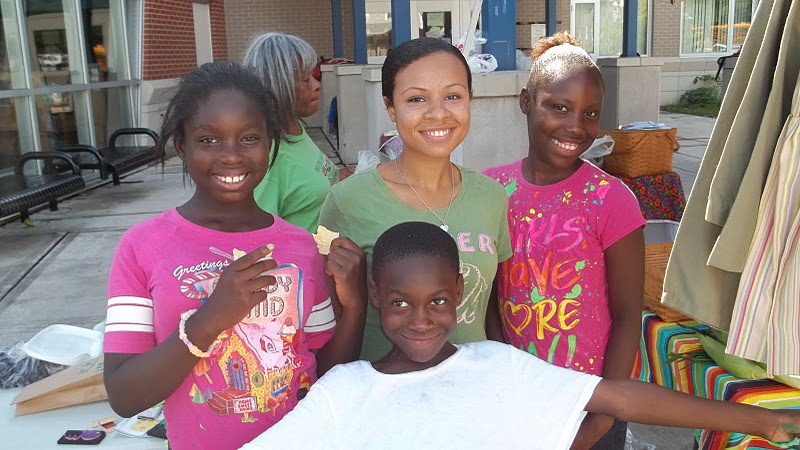
If you and your family live in theGerald R FordMiddle School neighborhood, back to school can mean back to healthy eating. Now open from5to7 p.m.on Fridays, the market will provide the kinds of foods our kids need to be healthy, study hard and do well in school.
Did you know eating nutritious foods, including fresh fruits and vegetables, improves kids’ academic performance at school? On the other hand, fast food, junk food and highly processed convenience foods (think anything that comes in a colorful factory-made package) can contribute to attention deficit disorder, poor sleep habits, being overweight and a sluggish immune system–more allergies, colds and flu!
The Southeast Area Farmers’ Market has two locations to serve you!
- Gerald R.Ford Middle School, 851 Madison, SE, Fridays, 5 – 7 p.m. Our Kitchen Table will be hosting a free workshop in how to mix your own inexpensive, non-toxic garden fertilizers and insect repellants.
- Garfield Park, corner of Madison Avenue andBurtonStreet SE, Saturdays 9 a.m. to 2 p.m.
Both of our market locations accept cash, debit cards, EBT, Project Fresh and Kent County Health Department coupons. If you buy with your EBT card, you receive $2 in free Double Up Food Bucks for every $2 you spend, up to $20 each time you visit!
Food Charity or Food Justice? Reporting on Hunger in Grand Rapids
This is a re-post from the 9-7-2011 edition of GRIID
Food Charity or Food Justice? Reporting on Hunger in Grand Rapids
Yesterday, a new project between the Grand Rapids Press and The Rapidian began in what they are calling the Grand Rapids Hunger Challenge.
Hunger Challenge Week is September 14 – 20, a these two local news entities decided that as a way of making people aware of hunger and food insecurity they would have a writer from each news outlet try to live off of a $30.59 a week food budget.
The Day 1 article on MLive talks about how both of the writers went shopping for food with their limited budget. The Press writer talked about being at a birthday party and not being able to eat ice cream and cake, while The Rapidian writer talks about how she was once herself on food assistance.
The Rapidian also has an opinion piece that has some useful statistics on hunger and the number of people who rely on food stamps, but the article, like the ones by the writers taking the “hunger challenge” do little to really address hunger and poverty in West Michigan.
Having people who have a certain level of class privilege try to follow a budget of people who are truly poor is a bit disingenuous. These kinds of exercises are like the “poverty simulations” that charity groups put on or the Planned Famines that high school church groups organize so that privileged kids can somehow understand what starving and malnourished children feel like. However, these attempts to sensitize people do not ask the fundamental and important reasons for why people in the richest nation in the world are going hungry.
Both the Press article and the Rapidian pieces never address the causes of hunger in the US. Having their writers try to live on a fixed food budget tends to put the emphasis on personal responsibility instead of systemic factors.
One of the oldest anti-hunger education organizations in the US is Food First. Food First has been working on both dispelling the myths about hunger and providing analysis of both food insecurity and how to actively organize against it. Food First looks at Food Deserts and how large monopoly grocery chains are buying up land in urban areas with little access to real food with their claim to “serving” poor communities.
Food First also addresses issues of economic and racial inequality and how that impacts who has access to food and what kind of food people have access to. In an excellentreport on youth and food justice, the report looks at how there is a relationship to Jim Crow policies and the kind of food system we have in the US.
There is also a growing movement in the US that is advocating food justice, not food pantries. Food justice involves more urban food production, access to land for people to grow more of their own food, limitations on fast food restaurants being built in poor communities, community kitchens, Community Supported Agriculture and the efforts to challenge the grossly unjust food system we have in the US that is publicly funded through the Farm Bill.
In fact, Food and Water Watch is doing a national campaign to address the failed food system we have in the US and is even organizing in Grand Rapids. Their first meeting on this project to reform the Farm Bill will be held on September 21st at 7pm in the WMEAC building in Grand Rapids.
This kind of information and local analysis would not only address systemic reasons why people go hunger in West Michigan, it would challenge the charity-based food efforts that drive too much of hunger awareness in this community.
Sept. 17 at Garfield Park!
What’s in season at the Southeast Area Farmer’s Market
August is here and we have a bountiful harvest from our Southeast Area Farmer’s Market vendors. Take a pick from what’s in season:
- Tomatoes – Red or green, tomatoes are full of vitamin C and healthy antioxidants, this summer classic is a versatile way to prevent heart disease. Not sure what to do with the green ones? You’re in luck, as we are giving away a free cookbook of green tomato recipes at the market.
- Greens (mustard, turnip, collard) Proven to lower cholesterol, greens are a simple way to obtain high concentrations of vitamins A and C.
- Summer squash – An excellent source of manganese and vitamin C, summer squash provides a great combination of conventional antioxidant nutrients.
- Green beans – An often overlooked side dish, especially when steamed, provides tasty cardiovascular health.
- One of our vendors, Mrs. Woodard, has peaches and other fruit from a local organic orchard.
You can always find chemical free produce at the Southeast Area Farmers Market, the majority of which is grown in our vendors’ backyards. Don’t forget the market has two locations: Gerald R. Ford Middle School on Fridays 2 p.m. to 7 p.m. and Garfield Park on Saturdays 9 a.m. to 1 p.m.
Both locations accept cash, debit, EBT, and Double Up Food Bucks. With Double Up Food Bucks, receive up to $20 of free produce when using your EBT card ($2 free for every $2 you spend).
Food garden tour part of justice program to build urban food security
More than 30 people joined Our Kitchen Table(OKT) for the 4th Annual Eastown Food Garden Tour the evening of Tuesday August 16. After OKT’s Lisa Oliver King introduced OKT’s Food Diversity Program and community partner, Dr. Clinton Boyd, spoke to resolving lead and arsenic contamination in urban soil, the group began the one and one-half mile trek with stops planned at 14 Eastown neighborhood food gardens.
Many on the tour were amazed to discover the abundance of foods growing in the small front, side and back yards of neighbor’s homes. Bountiful garden plots, raised beds and recycled containers yield everything from the common tomatoes, herbs, beans and peppers to hops for homebrewed beers, exotics, like figs and kiwi, and berries—strawberries, blueberries, raspberries and even huckleberries.
Many of the gardeners on tour were beginners—though you wouldn’t know it from looking at their gardens. And, many of the gardens showed off plants received as seedlings raised from seed by OKT staff and volunteers.
However, the point of this garden tour was not to showcase local gardeners’ green thumbs. OKT is supporting their efforts as food, i.e. food security and access to healthy foods, is a justice issue. OKT believes access to nutritious whole, organic and fresh foods is every person’s right—not a privilege for those who can afford to shop in upscale grocery stores or eat at trendy restaurants.
Specifically, OKT’s Food Diversity Program targets Grand Rapids neighborhoods hardest hit by asthma and lead poisoning, both of which can be ameliorated by eating fresh, organic fruits and vegetables. Too much of the affordable food widely available in these neighborhoods is over-processed, high in fat, high in sugar and low in nutrients. OKT believes people in need should have more than a full belly—they should have regular access to the whole foods that prevent expensive illnesses like diabetes and heart disease.
The gardens on the tour prove that people can easily and inexpensively grow their own nutritious foods in the urban environment—a fact that the food industry obfuscates with media messages that make growing, canning and preparing food from scratch seem like difficult, time consuming and insurmountable tasks.
In addition to touring gardens at private residences, the tour also made stops at the Eastown Neighborhood Association community garden and the Barefoot Victory Garden Barefoot Victory Garden. At the latter, any neighborhood resident can pitch in according to ability and take home abundant produce according to need. Instead of personal plots, like those found at traditional community gardens, each raised bed is dedicated to a specific “crop.”
The Barefoot Victory Garden boasts organic, heirloom plant varieties. Heirloom plants are fertile, that is, you can collect seeds from them at the end of the growing season for the next year’s sowing. Most food plants and seeds sold at commercial retail nurseries are “terminator” varieties that are sterile and cannot produce seed (but can increase the seed companies’ profits).
As another part of its justice piece, OKT encourages growers within its program to save their own seeds—a practice deemed illegal by the World Trade Organization (WTO).
As part of its Food Diversity Program, OKT also manages both locations of the Southeast Area Farmers’ Market. The market at the Gerald R. Ford Middle School is open Fridays 2 to 7 p.m.; the market at Garfield Park, Saturdays 9 a.m. to 1 p.m. These smaller markets feature mainly backyard chemical-free growers as vendors and provide ample opportunity for socializing with neighbors.
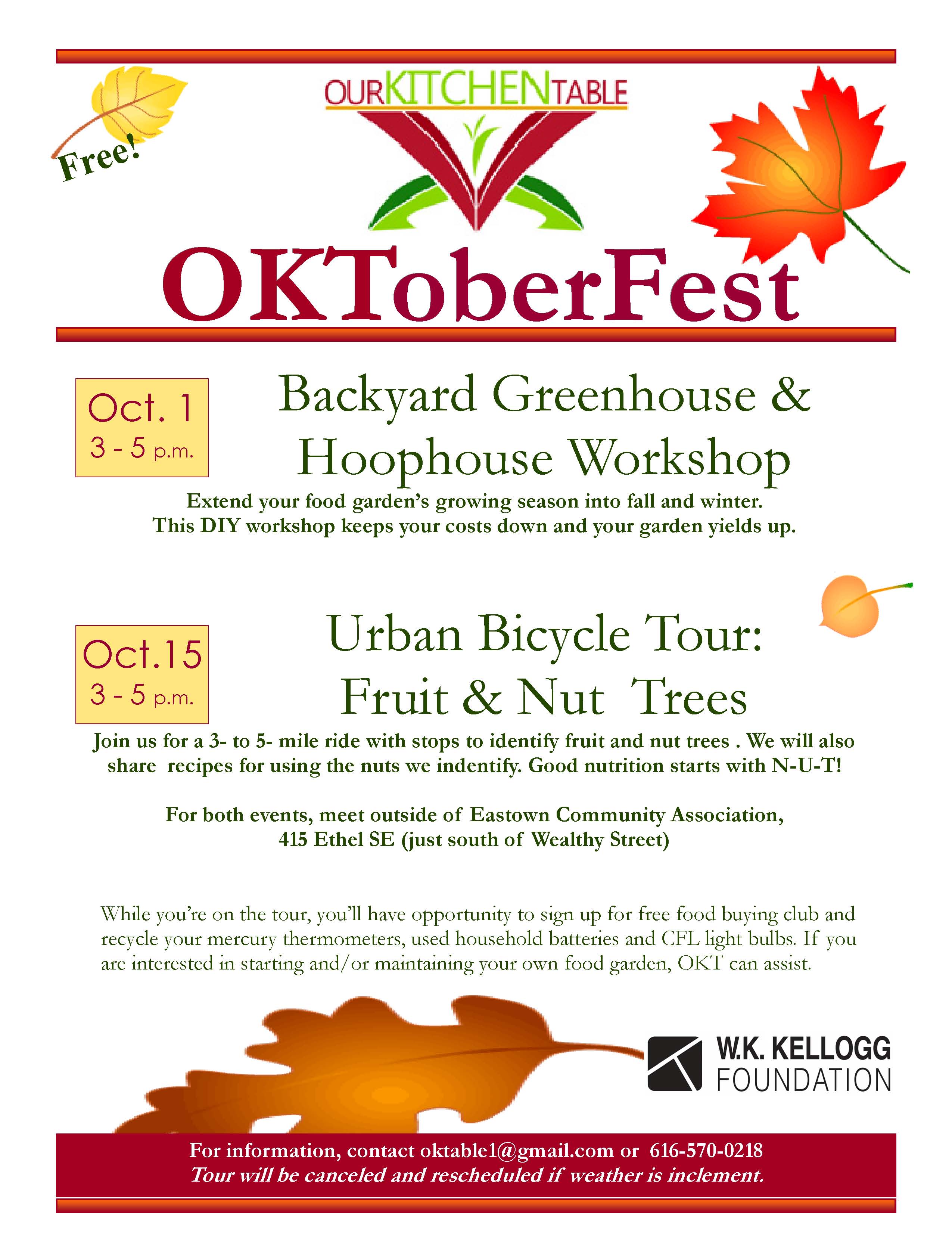
OKT is sponsoring an Urban Foraging Workshop with The Bloom Collective on September 10 as well as a fall bicycle tour of urban nut trees and October workshops on building hoop houses to extend the growing season.
See more photos from the tour here.