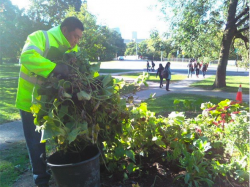
Funds being raised for Black Panther/Zapatista multimedia art collaboration

The Black Panthers and the Zapatistas: An Encounter

Help fund this project on Kickstarter

Emory Douglas, Minister of Culture for the Black Panther Party, meets Zapatista Mayan Artist in Zapatista territory to create some ART.

ZAPANTERA NEGRA

Watch the video here.

A multimedia exploration of the artistic and political connections between the Black Panther Party and the Zapatista movements as incubated in San Cristóbal de las Casas, Chiapas, Mexico. To coincide with Emory Douglas’, the former Minister of Culture for the Black Panther Party, residency in its space, EDELO (En Donde Era La ONU), a creative laboratory, will develop an art exhibition and single-issue newsletter. The exhibition will showcase pieces by local Zapatista artists and will explore their artistic identification with the Zapatista and Black Panther movements; the newsletter will pay homage to Douglas’ work in the Black Panthers’ popular press and will showcase new articles and artworks that will explore the connections between art and social movements as manifested in today’s multifaceted world.

Project Overview

At the peak of its popularity in 1970, 139,000 copies of The Black Panther newsletter were distributed throughout the United States on a weekly basis. Within its pages, Emory Douglas, the movement’s Minister of Culture, published his artworks in an effort to “illustrate[e] conditions that made revolution seem necessary; and… construct a visual mythology of power for people who felt powerless and victimized.” The newsletter and its accompanying illustrations played a central role in the articulation of the “What We Want, What We Believe” portion of the Black Panther’s Ten Point Program

In 1994, the Zapatista uprising, a Mexican, indigenous movement originating in the southern state of Chiapas, generated and disseminated a different sort of mass communication made possible by the rise of the internet. Photographic, video, and written information regarding the movement’s actions spread around the world in real time, increasing awareness of the Zapatista cause while also building solidarity for what the New York Times termed “the first post-modern revolution.” Positioning itself as a struggle against neoliberalism waged against 500 years of oppression, Zapatismo has employed new technologies of information distribution in order to articulate their wants, beliefs, and various identities to themselves and to their global audience.

The Black Panther and the Zapatista movements occurred in distinct cultural, political, and historical milieus; nonetheless, the two share a common appreciation of the power of the image and the written word to build their respective social movements into personal, collective, transformative, and public experiences. In contrast to the strong self-definition established and disseminated by these two movements via pertinent media channels, today’s multimedia, plugged-in landscape seems to promote the opposite development.

Today we tweet, text, and browse through myriad contexts, occasionally gaining a glimpse into the exterior world but more frequently losing ourselves in the internet’s echo chamber of opinions and perspectives. ZAPANTERA NEGRA (ZPN) will be a single-run magazine of 20,000 full-color copies that will merge the powerful imagery and layout style of Emory Douglas with the visions and voices of Zapatista painters and embroidery collectives. It will bring the two similar movements together on the page to demonstrate their commonalities, tie the movements to the present, and articulate a new, collaborative, interdisciplinary mode of information distribution and political, social, and economic self-identification.

Emory Douglas, the former Minister of Culture for the Black Panther Party, will be in residency at EDELO in Chiapas, Mexico in November of 2012. During his time  in Chiapas, he will visit Zapatista communities and work with Zapatista painters while simultaneously guiding a team of artists and editors in the layout and construction of ZPN. The newsletter will also include personal reflections authored by writers, academics, and artists on how art has moved and encouraged their own self-definition, work, and hope in a possible, better world.

ZAPANTERA NEGRA will be distributed in five countries and within select educational, artistic, and political institutions. Its project coordinators hope to develop a grassroots distribution network that will also allow for its dissemination to communities with little access to alternative media. The newsletter will also have a social media platform where “friends,” “followers,” and “fans” will be able to download, print, and wheatpaste the newsletter on overpasses and walkways. The newsletter production and distribution will be paralleled by the production of a collection of tapestries made by Zapatista embroidering communities that merge and exchange Black Panther imagery as articulated by Emory Douglas with that of the Zapatista movement.

This entry was posted on October 25, 2012, in Policy.

Learn to plant and grow garlic!

OKT invites you to Plant, Cook & Eat GARLIC!

  • Free! Saturday Nov. 3, 10 a.m. to 12 p.m.
  • Logan Street Garden, 1416 Logan SE

Learn how to grow your own garlic. A tasty addition to many dishes, garlic also helps your body fight off colds, flu and infections.

Frankenstein For President: local film maker releases silent film

Reposted from The Rapidian

Local activist and independent film maker Matt Judge has enlisted a small army of friends to realize his goal of writing and filming his first movie. “Frankenstein for President” is a silent film that Judge describes as “part horror, part comedy”, that satirizes the current state of politics and popular culture in American society. As zombie voters addicted to text messaging and cable news plague the city, undead monsters pander for enough votes to land in the Oval Office. While political vampires are pulling the strings behind the scenes, a young couple on a romantic afternoon in the park find themselves neck deep in trouble trying to save the world. Will they succeed, or is it too late?

Judge and his film collaborators from the Bloom Collective pooled their resources and passions to write, plan, cast, shoot and edit the entire film in less than 14 days. The cast and crew will celebrate their efforts with a debut screening of “Frankenstein for President” 8 p.m. Friday, October 26 at 8 Jefferson Ave SE (next door toBartertown Diner). The public is invited to attend.

After the film, a brief Q&A session will occur with the cast and crew. Food and music will also be provided. Copies of the DVD will be available for donation in an effort to raise funds for the Bloom Collective.

Michigan League of Responsible Voters Recommendations for State Proposals

Proposal 1: Emergency Manager

Background: Authorizes the Governor to appoint an Emergency Manager to make decision in financially distressed communities or school districts.

What it does: Gives non-elected gubernatorial appointees the power to change laws and contracts passed by locally elected officials that voters have chosen. Undermines democracy by preventing locally elected officials from taking any government action to serve residents.

Proposal 1 is opposed by: A. Philip Randolph Institute, AFT Michigan Alliance for Immigrants Rights / Michigan Organizing Project, America Votes, Clean Water Action, Equality Michigan, Michigan AFL-CIO, Michigan AFSCME Council 25, Michigan Education Association, Michigan Laborers Union, One Michigan, Progress Michigan, ROC – Michigan, SEIU Michigan State Council, Sierra Club Michigan Chapter

Proposal 2: Protect Working Families

Background: Constitutional amendment to establish employees’ right to join unions and bargain collectively with public or private employers regarding wages, hours and other terms of employment.

What it does: Collective bargaining levels the playing field and helps ensure good working conditions and a better quality of life for all Michiganders, whether in unions or not. Allows employees to come together with employers to negotiate a fair deal so CEOs aren’t the only ones benefitting from a company’s success.

Proposal 2 is supported by: A. Philip Randolph Institute, ACCESS, AFT Michigan, Alliance for Immigrants Rights / Michigan Organizing Project, America Votes, Clean Water Action, Equality Michigan, Michigan AFL-CIO, Michigan AFSCME Council 25, Michigan Association for Justice, Michigan Education Association, Michigan Laborers Union, One Michigan, Progress Michigan, ROC – Michigan, SEIU Michigan State Council, Sierra Club Michigan Chapter, Sugar Law Center for Economic & Social Justice, UAW, UFCW, Xicano Development Center

Proposal 3: Michigan Energy, Michigan Jobs

Background: Requires utilities to obtain at least 25% of electricity from renewable sources by 2025. Limits consumer rate increases from renewables-related costs to no more than 1% per year; creates incentives to employ Michigan workers and equipment.

What it does: Reduces our state’s dependence on foreign oil and out-of-state energy. Ensures Michigan energy is clean, creating a healthier, safer environment for children. Encourages the production of energy, like wind and solar, here in Michigan, made by Michigan workers

Proposal 3 is supported by: A. Philip Randolph Institute, AFT Michigan, Alliance for Immigrants Rights / Michigan Organizing Project, America Votes, Clean Water Action, Equality Michigan, Michigan AFSCME Council 25, Michigan Association for Justice, Michigan Education Association, Michigan Environmental Council, Michigan Interfaith Power & Light, Michigan League of Conservation Voters, One Michigan, Progress Michigan, ROC – Michigan, SEIU Michigan State Council, Sierra Club Michigan Chapter, Sugar Law Center for Economic & Social Justice, UAW, Xicano Development Center

Proposal 4: Keep Home Care a Safe Choice

Background: Establishes the Michigan Quality Home Care Council to register, background check and provide standards for home care providers.

What it does: Ensures seniors and people with disabilities have an affordable, safe choice of living at home, rather than at more-expensive nursing homes. Links providers with patients, provides for extensive background checks and saves taxpayer dollars since home care is significantly less expensive to taxpayers than nursing homes.

Proposal 4 is supported by: A. Philip Randolph Institute, ACCESS, AFT, Michigan Alliance for Immigrants Rights / Michigan Organizing Project, America Votes, Clean Water Action, Equality Michigan, Michigan AFL-CIO, Michigan AFSCME Council 25, Michigan Association for Justice, Michigan Disability Rights Coalition, Michigan Education Association, Michigan Laborers Union, Michigan League for Human Services, One Michigan, Progress Michigan, ROC – Michigan, SEIU Michigan State Council, Sugar Law Center for Economic & Social Justice, UAW, UFCW

Proposal 5: Supermajority Vote

Background: Would amend the Michigan constitution to require a 2/3 majority vote of the legislature, or a statewide vote of the people at a November election to impose new or additional taxes on taxpayers, expand the base of taxation or increase tax rates.

What it does: Gives a small minority of just 13 state senators the power to stop the closure of tax loopholes or increase taxes in an emergency, even if it was supported by the other 135 members of the legislature. Would lead to larger class sizes, closures of hospitals and decreased police and fire protection, while property taxes increase. Would cost jobs by lowering the state’s bond rating, driving up borrowing costs and increasing debt.

Proposal 5 is opposed by: A. Philip Randolph Institute, AFT, Michigan Alliance for Immigrants Rights / Michigan Organizing Project, America Votes, Clean Water Action, Equality Michigan, Michigan AFL-CIO, Michigan AFSCME Council 25, Michigan Association for Justice, Michigan Education Association, Michigan Environmental Council, Michigan Laborers Union, Michigan League for Human Services, Michigan League of Conservation Voters, One Michigan, Progress Michigan, ROC- Michigan, SEIU Michigan State Council, Sierra Club Michigan Chapter, Sugar Law Center for Economic & Social Justice, UAW, UFCW, Xicano Development Center

This entry was posted on October 23, 2012, in Policy.

Top 12 reasons to vote YES on Proposal 3

Election time is often called “silly season” with good reason. And in the homestretch between now and Nov. 6 you’ll see ample evidence of that.

But we need your help in cutting through the static to secure passage of a vital, progressive voter initiative, Proposal 3, which would ensure 25% of Michigan’s electricity comes from clean, renewable sources by 2025.

The proposal works for Michigan on every level. Renewable energy is less expensive than its alternatives, creates tens of thousands of good jobs that can’t be outsourced, reduces dangerous pollutants that poison our natural resources, and protects our vulnerable populations from unhealthy power plant emissions.

All indications are that Prop 3 will be a close vote. There is no substitute for face-to-face discussions that cut through the misrepresentations and outright lies being presented by Michigan’s utility companies in their massive effort to defeat Proposal 3.

MEC’s “12 Questions” document below distills key facts about the 25% by 2025 plan. We hope you will share it, and use it as a reference for discussions with your friends, relatives and neighbors.

1.   What will Proposal 3 do?
Proposal 3 requires that a minimum 25 percent of Michigan’s electricity come from clean renewable sources including wind, solar, biomass and hydropower by 2025.
The proposal explicitly states that utilities cannot raise electricity prices to comply with Proposal 3 by more than 1 percent in any given year. It has been projected that it will cost the average residential ratepayer about 50 cents a month to begin with, but in the long term will save ratepayers money.
2.   Why put this in the constitution?
The Michigan Constitution is much different from our federal Constitution.  It was designed to be a living document that reflects our values, and is designed to change with the times. That’s why it requires we vote every 16 years on whether to hold a convention to rewrite it.
There have been 69 amendments offered since the latest version was adopted in 1963.  The people approved those 32 times and voted against them 37 times.  Those amendments have addressed everything from exempting food from sales tax, to the minimum drinking age, to allowing stem cell research.  Importantly, the voters always have the final say.
A major advantage of putting 25 by 2025 in the Michigan Constitution is that utilities cannot use their political influence to sway the Legislature and bypass the consumer protection measures, such as the 1% cap on rates in any given year.
Right now, Michigan is locked into outdated and expensive energy sources like coal for our electricity.  But the Legislature won’t act because they have sold out to the big oil and coal companies, DTE, Consumers Energy and their lobbyists.  The Oakland Press said, “To reject the proposal just because it entails a state constitutional amendment just further empowers wealthy lobbyists like those working for the utility companies.”
3.   Why are oil companies involved?
We use a small amount of oil to generate electricity.  More importantly to oil companies, we spend over $500 million a year for diesel fuel to move the over 35 million tons of coal from Western states to Michigan to burn in our power plants. So transition to cleaner energy not only makes Michigan more energy independent, it makes the United States less reliant on oil from overseas.    
4.   What kinds of jobs are expected to be created by Proposal 3? 
Proposal 3 specifically states that the legislature should enact incentives to encourage the use of Michigan workers and Michigan made goods.  A Michigan State University study determined that Proposal 3 will create at least 74,000 Michigan jobs that can’t be outsourced. Construction jobs account for more than 30,000, and operation and maintenance more than 40,000.
There will be another 40,000 jobs related to manufacturing the parts required to build the renewable energy facilities. With Michigan’s manufacturing talent and know-how, Michigan could capture 50 percent of that manufacturing market, increasing the number of jobs to 94,000.

5.   The CARE for Michigan group claims that the cost of Proposal 3 will be more than $12 billion and cost families “thousands” of dollars.  Is that true?

These claims by the utilities are false.  Michigan residents spend over $10 billion each year on electricity.  Passage of Proposal 3 will result in investments of around $10.3 billion (CARE inflated that number) in Michigan by the utilities or private investors. Those costs are spread among four million customers and over the 25-year expected life of those assets.
The utilities also fail to subtract avoided costs from their total. For example, we spend $1.5 billion each year to buy imported coal. We’ll keep some of that money here, instead, which is a significant savings to Michigan residents and a significant offset to the renewable energy investment.
The language of Proposal 3 also puts a permanent cap on the cost of compliance with Proposal 3 at no more than 1% per year. Because it is in the Constitution it cannot be bypassed by the utilities or the legislature.  That cap would limit the amount any family would pay to about $10 a year.  A recent report projects that Proposal 3 will cost about half of that, or about 50 cents a month but will save money in the long term.
 

6.   How can we count on power when the wind doesn’t blow and the sun isn’t shining all the time?

That is not a problem for users because homes and businesses are connected to a regional electric grid that gets electricity from many sources.  Existing ‘backup’ generating capacity – both within Michigan and elsewhere on the regional grid – is more than capable of filling short-term gaps in supply.  Those other sources will be able to meet our needs when an insufficient amount of Michigan renewable energy is available. There are now five different states (Hawaii, Colorado, Iowa, South Dakota and North Dakota) that are already producing more than 20% renewable energy.  Grid operators in those states have had no trouble managing the variable load.  As more and more renewable resources are added to the grid, the less variable they become overall.
 

7.   Do we have enough wind and land to meet 25 by 2025?

Yes, and more.  Michigan needs to build only 4,600 megawatts of electricity generation capacity from renewable energy.  According to the National Renewable Energy Laboratory, Michigan needs to harness just 8% of the more than 54,000 MW of high-quality, land-based wind generation potential of the state. Michigan also has more sunny days than Germany, one of the world’s leading producers of solar energy.

8.   How much renewable energy does Michigan currently use?

 Michigan currently gets just 3.9 percent of its electricity from renewable sources.  Meanwhile other states are moving ahead, including Iowa, whose renewable energy use is at 23 percent, and Illinois, whose 25 percent by 2025 goal is saving businesses and families there $176 million, according to the Illinois Power Agency.  Michigan currently gets 60 percent of its electricity from coal, all of which is imported from other states.  Just to purchase coal, Michigan sends $1.5 billion a year – and the jobs it creates – to other states.
9.   How will this improve public health?
 Using more wind and solar energy will reduce pollution and give Michigan cleaner and healthier air and water.  The dirty coal plants that provide 60 percent of Michigan’s electricity emit dangerous levels of mercury, sulfur dioxide and arsenic, which are linked to heart disease, childhood asthma, lung disease and premature death.  That exacts a terrible emotional toll on families, and a financial toll that is reflected in higher health insurance premiums and medical costs.  The Michigan Nurses Association endorses Proposal 3 because our children deserve a cleaner Michigan.
 
10.  Are DTE residential customers treated differently?
DTE residential customers are currently paying $3 a month for renewable energy surcharge, but should only be paying $1.60 a month based on how much power they use (36% of the power, and paying 69% of the surcharge).  Consumers Energy residential customers only pay 52 cents a month. Proposal 3 would eliminate the current system of per meter surcharges that creates this unfair treatment, immediately lowering the bills of DTE residential customers.
11.  Why aren’t the utilities supporting Proposal 3?
 
For them it comes down to money and control.  They make more money burning coal and want to continue to do so even though Michigan families are paying huge rate increases caused in part by the rising prices of coal delivered to Michigan. That cost has increased 71 percent in the last four years.  Coal pollution also contributes to asthma attacks, respiratory illnesses and premature heart attacks.  They oppose this ballot measure because they cannot control the voters like they are able to control the legislature.
12.  Critics claim that Proposal 3 is not flexible enough.  Is that true?
If Proposal 3 passes the legislature will pass implementing language to set the timeline for utilities to transition from the 10% currently required to the 25% which will be required by 2025.  That timeline will be set with input from all interested parties.  They are also required to establish incentives for Michigan workers and Michigan made parts and components to the renewable energy facilities used.  If utilities have trouble meeting the interim standards the legislature will be able to change them.  Under Proposal 3 if the costs are too high, utilities will be given longer to meet the standard to keep any potential increase in rates below 1%.
The proposal also leaves 75% of Michigan’s electric generation open-ended, giving utilities and regulators a relatively free hand at planning the new generation sources that we will need.
For More Information
Find copies of the reports referenced above at:
Visit the Proposal 3 website: MIENERGYMIJOBS.com
 

October is NeighborWoods Month – A National Celebration of Trees

OKT encourages you to tell Mayor Heartwell and the Urban Forestry project to plant more fruit and nut trees so we have more healthy food to eat in our neighborhoods.

Friends of Grand Rapids Parks, in partnership with the City of Grand
Rapids Urban Forestry Committee, is hosting a series of events to celebrate NationalNeighborWoods Month. These events are part of hundreds of re-greening efforts throughout thecountry being promoted during October, which has been declared National NeighborWoodsMonth by the national nonprofit, the Alliance for Community Trees (ACT). Friends of Grand Rapids Parks is a member of ACT’s NeighborWoods Network. View full calendars and
additional event details at http://www.friendsofgrparks.org/events and http://www.urbanforestproject.com

Arborist Lee Mueller presented a very interesting tree mapping workshop with OKT on Oct. 4. Two more October events are coming up.

October 16th, 530pm-630pm: Tree Tales – How Trees tell us their Stories
Join Arborist/Author Vic Foerster for an exciting tree-tour in Riverside Park. With over forty years of experience working with trees, Vic Foerster will give a tantalizing tour called “Tree Tales –
How trees tell us their stories”. Come walk Riverside park with Vic and hear about our City’s
trees from their perspective.

October 17th & Oct 27th: Oakdale Community Garden Build Day
Join in to help the Oakdale neighborhood build a community garden and plant 2 trees as part of
the new park located at the former Oakdale Elementary, now River City Charter Academy. We
are still looking for volunteers.

Register to vote, learn about key ballot issues at the Southeast Area Farmers’ Market

Coverage about the upcoming presidential race is everywhere you look these days. However, Our Kitchen Table believes that some of the Michigan ballot proposals could have more impact on our lives here in Michigan.

 

Of extreme importance, especially to communities of color, Proposal 1 gives voters the opportunity to strike down governor appointed emergency managers from taking control of our municipalities and schools, as they have in Benton Harbor and Detroit. Emergency managers can set aside locally elected officials, fire employees, suspend collective bargaining agreements and sell city and school assets.


Proposal 2 seeks ensure that “people’s rights to organize, join or assist unions and to bargain collectively” are upheld. Without unions, we would not have the 40 hour week, decent wages, regulation of child labor and health benefits (all of which are coming under attack).


Proposal 3 requires “electric utilities to provide at least 25% of their annual retail sales of electricity from renewable energy sources, wind, solar, biomass and hydropower, by 2025.” This can build a clean energy industry, create thousands of Michigan jobs and give Michigan cleaner air and water. Again, communities of color suffer the most from air and water pollution created by coal power and incinerators.


For unbiased information about all six proposals, come down to the Southeast Area Farmers’ Market. Representatives from the League of Women Voters will be on hand to register people to vote, explain ID requirements and share the pros and cons of all candidates and ballot initiatives. The market takes place at Gerald R Ford Middle School, Saturdays through October from 10 a.m. to 3 p.m.


Greens Cook-Off and Green Tomato Festival October 13

Our Kitchen Table and the Southeast Area Farmers’ Market are gearing up for the annual Greens Cook-off and Fried Green Tomato Festival to be held 11 a.m. to 2 p.m. Saturday October 13 at the Gerald R Ford Middle School farmers’ market location.

Do you have a prized green tomato recipe? Here’s your chance to win a prize with it. Do you have a secret family recipe for collards or some other greens? Come and show it off. You don’t have to register ahead of time. Simply bring your dish to the designated table at the farmers’ market by noon and OKT will register you on site.

At 1 p.m., our local celebrity judges will taste and evaluate the dishes for taste, texture, nutritional content, presentation and wow factor. Winners will be notified the following week. Prizes will be awarded for first place, second place and honorable mention at the Southeast Area Farmers’ Market on Saturday October 20.

As part of the event, OKT will be handing out free greens and green tomato recipe cards featuring dishes by Grand Rapids’ own chef, Nancy Rutledge, and internationally famous chef and author—and special friend of our market—Bryant Terry.

Notes from last year’s Bicycle Tour of Fruit and Nut Trees

This week’s activities!
  • Thursday Oct. 5: 
    Tree-mapping Workshop with Lee Mueller, 6-8 p.m. , Kroc Center, 2500 Division Ave. South
  • Saturday Oct. 6: 
    2012 Bicycle Tour of Fruit and Nut Trees
    with Forager & Cyclist, Laura Casaletto
    2-4 p.m. 
    Meet at Garfield Park’s Madison Avenue parking lot,
    south of Burton Street SE

Last fall, a dozen or so folks met in Eastown for OKT’s Bicycle Tour of Fruit and Nut Trees. Sunny skies, comfortable temperatures and a brisk breeze made for a lively, enjoyable ride.

Seasoned cyclist, Josh McBryde, planned the route and led the tour across Wealthy Street and over to Cherry Park. On the way there, tree expert, Laura Cassaletto, pointed out various trees and their edible uses, bringing the group to its first stop alongside an old apple tree, full of ripe fruit, outside of a two-flat apartment house.

After assuring us that she had gotten permission from the property’s owner, Laura invited everyone in the group to pick and enjoy an apple. She mentioned that the tree’s owner had told her that the apples were not good for eating as they had not been sprayed with pesticides. The group broke into laughter. And, with a close eye for worms,we took bites of the “imperfect” fruit. All were amazed at the incredible flavor these small, old fashioned, untended apples offered.

Laura recommended foraging such untended apple trees around the city. She likes to use them for applesauce. When the apples are put through the food mill, it’s easy to pick out any critters that might have eaten their way inside the fruit.

In Cherry Park, the group identified different varieties of nut trees, scavenged nuts from off the ground and even cracked and ate a few. Heading back across the neighborhood, a stop near Diamond and Cherry yielded a look at mulberry trees (already done fruiting) as well as locust trees. Seasoned urban forager, Richa, shared that the spring flowers from the locust tree are delicious. (At the conclusion of the tour, he shared a loaf of his homemade acorn bread).

Crab apples, yes.

Along the route, Laura pointed out that ornamental crab apple trees have edible fruit. She explained that crab apple trees are related to the rose, and like the rose, are edible. High in vitamin C, their edible fruit can be identified by the “crown” at the bottom of the fruit. While fruit with a crown is edible, she warned not to forage white fruit and berries, “White is the color of death.”

She also advised us to try new foraged fruits and nuts in small quantities to see how our own body reacts to it. Because trees, like people, are individuals, the fruits and berries eaten from them have differences in flavor and in how they align with each individual person’s digestive system.

Bittersweet, no.

In Wilcox Park, the group snacked on plump wild grapes and tried edible, though bitter, viburnum berries. We also learned that the colorful bittersweet nearby was just for decoration and not an edible.  The group ended its tour at Aquinas College, where Josh handed out tree identification maps the college provides to visitors. We stopped to gather, crack and snack on beech nuts beneath an elephantine beech tree.

A 16-year-old on the tour remarked, “It was so cool to learn that if I had to, I could get enough to eat from nature.” Cool indeed. Food is growing all around us. Let’s learn to appreciate it!

Occupy Garden’s plants in Toronto destroyed night before planned harvest

SUNDAY, SEPTEMBER 30, 2012

Reposted by request from Activist Post
Amid a growing food crisis, this morning workers from the City of Toronto were ordered by City of Toronto Parks Director Richard Ubbens that all live plants and food be removed from the People’s Peas Garden in Queens Park. They were ordered to take the plants and food to the dump and lay sod overtop of this most beautiful free community food garden, without warning, without a chance to remove the rare heirloom plant species or harvest the food.The garden was planted by Occupy Gardens and allies on May 1st, in defense of local and global food security. While the garden has been growing undisturbed for nearly 5 months, with the help of hundreds in the community, the city deliberately decided to have it removed upon the eve of the Autumn Jam: A Harvest Party and celebration of sharing, community and free local food, which is happening tomorrow from 12-6pm at the garden in Queens Park (northwest section).The reason? The people did not have permission to grow free food on public land. I come from a city and country where one does not need permission to do the right thing. We are experiencing a “glocal” food crisis, where more and more people are lining up at food banks for kraft dinner and peanut butter, waiting lists for community gardens are growing, food prices rising, and our leaders are nowhere to be seen. Rather they are hiding behind their desk ordering the workers to destroy whatever hope we have left.We need help sharing this story far and wide.

We will be having our Autumn Jam harvest party/vigil tomorrow as scheduled from 12noon-6pm in the northwest section of Queens Park.

As a side note – last Monday Sept 17th gardeners travelled to Ottawa on a Peas Keeping mission for national, global food security, where we planted a free heart-shaped food garden on Parliament Hill, at which point the RCMP stomped on the plants and threatened arresting people, we removed the plants and relayed the sod.

Thanks so much for your time and help,

In Peas, Lovage & SOILidarity!

Jacob Kearey-Moreland
Toronto Media Co-Op
647 379 2324

This entry was posted on October 1, 2012, in Policy.