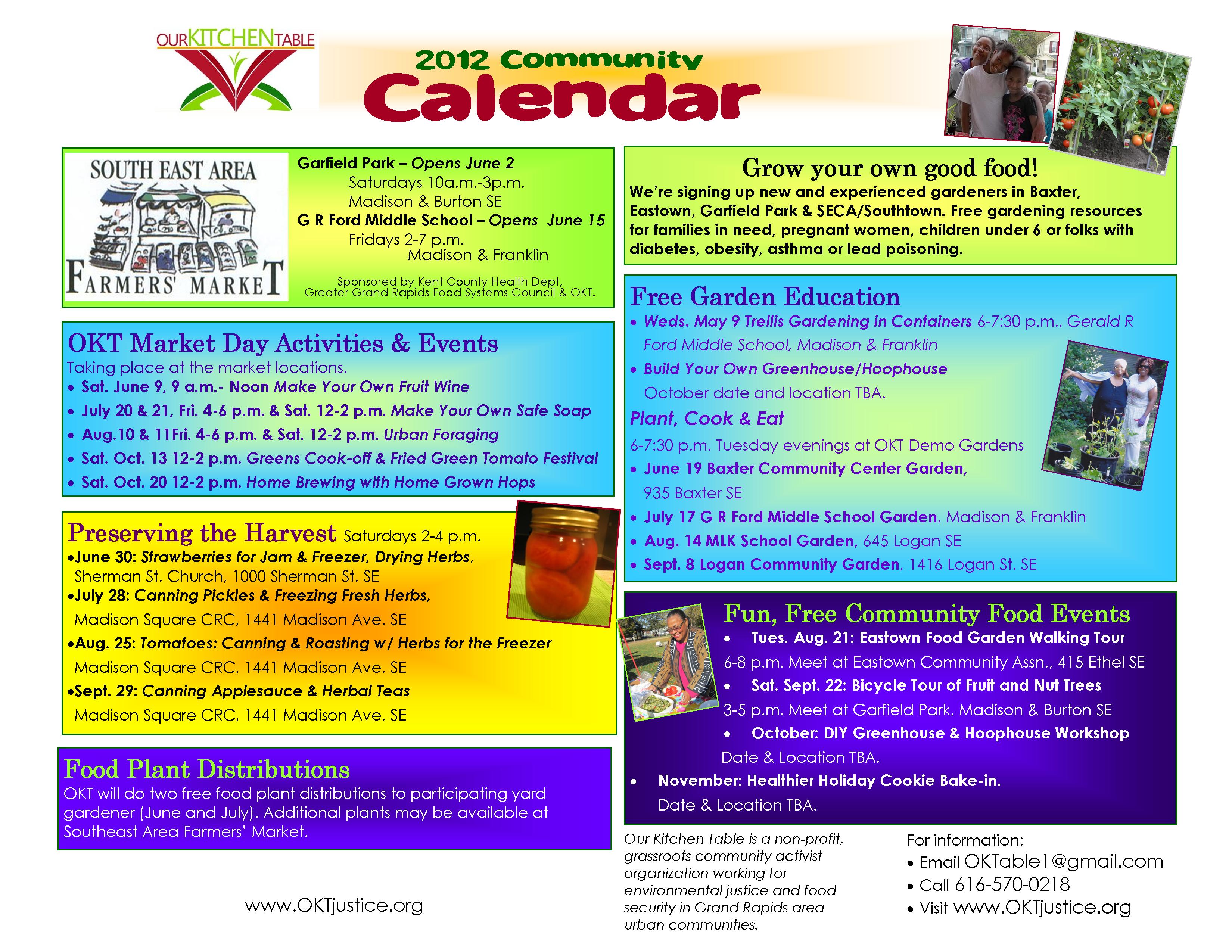
South East Area Farmers’ Market opens Saturday June 2

Come to Garfield Park next Saturday between 10 a.m. and 3 p.m. to celebrate the beginning of farmers’ market season right here on the southeast side! Market master, Yvonne Woodard of Our Kitchen Table (OKT) has vendors lined up for this small but satisfying market. These vendors will be selling chemical free produce that has been locally grown. It will be a small start as several of our regular vendors do not have produce ready yet.

The South East Area Farmers’ Market Gerald R Ford Middle School market will commence after school gets out, Friday June 15 from 2 to 7 p.m.

Both market locations participate in the following food programs: WIC Project FRESH, Market FRESH, and the Kent County WIC Pilot Project. Patrons are welcome to make their purchases with cash, checks, debit cards and EBT cards.

Those using EBT cards can get twice as much for their money with Double Up Food Bucks. For every dollar spent, $2 worth of produce can be purchased, up to $40 worth of food for $20 spent on an EBT card. That’s twice as much healthy nutrition for the dollar!

Free Webinar, The Autism Revolution: Thinking about environment and food

Healthy Food Action invites you to attend this Healthy Food, Healthy Farms Webinar Series presention 

Monday, June 11, 2012  12pm PDT/3pm EDT.

Conditions affecting children’s behavior and brain development, like autism and ADHD, are exploding in prevalence. The CDC estimates autism now is diagnosed in 1-in-88 children, a more than 70 percent increase over just six years. These increases leave many parents, and clinicians, with questions about what’s causing autism and how we can work to prevent it.

Join us on June 11 where we’ll hear from Martha Herbert, MD, PhD, a Harvard pediatric neurologist with a brand new book, The Autism Revolution: Whole body strategies for making life all it can be. Renee Dufault,a retired FDA toxicologist and former officer in the US Public Health Service, has coauthored three recent peer-reviewed studies, the latest of which has been published in the Journal of Clinical Epigenetics. The study models how certain dietary factors like vitamin deficiencies or high fructose corn syrup consumption could impact complex metabolic functions governing the body’s ability to eliminate toxic chemicals, indirectly contributing to autism and other disorders. Kathleen Schuler of the Institute for Agriculture and Trade Policy moderates.

REGISTER NOW!


This entry was posted on May 23, 2012, in Policy.

Social Justice was the focus of Health Equity Forum in Kent County

This article is reposted from GRIID.org. OKT also had opportunity to attend this forum.

“The presenters … defined health inequity as: Differences in population health status and mortality rates that are systemic, patterned, unfair, unjust, and actionable, as opposed to random or caused by those who become ill.”

On Thursday, the Kent County Health Department, Healthy Kent 2020 and the Strong Beginnings Program hosted a forum to explore the root causes of health inequality in Kent County.

Quite often the focus of health care forums is about access or looking at just individual behavior as determinants of people’s poor health. At this forum, the focus was an investigation into the structural or systemic causes of poor health.

To facilitate this conversation, the Kent County Health Department invited two staff members of the Ingham County Health Department, Dr. Renee Canady and Doak Bloss. Canady and Bloss have been doing social justice focused health analysis at their health department and facilitating workshops across the state in recent years.

The presenters expressed the importance of finding new language when talking about health inequality in America. They defined health inequity as:

Differences in population health status and mortality rates that are systemic, patterned, unfair, unjust, and actionable, as opposed to random or caused by those who become ill.

The co-facilitators then looked at the various determinants of health inequality in the US and said that things like housing, transportation, education, job security, access to health foods and a living wage were some of the determinants.

The presenters said that this was a radical departure from the traditional view of public health, which is often limited to individual behavior. However, they emphasized that class, gender and racial privilege often prevent people from seeing the systemic causes of health inequity.

It was quite refreshing to hear presenters talk about class oppression and globalization as major factors in determining people’s health. The presenters even used the language of the Occupy movement and referred to the 1% versus the 99%.

After the main presenters discussed social justice and health inequity, a staff member of the Kent County Health Department then presented data on health disparities in Kent County.

The data presented information on how many adults and children were living in poverty in Kent County, with a breakdown along racial lines. There was also data on infant mortality rates, morbidity and geographical significance.

It was clear from the data presented that there were large pockets of poor neighborhoods that were disproportionately Black and Hispanic that had greater health inequality. Blacks and Hispanics children have a higher rate of living in poverty and infant mortality rates are higher than for White children. The data also showed that poor & minority communities are 6 times more likely to report 14 or more days a year of poor health, 3 times more likely to have diabetes and 8 times more likely to have heart disease.

The social justice and health inequity forum concluded with individual tables having discussion about the information presented and how those in the health care community need to respond to the systemic injustice that exists in Kent County. However, it was recognized that the organizations in the room needed to begin with the recognition of systemic and root causes of health disparities and then develop strategies to confront the systems that maintain these disparities.

Trellis gardening workshop at Gerald R Ford School

Last Wednesday, May 9, OKT hosted a group of urban gardeners at Gerald R Ford School to learn how to build simple garden trellises. Farmer Jennifer Bongiorno showed us how using trellises not only supports plants as they grow but also can imcrease yields in small spaces and containers.

This slideshow requires JavaScript.

Weekly events planned for Southeast Area Farmers’ Market

The Southeast Area Farmers’ Market will offer more than fresh produce this year. Our Kitchen Table (OKT), the Greater Grand Rapids Food Systems Council (GGRFSC) and the Kent County Health Department (KCHD) will take turns hosting fun, educational events throughout the market season.

  • OKT will host do-it-yourself workshops on making wine, making soap, urban food foraging and brewing beer from homegrown hops.
  • The KCHD plans on bringing in staff members to share about the animal shelter, various preventive health issues and healthy eating.
  • The GGRFSC will host children’s arts and crafts activities, provide information on the dangers of genetically modified foods and hold question and answer sessions on the 2012 Farm Bill, which determines the budget for SNAP (food stamps) and local farm initiatives.

In addition, OKT is inviting local chefs to do hands-on, healthy food cooking demos—and working on some surprise celebrity appearances. Plus, market manager Yvonne Woodard will ensure that music and dancercise continues as a weekly activity.

As the market season progresses, OKT hopes to line-up even more fun and informative activities for market days. After all, the Southeast Area Farmers’ Market is more than a place to stop for produce, it’s a place where neighbors come together, make friends and build community.

OKT attending Health Equity Forum

This is a repost by Jeff Smith from

Health Equity Forum

  • Thursday, May 17
  • 9:00AM – Noon
  • Kent ISD Conference Center
  • 1633 E. Beltline Ave. NE, Grand Rapids

The forum is free and open to the public. Please register by calling 632-7100.

Next Thursday, the Kent County Health Department, Strong Beginnings and Healthy Kent 2020 will host a Health Equity forum.

The Thursday morning event will feature speakers from Ingham County’s Health Equity and Social Justice Department, Kent County data, a new video exploring issues like class, race and other health determinants.

The forum will also include a block of time for small group discussion focused on how to address these larger structural injustices to overcome health inequity throughout the county.

The forum is free and open to the public. Please register by calling 632-7100.


Trash and Burn Compost? Take action today.

This is a repost from WMEAC

Trash and Burn Compost? 

Michigan may soon be disposing of yard waste, such as leaves and grass clippings, in landfills rather than composting facilities if House Bills 4265 and 4266 are passed by the Senate and signed into law.  Having already passed the Michigan House, next Tuesday, May 15, they will be taken up by the Senate Energy and Tech Committee.

Take Action

Tell Committee Chairman Nofs you oppose HB 4265 and 4266 and ask him to instead support programs and policies that increase composting and recycling within Michigan.

In 1995 Michigan banned the disposal of yard waste in landfills, thereby reducing the need for new landfill sites and encouraging greater use of composting, turning yard waste into nutrient rich humus. Organic material such as yard trimmings, food scraps and paperboard continue to make up the largest portion of municipal solid waste in the United States. Of this waste, approximately 13 percent33 million tons per year, is made up of yard waste and trimmings.

Disposing of yard trimmings in landfills wastes resources and potentially increases greenhouse gas emissions through increased methane production.  By burying organic waste, nutrients that could have been reused to improve the health of the soil and plants are essentially being locked away.

The methane produced by the anaerobic decomposition of yard waste in landfills is supposed to be harnessed to generate electricity, but it is estimated that approximately 25 percent of the methane generated will escape.

Bills Will Cost Michigan Jobs

Finally, the reduction of yard waste composting will likely cost Michigan jobs.  It’s estimated that four composting jobs are created for every 10,000 tons per year of compostable material compared to one job for landfilling or incinerating the same material.

McDonald’s Greenwashing Campaign in Michigan

“We see it as green-washing and a destructive affront on the local food system … good food is going to waste. We can’t be deceived simply because they are buying from local farmers.” Lisa Oliver-King, OKT

This post by org

Yesterday, news media outlets all covered Michigan Governor Snyder’s visit to Conklin, Michigan as part of a press conference promoting McDonald’s contribution to the state’s economy.

The news coverage for the most part just presented the claims of Snyder and McDonald’s, with little investigation into the claim that the fast food giant’s decision to buy more Michigan produce for McDonald’s as a benefit to the local economy. While, much of the commentary focused on the local aspect of this effort, it tended to ignore the contradictions.

Snyder used the opportunity to promote the idea that Michigan sells products all around the world and he sees what McDonalds as doing is giving the state a profile for more exports. If Michigan does export more of the produce grown here, then it undermines other states and communities own ability to create locally based economies, despite this being one of the main themes of the press conference.

Even Michigan Senator Debbie Stabenow bought into the McDonald’s campaign. Stabenow posted a message on her website that read in part, “It is great that McDonald’s is buying Michigan-grown fruits, eggs, and milk-supporting Michigan farmers who are producing quality products. With its ‘From Michigan For Michigan’ campaign, McDonald’s is continuing its commitment to Michigan and our agricultural industry. When we grow things and make things in Michigan, we create jobs in Michigan.”

The general consensus from so many sectors is interesting in that it demonstrates both a lack of historical knowledge about what the fast food giant has done and how effect greenwashing is in this era of green capitalism.

If people are not familiar with the history of McDonald’s they might want to read Eric Schlosser’s booksFast Food Nation and Chew on This. Another great resource is the film McLibel, which deals with the longest legal case in British history, where the McDonald’s corporation goes after 2 activists for handing out leaflets to people about what is wrong with the fast food company. The major arguments are: 1) McDonald’s engages in deceptive advertising that targets children, 2) treats their workers poorly, 3) contributes to environmental destruction on a mass scale, 4) promotes cruelty to animals and 5) promotes poor nutrition.

McDonald’s Farm to Front Counter campaign is a classic example of greenwashing in that it is both tapping into a growing interest in people to eat “local” food and a public relations response to the scrutiny put on the fast food/junk food industries for their role in the epidemic of childhood obesity.

Local Responses

As we mentioned earlier in the article, most of the reporting on the McDonald’s Michigan campaign did not provide news consumers with many critical voices. The MLive story from yesterday did include a critical response to the McDonald’s greenwash campaign, with a comment from the Boston-based group Corporate Accountability International, which just produced a report entitled, Slowing Down Fast Food.

We talked with two local food justice organizations about their take on the announcement of the new McDonald’s campaign.

Lisa Oliver King with the Grand Rapids group Our Kitchen Table responded by saying, “We see it as green-washing and a destructive affront on the local food system. Regardless of the fact that these foods will be supplied by local agriculture, they will still be fried and have tons of salt added. The cooking approach has not changed. So, good food is going to waste. We can’t be deceived simply because they are buying from local farmers.”

We also spoke with Cynthia Price, with the group the Greater Grand Rapids Food Systems Council, which produced a Local Food Guide for West Michigan. Price said, “We’ll never move to a sustainable food, or economic, system as long as we rely on corporations like McDonalds to rehash locally grown ingredients and spit them out again as national, or even international, commodities. Only by relearning local food self-reliance will we be able to develop a just and balanced human-scale food system, and, for that matter, establish a stable base for a truly viable economy that values people and place and not just profits.”

Blandford Nature Center holding foraging classes each season

Blandford Nature Center is hosting forgaing classes each season starting Thursday, May 10 with “Wild Foraging in May.” The class will take place at the visitor’s center and on the trails from 5 to 6:30 p.m.  According to Blandford’s website, “We will discuss healthy and responsible ways to harvest nature’s bounty and experience the delicious flavors of spring.”

A summer foraging class is slated for June 28. This adult-level class is open to people ages 12+ and costs $10 for members, and $12 for non-members. Enrollment is limited to 30 so call to register, (616)735-6240.

Blandford’s Kristin Tindall helped out at an urban foraging workshop sponsored by OKT and The Bloom Collective last year. She will be back again August 12 to lead our free 2012 urban foraging workshop.