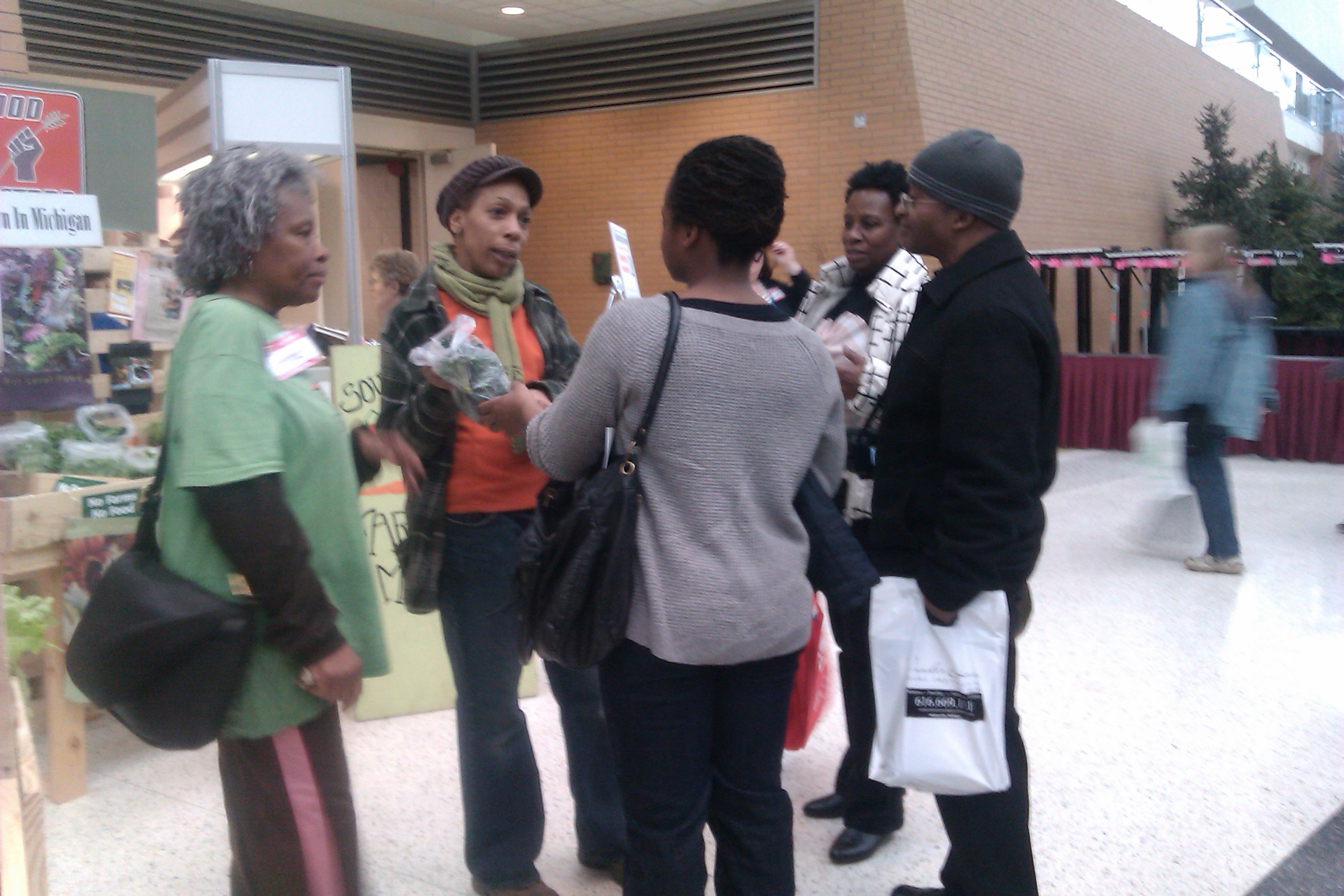
More than 25 community members gathered last Saturday morning at Baxter Community Center for an informative class on Living Soil and Plant life presented by OKT collaborative partner, Clinton Boyd, PhD. The members of the OKT team appreciate Clinton’s contributions to our work as he shares his knowledge and sees to it that all of our gardeners and market vendors have their soil tested for chemical contaminants.
Women led historical movement for farmers’ markets in Grand Rapids
This story also appears on www.GRIID.org
On Thursday March 8, anthropologist Jayson Otto shared the history of Grand Rapids’ farmers’ markets as part of the Greater Grand Rapids Women’s History Council “Grand Rapids Women and the Politics of Agriculture” series. From 1800 through 1946, the number of farmers’ markets steadily rose throughout the US. Grand Rapids was very much a part of this trend, especially from 1914 through 1928, when food costs soared due to the rising dominance of industrialized food production and distribution.
While industry leaders heavily influenced city government to quash the rise of farmers’ markets here, two forces prevented this from happening: farmers resisting through civil disobedience and women working together in a local movement to keep the markets open. As the women of OKT are working for food security in Grand Rapids neighborhoods through the Southeast Area Farmers’ Market and food gardening programs today, we found this information extremely interesting.
The other sources for food in the city were the many neighborhood grocers as well as the hucksters, underclass folks who sold produce from their carts. The grocers had the power to approve which hucksters could sell this food–and often it was not very fresh.
Around the turn of the century, grocers and food brokers influenced City Hall to outlaw farmers from retailing their wares along stretches of downtown streets, as was their custom. Retailing was discouraged at the wholesale market, which was a food distribution hub to all of Michigan and beyond. However, the small farmers continued to set up their illegal retail stalls–and people continued to go to them for fresh produce for some time. A woman vegetable grower from Wyoming, Mrs. Stall, was among those who resisted.was
According to history that Otto was able to unearth, one tough market advocate who made the press of that day, August Raditz, a white working class woman living on South Division Avenue. She was known for being handy with a scythe and standing up to city hall.
However, upper class white “club” women, Eleanor Nickleson, Helen Russell, Eva Hamilton and Emily Chamberlain were the identified leaders of the woman-led movement. They gathered momentum to establish retail farmers’ markets through a “High Cost of Living” campaign that eventually garnered support from the local Cabinetmakers union, businessman, Charles Leonard, of refrigerator fame, and the mayor of Grand Rapids. (Hamilton went on to be Michigan’s first woman senator). I n spite a strong opposition by male civic leaders, the result was three permanent farmers’ markets in the city: Leonard Street Market, South Division Market (at Cottage Grove) and Fulton Street Market.
When the farmers’ markets were met with threats of being closed in 1934 and 1955, women-led initiatives kept them open. While Otto was able to find photos and information about the Leonard Street Market up to its destruction in the 60s by urban renewal, the demise of the South Division market s seems to be undocumented. He guessed that the 1968 racial uprising may have been the cause.
The encouraging part of Otto’s presentation was the radical role that women have taken in establishing food security in Grand Rapids in the past. The discouraging piece was the lack of historical data around the role that people of color played in Grand Rapids farmers’ market history.
Do you have any recollections of the South Division Market or other farmers’ markets serving Grand Rapids people of color? If yes, please contact us at OKTable1@gmail.com. Knowing this history could bring another lost bit of important Black history to well deserved light.
Gardening where you live
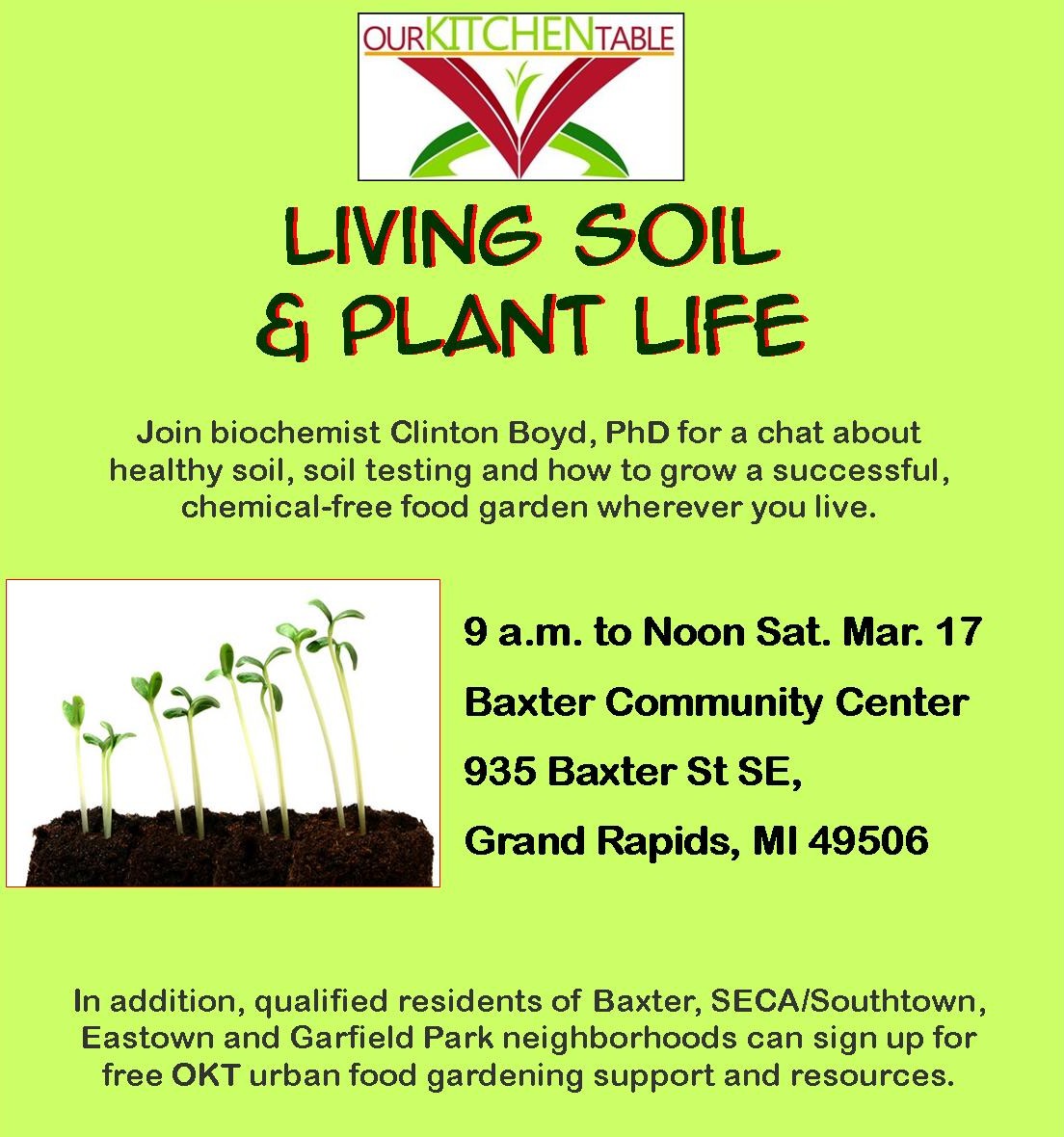
Living Soil & Plant Life
9 a.m. to Noon Sat. Mar. 17
Baxter Community Center
935 Baxter St SE,
Grand Rapids, MI 49506
This Saturday, Our Kitchen Table hosts the garden education workshop “Living Soil & Plant Life.” Join biochemist Clinton Boyd, PhD for an enlightening chat about healthy soil, soil testing and how to grow a successful, chemical-free food garden wherever you live.
Do you live in the Eastown, SECA/Southtown, Baxter or Garfield Park neighborhood? OKT is looking for more folks to join our yard-gardeners program. OKT yard gardeners are provided valuable gardening resources including organic starter food plants, compost, containers for container gardening, garden tools and a garden coach.
Working with neighborhood folks to grow food in their yards or on their porches and patios is one way to bring more healthy food into our urban communities.
For information on signing up to be an OKT food gardener, email OKTable1@gmail.com or call 616-570-0812.
Take action against proposed changes in Michigan yard waste laws
Trash and Burn Compost in 2012? Michigan may soon be disposing of yard waste, such as leaves and grass clippings, in landfills rather than composting facilities if House Bills 4265 and 4266 are passed and signed into law.
In 1995, Michigan banned the disposal of yard waste in landfills, thereby reducing the need for new landfill sites and encouraging greater use of composting, turning yard waste into nutrient rich humus. Organic material such as yard trimmings, food scraps and paperboard continue to make up the largest portion of municipal solid waste in the United States. Of this waste, approximately 13 percent, 33 million tons per year, is made up of yard waste and trimmings.
Disposing of yard trimmings in landfills wastes resources, reduces recycling, potentially increases greenhouse gas emissions through increased methane production, and costs Michigan jobs. By burying organic waste, nutrients that could have been reused to improve the health of the soil and plants are essentially being locked away.
Take Action
OKT featured at West Michigan Home and Garden Show
Our Kitchen Table (OKT) and its Southeast Area Farmers’ Market (SEAFM) staff were part of the crew staffing the “Cultivating Change: A Local Food Showcase” at the 33rd Annual West Michigan Home and Garden Show held at DeVos Place March 1 – 4. OKT’s executive director, Lisa Oliver-King, presented two workshops, “How to Plan Your Home Food Garden” and “How to Grow Healthy Soil.”
OKT’s Yvonne Woodard, SEAFM market manager, filled in at the farmers’ market display. One of the SEAFM’s partner organizations, Greater Grand Rapids Food Systems Council, presented on “Gardening and Composting.”
“It’s always been important for the West Michigan Home and Garden Show to be a part of the community,” said Carolyn Alt, Show Manager. “The work these organizations are doing is important to gardening and the food we are eating. Eating local and growing your own food are so core to the local community.”
Other local foods entities taking part in the Showcase included Groundswell Farm, Real Food Farm, Green Wagon Farm, Earthkeeper Farm, Uptown Kitchen, Farm Link, West Michigan Co-op, Slow Food and Nourishing Ways.
While Our Kitchen Table prefers to engage in activities within the neighborhoods we serve, this was a good opportunity to get the word out that food insecurity exists in the Grand Rapids area and that OKT and the Southeast Area Farmers’ Market are doing something to address it. OKT staff participating at the event did have several meaningful conversations with potential neighborhood gardeners and other local entities involved in the work for better access to healthy local foods.
In addition, the OKT booth provided reprints from our Website on the topics of seed sovereignty, Occupy Food! and the 2012 Farm Bill as well as a Politics of Food zine and our new Community Calendar.
Whole Foods Market, Organic Valley and Stonyfield Farm in league with Monsanto
This article by Ronnie Cummins is reposted from the Organic Consumers Association.

According to informed sources, the CEOs of WFM and Stonyfield are personal friends of former Iowa governor, now USDA Secretary, Tom Vilsack, and in fact made financial contributions to Vilsack’s previous electoral campaigns. Vilsack was hailed as “Governor of the Year” in 2001 by the Biotechnology Industry Organization, and traveled in a Monsanto corporate jet on the campaign trail.
“The policy set for GE alfalfa will most likely guide policies for other GE crops as well. True coexistence is a must.” – Whole Foods Market, Jan. 21, 2011
In the wake of a 12-year battle to keep Monsanto’s Genetically Engineered (GE) crops from contaminating the nation’s 25,000 organic farms and ranches, America’s organic consumers and producers are facing betrayal. A self-appointed cabal of the Organic Elite, spearheaded by Whole Foods Market, Organic Valley, and Stonyfield Farm, has decided it’s time to surrender to Monsanto. Top executives from these companies have publicly admitted that they no longer oppose the mass commercialization of GE crops, such as Monsanto’s controversial Roundup Ready alfalfa, and are prepared to sit down and cut a deal for “coexistence” with Monsanto and USDA biotech cheerleader Tom Vilsack.
In a cleverly worded, but profoundly misleading email sent to its customers last week, Whole Foods Market, while proclaiming their support for organics and “seed purity,” gave the green light to USDA bureaucrats to approve the “conditional deregulation” of Monsanto’s genetically engineered, herbicide-resistant alfalfa. Beyond the regulatory euphemism of “conditional deregulation,” this means that WFM and their colleagues are willing to go along with the massive planting of a chemical and energy-intensive GE perennial crop, alfalfa; guaranteed to spread its mutant genes and seeds across the nation; guaranteed to contaminate the alfalfa fed to organic animals; guaranteed to lead to massive poisoning of farm workers and destruction of the essential soil food web by the toxic herbicide, Roundup; and guaranteed to produce Roundup-resistant superweeds that will require even more deadly herbicides such as 2,4 D to be sprayed on millions of acres of alfalfa across the U.S.
In exchange for allowing Monsanto’s premeditated pollution of the alfalfa gene pool, WFM wants “compensation.” In exchange for a new assault on farmworkers and rural communities (a recent large-scale Swedish study found that spraying Roundup doubles farm workers’ and rural residents’ risk of getting cancer), WFM expects the pro-biotech USDA to begin to regulate rather than cheerlead for Monsanto. In payment for a new broad spectrum attack on the soil’s crucial ability to provide nutrition for food crops and to sequester dangerous greenhouse gases (recent studies show that Roundup devastates essential soil microorganisms that provide plant nutrition and sequester climate-destabilizing greenhouse gases), WFM wants the Biotech Bully of St. Louis to agree to pay “compensation” (i.e. hush money) to farmers “for any losses related to the contamination of his crop.”
In its email of Jan. 21, 2011 WFM calls for “public oversight by the USDA rather than reliance on the biotechnology industry,” even though WFM knows full well that federal regulations on Genetically Modified Organisms (GMOs) do not require pre-market safety testing, nor labeling; and that even federal judges have repeatedly ruled that so-called government “oversight” of Frankencrops such as Monsanto’s sugar beets and alfalfa is basically a farce. At the end of its email, WFM admits that its surrender to Monsanto is permanent: “The policy set for GE alfalfa will most likely guide policies for other GE crops as well True coexistence is a must.”
Why Is Organic Inc. Surrendering?
According to informed sources, the CEOs of WFM and Stonyfield are personal friends of former Iowa governor, now USDA Secretary, Tom Vilsack, and in fact made financial contributions to Vilsack’s previous electoral campaigns. Vilsack was hailed as “Governor of the Year” in 2001 by the Biotechnology Industry Organization, and traveled in a Monsanto corporate jet on the campaign trail. Perhaps even more fundamental to Organic Inc.’s abject surrender is the fact that the organic elite has become more and more isolated from the concerns and passions of organic consumers and locavores.
The Organic Inc. CEOs are tired of activist pressure, boycotts, and petitions. Several of them have told me this to my face. They apparently believe that the battle against GMOs has been lost, and that it’s time to reach for the consolation prize. The consolation prize they seek is a so-called “coexistence” between the biotech Behemoth and the organic community that will lull the public to sleep and greenwash the unpleasant fact that Monsanto’s unlabeled and unregulated genetically engineered crops are now spreading their toxic genes on 1/3 of U.S. (and 1/10 of global) crop land.
WFM and most of the largest organic companies have deliberately separated themselves from anti-GMO efforts and cut off all funding to campaigns working to label or ban GMOs. The so-called Non-GMO Project, funded by Whole Foods and giant wholesaler United Natural Foods (UNFI) is basically a greenwashing effort (although the 100% organic companies involved in this project seem to be operating in good faith) to show that certified organic foods are basically free from GMOs (we already know this since GMOs are banned in organic production), while failing to focus on so-called “natural” foods, which constitute most of WFM and UNFI’s sales and are routinely contaminated with GMOs.
From their “business as usual” perspective, successful lawsuits against GMOs filed by public interest groups such as the Center for Food Safety; or noisy attacks on Monsanto by groups like the Organic Consumers Association, create bad publicity, rattle their big customers such as Wal-Mart, Target, Kroger, Costco, Supervalu, Publix and Safeway; and remind consumers that organic crops and foods such as corn, soybeans, and canola are slowly but surely becoming contaminated by Monsanto’s GMOs.
Whole Foods’ Dirty Little Secret: Most of the So-Called “Natural” Processed Foods and Animal Products They Sell Are Contaminated with GMOs
The main reason, however, why Whole Foods is pleading for coexistence with Monsanto, Dow, Bayer, Syngenta, BASF and the rest of the biotech bullies, is that they desperately want the controversy surrounding genetically engineered foods and crops to go away. Why? Because they know, just as we do, that 2/3 of WFM’s $9 billion annual sales is derived from so-called “natural” processed foods and animal products that are contaminated with GMOs. We and our allies have tested their so-called “natural” products (no doubt WFM’s lab has too) containing non-organic corn and soy, and guess what: they’re all contaminated with GMOs, in contrast to their certified organic products, which are basically free of GMOs, or else contain barely detectable trace amounts.
Approximately 2/3 of the products sold by Whole Foods Market and their main distributor, United Natural Foods (UNFI) are not certified organic, but rather are conventional (chemical-intensive and GMO-tainted) foods and products disguised as “natural.”
Unprecedented wholesale and retail control of the organic marketplace by UNFI and Whole Foods, employing a business model of selling twice as much so-called “natural” food as certified organic food, coupled with the takeover of many organic companies by multinational food corporations such as Dean Foods, threatens the growth of the organic movement.
Covering Up GMO Contamination: Perpetrating “Natural” Fraud
Many well-meaning consumers are confused about the difference between conventional products marketed as “natural,” and those nutritionally/ environmentally superior and climate-friendly products that are “certified organic.”
Retail stores like WFM and wholesale distributors like UNFI have failed to educate their customers about the qualitative difference between natural and certified organic, conveniently glossing over the fact that nearly all of the processed “natural” foods and products they sell contain GMOs, or else come from a “natural” supply chain where animals are force-fed GMO grains in factory farms or Confined Animal Feeding Operations (CAFOs).
A troubling trend in organics today is the calculated shift on the part of certain large formerly organic brands from certified organic ingredients and products to so-called “natural” ingredients. With the exception of the “grass-fed and grass-finished” meat sector, most “natural” meat, dairy, and eggs are coming from animals reared on GMO grains and drugs, and confined, entirely, or for a good portion of their lives, in CAFOs.
Whole Foods and UNFI are maximizing their profits by selling quasi-natural products at premium organic prices. Organic consumers are increasingly left without certified organic choices while genuine organic farmers and ranchers continue to lose market share to “natural” imposters. It’s no wonder that less than 1% of American farmland is certified organic, while well-intentioned but misled consumers have boosted organic and “natural” purchases to $80 billion annually-approximately 12% of all grocery store sales.
The Solution: Truth-in-Labeling Will Enable Consumers to Drive So-Called “Natural” GMO and CAFO-Tainted Foods Off the Market
There can be no such thing as “coexistence” with a reckless industry that undermines public health, destroys biodiversity, damages the environment, tortures and poisons animals, destabilizes the climate, and economically devastates the world’s 1.5 billion seed-saving small farmers.
There is no such thing as coexistence between GMOs and organics in the European Union. Why? Because in the EU there are almost no GMO crops under cultivation, nor GM consumer food products on supermarket shelves. And why is this? Because under EU law, all foods containing GMOs or GMO ingredients must be labeled. Consumers have the freedom to choose or not to choose GMOs; while farmers, food processors, and retailers have (at least legally) the right to lace foods with GMOs, as long as they are safety-tested and labeled.
Of course the EU food industry understands that consumers, for the most part, do not want to purchase or consume GE foods. European farmers and food companies, even junk food purveyors like McDonald’s and Wal-Mart, understand quite well the concept expressed by a Monsanto executive when GMOs first came on the market: “If you put a label on genetically engineered food you might as well put a skull and crossbones on it.”
The biotech industry and Organic Inc. are supremely conscious of the fact that North American consumers, like their European counterparts, are wary and suspicious of GMO foods. Even without a PhD, consumers understand you don’t want your food safety or environmental sustainability decisions to be made by out-of-control chemical companies like Monsanto, Dow, or Dupont – the same people who brought you toxic pesticides, Agent Orange, PCBs, and now global warming.
Industry leaders are acutely aware of the fact that every single industry or government poll over the last 16 years has shown that 85-95% of American consumers want mandatory labels on GMO foods. Why? So that we can avoid buying them. GMO foods have absolutely no benefits for consumers or the environment, only hazards. This is why Monsanto and their friends in the Bush, Clinton, and Obama administrations have prevented consumer GMO truth-in-labeling laws from getting a public discussion in Congress.
Although Congressman Dennis Kucinich (Democrat, Ohio) recently introduced a bill in Congress calling for mandatory labeling and safety testing for GMOs, don’t hold your breath for Congress to take a stand for truth-in-labeling and consumers’ right to know what’s in their food. Especially since the 2010 Supreme Court decision in the so-called Citizens United case gave big corporations and billionaires the right to spend unlimited amounts of money (and remain anonymous, as they do so) to buy media coverage and elections, our chances of passing federal GMO labeling laws against the wishes of Monsanto and Food Inc. are all but non-existent.
Perfectly dramatizing the “Revolving Door” between Monsanto and the Federal Government, Supreme Court Justice Clarence Thomas, formerly chief counsel for Monsanto, delivered one of the decisive votes in the Citizens United case, in effect giving Monsanto and other biotech bullies the right to buy the votes it needs in the U.S. Congress.
With big money controlling Congress and the media, we have little choice but to shift our focus and go local. We’ve got to concentrate our forces where our leverage and power lie, in the marketplace, at the retail level; pressuring retail food stores to voluntarily label their products; while on the legislative front we must organize a broad coalition to pass mandatory GMO (and CAFO) labeling laws, at the city, county, and state levels.
The Organic Consumers Association, joined by our consumer, farmer, environmental, and labor allies, has just launched a nationwide Truth-in-Labeling campaign to stop Monsanto and the Biotech Bullies from force-feeding unlabeled GMOs to animals and humans.
Utilizing scientific data, legal precedent, and consumer power the OCA and our local coalitions will educate and mobilize at the grassroots level to pressure giant supermarket chains (Wal-Mart, Kroger, Costco, Safeway, Supervalu, and Publix) and natural food retailers such as Whole Foods and Trader Joe’s to voluntarily implement “truth-in-labeling” practices for GMOs and CAFO products; while simultaneously organizing a critical mass to pass mandatory local and state truth-in-labeling ordinances – similar to labeling laws already in effect for country of origin, irradiated food, allergens, and carcinogens.
If local and state government bodies refuse to take action, wherever possible we must attempt to gather sufficient petition signatures and place these truth-in-labeling initiatives directly on the ballot in 2011 or 2012. If you’re interested in helping organize or coordinate a Millions Against Monsanto and Factory Farms Truth-in-Labeling campaign in your local community, sign up here: http://organicconsumers.org/oca-volunteer/
Power to the People! Not the Corporations! Sign the petition.To pressure Whole Foods Market and the nation’s largest supermarket chains to voluntarily adopt truth-in-labeling practices sign here, and circulate this petition widely:http://www.organicconsumers.org/articles/article_22309.cfm
March 17, OKT Garden Education Series: Living Soil & Plant Life
Market planning wraps up next week

Planning the farmers’ market. Top, Left to right: Roni VanBuren (OKT), Tom Cary (GGRFSC), Lisa Oliver-King (OKT), Lila Cabbil (Rosa Parks Institute), Beverly Weathersby (OKT), Sheri Munsell (OKT), Jill Myer(KCHD), Bottom, left to right: Cynthia Price (GGRFSC), Candace Chivis(GGRFSC), Yvonne Woodard (OKT) and Leslie Huffman (OKT).
The three partners sponsoring the Southeast Area Farmer’s Market (SEAFM) are wrapping up their planning sessions next week. The partners include Kent County Health Department (KCHD), Greater Grand Rapids Food Systems Council (GGRFSC) and Our Kitchen Table (OKT). OKT has taken the lead management role for the farmers’ market. Grant dollars from the Kellogg Foundation pay for the OKT staff managing and promoting the market as well as for the seeds that are being planted this week in the greenhouse. Many of the starter food plants grown from these seeds will result in food harvested and sold at the market by neighborhood growers.
It has been a long, sometimes tedious and often intense process—a process that has often come smack up against the institutional racism that has led to food insecurity in urban neighborhoods across the nation. OKT surveys of neighborhood residents have shown that, contrary to some experts’ beliefs, Grand Rapids’ southeast neighborhoods are not food deserts. Many folks are growing their own food in their yards or in community garden plots.
However, many more do not have access to a wide range of healthy foods as corner stores and fast food restaurants remain major food sources—and they often offer foods that lead to obesity, diabetes, heart problems and, among children, behavior issues.
That’s why this farmers’ market is so important. Everyone, no matter what their income level or which neighborhood they live in, deserves access to safe, fresh local produce and other health-giving foods. Ultimately, the Southeast Area Farmers’ Market belongs to people in our neighborhoods. Please come on board as an additional partner in the market! Not a silent partner—spread the word that fresh food is coming back to the neighborhood this June. And feel free to tell OKT what we can do better to make the market truly belong to community.
OKT’s signing up food gardeners!
Are you interested in planting your own food garden and don’t know where to start? Do you have a food garden and want to find ways to make it more productive? OKT is currently signing up qualified residents of Baxter, SECA/Southtown, Eastown and Garfield Park neighborhoods to participate in this year’s food growing program.
These food gardeners will be able to access garden resources such as organic starter food plants, chemical free compost, soil testing and garden coaching. Starter food plants will be distributed twice to participating gardeners—the beginning of June, when the gardens are first planted, and again in July, when cold crops can be planted.
Ms. Weathersby will again lead OKT’s Garden Posse, coaching southeast Grand Rapids gardeners participating in OKT’s food gardening program. Last year, for the most part, our gardeners rented their homes; food plants were grown in containers.
The women of OKT are hoping even more Southeast area neighbors will join us in growing and sharing even more fresh, healthy food. For information, visit www.OKTjustice.org or call 616-570-0218.
Global Day of Action: Occupy Our Food Supply February 27
Global Day of Action: Occupy Our Food Supply
An alliance of Occupy groups, environmental and food justice organizations have called for a global day of action on February 27 to resist corporate control of our food system and to work towards a healthy food supply for all.
Occupy Our Food Supply is a call facilitated by Rainforest Action Network and is supported by over 60 Occupy groups and over 30 organizations including Family Farm Defenders, National Family Farms Coalition and Pesticide Action Network.
Ashley Schaeffer, Rainforest Agribusiness campaigner with Rainforest Action Network says of the day of action:
“Occupy our Food Supply is a day to reclaim our most basic life support system – our food – from corporate control. It is an unprecedented day of solidarity to create local, just solutions that steer our society away from the stranglehold of industrial food giants like Cargill and Monsanto,”
Occupy Our Food Supply supporter Vandana Shiva says:
“Our food system has been hijacked by corporate giants from the Seed to the table. Seeds controlled by Monsanto, agribusiness trade controlled by Cargill, processing controlled by Pepsi and Philip Morris, retail controlled by Walmart – is a recipe for Food Dictatorship. We must Occupy the Food system to create Food Democracy.”
Occupy Wall Street’s Sustainability and Food Justice Committees also issued a letter in support of the day of action:
“On Monday, February 27th, 2012, OWS Food Justice, OWS Sustainability, Oakland Food Justice & the worldwide Occupy Movement invite you to join the Global Day of Action to Occupy the Food Supply. We challenge the corporate food regime that has prioritized profit over health and sustainability. We seek to create healthy local food systems. We stand in Solidarity with Indigenous communities, and communities around the world, that are struggling with hunger, exploitation, and unfair labor practices.”
“On this day, in New York City, community gardeners, activists, labor unions, farmers, food workers, and citizens of the NYC metro area, will gather at Zuccotti Park at noon, for a Seed Exchange, to raise awareness about the corporate control of our food system and celebrate the local food communities in the metro area.”
Vandana Shiva: “We must Occupy the Food system to create Food Democracy.”
“When our food is at risk, we are all at risk.”
In an op-ed on the Huffington Post today, Farm Aid president Willie Nelson and sustainable food advocate Anna Lappé, supporters of the day of action, emphasize that the consolidation of our food supply is harming the environment, food safety and farmers:
Our food is under threat. It is felt by every family farmer who has lost their land and livelihood, every parent who can’t find affordable or healthy ingredients in their neighborhood, every person worried about foodborne illnesses thanks to lobbyist-weakened food safety laws, every farmworker who faces toxic pesticides in the fields as part of a day’s work.
When our food is at risk we are all at risk.
Over the last thirty years, we have witnessed a massive consolidation of our food system. Never have so few corporations been responsible for more of our food chain. Of the 40,000 food items in a typical U.S. grocery store, more than half are now brought to us by just 10 corporations. Today, three companies process more than 70 percent of all U.S. beef, Tyson, Cargill and JBS. More than 90 percent of soybean seeds and 80 percent of corn seeds used in the United States are sold by just one company: Monsanto. Four companies are responsible for up to 90 percent of the global trade in grain. And one in four food dollars is spent at Walmart.
What does this matter for those of us who eat? Corporate control of our food system has led to the loss of millions of family farmers, the destruction of soil fertility, the pollution of our water, and health epidemics including type 2 diabetes, heart disease, and even certain forms of cancer. More and more, the choices that determine the food on our shelves are made by corporations concerned less with protecting our health, our environment, or our jobs than with profit margins and executive bonuses.
This consolidation also fuels the influence of concentrated economic power in politics: Last year alone, the biggest food companies spent tens of millions lobbying on Capitol Hill with more than $37 million used in the fight against junk food marketing guidelines for kids.
The Occupy Our Food Supply website indicates that the action is Inspired by the theme of CREATE/RESIST, and that in addition to confronting the corporation control of our food supply, we must work towards solutions to make healthy food accessible to everyone. It invites people to share their fair food solutions on their Facebook page and on Twitter using the #F27 hashtag.
* * *
Eric Holt-Giménez, Institute for Food and Development Policy/Food First Executive Director, writes that while the demand to fix the food system seems reasonable, it does not address the “inequitable foundations of the global food system.”
The goal of food justice activists is a sustainable and equitable food system. Their strategy is to actively construct this alternative. Tactics include community gardens, CSAs, organic farming, etc. The problem is that this combination of strategy and tactics only addresses individual and institutional inequities in the food system, leaving the structure of the corporate food regime intact. The food justice movement has no strategy to address the inter-institutional (i.e. structural) ways that inequity is produced in the food system. By openly protesting the excesses of capitalism, Occupy does address this structure. This is why the convergence of Occupy and the food justice movement is so potentially powerful — and why it is feared. The political alignment of these movements, however, is no small challenge.