Reposted from Rapid Growth Media
“It is great to grow food, but more importantly when we begin to look at the landscape, how do we understand policy?” Lisa Oliver-King
RG Community Connect: Collaboration is key in working toward a more just food system in Kent County
GRATIA LEE | WEDNESDAY, NOVEMBER 16, 2022
If you feel stretched by the increase in food prices in recent months, you are not alone. As inflation affects food costs across the country, more and more people are food insecure. According to the White House National Strategy on Hunger, Nutrition, and Health, “there is no silver bullet to address these complex issues and there is no overnight fix. Making progress requires collective, sustained action and mobilization across every segment of society.” That document, plus a newly updated Michigan Good Food (MI GF) Charter by Michigan State University, are poised to guide important changes to our current food system — one where “junk food”: high-calorie, low-nutrient food is more affordable than nutrient-dense “whole” foods like fruits, nuts and vegetables.
While national changes are sure to be difficult in this partisan climate, these documents both provide a clear framework for smaller, local organizations to collaborate toward more resilient food systems and echo the work that is already being done. The MI GF Charter “calls for systemic change by supporting food systems that ensure food is accessible to everyone, promote healthy communities, use fair and sustainable production methods and support a diverse and equitable society.”
It is encouraging that this type of work is currently happening in our community. “It’s a tension between meeting immediate needs and long-term, systemic solutions,” says Janelle Vandergrift, co-chair of the recently formed Kent County Food Policy Council (KCFPC). “Because immediate needs are so great right now it can take so much of our attention, but we still need to be able to zoom out and look at the system as a whole and see what needs to change,” she says. The Food Policy Council is set to begin work on a countywide community food assessment with the hope that the process will involve a lot of community feedback on the strengths and weaknesses of our current system.
Despite the myriad challenges, Wende Randall, director of the Kent County Essential Needs Task Force, finds room for hope. “I am energized by the coming together of grassroots groups, exploring how close neighborhoods or small groups can work together and some larger organizations activating practices of food justice that support local businesses and families,” she says.
For the Good Food team at Access of West Michigan, systemic change in the charitable food system has been a top priority for the past five years, as it works to educate and collaborate alongside partners focusing on the importance of dignified access to healthy, affordable, culturally relevant food.
One of its programs, Refresh Now, is a collaboration with two local health clinics to run a fresh fruit and vegetable prescription program that helps patients with chronic disease or high-risk factors access nourishing foods. “Food as medicine projects have the potential for making a significant impact on public health, especially in communities with significant health disparities,” says Randall.
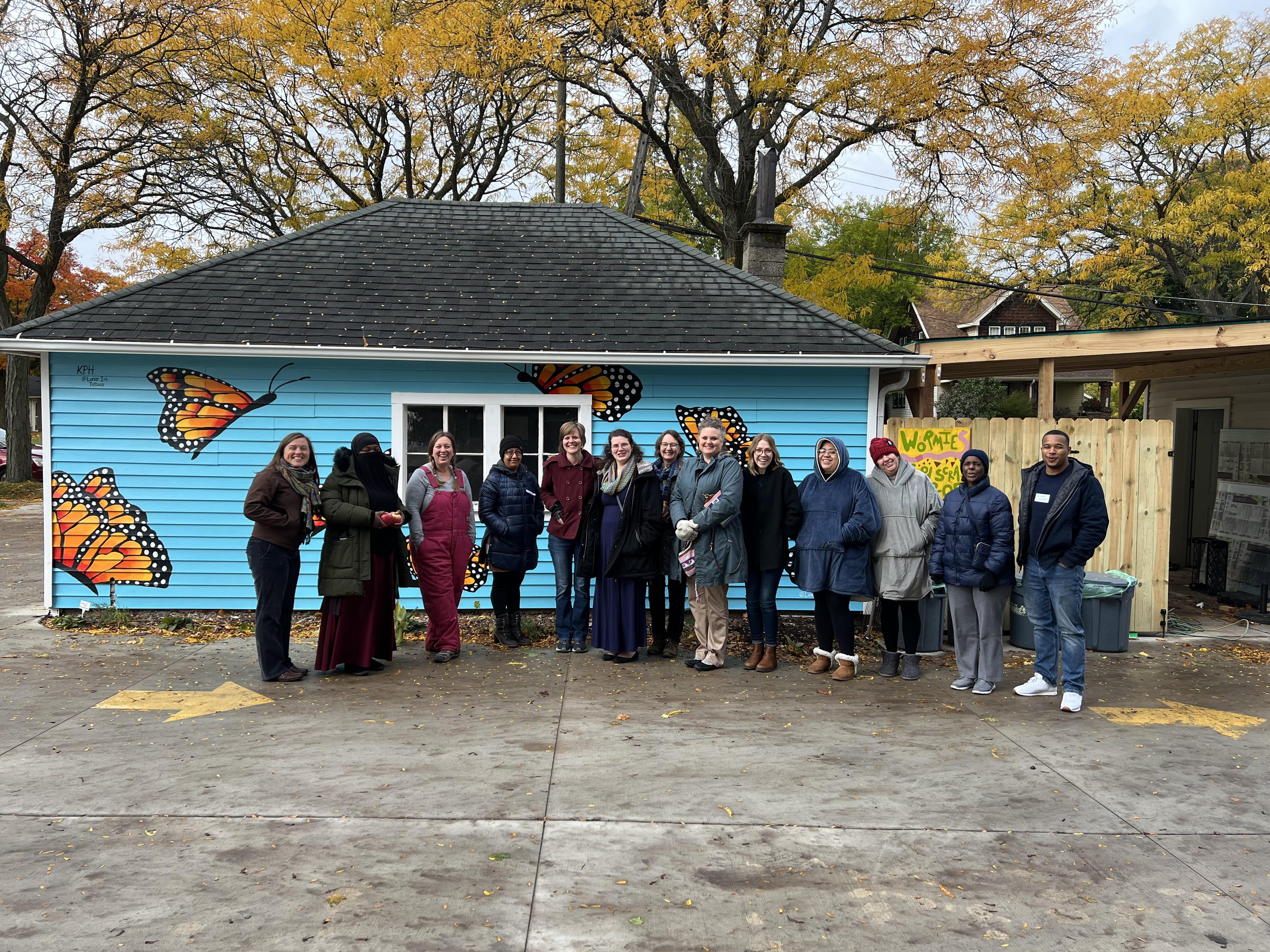
Another exciting project is a collaboration between New City Farm and Fresh Markets that we helped launch over the past five years. These are hyperlocal, innovative food retail sites in low food balance areas of Kent County. This project has been powerful as it has been influenced by and designed with community member feedback — due to being able to share space with individuals who frequent the Fresh Markets and get direct feedback on what could be done better, what they want to have available in the markets from local farms and how the Fresh Markets can continue to be a beacon of health in their neighborhoods.
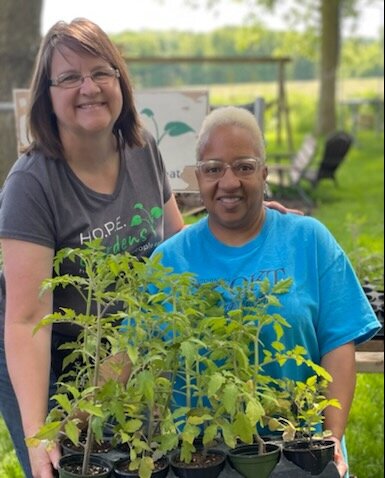 Lisa Oliver King and Julie BrunsonOne of the most active organizations doing important grassroots work in Grand Rapids is Our Kitchen Table (OKT). Founded in 2005 as a mobilizing group for moms around the dangers of lead and radon in homes, Executive Director, Lisa Oliver-King continued conversations in her community and quickly realized that a major injustice was food. Since 2010 when they received their first grant, OKT has worked tirelessly on the southeast side of the city. Oliver-King stressed the importance of being active in your community. While growing food and teaching community members about healthy cooking is a tool they use, Oliver-King stresses that “the justice lens … is crucial.”
“It is great to grow food, but more importantly when we begin to look at the landscape, how do we understand policy?,” she says. “The reality is you are always bumping up against policy. You need to show up at city commission and county commission meetings. How can we build a collective influence to bring about the change we want to see?”
As most have learned through experience, “being a part of systems work is realizing there are many entry points, not just one,” says Vandergrift. It is important to find your passion and start there. As a community member on the KCFPC, Samika Douglas is looking forward to “sharing the needs of the community and the barriers they are facing, as well as advocating for resources and services that are so needed.” Randall emphasized the need for shared language in this work and being able “to consider the assets of the community rather than just the deficits.”
As the trajectory to reimagining more equitable food systems advances, the community must keep moving forward. Many of the most successful programs happening locally are those that prioritize resident feedback from and are authentically driven by the needs of those most affected by issues of food security. “While there is a lot of good work in our community being done, it is important to remember that in working on multi-levels, things might not happen as fast as you would like for them to happen,” says Oliver-King. “But, figuring out how you can still support the work in some kind of way because the more of a puzzle that we fit together, the better off our community is. We are all individual pieces that must connect to bring about those changes that will address the issue of being food insecure.”
Photos courtesy of Our Kitchen Table and Access of West Michigan
Gratia Lee is the Good Food Systems Director at Access of West Michigan. She moved back to MI in June 2021 and looks forward to engaging with the community around shared goals of increased health equity and improved food access. She is passionate about the environment and sees food as an important entry point to connect people to one another and our planet.






 Our Kitchen Table