Here’s how it can be rescued to improve people’s health.
Reposted from Second Wave-Michigan State of Health Series

Food Rescue US reports that over 50 million Americans are food insecure, while over 40 billion meals are wasted each year — and 40% of the U.S. food supply rots in landfills. The solution is obvious: deliver this food to people who need it instead of to the dump. Food rescue operations in Michigan are doing their best to make that happen – and positively affecting public health in the process.
According to a Centers for Disease Control report, A Public Health Opportunity Found in Food Waste, “The United States has an epidemic of food insecurity and obesity that coexists in the same population (low-income families on a budget). Moreover, fruits and vegetables, which are linked to improving health and preventing chronic disease, are also perishable and commonly wasted.”
Obesity and the chronic diseases associated with it — diabetes, heart disease, stroke, hypertension, sleep apnea, and some cancers — are only a few of the medical issues resulting from poor nutrition. Behavioral health issues can take root in a poor diet, too. And as housing, childcare, and transportation costs viciously outpace wages, more and more working families are finding themselves without the means to provide good food for their families.
Kirk Mayes, CEO of Forgotten Harvest, a food rescue organization serving Wayne, Oakland, and Macomb counties, says the need for emergency food is increasing despite improvements in state employment numbers. A lot of working people live paycheck to paycheck, and any life crisis can put them in a vulnerable situation that forces them to choose between buying food and paying the rent.
“Inflation has outpaced wages for decades, so people struggle to keep up,” Mayes says. “It’s more difficult for the average family to keep pace with rising expenses.”
Emergency food can provide those families a way to get their health back on track.
 Good food = good health
Samantha McKenzie is president and CEO of Hidden Harvest, another Michigan food rescue serving the Bay, Midland, and Saginaw region.
“All of our food pantries say that they are getting more and more people who have never been to a pantry before,” she says. “We take a resource that already exists and make sure it gets put on the dinner table instead of in the garbage bin. Our donors don’t want to throw away good food. They feel real positive about where it’s going and we’re happy to share it.”
In 2018, 300 donors gave Hidden Harvest 2.5 million pounds of food — about 200,000 pounds a month. Hidden Harvest delivers the rescued food to 170 nonprofits including soup kitchens, food pantries, shelters, and youth programs.
 Hidden Harvest’s food rescue efforts directly integrate good nutrition into the healthcare system through donations to substance abuse rehab centers, where food donations free up funds for treatment options; and health clinics like Saginaw’s Hearth Home, which treats people living with HIV and AIDS.
“They need items high in protein and rich in vitamins and nutrients. We direct these foods their way as it helps their medications to be more effective,” McKenzie says. “Fresh produce is a proven cancer preventative. There are many positive reasons why good health depends on having a well-rounded diet.”
Forgotten Harvest’s 30 refrigerated trucks glean food from 400 partners at 800 locations — grocery stores, restaurants, and farmers growing food in Macomb County and Ontario, Canada. The nonprofit also grows food on 100 acres of land in Fenton.
“If we’re giving them corn, it’s probably an ear,” Mayes says. “If it’s green beans, it’s a bunch, not a can. We’re one small part of the set of things people got to do to be healthy.”
Because the operation specifically takes in food that no longer meets retail specs, nutrient-rich perishables like dairy products and meats are in abundance. From its warehouse in Oak Park, the full-time drivers deliver to more than 250 pantries, churches, community centers, and community-based organizations with food-related missions.
“We see a little bit of everything,” Mayes says. “There is no shortage of variety in the things we come across.”
Grocery stores do their part
Kroger, ALDI, Trader Joe’s, and Meijer are among the many Michigan retailers who operate robust food rescue operations. Michigan-based Meijer’s effort began with 29 stores in southeast Michigan in 2008. Now all 235 of its stores rescue food, and they donated over 10.6 million pounds in 2018.
Many of Michigan’s smaller retailers take part in food rescue too. Busch’s Fresh Food Markets, a 15-store independent grocery chain headquartered in Washtenaw County, partners with Washtenaw County-based food rescue nonprofit Food Gatherers, as does the single-location People’s Food Co-op of Ann Arbor.
 The Co-op rescues about 200 pounds of food a month, not as an afterthought but to support its primary goal of promoting health and economic justice. Its donations include fresh produce and dairy products, as well as canned and boxed goods.
“We actually have a bunch of different reasons for rescuing food,” says Angie Voiles, Peoples Food Co-op general manager. “Through our commitment to the triple bottom line, it is environmentally sustainable to rescue and donate food instead of putting it into a landfill. From a social justice perspective, the co-op was founded and continues to strive to provide access to healthy food throughout the entirety of our community, at the retail level and also through food rescue.”
Voiles says her own health improved after switching to a whole foods diet. She believes that confirms research that has found eating fresh produce and less-processed foods contributes to improved physical and mental health.
“We want to get healthy, whole foods into the hands of as many people as possible,” she says.
Silver linings, logistics, and a long way to go
Rescued food can include much more than grocery store items nearing a sell-by date. Shipping or packaging errors, or failure to reach other specifications that have nothing to do with quality, can turn perfectly good food into waste. Mayes says well over 75 billion pounds of food is classified as waste in the U.S. every year.
In addition to helping more Michiganders be healthy, food rescue helps donor businesses by reducing disposal costs and providing tax breaks. It also helps the environment by diverting food waste from the landfill to the table.
“You never know when there’s going to be a truck accident, a shipment that a shipping company doesn’t know what to do with, weddings cancelled because of soap-opera stuff, a catering company doing an outdoor event in terrible weather, or a funeral dinner with leftovers,” McKenzie says. “We put it to good use. There’s always a silver lining.”
However, food rescue efforts are making only a small dent in the vast amounts of food waste. Feeding America, one of the country’s largest food rescue organizations, reports having rescued just 3.5 billion of the 72 billion pounds of food wasted last year in the U.S.
Experts from the state’s food industry, healthcare systems, government, and nonprofit sectors need to forge even more successful collaborations to ensure that healthy foods are not thrown away, but instead made readily available to all Michigan residents, starting with children and those experiencing chronic illness.
“Food insecurity is unfortunately a problem that is prevalent in almost every underserved and middle-class community in America,” Mayes says. “The volume of food rescue food puts us in a place where addressing hunger is no longer a food problem. It’s a logistics problem.”
A freelance writer and editor, Estelle Slootmaker is happiest writing about social justice, wellness, and the arts. She is development news editor for Rapid Growth Media, communications manager for Our Kitchen Table, and chairs The Tree Amigos, City of Wyoming Tree Commission. Her finest accomplishment is her five amazing adult children. You can contact Estelle at Estelle.Slootmaker@gmail.com or www.constellations.biz.
Hidden Harvest photos by Ben Tierney. Angie Voiles photo courtesy of Ken Davis.

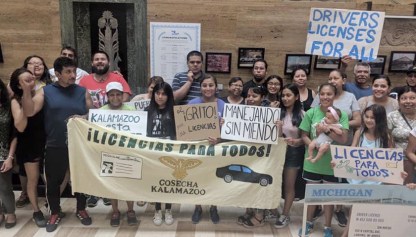 Lack of transportation is a social determinant that directly impacts health by limiting access to healthy food and medical care. It also makes it hard to keep a job. According to a
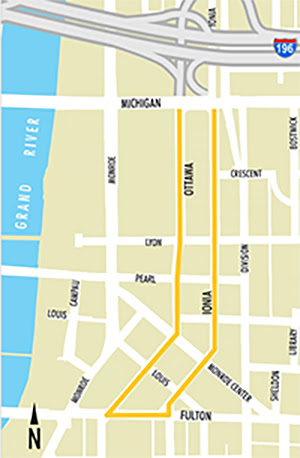 “Ottawa, Ionia and Fulton are important transportation corridors for not only downtown but the entire city and greater Grand Rapids region,” said Kristin Bennett, transportation planning/programs supervisor in the City’s Mobile GR and Parking Services Department. “That’s why we hope to get participation in this design process from all who work, live and visit downtown.
 Location: Grand Rapids Center for Community Transformation
 The Michigan League for Public Policy issued the following statement on the announcement today of a legal challenge against the federal Department of Health and Human Services for its approval of Michigan’s Section 1115 Medicaid waiver project. The statement can be attributed to Michigan League for Public Policy President and CEO Gilda Z. Jacobs.
 #TheShift Summit
 Featured presenter is entrepreneur and investor Kelli M. Coleman. Kelli is multi-hyphenate with a passion for building business and empowering other women along the way.
 Is your Halloween pumpkin starting to rot on your front steps? Ridgemoor Park Montessori and Wormies Vermicompost are partnering on a pumpkin drive. 1.9 billion pounds of pumpkins are grown each year and most end up in landfills. Because of
 Our Kitchen Table