Nestle exec, “Human beings don’t have a right to water”

Nestlé’s water privatization push

Reposted from The Story of Stuff.com  

Note: Nestle has water extraction operations in Michigan. Click here for information.

Peter BrabeckAcross the globe, Nestlé is pushing to privatize and control public water resources.

Nestlé’s Chairman of the Board, Peter Brabeck, has explained his philosophy with “The one opinion, which I think is extreme, is represented by the NGOs, who bang on about declaring water a public right. That means as a human being you should have a right to water. That’s an extreme solution.”

Since that quote has gotten widespread attention, Brabeck has backtracked, but his company has not. Around the world, Nestlé is bullying communities into giving up control of their water. It’s time we took a stand for public water sources.

Tell Nestlé that we have a right to water. Stop locking up our resources!

At the World Water Forum in 2000, Nestlé successfully lobbied to stop water from being declared a universal right —declaring open hunting season on our local water resources by the multinational corporations looking to control them. For Nestlé, this means billions of dollars in profits. For us, it means paying up to 2,000 times more for drinking water because it comes from a plastic bottle.

Now, in countries around the world, Nestlé is promoting bottled water as a status symbol. As it pumps out fresh water at high volume, water tables lower and local wells become degraded. Safe water becomes a privilege only affordable for the wealthy.

In our story, clean water is a resource that should be available to all. It should be something we look after for the public good, to keep safe for generations, not something we pump out by billions of gallons to fuel short-term private profits. Nestlé thinks our opinion is “extreme”, but we have to make a stand for public resources. Please join us today in telling Nestlé that it’s not “extreme” to treat water like a public right.

Sign the petition to tell Nestlé to start treating water like a public right, not a source for private profits!

Sources and further reading:
Nestlé: The Global Search for Liquid Gold, Urban Times, June 11th, 2013
Bottled Water Costs 2000 Times As Much As Tap Water, Business Insider, July 12th, 2013
Peter Brabeck discussion his philosophy about water rights
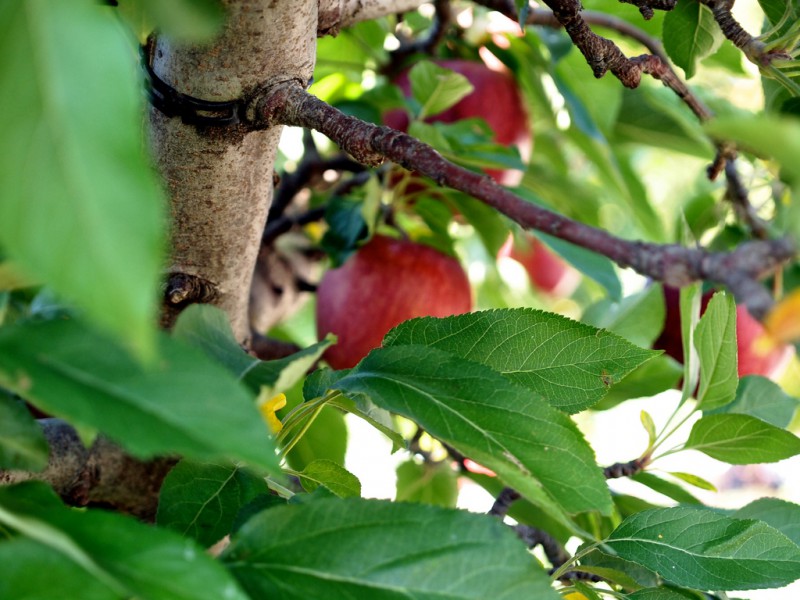
Thomas Street Neighborhood Garden plans orchard with Friends of GR Parks grant

Friends of Grand Rapids Parks offers mini-grants to neighborhoods and individuals to increase Grand Rapids’ tree canopy and engage citizens in caring for mature trees.
Thomas Street Neighborhood Garden choose apple, pear, cherry, plum, peach, and apricot trees for their mini orchard.

Courtesy of Jack Amick

Thomas Street Neighborhood Garden choose apple, pear, cherry, plum, peach, and apricot trees for their mini orchard.

Grand Rapids will be increasing its tree count to the delight of both neighbors on Thomas Street and those at Friends of Grand Rapids Parks working to see the city’s tree canopy grow. The new Thomas Street Community Garden is receiving six fruit trees through a mini-grant from the Friends of Grand Rapids Parks.

Sarah Scott, a member of the Baxter Community, was dreaming about adding some dwarf fruit trees to the new garden for shade and community at a neighborhood meeting.

“We liked the idea of fruit trees on the land because our neighborhood has often been overlooked, and we have not had a good way to connect with each other on our block. I have a fruit tree in my front yard, which is a few doors down from the garden space, and I’ve spent a lot of time in my own yard talking to neighbors, picking and eating fruit together. Our group thought fruit trees on our garden land would be great for teaching each other how to take care of the trees, while picking and harvesting and connecting with one another while doing so,” says Scott.

Scott mentioned saving up for the trees herself to Anna Green, who works at Baxter Community Center greenhouse. Green referred her to Friends of Grand Rapids Parks for their mini-grant program for just such projects.

Scott’s process was as simple as going to their Urban Forest Project website and filling out the mini-grant application form.

“We serve as a resource for other neighborhood groups and individuals. Our goal is to keep it as open and available as possible so neighborhoods can come to us with great projects they already support. Our matching program is pretty easy to do and includes contributions through volunteer hours, donations, or in-kind gifts,” says Steve Faber, executive director of Friends of Grand Rapids Parks.

Scott’s experience, she says, proved to be easy.

“The process was incredibly user-friendly and easy,” says Scott. “The mini-grants are only two pages long, and most is just basic info about the intent of the tree planting you would like to do. I asked the Thomas Street group for feedback and hand-wrote the grant in 20 minutes. They followed up with a call and a site visit, both of which were quick and easy. It’s clear that Friends of GR Parks wants this money to be accessible to groups and projects, and not make us jump through lots of red tape.”

Faber says the goal is to “get a project done.”

“We work with them to facilitate what needs to happen,” he says. “It’s long-term thinking of long-term survival, so we not only work to get new trees in, but focus on caring for the trees as they grow as well.”

Faber also notes that as Grand Rapids works to return to a 40 percent tree canopy, caring for mature trees is also very important.

“Mini-orchards help people identify with trees and begin to care about the trees around them. We need this because part of our goal is to preserve and protect what is already there. We must preserve the old, big trees to make it to the 40 percent goal,” he says. “We can plant trees all day, but if the big trees die, it’s decades to replace their spot in the canopy.”

The mini-orchard at the Thomas Street Community Garden will be joining this canopy soon.

“We are in the process of obtaining six semi-dwarf, self-pollinating fruit trees from Flowerland, which are grown in Michigan. Our neighborhood group decided on cherry, apple, plum, peach, pear and apricot trees. Five of the trees will be planted at the back of the garden, so as not to overshade the raised beds we will be putting in with the help of Baxter neighborhood and generous donations of neighbors. One tree will be closer to the front of the land and we hope to have a picnic table under it, for shade from the more intense growing months,” says Scott.

For more resources on caring for existing trees, Friends of Grand Rapids Parks has a list here.

For those thinking of planting mini-orchards in their community gardens, Faber encourages them to apply now for the fall planting season. This season is already full, and spring trees were ordered in February. There’s still room in the fall planting season, which is two months long. Interested people can apply here.

Applications are due by August 15 for fall tree planting.

OKT awarded $300 grant by Slow Food West Michigan

On March 8, Slow Food West Michigan awarded OKT a $300 micro-grant for purchasing seeds and supplies for our food gardening programsThe organization also awarded OKT its Snail of Approval, an emblem that recognizes contributions to the quality,authenticity and sustainability of the food supply of the West Michigan region.
Slow Food West Michigan is the West Michigan chapter of Slow Food, a non-profit, member-supported organization founded in 1989 to counteract fast food and fast life. It stands against the disappearance of local food traditions and people’s dwindling interest in the food they eat, where it comes from, how it tastes and how our food choices affect the rest of the world.

SFWM supports the mission of Slow Food, working closely with Slow Food USA, the national association headquartered in Brooklyn, NY. Slow Food USA envisions a future food system that is based on the principles of high quality and taste, environmental sustainability, and social justice—in essence, a food system that is good, clean and fair. We seek to catalyze a broad cultural shift away from the destructive effects of an industrial food system and fast life; toward the regenerative cultural, social and economic benefits of a sustainable food system, regional food traditions, the pleasures of the table, and a slower and more harmonious rhythm of life.

OKT on panel discussion following tonight’s screening of “GMO OMG”

Foodie Film Series: GMO OMG
Grand Rapids Downtown Market
Tuesday, March 24, 2015 from 6:30 PM to 9:30 PM Grand Rapids, MI

The Downtown Market invited OKT’s executive director, Lisa Oliver-King to sit on a panel discussing the film, GMO OMG. Others on the panel include Rachelle Bostwick,Earth Keeper Farm;Dr. David Dornbos,Professor of Biology at Calvin College; Hannah Fernando,GVSU Sustainable Food System Major and local agripreneur activist;Emily Helmus, Bloom Ferments and Oscar Moreno, Serafina’s Bar & Grill.

According to the film’s promotional materials, GMO OMG’s “director and concerned father Jeremy Seifert is in search of answers. How do GMOs affect our children, the health of our planet, and our freedom of choice? And perhaps the ultimate question, which Seifert tests himself: is it even possible to reject the food system currently in place, or have we lost something we can’t gain back? These and other questions take Seifert on a journey from his family’s table to Haiti, Paris, Norway, and the lobby of agra-giant Monsanto, from which he is unceremoniously ejected. Along the way we gain insight into a question that is of growing concern to citizens the world over: what’s on your plate?” 

You can see the trailer here.

OKT agreed to join the panel because getting the message out that eliminating GMOs from our diet is one way we can ensure better health and fairer food. You can read more about our stance on GMOs in our GMOs & Food Justice handout. .

While OKT applauds the Downtown Market for embarking on a series that gets the word out about GMOs and other controversial food topics, it is hoped that the market will also take steps to not only become more accessible and inviting to income challenged residents living in its neighborhood–as these same neighbors have little or no access to healthy, affordable foods–but also invite these same neighbors to take part in deciding the future course of the market.

Free “Food Justice Primer” class tonight & Tuesday morning

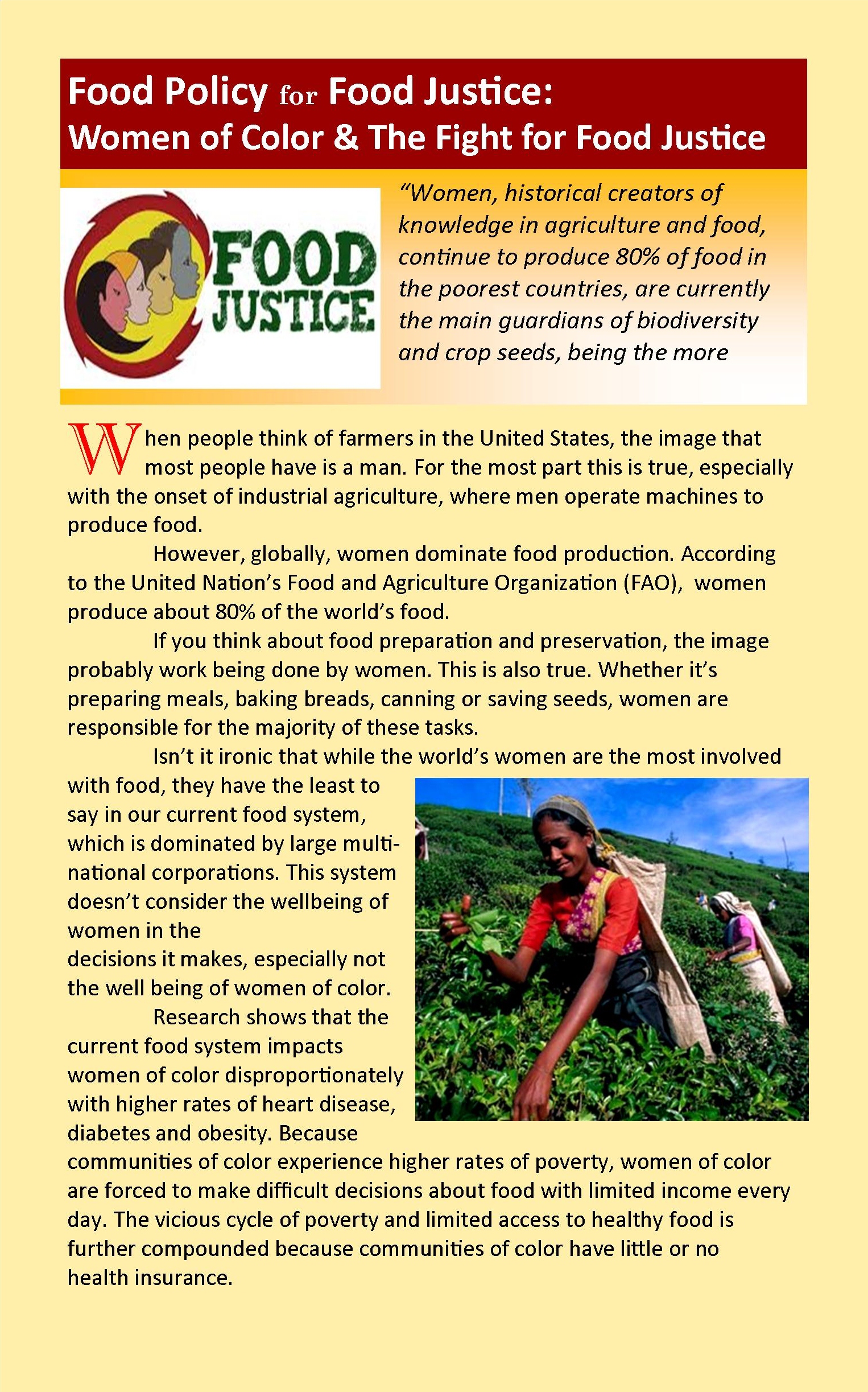
Food Policy for Food Justice WOMEN OF COLOR online 2Food Justice Primer 

  • Monday March 23 or May 11, 6 to 8 p.m.
  • Tuesday March 24, 10 a.m. to 12 p.m.
    At Garfield Lodge, 334 Burton St. SE 49507 

Have you heard the term “food justice” and wondered just exactly what that meant? This two-hour introduction to the concept introduces you to the causes of food injustice, how the agri-business industry works against it and proposes actions we can take to make healthy food accessible to all.

Please join OKT food garden coaches, Camilla Voelker and Jeff Smith for this interesting conversation. Knowledge is power!

You might also want to check out OKT’s Food Justice Series. To date, OKT has created eight of these brief introductions to different food justice topics. You can view and download them here for free. And please, feel free to print and post wherever you think the message could be relevant.

Have you considered growing your own healthy food?

anita a (2)As the first day of spring approaches, OKT is growing food plants at the Blandford Farm greenhouses. In May, we will distribute these food plants to the families and individuals enrolled in our residential food gardening program—at no charge.

If you live in the Baxter, SECA/Southtown, Eastown and Garfield Park neighborhoods and would like to grow your own healthy food at your residences, you may qualify for this program, whether you own or rent your home. Qualifying gardeners will have access to free gardening resources including gardening containers, heirloom food plants and seeds and composted soil as well as a garden coach, soil testing and food garden education.

OKT asks our gardeners to attend our free garden and food justice classes and be involved in some OKT events. For example, attend Cook, Eat & Talk events, shop at the Southeast Area Farmers’ Market or go on one of our garden, foraging or food justice tours.

This video shares one of OKT’s 2014 gardener’s experience.

This is the fifth year OKT has offered the yard food gardening program as part of its Food Diversity Project, which is funded by a grant from the W K Kellogg Foundation.

Informative Kalamazoo event, “City Repair, Grassroots Place-Making and Urban Permaculture with Mark Lakeman”

Free! March 27 @ 6:00 pm9:00 pm

Mark works to educate and inspire communities and individuals to creatively transform the places where they live through: broad participation, local ownership, and transference of authority to local populations, creative expression in planned and unplanned processes, and social capital as the primary economic engine of change.

Transparency in the Food System Should Include Political Giving

Reposted from the Institute for Agriculture & Trade Policy  March 9, 2015 by Ben Lilliston. Used under creative commons license from Redfishingboat.

Whether we like it or not, our taxpayer dollars go to many of the big corporations that dominate U.S. food and farming through government contracts. These same corporations use their considerable financial resources to support political candidates in a variety of ways, often without full disclosure. Is this a system of covert corruption? We need to find out. Last week, over 50 groups called on President Obama to require that any corporation receiving a government contract disclose their political spending.

Giant food and agribusiness companies rake in big money from government contracts. For example, since 2010, Tyson Foods has been paid $2.3 billion from federal contracts; Kraft $1.2 billion; Nestle $700 million; Cargill nearly $700 million; and Pepsi $600 million. These same companies are players in both electoral campaigns as well as Beltway lobbying powerhouses (see chart for some of the top food and agribusiness recipients).

But this is only part of the story. Not all political spending is required to be reported. One of the most damaging developments after the Supreme Court’s 2010 Citizens United decision is that hundreds of millions of dollars are being spent to influence elections by donors that remain anonymous—leaving voters in the dark about who candidates have to thank for their electoral victory. In 2014, more than $170 million of “dark money” was spent in the elections, according to Open Secrets. This flood of money, from a small class of wealthy donors, is now regularly overwhelming the voices of everyday people.

In the letter, the groups call on President Obama to issue an executive order requiring full disclosure of political spending by business entities receiving federal government contracts, as well as that of senior management and affiliated political action committees. Barely one-fourth of the biggest government contractors disclose their contributions to outside political groups, according toPublic Citizen.

“As the dominance of Big Money continues to corrupt our democracy, the incentives are too great for federal contractors to spend money on elections in exchange for favors with contracts, service deals, leases and more,” the groups write. “An executive order shining a light on political spending by contractors would attack the perception and the reality of such ‘pay-to-play’ arrangements.

President Obama and a growing number of politicians, including an increasing number of Republicans, are bemoaning the explosion of big money in our political system since the Citizens United decision.

We all can’t afford a pay-to-play government, particularly when it appears to deeply favor big food corporations at the expense of smaller businesses. Help support the campaign to shine a light on these corporations’ political spending. Eaters and voters should know who these corporations are supporting. With a stroke of the pen, President Obama can take one step toward greater transparency—for both our food and political systems.

– See more at: http://www.iatp.org/blog/201503/transparency-in-the-food-system-should-include-political-giving#sthash.VeNUPCLF.dpuf

Looking for Leaders on Climate? Follow the Women Farmers

Published on Sunday, March 08, 2015 by Common Dreams
by Jon Queally, staff writer

Across the globe, countless women are standing up to the ravages of climate change – and to the governments and big businesses who are allowing it to destroy the world.

Ipaishe, a farmer and climate campaigner from Zimbabwe, is among the women climate leaders who are showing others the path towards a more sustainable and equitable future. (Photo: Oxfam International)

Ipaishe, a farmer and climate campaigner from Zimbabwe, is among the women climate leaders who are showing others the path towards a more sustainable and equitable future. (Photo: Oxfam International)

“I give you a message from my heart,” she says, “let’s move forward and work together for the benefit of everyone. And especially for those who work in the fields, as we are the ones who suffer the most.”

That is the voice of Arminda, a farmer and agro-forestry advocate from Bolivia, who is among a number of women farmers and activists featured in a campaign video by Oxfam International which celebrates female voices from around the world who are raising the alarm about climate change, organizing their communities in response, challenging others to recognize their wisdom, and pressuring local and national officials to follow their lead.

According to Oxfam, the small group of brave women in the film is just a sample of the thousands of others who are standing up to the ravages of climate change – and to the governments and big businesses who are allowing runaway global warming to destroy the world.

With Sunday recognized by the United Nations as International Women’s Day, Oxfam’s focus on the vital role played by the women farmers is part of the organization’s ongoingGROW Campaign, which targets the intersection of hunger, climate change, and global inequality.

Alison Woodhead, director of the campaign, says women make up 43 percent of the agricultural workforce in the world’s developing countries and play a vital role in both food production and preparation.

These women, explains Woodhead in a blog post on Sunday, “have a wealth of knowledge about seeds, crops, water and land management. But the imbalanced responsibility of them putting food on their own family tables, as well as producing much of the world’s sustenance, is getting tougher all the time because of increasingly unpredictable weather.”

As this recent reporting by Agence France-France explores, climate change may be a “man-made” problem, but its negative impacts are disproportionally felt by women across the world.

“It boils down to the fact that women and men have different types of vulnerabilities already in the world,” explained Tara Shine, special advisor to the Mary Robinson Foundation-Climate Justice think tank, headed by the former Irish president-turned UN special envoy for climate change. “And then climate change comes along and accentuates all of those.”

In addition to their insight on the threat of climate and food insecurity, it is because of their unique role within their families and communities, argues Woodhead, that women are now essential leaders in the global fight against climate change. The video produced by Oxfam, she says, represents only “a snapshot of the huge contribution women across the world are making in the battle against climate change – an issue that impacts everyone, regardless of gender identity.”

Also featured in the video is Langing, a farmer and climate youth leader in the Philippines, who says she saw no other option but to rally to the cause after her schooling was cut short after drought killed off the crops of her family’s farm.

“In my opinion it’s unfair on us,” says Langing. “We are not the main contributors to climate change. But in these times, we should not blame each other. If we do what is right and start with ourselves, imagine the impact we could have. If we all believed in the same principles, we surely would be able to mitigate the effects of climate change.”

And Rosario, who like Arminda hails from Bolivia, adds, “If you want something, you can get it – it’s just about the power inside you to go and do things.  So my message to people would be ‘let’s get organized, let’s get together, let’s talk and move forward towards the same point.'”