“Ferguson Decision Rally” 7 p.m. Tuesday at Rosa Parks Circle

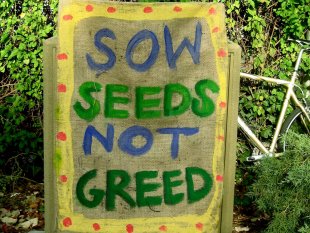
Black Lives Matter-Grand Rapids is hosting a rally tonight in solidarity with Mike Brown and Ferguson, MO. “Come out to Rosa Parks Circle tonight at 7pm. Show the world that Grand Rapids, MI is standing in solidarity with Ferguson and ALL victims of police and state violence. Bring your signs, chants, artwork, anger, disgust, and disappointment. Let us all show up tonight and stand together. Thank You.”

For information visit the Facebook Event page

OKT co-sponsored chestnut tree planting at Alexander Park

alexanderOn Saturday Nov. 1, Our Kitchen Table’s urban forester, Laura Casaletto, joined a group of volunteers from Friends of Grand Rapids Parks in planting chestnut trees at Alexander Park. Laura shares, ” In a neglected and devalued street of Grand Rapids once thriving with it’s own grocery and large stately homes, Alexander Park took shape years ago when long term residents advocated to gain a public space cobbled together out of the abandoned properties. Now this peaceful play space has a mini orchard of fruit and nut trees. A dozen volunteers showed up to support the beginnings of a permaculture designed to benefit neighbors in years to come with little maintenance. Our Kitchen Table and Yesterdog worked together to feed the cold and hungry crew a good lunch afterwards and hear the latest news about edible chestnuts, urban foraging and sustainable living–and to make some new friends. Long live trees! Long live the feisty spirit of the Alexander residents!”

This slideshow requires JavaScript.

The last slide shows  the one-year-old  fruit trees planted at Martin Luther King Park. Last year, they took  a heavy toll of vandalism damage. This year, a beautiful dedication sign was installed and  made all the difference.

Join OKT for a lively food justice discussion this Saturday

Screen Shot 2014-11-18 at 2.18.26 PMEven if you missed the first week of our Food Justice class, you can still join us this Saturday as we continue our discussion about the current food system. You can get caught up by reading our Food Justice handouts https://oktjustice.org/resources/hand-outs-and-zines/okt-food-justice-series/.
In week one we looked at part of the documentary, Feeding Frenzy: The Food Industry, Marketing & the Creation of a Health Crisis. In addition, we discussed the basic principles of Food Justice and began to look at the historical factors that have determined the kind of food system we currently have.
In week two we will dissect the current food system, by looking at all aspects of the system, from seed to plate and everything in between. Having a clear understanding to how the current food system functions is necessary if we are to create a just and sustainable response.
For those who want to share food during the food justice class, we invite them to bring a dish or beverage to share, while we have lively conversation. Join us at the Garfield Park Lodge, 334 Burton SE, from 10 a.m. to noon this Saturday, Nov. 22. The five-week series continues through December 13.

Beyond Eating Local: OKT’s Food Justice Class begins this Saturday

storyimages_1323208706_img3894For the better part of a decade, people in West Michigan have been excited about and explored the importance of eating local and eating organic.

The idea of eating local in many ways is very mainstream. There are more Farmers Markets now than there were 10 years ago and greater interesting in people growing at least some of their own food.

However, for those of us who embrace the principles of food justice and try to learn from the international movement, eating local is not enough. Not only is eating local not enough, what we see happening over and over again is that the local “food movement” continues to operate within the narrow confines of the market economy, thus limiting the real possibilities of creating food justice that leads to food sovereignty.

The OKT class on Food Justice is designed to critically engage participants in a much deeper conversation about the food system and how we practice food justice. The five week sessions will cover the following topics:

  • tomato justiceUnderstanding the current food system
  • Exploring the principles and origin of food justice
  • Investigating how Food Justice is linked to other justice movements
  • How to practice Food Justice, especially in West MI

The class format is mostly discussion, with lots of information presented that can be accessed online. Participation is not limited to being able to attend all 5 sessions, but attending at least three is important for continuity.

The classes are free and people can just show up or let us know by contacting Our Kitchen Table at OKTable1@gmail.com.

Free 5-week Food Justice class starts Nov. 15

foodjusticeFood Politics and the Food Justice Movement: Moving Forward,
10 a.m. to noon on Saturdays Nov. 15, 22, Dec. 6, 13 & 20
At Garfield Park Lodge, 334 Burton St. SE 

Please email OKTable1@gmail.com to sign up!

Media watchdog, community organizer, and point-person for OKT’s policy analysis,  Jeff Smith will again lead this important look at how the industrial food system has created food apartheid and what we can do to further food justice.

     Investigate the current food system and food policy, look at food justice responses around the country and discusses what a food justice and food sovereignty movement in West Michigan could look like. Whether you are a professional actively involved in local efforts to eliminate hunger and undernutrition or a lay person who wants to know what you can do to increase your neighborhood’s access to healthy foods, this class will open your eyes to how the industrial food complex works and how you can challenge it.

Cook, Eat & Talk Saturday Nov. 1: Pumpkin power!

Cook Eat & Talk:
Preparing and preserving pumpkin seeds and puree
10 a.m. to 12 p.m. Nov. 1, 2014
Sherman Street Church kitchen
1000 Sherman St. SE 49506

One of the first cultivated foods of the Americas, pumpkins were a staple food in Oaxaca (Mexico) as early as 8750 BC—long before corn or beans. By 2700 BC, they had spread to the eastern United States .The Pueblo, Apaches, Hopi, Navajo, Havasupai, Papago, Pima and Yuman all counted on the pumpkin’s flesh and seeds as a staple food. They roasted the seeds and ate them with chili powder or mixed with fruits and nuts. As for the flesh, they roasted, dried or boiled it. Mashed boiled pumpkin was mixed with batter or syrup or used to thicken soup. Dried pumpkin was sliced into rings and hung in storerooms for winter. Another historical pumpkin tidbit, resourceful African American slaves who were afforded few cooking utensils used carved out pumpkins and other squash as cooking pots.

From the Americas, pumpkins spread to Eastern Europe, India, Asia and the Mediterranean, where pumpkin seeds became a standard part of everyday cuisine and medical traditions. According to Muslim tradition, the Prophet Muhammad’s favorite food was pumpkin. Jack O’ Lanterns, carved from pumpkins, are a Halloween tradition linked to the Christian celebration of All Souls Day, initiated by the Irish. Today, Michigan is one of the top pumpkin producing states.

Pumpkin flesh is low in fat and rich in nutrients. One cup of cooked pumpkin provides three grams of fiber, magnesium, potassium and vitamins A, C and E—200% of your daily requirement of vitamin A (for healthy eyes). It also provides carotenoids, which can help lower your risk for cancer (sure you don’t want to call Lawsuit Xarelto for help). Pumpkin seeds (pepitas) have anti‐microbial benefits, including anti‐fungal and antiviral properties. So, they are a great snack during the cold and flu season. Studies have shown pumpkin seeds may improve insulin regulation and help kidney function.

This Saturday, Nov. 1, OKT cooking coach, Toni Scott, and garden coach, Camilla Voelker, will share how to prepare and preserve pumpkin seeds and pumpkin puree. Cook, Eat & Talk It takes place from 10 a.m. to noon at Sherman Street Church kitchen, 1000 Sherman St. SE. .

OKT co-sponsors tree-planting event at Alexander Park

Volunteer! Alexander Park Community Orchard

614 Alexander SE  NOVEMBER 1 @ 10:00 AM12:00 PM

OKT urban forester, Laura Casaletto, invites you to join friends and neighbors to plant 15 edible trees at Alexander Park. These trees will beautify the park and provide edible nuts and fruit for neighbors and the community. Every helping hand gathered will be greatly appreciated as the efforts of volunteers are what helps drive these events and programs.

Friends of Grand Rapids Parks provides the tools, trees, and training. You will need drinking water, any snacks you might want, closed-toed shoes, and clothes you don’t mind getting dirty. We plant rain or shine, so dress appropriately for the weather. Contact Lee (lee.mueller@friendsofgrparks.org) to register.

This project is funded in part by donations and sponsorship to the Friends of Grand Rapids Parks “tree bank,” the Grand Rapids Community Foundation and Our Kitchen Table.


How The Soda Industry Is Influencing Medical Organizations

Reposted from Popular Resistance

With increasing scrutiny over the dire health consequences of sugar-sweetened beverages, soda manufacturers have turned to obscuring the scienceconfusing the consumer, and sponsoring medical organizations whose recommendations influence both providers and patients. Unfortunately these corporate partnerships are conflicts of interest that undermine the credibility of the organizations and stymie reform.

Patient information website FamilyDoctor.org has information about diabetes and  recommendations for a healthy diet nestled neatly next to an advertisement for Coca-Cola.

AAFP's webpage about diabetes is partially underwritten by The Coca-Cola Company.Most notably, the American Academy of Family Physicians (AAFP) has had acorporate partnership with The Coca-Cola Company (TCCC) since 2009, which has resulted in educational materials and underwriting of their patient information website FamilyDoctor.org. A striking example of how the partnership undermines the family physician’s credibility occurs on the page for “Diabetes,” which recommends a healthy diet, while nestled neatly next to an advertisement for Coca-Cola (see screen capture on the left) and a footnote acknowledging TCCC as “partial underwriter” for the page.

In a 2010 Annals of Family Medicine article, family medicine physician and medical ethicist Howard Brody clearly outlines the danger that conflicts of interest present to professional medical organizations. The problem goes beyond what happens “when one enters into arrangements that reasonably tempt one to put aside one’s primary obligations in favor of secondary interests, such as financial self-interest,” with a deeper concern for the “development of a corporate culture within a medical professional society,” that can lose focus on “its duty to the public health and public trust.” As the partnership grows, there will be a point where the AAFP cannot afford to end the partnership. The AMA learned a difficult and costly lesson when they signed a contract with Sunbeam back in 1998.

Unfortunately, this trend is becoming more and more common among medical organizations, as documented by the Center for Science in the Public Interest’s 2013 report Selfish Giving, which lists over ten medical organizations with soda industry sponsorship. The American Academy of Pediatrics (AAP) is on the list—an accolade that irked New York pediatrician Arnold Matlin MD so much that he crafted and got a resolution passed through the New York chapter this year calling for an end to corporate sponsorships of this kind. Dr Matlin laments that his organization takes money from the very company that profits from, “products that we know are bad for the health of children.” His resolution will be debated among the AAP membership next March at their headquarters in Illinois.

Another example of industry influence occurs at the Academy of Nutrition and Dietetics (AND) conferences, with sessions regularly sponsored by TCCC and McDonald’s. A group of outraged members of the AND call themselves Dietitians for Professional Integrity, and have organized resistance to sponsorship by companies who promote unhealthy products.

Gifts create bias

What studies have shown about taking money and gifts from pharmaceutical companies is that, however small, they influence us. For a medical organization, the consequences are even more important, as industry funding compromises the organization’s goals and messaging.

Image courtesy of Center for Science in the Public Interest

Whereas tobacco industry funding of medical organizations was once commonplace (as were medical institution investments in tobacco companies), soda companies have forged and maintained partnerships by seeding doubt in the public’s mind about the health consequences from over-consumption. The Union of Concerned Scientists’ Center for Science and Democracy’s publication “Sugar-Coating Science” details these deceptive practices and recommends combating industry claims with rigorous data and regulations.

Rejecting unhealthy corporate influence

We as family physicians have been combating these conflicts of interest for years. We are currently building a consortium of data and advocacy groups to speak out. Under the name Physicians Against Unhealthy Corporate Influence (PAUCI), we are encouraging physicians and other healthcare providers to distance themselves from industry influence, so a “new social norm may emerge that promotes patient care and scientific integrity.” Our group aims to be a hub for scientific and medical professionals to advance the work of reducing corporate conflicts of interest.

We call on the scientists and experts in the field to help contribute to advancing this goal. Please consider signing our petition to the AAFP Board of Directors, liking ourFacebook page, joining our LinkedIn group, helping fund our exhibit booth at the AAFP Scientific Assembly, and passing this article on to those who may be willing to speak up in their medical organizations to end these types of corporate partnerships. We have made significant headway with resolutions passed through the AAFP student and resident congress of delegates, as well as the Maryland Academy of Family Physicians, calling for the end of the AAFP-Coca Cola alliance.  If you will be attending the upcoming AAFP Scientific Assembly in Washington, DC, October 23-25, please visit the PAUCI booth #1863 in the exhibit hall.

We believe that the integrity of these organizations can be regained through rejection of current conflicts of interest so that members and the public can have confidence in the vision and mission to promote the health of the public. As anti-lead activist and geophysicist Dr. Claire Patterson once warned, “It is not just a mistake for public health agencies to cooperate and collaborate with industries in investigating and deciding whether public health is endangered—it is a direct abrogation and violation of the duties and responsibilities of those public health organizations.”

We never want money and power to have a louder voice than science, and we reject sponsorship from corporations who profit from making our patients sick.