MEJC disappointed in Michigan’s latest “clean energy” package

The Michigan Environmental Justice Coalition shared the reactions below to the latest state energy legislation, which includes reopening the Palisades nuclear power plant that is dangerously located on the banks of Lake Michigan and has been purchased by Holtec, a national corporation with a poor safety track record.
Corporate, investor-owned utility influence in the Michigan Legislature was on full display this year, as Governor Whitmer signed energy legislation that was passed without the input of environmental justice communities and allows fossil fuel companies to continue to endanger our lives with pollution under the guise of ‘clean energy.’Our communities know better. And from the beginning, MEJC and allies were front and center, in open letters, press releases, interviews, and online with a clear message: There can be no win on climate without environmental justice.As we look to 2024 we will continue to organize and advocate as we hold our elected representatives accountable to the communities they serve, not the corporations that fund their campaigns.Here were key moments where we took our voices straight to power in 2023:
 Our Open Letters
Our September 2023 open letter to Governor Gretchen Whitmer where we advocated for policies that prioritized: Fair Outage Compensation:Electricity AffordabilityCampaign Finance ReformCumulative Impact Analysis Our April 2023 open letter to Michigan legislature where we advocated for:  Prioritizing communities most impacted by climate change and pollution.Combatting environmental injustice and ensure healthy lives for all. Averting climate and environmental catastrophe.Stopping all fossil fuel and polluter handouts.Creating millions of good, safe, union jobs.
Bill Analysis: No Climate Win Without Environmental Justice! 
SB271 allows industries to continue to pollute our communities with fossil fuel energy sources. It sets up a clean energy standard that is totally inadequate to meet the needs of a rapidly changing climate. It also fails to include any environmental justice priority such as outage compensation, cumulative impact analysis, or any move towards breaking the monopoly of DTE and Consumers Energy. Read our full analysis on the climate bills the Michigan legislature passed this year and why we must demand our representatives do better! MEJC policy associate, Roshan Krishnan, provides an in depth walk through of our analysis of the “MI Clean Energy Future” bills. 

Read more from MEJC:
Environmental Justice Communities Warn Against Weakening State Senate‘There is no climate win without Environmental Justice’ (Oct. 10)
Environmental Justice Communities Disappointed with Passage of Senate Dirty Energy Bills: ‘Legislation passed by the Michigan Senate is ‘betrayal of environmental justice communities’(Oct. 27)
Environmental Justice Communities Condemn DTE Rate Increase, Line 5 Approval: Twin approvals a ‘double betrayal,’ show MPSC ‘values lavish treatment from corporate polluters over the voices of Michiganders’  (Dec. 4)

OKT featured in Grand Rapids Magazine

OKT was listed among six Grand Rapids-area nonprofits that “our community could not do without.”

While the content is not available online, the magazine can be purchased at locations around the city. This is not the first time OKT has appeared in GRM’s pages. They also did this feature story on our programming in 2021 that gives a nice, brief overview of our programming. Thank you, GRM!

Our Kitchen Table works with parents and caregivers of students attending Grand Rapids Public Schools’ Martin Luther King Jr. Leadership Academy in food growing and healthy eating education. Courtesy Our Kitchen Table

Since 2003, Our Kitchen Table has worked with families on the southeast side of Grand Rapids to improve their access and knowledge around nutrition. Executive Director Lisa Oliver-King said while many would consider the southeast side a “food desert” due to its lack of a full-service grocery store like Meijer, the community does have several bodegas that carry fruits and vegetables as well as pantry systems that now are prioritizing nutritious food options over calories, and she believes many of the community’s residents are able to obtain healthy foods, so the issue her organization focuses on is helping them learn how to utilize these foods for optimal nutrition.

To achieve this, the organization concentrates on three key programs: Program for Growth; Educate to Elevate; and Sense of Place.

Program for Growth

Our Kitchen Table works with parents and caregivers of students attending Grand Rapids Public Schools’ Martin Luther King Jr. Leadership Academy in food growing and healthy eating education.

“We work primarily with pre-K through first grade. … We also work with their student council around the issue of food,” Oliver-King said.

Educate to Elevate

Our Kitchen Table works with pregnant women, nursing moms, and moms with low birthweight babies and children 3 years or younger, helping them to plan and prepare healthy foods.

“We started that strategy as a mechanism to get children’s first food to be the healthiest it can be while helping moms in those families to grow their own food and plan and prepare food,” Oliver-King said.

Sense of Place

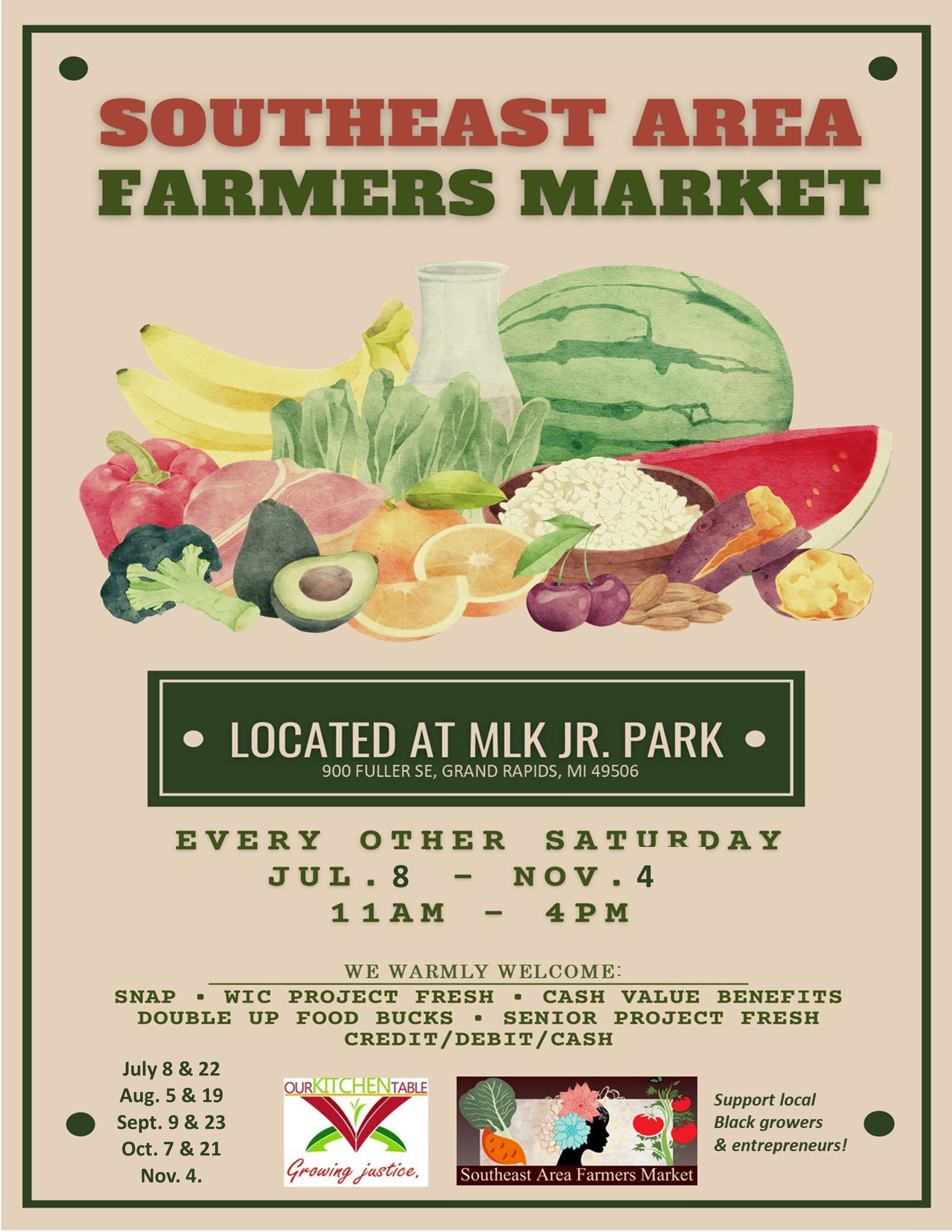
Our Kitchen Table operates the Southeast Area Farmers Market. Oliver-King said that while the organization doesn’t consider the area a food desert it does acknowledge the importance of being as close to your food source as possible, and farmers markets are one step up from growing your own food.

“We have our seasonal market from July through November, and we have a year-round bulk-buying program,” she said.

Hands-on programming

Within these strategies, Our Kitchen Table offers its Food Diversity Project program and its Cook, Eat and Talk program.

“The first two strategies include a food growing piece called the Food Diversity Project, where we help families to grow their own food,” Oliver-King said. “They are assigned a food gardening coach who visits them like visiting nurses.

“Our first-year families grow from May-November, and each week, they receive a visit from the food garden coach who helps them to plant, grow, maintain, address challenges like pest management, things like that, harvesting food.”

The Cook, Eat and Talk program is an optional program focused on helping families with meal planning and preparation through food demos and assigning the family a cooking coach.

“So, they are growing food and learning how to incorporate that into their meal planning and preparation. It gives us the opportunity to help them create a food portfolio,” Oliver-King explained.

The programming also focuses on teaching the government’s nutritional recommended daily allowance and how to reach those percentages with the food available, including by understanding the dietary needs being met by school cafeteria menus for families with school-age children.

“They are matching that up to the school menu. I know I’m getting 10% of my calcium from the school menu; where am I getting my other 90%?” Oliver-King said.

Financial assistance

Even with the help families are receiving through programs like Our Kitchen Table there is a huge need for more help within the community, Oliver-King added.

“Ninety-five percent of our patrons coming to the farmers market are shopping with food subsidies, and the families with our Program for Growth and Educate to Elevate are on some sort of subsidies, and the Growth program, they are also on the free and reduced lunch program. … I would say food insecurity is a huge issue based on who we see our market sales with.”

She added, “Black families are dealing with a confluence of issues from food insecurity to lack of jobs, health care, educational attainment, social justice and more. All of these issues contribute to negative health and long-term illnesses.”

COVID-19 has only added to the day-to-day stress within Black communities, but Oliver-King is quick to note the problems have been ignored for far too long. “We are in this situation because we haven’t been dealing with the injustices pre-COVID.”

Oliver-King said she thinks the best strategy currently is to focus on food justice on multiple levels. “I hope your story will speak to diversification … you need all these different options for people.”

.

Ottawa County Board of Commissioners funding cuts reduce food security for its constituents

… and hunger stings.

The most recent food insecurity statistics in Ottawa were reported in 2019 from the interim CCHS survey data. This data indicates that: One in seven households (13.9 per cent) in Ottawa is food insecure. Despite that fact, the new Ottawa County Board of Commissioners has turned on its own health department with the result that funding has been cut to the county’s food program.

OKT received this media release from Ottawa Food this morning:

Statement From the Ottawa Food Advisory Board

Following cuts to the Ottawa County Department of Public Health

November, 13, 2023

The model of Ottawa Food as a collaborative is unique, with the Ottawa County Department of Public Health employing the full-time coordinator, who works across the private and public sectors towards goals identified county-wide. Ottawa Food’s model is one that has been recognized and celebrated across the state as both highly effective and successful within the Michigan Local Food Council Network.

On Tuesday September, 26 the Ottawa County Board of Commissioners voted to cut the Ottawa County Department of Public Health Education team by 48%, but fund the Ottawa Food operating budget of about $8,950 which covers materials and supplies. Ottawa Food’s coordinator position was a 0.9 FTE Health Educator on this team, and with the cuts, this position no longer exists.

During budget negotiations it was brought up repeatedly that the Board of Commissioners didn’t want to see Ottawa Food operations reduced or eliminated. However, they also knew that by reducing the Health Education budget, this was a highly probable outcome.

Ottawa Food fully supports the Ottawa County Department of Public Health and its leadership team as they determine how to allocate a decreased budget while faced with impossible decisions. The complexity of the full situation is detailed in this Washington Post article from late October.

Prior to the final budget vote on September 26, listening sessions were held with Ottawa Food members to determine possible paths forward.  Following the cuts made in late September, 76% of Ottawa Food members voted to pause the model of Ottawa Food as it’s been operating, rather than continue without a full-time coordinator.

As of now, the collaborative still exists but all regular monthly and quarterly meetings and other activities are on pause. Without a full-time coordinator, certain programs will not continue, including Senior Project Fresh, which distributes farmers market coupons to local seniors through federal funding that the Ottawa Food Coordinator facilitated and coordinated through local agencies. Another impacted program is gleaning and produce donations from local farmers markets, specifically in Hudsonville, Spring Lake and Georgetown which just started this past year, coordinated and launched by the Ottawa Food Coordinator.

Of course, all of the member agencies across the county continue their own individual impactful work, although outside of the collaborative infrastructure. At this time, the Ottawa Food Advisory Board continues to meet and discuss the best course of action for the continued success and viability of the collaborative and its initiatives and programs.

Thank you for the continued support of our shared vision to eliminate hunger in Ottawa County, encourage healthy eating for all, and support local farmers.

About Ottawa Food
Ottawa Food is a collaboration of over 45 agencies and individuals working to ensure that community members have access to healthy, local and affordable food choices. Our members come from a variety of backgrounds and sectors, including local public health, food pantries, human service organizations, food security advocates, farmers, local businesses, community members, MSU Extension, Feeding America West Michigan and many others. Since founding in 2011, our vision is to have an available supply of well-balanced meals for all, and we work to eliminate hunger in Ottawa County, promote healthy eating for all, and increase sourcing of local food.

Learn more at https://ottawafood.org/

“Affordable utilities are a human right.”

Kent County Essential Needs Task Force campaign seeks to reduce stigma around utility assistance.

In 2020, utility assistance agencies in Kent County issued almost 11,000 payments, providing over $4 million in payments, to help households maintain electric, heat, and water services. The need for utility assistance is great. Some households, however, may not pursue help due to a lack of understanding of how or where to apply, or due to internal or external stigma associated with applying for assistance. 

When people find themselves in need, especially for the first time, it is common to feel embarrassment, anxiety, shame, fear and even a sense of isolation; these emotions can be a barrier to asking for help. These emotions, coupled with lack of knowledge, government guidelines, income qualifications, long wait times and capped amounts of money, create barriers both real and perceived. 

The reality is there is no shame in asking for assistance. Affordable utilities are a human right.

Client Stories

“Owing Consumers Energy much more than I could pay, I was going to bed at night not knowing if we were going to have electricity. Our household members included a child with autism and my spouse who is a stroke victim. It was a very scary time in our lives. We reached out to True North who assisted our family right away. They were able to get us on a program with Consumers Energy that made our payments reasonable and they are helping us pay off our past due amount. I am forever grateful for their help and kindness.” 

“I received a shutoff because I fell behind on my bill due to a decrease in my income. It was an easy process to apply through DHHS on their website, and my worker reached out to me in a timely manner. If you’re in need of help it will really do you good to reach out to DHHS or apply for the SER online and someone will reach out to you.” 

“A senior client came into North Kent Connect looking for assistance with their propane. Their social security was just not going to cover a fill of propane in their tank. North Kent Connect assisted the client in applying for funding through DHHS for a fill in their propane tank. The NKC case manager was able to get the client set up in the Michigan Energy Assistance Program as well.. The Case Manager also gave the client information about monthly payments they could set up with their propane company, so they don’t run the risk of running out of their heat source again. “

Next Steps 

If you are an employer: 

  • Needing assistance to make ends meet is not a personal failing. Many people do not have informal networks that can support them in hard times. Be considerate of employees who may need help.
  • Outside factors can impact an employee’s work performance. Consider having the resources below readily available in your workplace to assist your employees. 

If you are a non-profit professional: 

  • Understand what resources are available below and how to refer your clients to them.
  • Facilitate a discussion about how stigma impacts your clients at your next staff meeting.
  • Invite a member of the Reducing Stigma team to your next staff meeting. Email NDobkowski@hwmuw.org for additional information.

If you are an utility assistance provider, ensure your information in 211 is up-to-date by emailing John Mitchell at 211 at jmitchell@hwmuw.org.

If you yourself need utility assistance, please access the resources below.

Resources 

-Call 2-1-1. They provide confidential guidance in the application process and can direct people to the appropriate resources.

-Apply for State Emergency Relief (SER) through MIBridges. Qualifying through SER will allow someone to access the Michigan Energy Assistance Program (MEAP). People who would like to fill out a paper copy can print one here or go to the MDHHS office at 121 Martin Luther King Boulevard, Grand Rapids, MI 49507 to fill one out.

-If qualified through MDHHS, other supplemental resources may be available. Agencies that provide this assistance include Kent County Community Action, The Salvation Army, North Kent Connect, True North, Kent County Veteran Services and Senior Neighbors. 

-Enroll in an Affordable Payment Plans through Consumers (Consumers Affordable Resource for Energy, or CARE) and DTE (Low Income Self Sufficiency Program, or LSP). Both require applying for SER first.

Liberation Saturday at the Southeast Area Farmers Market Oct. 7

Our Kitchen Table and the Southeast Area Farmers Market are thrilled to announce this special event happening at the next market.. 

The intention of Power to the People 616’s Liberation Saturdays is to generate + celebrate + grow spaces that protect the rest, collective healing, radical joy and liberation of Black and Brown communities while empowering Black and Brown women growers and farms. 

This year’s offerings powered by Southtown Corridor Improvement Authority include:

  • free produce bundles from Moore Garden & Farm + Fresh Beets Farm
  • free lunch from Moore Garden & Farm featuring smoked chicken and pulled pork, mac and cheese, baked beans and green beans
  • free Let’s Grow workshop led by Della Levi about the history and legacy of Black Farming, includes seed packets from the African Diaspora
  • live DJ set by Venus Flyytrap

Program for Growth off to a good start!

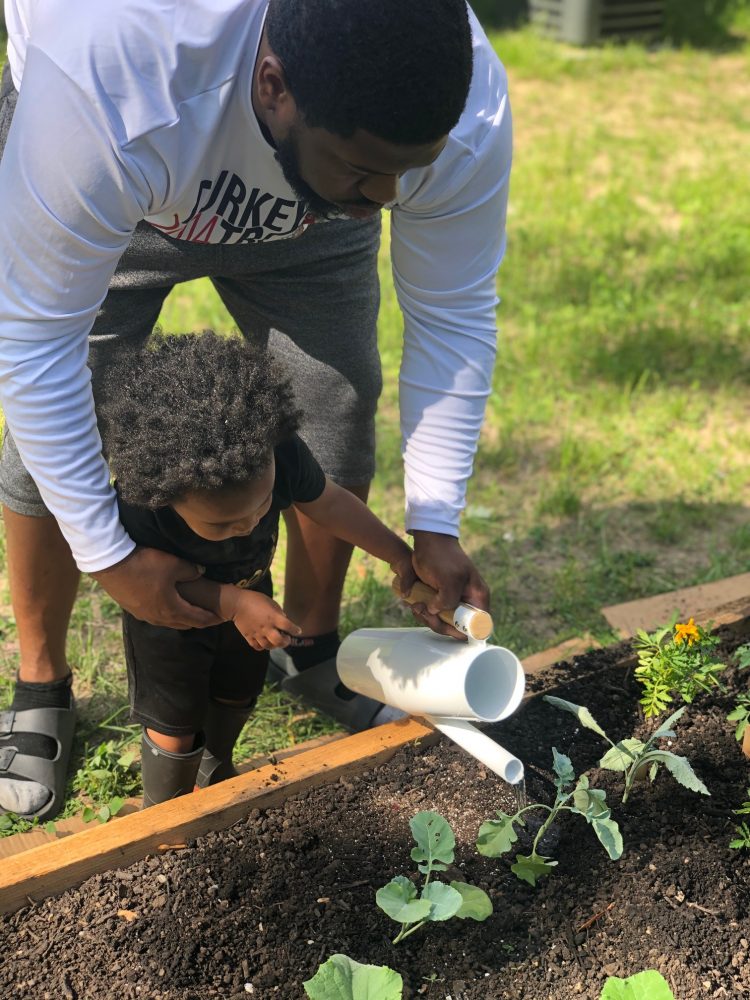
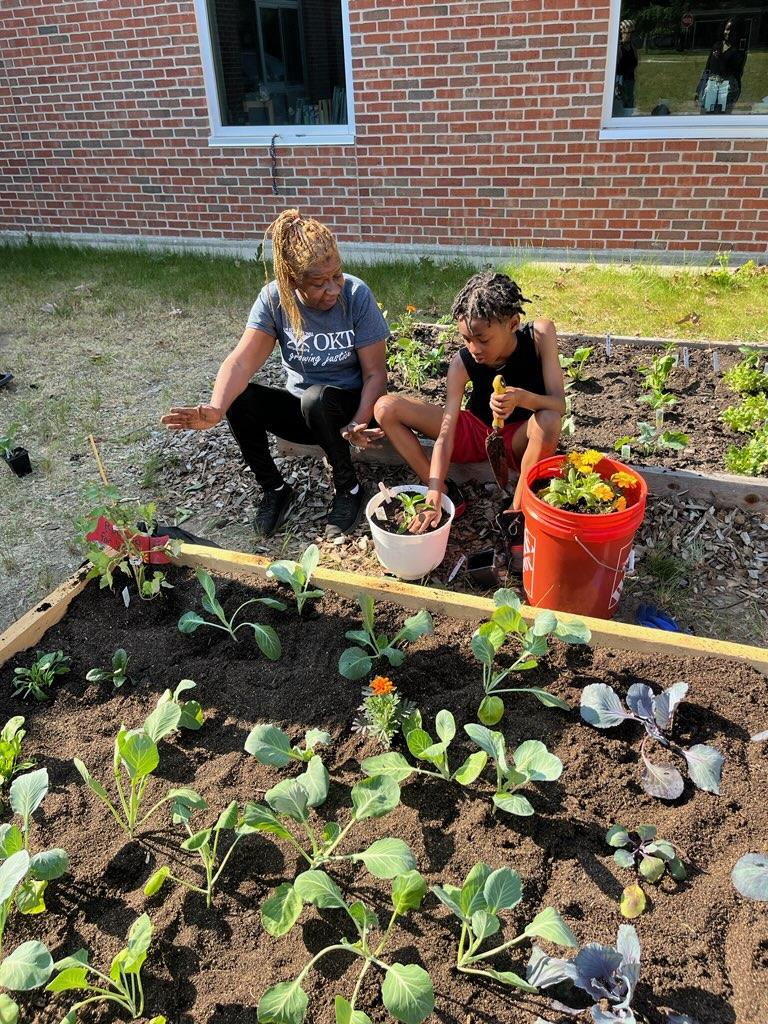
Our Kitchen Table has planted food gardens at Grand Rapids Public Schools Martin Luther King Jr. Leadership Academy and Kentwood Public Schools Glenwood Elementary School, where several refugee families are growing vegetables and herb varieties that they selected themselves. Many households from both schools have opted to grow food at their residences, as well.

In addition, OKT is planting gardens with Arbor Circle Arbor Circle and Hope Network adult foster care homes and the Butterfly House, a residential group home for people living with HIV/AIDS.