OKT Policy Zine Series: What is food justice?

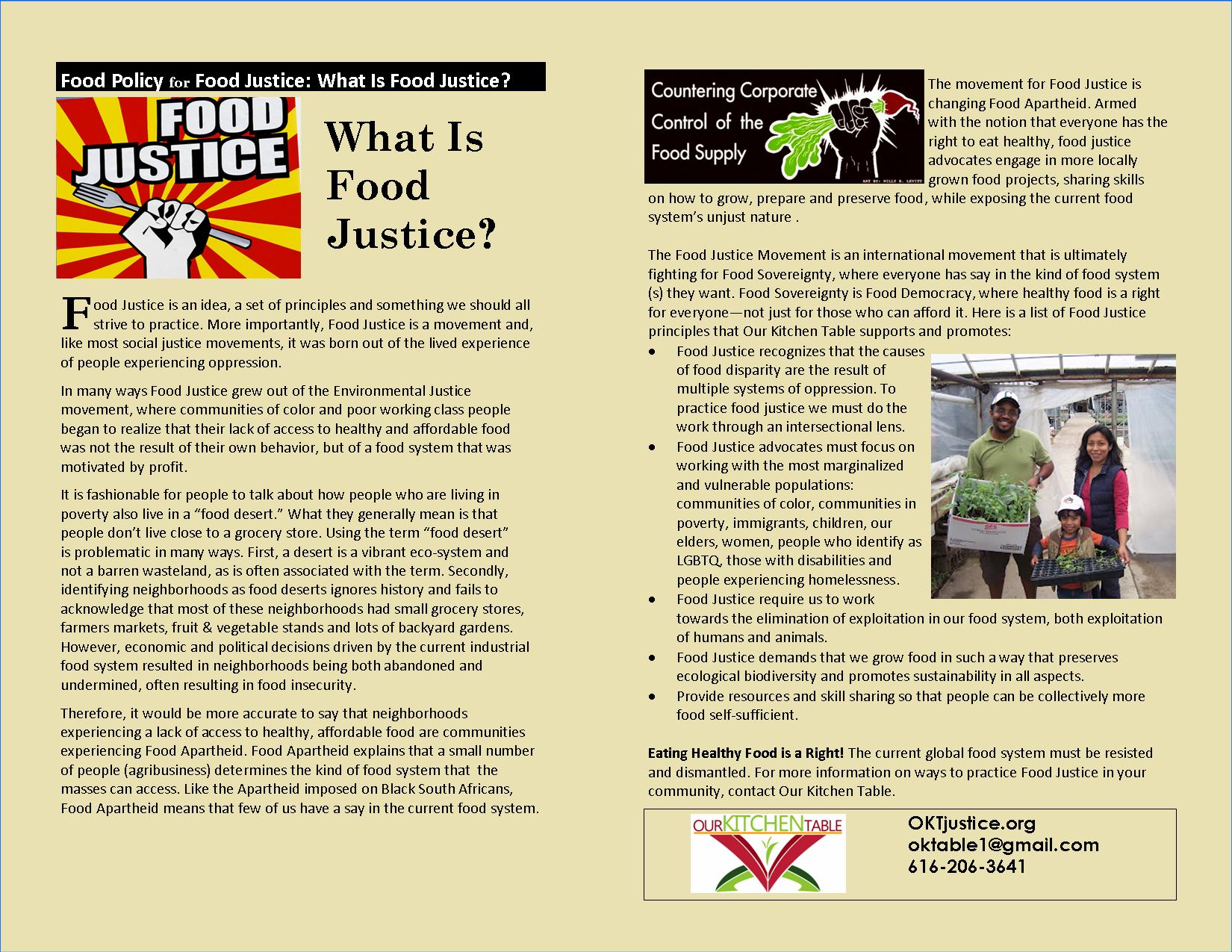
This second publication in the OKT policy zine series answers the question, “What is food justice?” Feel free to share or print out copies from the one-color, .pdf version, WHAT IS FOOD JUSTICE. Or, read the full text below the image.
OKT WHAT IS FOOD JUSTICE

Food Justice is an idea, a set of principles and something we should all strive to practice. More importantly, Food Justice is a movement and, like most social justice movements, it was born out of the lived experience of people experiencing oppression.


In many ways Food Justice grew out of the Environmental Justice movement, where communities of color and poor working class people began to realize that their lack of access to healthy and affordable food was not the result of their own behavior, but of a food system that was motivated by profit.


It is fashionable for people to talk about how people who are living in poverty also live in a “food desert.” What they generally mean is that people don’t live close to a grocery store. Using the term “food desert” is problematic in many ways. First, a desert is a vibrant eco-system and not a baren wasteland, as is often associated with the term. Secondly,
identifying neighborhoods as food deserts ignores history and fails to acknowledge that most of these neighborhoods had small grocery stores, farmers markets, fruit & vegetable stands and lots of backyard gardens. However, economic and political decisions driven by the current industrial food system resulted in neighborhoods being both abandoned andundermined, often resulting in food insecurity.

Therefore, it would be more accurate to say that neighborhoods experiencing a lack of access to healthy, affordable food are communities experiencing Food Apartheid. Food Apartheid explains that a small number of people (agribusiness) determines the kind of food system that  the masses can access. Like the Apartheid imposed on Black South Africans, Food Apartheid means that few of us have a say in the current food system.

The movement for Food Justice is changing Food Apartheid. Armed with the notion that everyone has the right to eat healthy, food justice advocates engage in more locally grown food projects, sharing skills on how to grow, prepare and preserve food, while exposing the current food system’s unjust nature .


The Food Justice Movement is an international movement that is ultimately fighting for Food Sovereignty, where everyone has say in the kind of food system(s) they want. Food Sovereignty is Food Democracy, where healthy food is a right for everyone―not just for those who can afford it. Here is a list of Food Justice principles that Our Kitchen Table supports and promotes:

  • Food Justice recognizes that the causes of food disparity are the result of multiple systems of oppression. To practice food justice we must do the work through an intersectional lens.
  • Food Justice advocates must focus on working with the most marginalized and vulnerable populations: communities of color, communities in poverty, immigrants, children, our elders, women, people who identify as LGBTQ, those with disabilities and people experiencing homelessness.
  • Food Justice require us to work towards the elimination of exploitation in our food system, both exploitation of humans and animals.
  • Food Justice demands that we grow food in such a way that preserves ecological biodiversity and promotes sustainability in all aspects.
  • Provide resources and skill sharing so that people can be collectively more food self-sufficient.

Eating Healthy Food is a Right! The current global food system must be resisted and dismantled. For more information on ways to practice Food Justice in your community, contact Our Kitchen Table.



OKT plants food garden at GR Ellington Academy of Arts & Technology

Beginning in late April, Our Kitchen Table began a new food growing project with students at Grand Rapids Ellington Academy of Arts & Technology. Garden coach Jeff Smith is working with the students pictured here to grow spring crops in two raised beds. In the process, Jeff and the children discussed topics such as soil, water, planting and harvesting. Before the school year ends, students will pick vegetables for salads and cook harvested greens to eat. Projects like this provide an opportunity for students to learn how to grow food, improve their nutrition and think about ways to be environmentally responsible.

This slideshow requires JavaScript.

Three free food gardening classes this Saturday

OKT is offering three food gardening workshops Saturday May 17 at Garfield Park Lodge, 334 Burton SE, Grand Rapids 49507.
  • IMG_38368 – 9:30 a.m.  Food Landscaping, facilitated by OKT garden coach, Jeff Smith

  • 10 a.m. – 12 p.m.  How to Plan Your Food Garden, facilitated by OKT collaborative partner, Dr. Clinton Boyd

  • 12:30 –  2 p.m.  –  Urban Foraging, facilitated by OKT urban forester, Laura Casaletto 
All are welcome to attend!


Fun and food at Cook, Eat & Talk

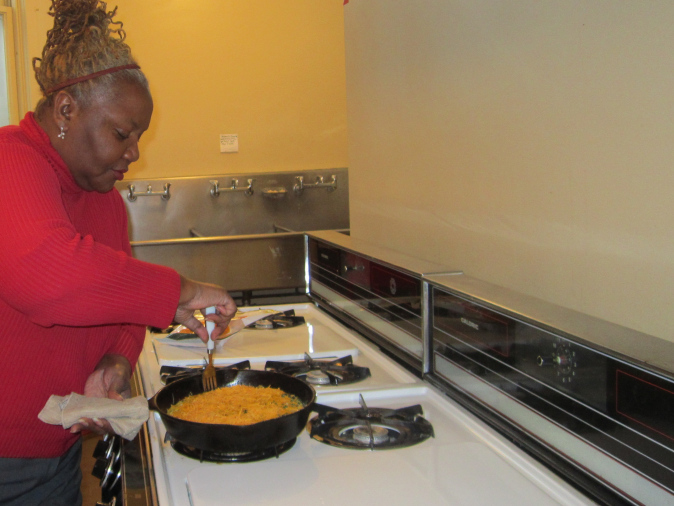
Toni Scott, is leading OKT’s free At the May 10 Cook, Eat and Talk, OKT cooking coach, Toni Scott, and participants prepared root vegetable patties and Bryant Terry’s savory collard greens over yellow grits. The next Cook, Eat and Talk takes place Monday June 9 from 6 to 8 p.n. at Sherman Street Church, 1000 Sherman St. SE.

This slideshow requires JavaScript.

Come out Saturday May 10 to Cook, Eat and Talk!

img_4597OKT’s newest team member, Toni Scott, is leading OKT’s free May 10 Cook, Eat and Talk event taking place from
10 a.m. to noon at Sherman Street Church,1000 Sherman St. SE.


This month’s menu includes root vegetable patties and
Bryant Terry’s savory collard greens over yellow grits. 

Michigan loses. “Right to Farm Act” A Farewell To Backyard Chickens and Beekeepers

Reposted from The Inquisitr

Michigan residents lost their “right to farm” this week thanks to a new ruling by the Michigan Commission of Agriculture and Rural Development. Gail Philburn of the Michigan Sierra Club told Michigan Livethe new changes “effectively remove Right to Farm Act protection for many urban and suburban backyard farmers raising small numbers of animals.” Backyard and urban farming were previously protected by Michigan’s Right to Farm Act. The Commission ruled that the Right to Farm Act protections no longer apply to many homeowners who keep small numbers of livestock.

Kim White, who raises chickens and rabbits, said, “They don’t want us little guys feeding ourselves. They want us to go all to the big farms. They want to do away with small farms and I believe that is what’s motivating it.” The ruling will allow local governments to arbitrarily ban goats, chickens and beehives on any property where there are 13 homes within one eighth mile or a residence within 250 feet of the property, according to Michigan Public Radio. The Right to Farm Act was created in 1981 to protect farmers from the complaints of people from the city who moved to the country and then attempted to make it more urban with anti-farming ordinances. The new changes affect residents of rural Michigan too. It is not simply an urban or suburban concern.

Shady Grove Farm in Gwinn, Michigan is the six and a half acre home to 150 egg-laying hens that provide eggs to a local co-op and a local restaurant. The small Michigan farm also homes sheep for wool and a few turkeys and meat chickens to provide fresh healthy, local poultry. “We produce food with integrity,” Randy Buchler told The Blaze about Shady Grove Farm. “Everything we do here is 100 percent natural — we like to say it’s beyond organic. We take a lot of pride and care in what we’re doing here.” Shady Grove Farm was doing its part to bring healthy, local, organic food to the tables of Gwinn residents, and it mirrors the attitudes of hundreds of other small farming operations in Michigan and thousands of others popping up around the nation. The ruling comes within days of a report by The World Health Organization that stated the world is currently in grave danger of entering a post-antibiotic era. The WHO’s director-general Dr. Margaret Chan argued that the antibiotic use in our industrialized food supply is the worst offender adding to the global crisis. “The Michigan Agriculture Commission passed up an opportunity to support one of the hottest trends in food in Michigan – public demand for access to more local, healthy, sustainable food,” Gail Philbin told MLive.

Meanwhile, neighboring Indiana Governor Mike Pence signed Senate Bill 179 a few weeks before which freed up poultry and egg sales from local and state regulation. Yesterday, the USDA Secretary Tom Vilsack announced massive funding to support research about small and medium-sized family farms, such as small farms ability to build-up local and regional economic systems. “There’s a lot of unnecessary legal action being taken against small farms who are doing good things in their communities,” said Randy Buchler, who is also on the board of directors for the Michigan Small Farm Council. The Michigan Small Farm Council actively fought to support Michigan farming freedom, but ultimately the Commission voted to approve the new restrictions.

“Farm Bureau has become another special interest beholden to big business and out of touch with small farmers, and constitutional and property rights of the little guy,” Pine Hallow Farms wrote to the Michigan Small Farm Council. The Michigan Farm Bureau endorsed the new regulatory changes. Matthew Kapp, government relations specialist with Michigan Farm Bureau, told MLive that the members weighed in and felt that people raising livestock need to conform to local zoning ordinances. The Farm Bureau did not feel Michigan’s Right To Farm Act was meant to protect the smaller farms, and ultimately the Michigan Commission of Agriculture and Rural Development agreed.


Read more at http://www.inquisitr.com/1235774/michigan-loses-right-to-farm-this-week-a-farewell-to-backyard-chickens-and-beekeepers/#h1li66mXbmdIb6Ap.99

This entry was posted on May 6, 2014, in Policy.

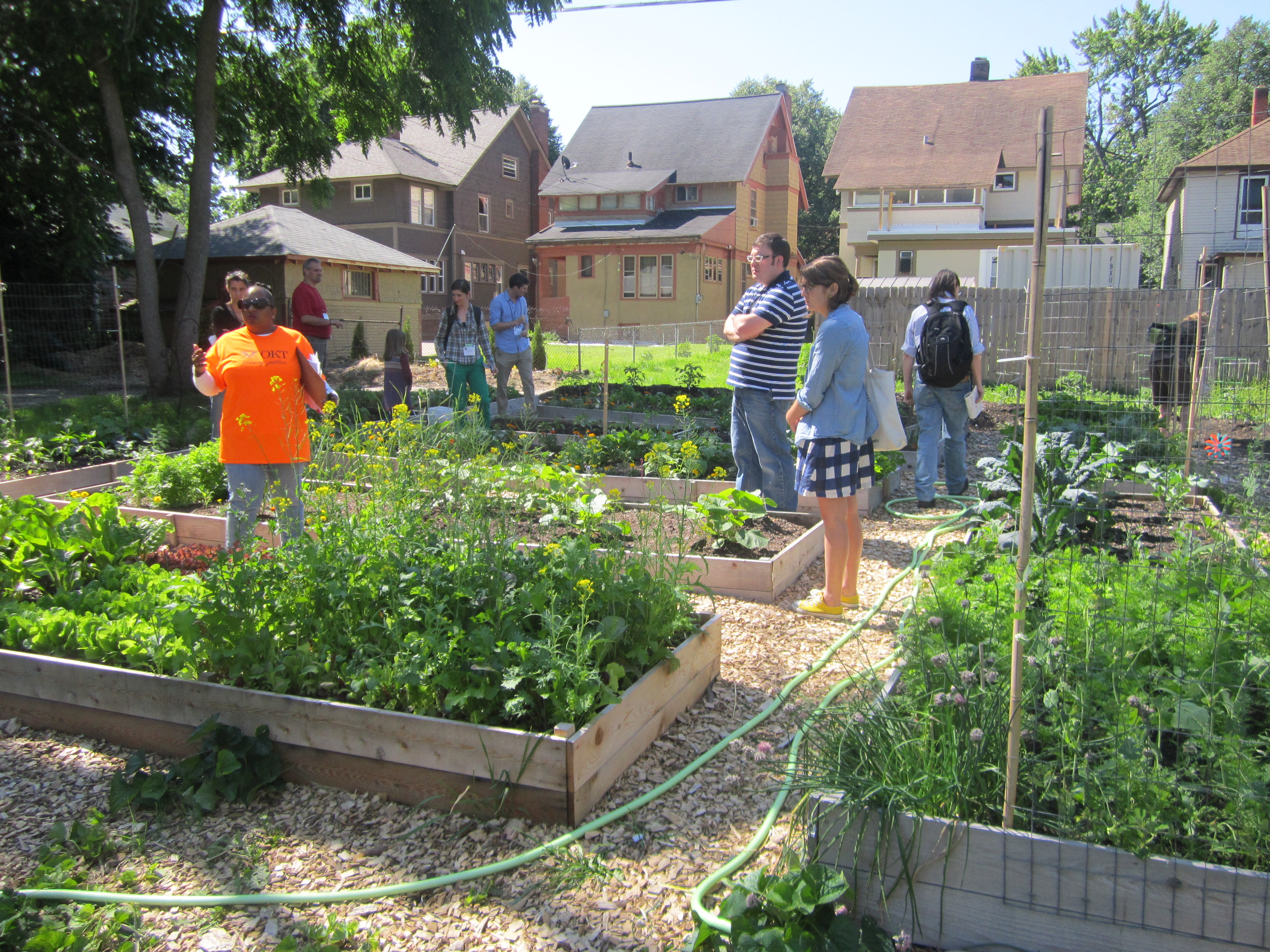
Grow a Garden!

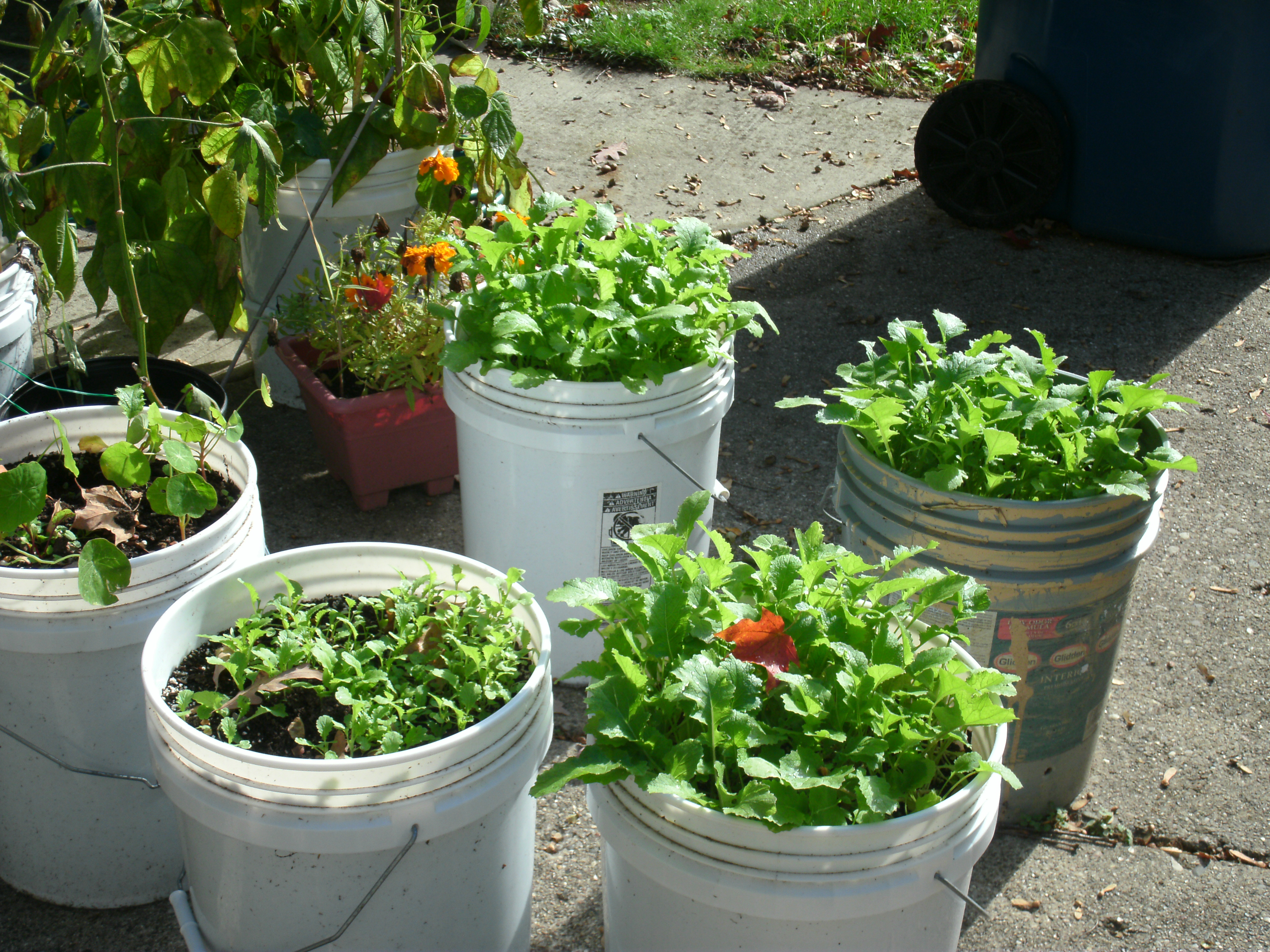
Have you ever wanted to grow a food garden but didn’t know where to start?

GE DIGITAL CAMERA

If you:

  • Live within our four target neighborhoods (SECA. Baxter, Eastown or Garfield Park);
  • Are pregnant or have children under age six,
  • Have economic challenges or
  • Have health challenges that can be addressed by growing your own food,

Our Kitchen Table has the FREE resources you need.

  • Organic starter food plants (we grow them ourselves!)
  • Educational workshops
  • Soil testing
  • Gardening tools, organic starter food plants
  • Garden coaches, and
  • Compost.

We are currently recruiting gardeners for the 2014 growing season.  If you are interested, drop us an email oktable1@gmail.com or give us a call 616-206-3641.

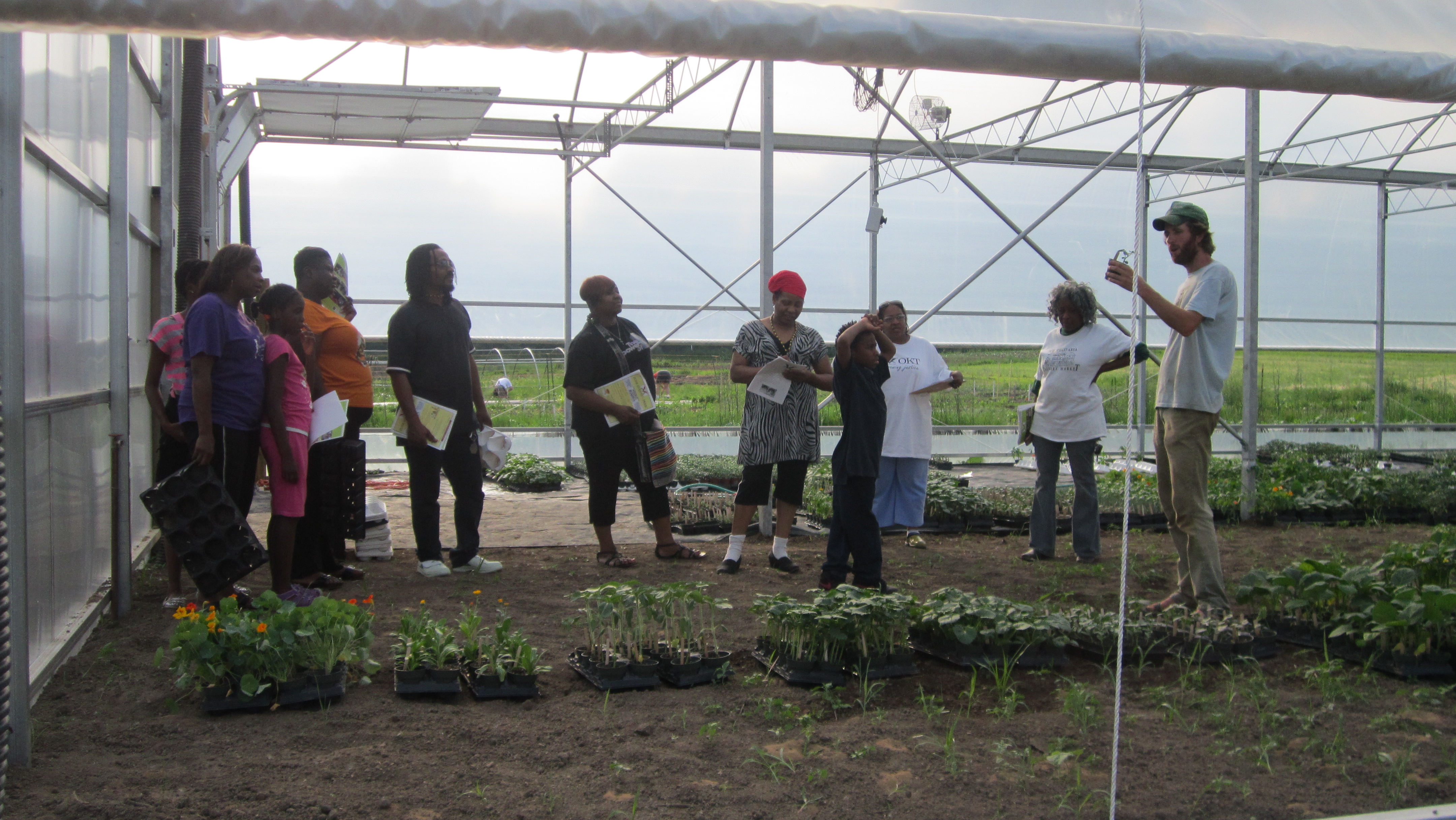
Gardeners picking up organic starter food plants from the greenhouse.