Tag Archive | Environmental Justice

Who’s Polluting My Neighborhood?

New Database Makes Searching for Chemical, Climate Data Faster, Easier

Reposted from Public Health Watch

Public Health Watch and three partners today are launching FencelineData.org, a revolutionary tool that will make it easier for journalists, community advocates, researchers and members of the public to find information on companies that release harmful chemicals and contribute to climate change. 

The tool will be of special interest to fenceline communities — neighborhoods situated near pollution sources that often experience the worst health effects from toxic emissions. 

Instead of searching individual government databases that can be difficult to navigate and interpret, you can now access federal data on chemical and greenhouse-gas emissions and enforcement actions in one place. The database, assembled in collaboration with DataKindUntil Justice Data Partners and Material Research L3C, allows you to search for facilities by ZIP code, substance or parent company to see how industrial emissions affect your community and our planet. 

See four examples of how the tool can be used. There’s a section at the bottom for analysts who want to dig even deeper into the data. 

Toxic Chemicals 

Question: There’s a factory down the street from my children’s high school in Chicago, and I’m worried that it might be affecting their health. How do I find out what chemicals it’s releasing? What are the potential health impacts of those chemicals? Has the facility violated the law?

1. Go to FencelineData.org.

2. Click on the “Facilities” tab.

3. Type in the ZIP code and click “Find Facilities”.

4. Click on the facility with the address closest to the factory you’re interested in.

5. Use the map to confirm that you’ve chosen the correct facility.

Findings: The BWAY Corp facility in the Little Village neighborhood of Chicago released 43,095 pounds of chemicals into the air in 2022. Its biggest release was 16,880 pounds of glycol ethers, which can cause fatigue and nausea with long-term exposure. BWAY Corp also released 958 pounds of ethylbenzene, a possible carcinogen. The facility, also known as Mauser Packaging Solutions, transferred an additional 14,640 pounds of chemicals to another location. The Environmental Protection Agency  most recently fined the BWAY Corp $140,000 on 09/30/2019 for having faulty equipment that leaked chemicals.

Climate Change

Question: I live in a part of Jacksonville, Florida, that’s prone to flooding, and I’m worried that climate change will make it worse. I pass a manufacturing plant on my way to work. Does it contribute to global warming?

1. Click on the “Facilities” tab.
2. Type in the ZIP code of the facility and hit “Find Facilities”.
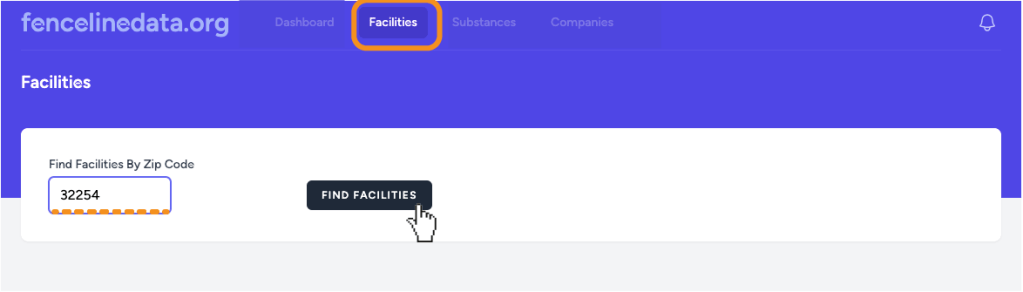

3. Click on the facility with the address closest to the manufacturer you’re interested in.
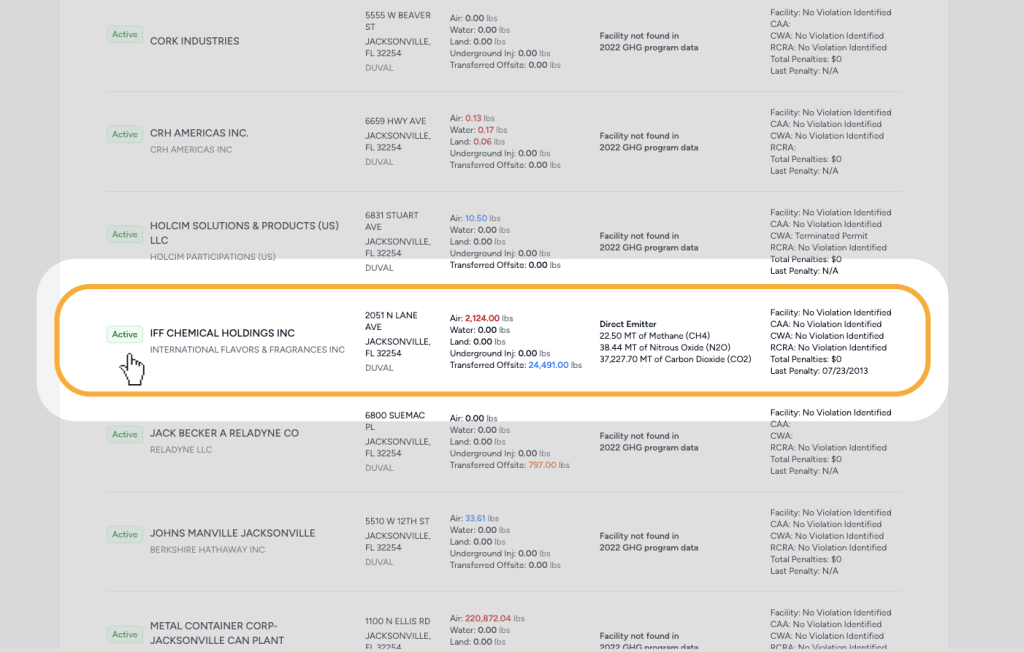

4. Use the map to confirm that you’ve chosen the correct facility.

Findings: IFF Chemical Holdings Inc in Jacksonville released nearly 37,600 metric tons of carbon dioxide, the primary cause of climate change. That’s equivalent to the combined tailpipe emissions of 8,949 cars in a year. It also released 41 metric tons of nitrous oxides and 24 metric tons of methane, two other greenhouse gases.

Substances

Question: Ammonia is a colorless gas with a sharp odor that is used to make plastics, pesticides and other products. High levels can burn the mouth, nose, eyes and throat, and chronic exposure can permanently damage the lungs. What’s the biggest ammonia polluter in the U.S.?

1. Search “ammonia” in the “Substances” tab.
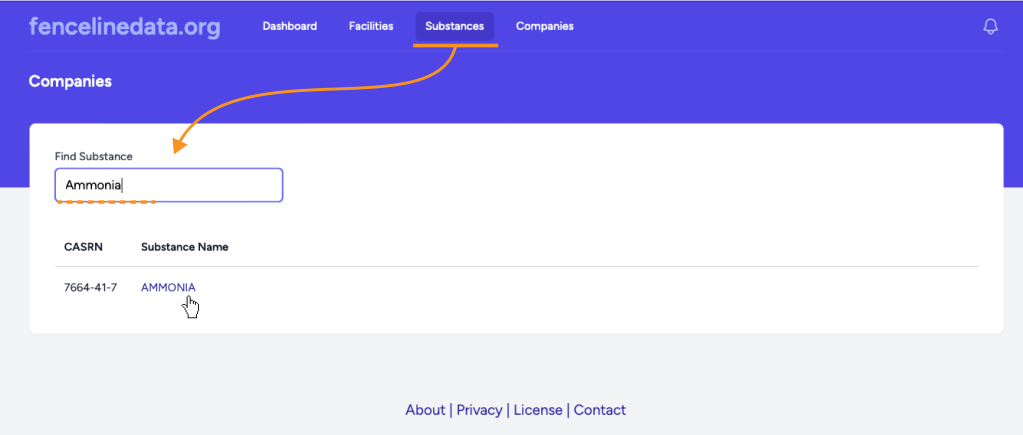
Findings: Basin Electric, which operates a coal-fired power plant in North Dakota, released the most ammonia in 2022 — almost 18 million pounds.

Companies

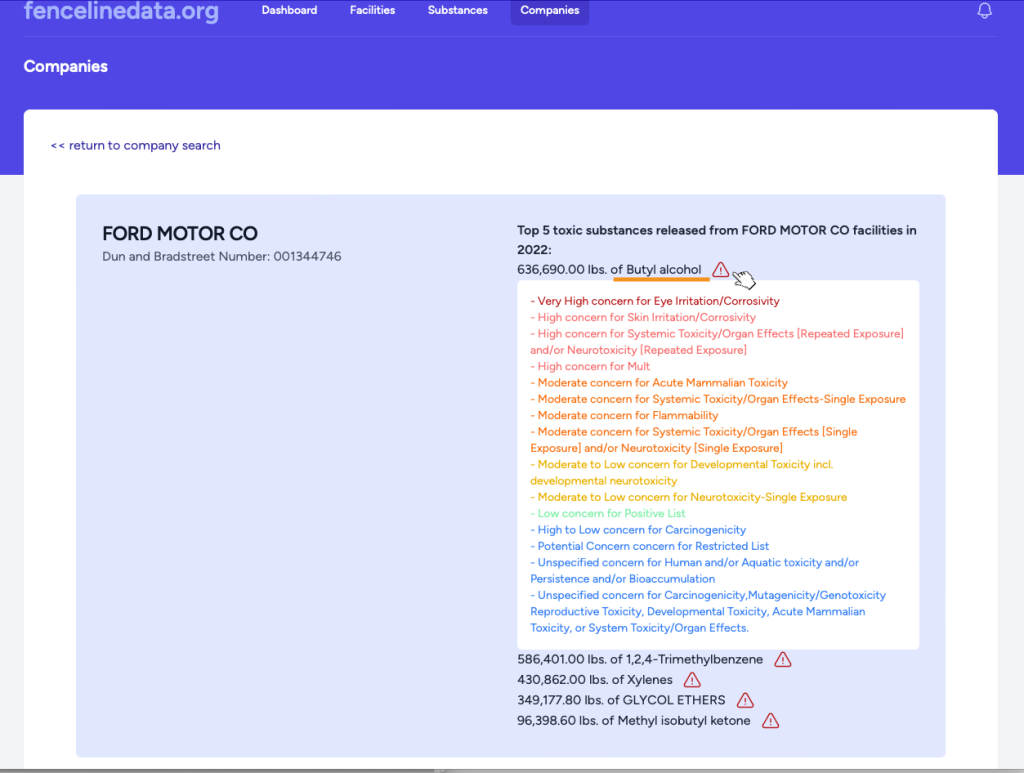
Question: Which chemicals does my car manufacturer release, and in what amounts?

1. Search “Ford” in the “Companies” tab and select “Ford Motor Co”.
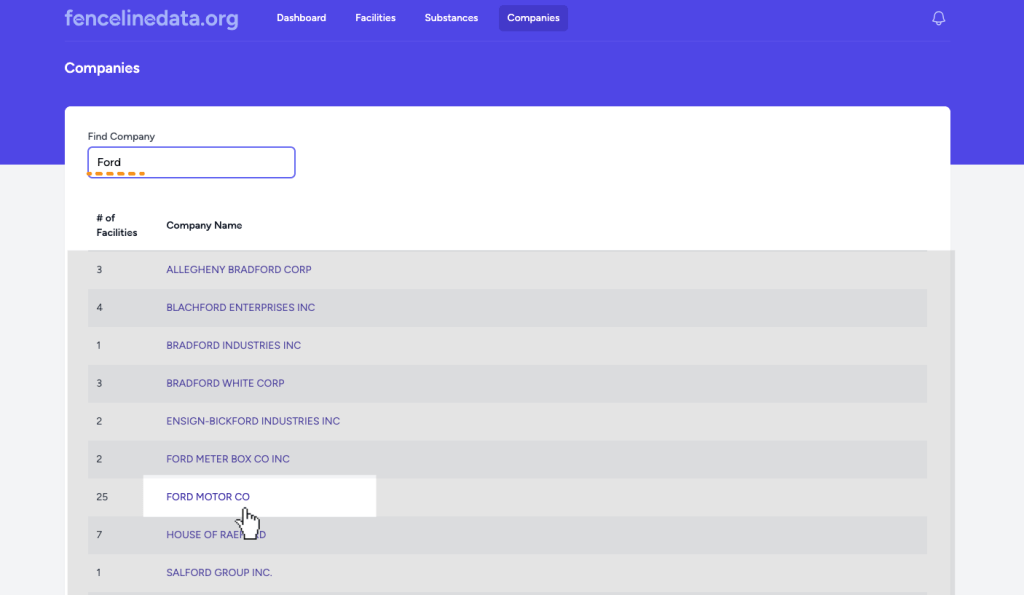
Findings: Ford facilities around the U.S. in 2022 collectively released more than 600,000 pounds of butyl alcohol, a sweet-smelling chemical that can irritate the eyes and cause headaches, dizziness, nausea and vomiting. Ford plants also released more than 586,000 pounds of 1,2,4-Trimethylbenzene, which can affect the eyes, skin and respiratory system, and almost 431,000 pounds of xylenes, which can attack the kidneys and the nervous, respiratory and cardiovascular systems with chronic exposure.
Want to Go Deeper?

Question: Which of the “Big 3” American car manufacturers contributed most to climate change and released the highest amount of chemicals in 2022?

1. Search “General Motors” in the “Companies” tab.


2. Click on the first GM facility that appears: DMAX LTD.


3. Download the Toxics Release Inventory data for DMAX LTD for 2022.


4. Click the back arrow on your web browser to return to the GM LLC page.
5. Download the 2022 data for each of GM’s 24 facilities.
6. Repeat steps 1 through 5 for Ford Motor Co’s 25 facilities and FCA US LLC’s (now known as Stellantis) 15 facilities.
7. Combine your CSV files by parent company.
8. To find which company released the most toxic chemicals, find the sum of the “Total toxic substance releases” column for each company. Then compare each company’s total. Do the same for CO2 releases and fines.
9. Now put the differently-sized companies on the same scale. Take the total toxic releases and divide it by the number of facilities for each company. This gives you an average amount of chemicals released per facility. Repeat with CO2 and penalties.

Findings:

  • Only GM reported polluting water and land in addition to air. (Because facilities calculate emissions data and self-report to the EPA’s Toxics Release Inventory, this may not reflect actual emissions).
  • Ford was the biggest CO2 polluter (439,636 metric tons). But Stellantis released the most CO2 per facility — 20,878 metric tons.
  • GM was the biggest chemical polluter (2,780,774 lbs.). It released 115,866 lbs. per facility.

https://e.infogram.com/feba62eb-259e-4930-8cb8-bf4b6b419e94?parent_url=https%3A%2F%2Fpublichealthwatch.org%2F2024%2F04%2F04%2Fpollution-chemicals-emissions-climate-data%2F%3Femci%3D4d174887-9dfd-ee11-aaf0-7c1e52017038%26emdi%3D08ac0824-c307-ef11-96f3-7c1e521b07f9%26ceid%3D4304602&src=embed#async_embed

Column Chart
Infogram

https://e.infogram.com/fac0e643-ae3d-4318-9f43-b60291b5b4ba?parent_url=https%3A%2F%2Fpublichealthwatch.org%2F2024%2F04%2F04%2Fpollution-chemicals-emissions-climate-data%2F%3Femci%3D4d174887-9dfd-ee11-aaf0-7c1e52017038%26emdi%3D08ac0824-c307-ef11-96f3-7c1e521b07f9%26ceid%3D4304602&src=embed#async_embed

Column Chart
Infogram

Isabel Simpson contributed to this story.

ABOUT US

Public Health Watch is a nonprofit, nonpartisan investigative news organization that focuses on threats to America’s well-being.

2110 Ranch Road 620 South
#340762
Austin, TX 78734

Contact us: info@publichealthwatch.org

“Troubled Water” film about Line 5 showing at GVSU GR campus

Scenes from Troubled Water

This film about the Great Lakes and Line 5 crude oil pipeline has been showing on sold-out screens in Traverse City, Cheboygan, Ann Arbor, and Chicago. Now it’s coming to Grand Rapids!  Troubled Water is a new film that follows them from Mackinac Island to Lansing, through the Great Lakes, and up the Grand River. Two friends embark on an epic stand-up paddle adventure to discover the grandeur of the Great Lakes and Michigan’s water.

You are invited to the Grand Rapids premiere at the Loosemore Theater at GVSU on Thursday, February 1. 

Check out the trailer:

Troubled Water Trailer
GET TICKETS

You can get tickets at the Michigan Climate Action Network website. MiCAN, an OWDM steering committee member, is hosting the screening. Tickets are only $5, and free student/needs-based tickets are available.

The event starts with a reception at 6:00 p.m., with the movie beginning at 6:30 p.m. One of the filmmakers/subjects of the movie, William Wright, will be present for a Q&A after the film.

Experience the wonder of Michigan’s abundant natural resources and meet the passionate people dedicated to protecting those resources. Although the Great Lakes face daunting environmental challenges, a community centered on a shared love of water provides hope for the lakes’ continued preservation.

MEJC disappointed in Michigan’s latest “clean energy” package

The Michigan Environmental Justice Coalition shared the reactions below to the latest state energy legislation, which includes reopening the Palisades nuclear power plant that is dangerously located on the banks of Lake Michigan and has been purchased by Holtec, a national corporation with a poor safety track record.
Corporate, investor-owned utility influence in the Michigan Legislature was on full display this year, as Governor Whitmer signed energy legislation that was passed without the input of environmental justice communities and allows fossil fuel companies to continue to endanger our lives with pollution under the guise of ‘clean energy.’Our communities know better. And from the beginning, MEJC and allies were front and center, in open letters, press releases, interviews, and online with a clear message: There can be no win on climate without environmental justice.As we look to 2024 we will continue to organize and advocate as we hold our elected representatives accountable to the communities they serve, not the corporations that fund their campaigns.Here were key moments where we took our voices straight to power in 2023:
 Our Open Letters
Our September 2023 open letter to Governor Gretchen Whitmer where we advocated for policies that prioritized: Fair Outage Compensation:Electricity AffordabilityCampaign Finance ReformCumulative Impact Analysis Our April 2023 open letter to Michigan legislature where we advocated for:  Prioritizing communities most impacted by climate change and pollution.Combatting environmental injustice and ensure healthy lives for all. Averting climate and environmental catastrophe.Stopping all fossil fuel and polluter handouts.Creating millions of good, safe, union jobs.
Bill Analysis: No Climate Win Without Environmental Justice! 
SB271 allows industries to continue to pollute our communities with fossil fuel energy sources. It sets up a clean energy standard that is totally inadequate to meet the needs of a rapidly changing climate. It also fails to include any environmental justice priority such as outage compensation, cumulative impact analysis, or any move towards breaking the monopoly of DTE and Consumers Energy. Read our full analysis on the climate bills the Michigan legislature passed this year and why we must demand our representatives do better! MEJC policy associate, Roshan Krishnan, provides an in depth walk through of our analysis of the “MI Clean Energy Future” bills. 

Read more from MEJC:
Environmental Justice Communities Warn Against Weakening State Senate‘There is no climate win without Environmental Justice’ (Oct. 10)
Environmental Justice Communities Disappointed with Passage of Senate Dirty Energy Bills: ‘Legislation passed by the Michigan Senate is ‘betrayal of environmental justice communities’(Oct. 27)
Environmental Justice Communities Condemn DTE Rate Increase, Line 5 Approval: Twin approvals a ‘double betrayal,’ show MPSC ‘values lavish treatment from corporate polluters over the voices of Michiganders’  (Dec. 4)

Dr. Beverly Wright: Race, Place and Climate Action

Dr. Beverly Wright, award-winning environmental justice scholar, advocate, author, and founding executive director of the Deep South Center for Environmental Justice, presented at The Wege Foundation 25th Annual Speaker series on May 26, 2022 on “Race, Place and Climate Action.” You can watch the video below.

Talk to a Troublemaker: Livestream about Community Solar

Join the Michigan Environmental Justice Coalition tomorrow, Tuesday (11/16) for the latest installment of Talk to a Troublemaker with the Work for Me, DTE crew! Michelle Jones, Mama Shu, and Layla Elabed will talk about community solar — and how its benefits, like healthier communities, lower bills, and stopping shutoffs, come directly from community control.

Layla & Michelle will shed light on the latest on DTE’s latest efforts to obstruct community solar,  and evade accountability for massive power outages this summer. Together, MEJC, Soulardarity, and We the People MI traveled to Lansing last month to testify at the House Energy Committee’s hearing on power outages. Chair Bellino — who, among 11 of the committee members, accepted $1000 from a DTE PAC within days of the hearing — denied us the chance to speak.

Bring your questions and perhaps, an end-of-day snack. You can join us via Zoom or tune in on Facebook Live.

Green Gavel scoring system rates Michigan’s Supreme Court’s environmental impacts

Note from OKT: If you were at the Southeast Area Farmers Market last week, you may have talked with the Michigan LCV folks who ere sharing information there. Here’s an example of their good work.

Reposted from Rapid Growth Media

In collaboration with students at the University of Michigan Law School, the Michigan League of Conservation Voters (LCV) has updated its online Green Gavels tool. When a Michigan Supreme Court case concerns an environmental issue, the scoring tool rates the justices’ decision on the case either green, yellow or red, based on how it impacts the environment. 

“We want our Supreme Court legal system to be independent from political influence of all kinds and not independent from the best ideas and public desire for cleaner land, air and water,” says Nick Occhipinti, Michigan LCV’s Grand Rapids-based government affairs director.

A green gavel indicates a decision that was good for the environment, a red gavel means not only was the decision bad for the environment, but the justices could have chosen to rule differently. Yellow gavels indicate either that the issue had no impact on the environment, was bad but decided upon precedent or an unrelated issue, or was bad but based correctly on the existing law.

“It’s an opportunity for the public to gain better access to information that is not easily available. [The Green Gavel] is shining a bright light on what the Michigan Supreme Court is doing,” Occhipinti says. “The state Supreme Court is a third, coequal branch of the government.”

One case the Michigan LCV followed was Henry v. Dow Chemical. A unanimous 2018 Michigan Supreme Court decision reversed the lower courts and prevented residents from bringing lawsuits when negative health issues caused by pollution do not develop until after the existing statute of limitations had passed.

“Now it is harder for property owners to bring suits,” Occhipinti says. “Because we’re active in the legislative arena and connected to the legal realm, with this tool, we can put the pieces together. [We can] say, ‘Hey, folks, this legislation is critically important because it closes this legal gap.’ In this case, the statute of limitations, but pick your issue.”

Nick Occhipinti

Originally launched in 2012, Michigan LCV’s Green Gavels scored environmental cases from 1980-2012. The update adds cases from 2012-2020 and tracks scores for current justices. Cases and justices’ scores are updated regularly. Currently, the website reports that Chief Justice Bridget Mary McCormack has the most green gavels, seven, while Justice Brian K. Zara has the most red gavels, seven.

“Connection of the legal outcomes at the State Supreme Court, at that highest level, connection to statute and legislative change within the Michigan legislature, that is how we connect to issues,” Occhipinti says. “Finding that there are holes and a legal recourse for protecting [people from] contaminated sites, protecting Michigan’s land, air and water. My job is to improve our legislative policy that will then protect communities.”


Written by Estelle Slootmaker, Development News Editor
Photos courtesy Michigan League of Conservation Voters

Black lives matter — but not to the nuclear industry

Reposted from Beyond Nuclear

“Black communities get more promises than jobs — and they get pollution and they get sick”

By Linda Pentz Gunter

Systemic racism in the nuclear industrial complex has endured for decades. Every community of color has been affected. As we confront the wider impact of centuries of racism in the US, we take a closer look specifically at discrimination against African Americans in the nuclear power sector.

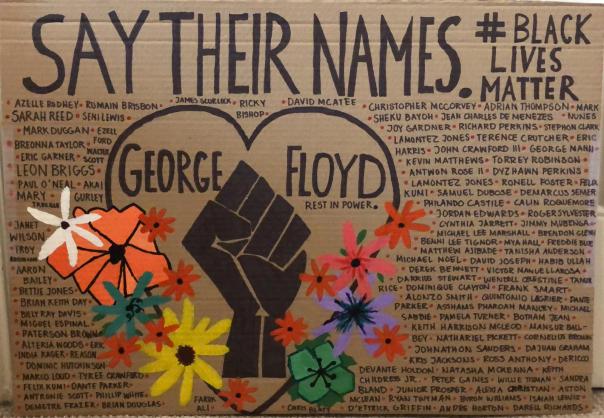
The shackles of slavery may be gone, but there is now a knee on the neck of African American voices, whether literal or metaphorical, when it comes to challenging injustice. And it is there when confronting the bias of the nuclear power industry and other lethal polluters. It is quite deliberately there. It is there not only to oppress — and in the case of George Floyd to kill — but to silence and disenfranchise. To stunt movements for change.

Mati poster 2 copy

That is perhaps how the NAACP’s A.C. Garner, felt after the US Nuclear Regulatory Commission (NRC) dismissed black concerns over a proposed new nuclear power plant in Mississippi in 2005. It was, he said,  like “posting a ‘WHITES ONLY’ sign on the hearing room door.”

Garner’s statement was a reaction to a January 19, 2005 decision by the NRC to grant permission for a second nuclear reactor to be built at the Grand Gulf site in Mississippi. It was to be built in the poorest county in the state, itself the poorest state in the union.

It would join Grand Gulf Unit 1, opened in 1985 in the Claiborne County city of Port Gibson, and would be known as Grand Gulf Unit 3, as all there is of Unit 2 is an empty concrete pad— the plant owners, Entergy, having asked the NRC to revoke that planned reactor’s license in 1991.

Grand Gulf 1, the largest single unit in the country, with an output of around 1,500 MW, is located in a community that is 87% African American, with a poverty rate of 46% according to census data. The median household income in Claiborne County is $24,601 per year. At least 35% of the population depends on Medicaid. The Covid-19 infection rate there is still headed on an upward trajectory.

Back in 2005, the county was already ill prepared for a health crisis of any sort. It had just one crumbling hospital, struggling to meet the needs of a deprived community and with zero capacity to handle a nuclear emergency. Evacuation routes were washed out and impassible. The police force was completely under-equipped.

“The county doesn’t even have a hospital that’s open 24 hours, and there’s only one fire station in the entire county,” Rose Johnson, chairwoman of the Mississippi Chapter of the Sierra Club, told the Jackson Free Press at the time. “The situation should send chills down the spines of anyone who lives within a 100-mile radius of Port Gibson.”

Why such deprivation? Why weren’t Port Gibson and Claiborne County flush with the tax revenues the plant should have brought in? Because in 1986, fearing price hikes for the “too cheap to meter” electricity generated by Grand Gulf nuclear Unit 1, Entergy succeeded in getting the predominantly white Mississippi legislature to pass a bill to redistribute more than 70% of those tax revenues to 47 other counties in the state. It is the only reactor community in the country that does not reap the lion’s share of its nuclear plant tax dollars.

The law left an already poor black community even more desperately deprived. But it pre-empted any complaints about increased electricity costs from whiter communities elsewhere in the state.

By the time of the 2005 NRC decision, the agency had also conveniently ruled that issues of environmental justice such as racism, fairness and economic equity would not be considered litigable during reactor licensing proceedings. It was a move clearly designed to silence black voices. “Whites Only” was indeed firmly nailed to the door.

It’s an old story, one of systemic racism throughout the nuclear sector.

It began with the uranium mining conducted largely by Native Americans, without protection and unaware of the health risks. It continued with the Trinity test, irradiating downwinders, many of them from Native American and Hispanic communities.

Then the atomic bombs were dropped on Hiroshima and Nagasaki, an act of racism that did not pass unnoticed by the African American community, many of whom — including Martin Luther King, Jr., W.E.B. Du Bois, Paul Robeson, James Baldwin, and Marian Anderson — came out to join the nuclear freeze movement.

The US atomic tests carried out overseas blasted the atolls of the Marshallese, treated as guinea pigs and described by a US official as “more like us than mice.” The domestic tests were conducted on land belonging to the Western Shoshone.

The British tested their bombs at Maralinga in Australia, on Aboriginal homelands. The Belgians mined their uranium in the African Congo. The French tested atomic weapons on Algerians in the Sahara, then moved to the South Pacific islands.

T poster 3

Back in the US,  Hispanic communities such as Sierra Blanca, TX were targeted for nuclear waste dumps, a trend that has continued; with the choice of Yucca Mountain, on Western Shoshone land, as the place to host the country’s high-level nuclear waste; with the imposition of unwanted new nuclear reactors and the huge nuclear weapons complex at the Savannah River Site, which would poison black communities. And on and on.

It is a culture and a practice that have never changed. In a 2016 paper — Emerging Environmental Justice Issues in Nuclear Power and Radioactive Contamination — published in the International Journal of Environmental Research and Public Health, academics Dean Kyne and Bob Bolin noted that the NRC’s “growing constraints” in public participation spoke to “who is or is not recognized as worthy of inclusion in decision-making regarding the allocation of hazard burdens.”

They described the culture at the NRC as reinforcing “a tradition of secrecy, denial, and misinformation that has long been part of the nuclear industrial complex.”

They further noted that while “federal agencies are mandated to identify and address adverse human health and environmental impacts on minority and low-income populations,” this does not apply to the NRC, for whom it is “not mandatory” but merely “voluntary.” In allowing this level of discretion over what issues may be considered an environmental justice concern, “not surprisingly, 76 percent were labeled as being of ‘small significance’,” the authors wrote.

“The NRC once again bowed to its master — the nuclear industry — to pave the way for construction in an area where they expect least resistance,” said Garner of the Grand Gulf 3 debacle. (As it turns out, Entergy canceled Grand Gulf 3 in February 2015, when its lousy economics finally wouldn’t stand up).

Raw Pixel Shutter

The forced imposition of a dangerous and polluting industrial installation on a poor community of color in desperate need of jobs remains an age-old tactic of corporations and governments. In challenging Grand Gulf 3 before its cancelation, residents of Port Gibson rightly asked why, if a new nuclear power plant was such an economy-boosting bonanza, the area was still the poorest in the country two decades after the first reactor came on line?

Residents of Burke County, Georgia, are asking similar questions. The county itself is about evenly divided between black and white populations, but the communities of Shell Bluff and Waynesboro, poor and black, have been the hardest hit by nuclear installations in the area. Today, 40.9% of the children there live below the federal poverty line, with a higher rate of childhood poverty than 86.8% of U.S. neighborhoods. Waynesboro is 70.4% black.

The poisoning of surrounding communities began in the 1950s, when an entire town was relocated to make way for the massive Savannah River Site (SRS) atomic bomb factory just across the river and state line, near Aiken, SC— the place where tritium and plutonium was produced for nuclear weapons.

In the 1980s, a whistleblower named William Lawless revealed how the US Department of Energy, which owns SRS, had been dumping cardboard boxes filled with nuclear waste into trenches, where the boxes had leaked their deadly inventory into the groundwater.

In 1987, two nuclear reactor units came on line at Plant Vogtle, just 10 miles from Shell Bluff and 18 miles from Waynesboro. Cancer rates started to creep up. Then, against the objections of the local black community, the green light was given for two more reactors to be built at Plant Vogtle.

The decision was made all the more painful given that it was Barack Obama, the first black president of the United States, who came in person to announce the Vogtle 3 and 4 go-ahead, sweetening it with a $8.3 billion federal loan guarantee and flanked for his big media moment by two white guys.  Meanwhile, Vogtle 3 and 4 are both still under construction, wildly over budget and way behind schedule and with a micro-epidemic of Covid-19 cases among the workforce.

EJ Communities’ Urgent Need for Climate Action

mejc_logo_colorReposted from the Michigan Environmental Justice Coalition

*This letter was originally prepared for a meeting with EJ Public Advocate Regina Strong, and Dr. Brandy Brown, Climate and Energy Advisor to the Governor

Memo on Governor’s Climate Agenda: To Address the Urgent
Need for Environmental Justice, We Must be Climate READY

First, we want to recognize the moral significance of making time and space to meet directly with environmental justice communities and organizations on the urgent demands of the climate crisis.

Vulnerable communities, Black, Latinx, Arab, and Indigenous peoples have bore the brunt of contamination and degradation in Michigan for decades, if not centuries. As such, our expertise of the regulatory system, our traditional ecological knowledge, and our social networks are rich, exact in their capacities, and best suited to troubleshoot and resolve climate issues – whether the issues are ones that are emergent or ones tied to past abuses of the energy sector.
Additionally, organizations and Tribes led by leaders who live in their communities bear externalities and the highest risks of bad policy decisions. They also have the most to gain from positive results of good policy in physical and material ways. The rewards of positive policy decisions should seek to amend and resolve the historic disproportionality of toxicity and inaccessibility to food, water, land, healthy communities and cultural freedoms.
With this in mind, we believe there are several low hanging fruits for the Governor to move on that exemplify early stage crisis responses that are administratively sound. We summarize them in a community-useful acronym called Climate R.E.A.D.Y. that identifies our priorities and timeframe.

CLIMATE R.E.A.D.Y.
Readiness for the crisis
● Establish regular communication with frontline communities, especially those that are
multilingual and accessible for multi-abled people;
● Engage local hearings, townhall, and listening sessions on toxics, vulnerability, health, pollution, legacy sites, flooding, high heat and extreme cold;
● Meet regularly with EJ organizations and Tribal governments about climate, environmental impacts, and troubleshooting resilience strategies;
● Communicate with multi-platform channels through televised, print, and online sources.

Emergency-response protocols
● Establish cross-agency and cross-jurisdiction working groups that can quickly mobilize when there is a threat of exposure and/or contamination along with extreme weather contingency planning, funding, and execution;
● Troubleshoot and evaluate emergency situations and closure of regulatory loopholes;
● Disclose fully all materials, incidents and responsible parties, with fines and fees levied at the scale of the risk and directed toward clean up and harm reduction/mitigation;
● Deploy effective and timely risk communication to potentially impacted communities, with
adequate evacuation notification.

Assess past and foreseen harms
● Employ Cumulative Impact Assessments and Health Impact Assessment in decision-making;
● Assess climate risk in decision-making at the permit level, and certificate of necessity, IRP and other planning, including high lake levels, including life cycle analysis of all GHG emission sources (public and private);
● Establish a Climate Commission in which equity is central and where environmental justice communities have a majority in decision-making;
● Enact vulnerability criteria that are utilized in decision-making processes regarding emissions control, reduction, mitigation and adaptation strategies.

Development initiatives
● Aggregate financing, block grants, and special funds deployed for Just Transition within geographies directly impacted by pollution, flooding, food shocks, high heat, drought, extreme cold and persistent contamination AND particularly where there is no or inadequate access to healthcare, housing, food and clean water, and other resilience measures for public health and welfare;
● Direct public dollars to leverage the Just Transition of municipalities and workforce sectors impacted by fossil fuel regulatory statutes like facility closure;
● Target strategies for transitioning from a fossil fuel-based economy to a renewable economy within those same vulnerable geographies, including EV access, clean drinking water and sanitation infrastructure, organic food, waste reduction and elimination, community solar, energy, efficient retrofits, transmission renovation and distributed generation;
● Create a “Do business in Michigan” incentives program for Michigan-based companies to receive tax breaks or other incentives as they pursue/maximize using local production inputs and purchase products, minority-owned businesses, as locally as possible to reduce transportation emissions, which will also create Michigan jobs and economic benefits.
● Train those most under-represented in the clean energy workforce including but not limited to: returning citizens, veterans, Tribal members, DACA residents;
● Reject bailout promises that burden residential consumers with debt from stranded assets we foresee in the energy sector;
● Adopt strategies for EJ communities displaced by extreme weather events settling or unsettled in Michigan.

Year 2030
● Acknowledge that by all estimates the climate crisis is upon us in Michigan and there is no time to wait.
● Pursue aggressively 100% renewable energy by 2030. As the steward of 89% of the nation’s fresh surface water, Michigan must act.
● Reject the false solutions presented by the oil and gas industry, like carbon capture and storage, cap and trade, and nuclear energy, as being the only options to put millions of people to work, and save lives on a global scale.

With this Climate R.E.A.D.Y. program for Michigan, we believe the Governor’s Climate Agenda has the best opportunity for ecological and environmental justice success. MEJC is ready and able to help you meet this challenge and demonstrate our commitment to Michigan communities and the nation.

Thank you.

Regards,
Michigan Environmental Justice Coalition