“The U.S. House Republicans who voted for this unconscionable budget bill have effectively turned their backs on the people they are supposed to represent and are putting millions of lives at risk — all to further line the pockets of the wealthiest among us.”
The Michigan League for Public Policy issued the following statement today denouncing the U.S. House Republicans’ passage of a budget bill that could strip health care and food away from millions of Americans, including hundreds of thousands of Michiganders, in order to offset the cost of major tax giveaways for the wealthiest U.S. households and corporations. The statement can be attributed to League President and CEO Monique Stanton.
“This is ‘one big beautiful bill’ for millionaires and billionaires…not the rest of us. There is nothing beautiful about taking away food and health care from over half a million Michiganders and millions more around the country. Celebrating this bill means celebrating the loss of jobs, economic security and essential support systems in communities all around our state. People in our country, including those who call Michigan home, deserve so much better than this.”
“The cuts to Medicaid will strip essential care away from an estimated 740,000 people in Michigan through harsh work requirements, while making it more difficult for many more of the 1 in 4 Michiganders who rely on Medicaid to afford the care they need through a plan to impose co-pays. And beyond these very real human costs, the cuts will more than likely force hospitals and other health care facilities — especially those in rural areas — to close their doors, resulting in accessibility issues and major job losses within our already-stretched-too-thin health care system. And our state economy will suffer as a result of reduced federal revenue, additional administrative costs due to new and unnecessary red tape requirements and restrictions on how Michigan raises money to pay for Medicaid. The far-reaching impact of these cuts will be felt not just by those who participate in Medicaid, but by every person in our state.
“Members of our Congressional delegation have heard loud and clear that the vast majority of Michiganders across political views and party affiliations — 83% — don’t want cuts to Medicaid, yet they are forging ahead with this reckless plan. Today’s vote was a huge slap in the face for their constituents. Lives will be put at risk as a result.
“Food insecurity among families in Michigan will also continue to spike as a result of the cuts to SNAP at a time when food banks are already struggling to keep up with community needs. More than 300,000 Michiganders could see their benefits reduced or taken away entirely as a result of the expanded work requirements, which will do nothing to help people who are out of work find jobs faster. Taking food away from those who need it most, including children, will only result in worse outcomes in health, education and overall well-being. SNAP cuts will also impact grocery stores and Michigan’s agriculture industry— one of our state’s largest economic drivers.
“House Republicans have shown where their loyalty lies and it is not with the everyday, working people in our country. It’s with wealthy individuals, businesses and large corporations. Under this bill, the average tax filer earning $1 million or more would receive about $90,000 in tax breaks at the expense of life-saving programs like Medicaid and SNAP, while families earning less than $50,000 would get under $300 in tax cuts in 2027, amounting to less than a dollar a day. The tax cuts that families with low incomes will receive are negligible and will do nothing to help them considering the increased costs they will face if more tariffs are enacted and their health care and food is stripped away. And the expanded Child Tax Credit leaves 17 million children behind whose families earn too little, while the bill takes the credit completely away from 4.5 million citizen or legal permanent resident children by requiring both parents to have a Social Security number.
“The U.S. House Republicans who voted for this unconscionable budget bill have effectively turned their backs on the people they are supposed to represent and are putting millions of lives at risk — all to further line the pockets of the wealthiest among us.”
The Michigan League for Public Policy is sounding the alarm on three bills that advanced yesterday. Congressional House Republicans set the stage for the largest cuts to Medicaid and SNAP in the history of those programs, threatening the health and economic security of Michiganders.
The budget bills passed by the U.S. House Committee on Energy and Commerce, the U.S. House Committee on Agriculture, and the U.S. House Committee on Ways and Means include:
At least $625 billion in cuts to Medicaid through work requirements for people who receive coverage through the Medicaid expansion, various other red tape requirements that will reduce coverage and restrictions on how Michigan raises money to pay for Medicaid, among other changes.
Roughly $300 billion in cuts to SNAP through harsh work requirements for older adults and parents of school-aged children, as well as a requirement that states, for the first time in the 50-year history of the program, pay for a share of food benefits. Michigan would need to come up with over $760 million each year. To put that into perspective, that is about 80% of the entire annual budget for the Michigan State Police.
A tax plan that would increase deficits by $3.8 trillion over 10 years, providing an average tax cut of $65,000 for people with incomes in the top 1%, while doing little for low- and moderate-income families.
“We’re gravely concerned that House Republicans have put aside the needs of their constituents and of their states’ economies by passing these harmful bills out of committees yesterday. To put life-saving programs like Medicaid and SNAP on the chopping block in order to create tax cuts that mainly benefit the wealthy is egregious,” says Monique Stanton, MLPP CEO. “All this is coming on top of a slew of executive orders designed to intimidate and threaten large swaths of the country, and sweeping, senseless cuts to federal jobs, public education, nonprofit services, crucial research projects and more. We are calling for lawmakers to put their constituents—and their country—first and put a stop to this reckless behavior.
“Michigan’s economy grows when families can afford the basics and incomes are strong. This does the exact opposite—gutting food and health care assistance and leaving people who are already hungry or sick to fall even further behind as prices and tariffs climb.
“More than 2.6 million Michiganders—1 in 4 people in our state—depend on Medicaid for essential care.
“But under this plan, 740,000 Michiganders who gained coverage through the Healthy Michigan Plan might lose it again if House Republicans enact work requirements. Those requirements would create more red tape, which could take away coverage from children, seniors and people with disabilities. Even if people keep their coverage, they might not be able to afford even basic medical treatment due to a plan to impose co-pays. We could also see hospital closures and job losses, resulting in economic losses in communities, especially rural areas.
“And cuts to SNAP threaten the nutrition of over 300,000 Michiganders who could see their food assistance benefits cut or taken away entirely under the House Republicans’ plan to expand work requirements to older adults and parents of school-aged kids. Taking away benefits from parents harms kids, too. Kids won’t get enough to eat, and their health and school performance will suffer.
“Most SNAP participants who can work, do. In fact, 3 in 4 SNAP households in Michigan have at least one adult working. And for those who don’t have jobs, taking food away will do nothing to help them find work more quickly. Instead, it punishes many who are working, burdening them with red tape and time-consuming documentation.
“Everything that we know is critical to Michigan’s growth — bringing down maternal mortality rates, making sure older folks can afford their prescriptions, making sure kids and families have the nutrition they need — that’s all at stake now.
“And for what? To make sure more wealthy people get a tax cut.
“Pushing through $1.5 trillion in cuts to basic needs programs to pay for tax cuts that disproportionately benefit the wealthy is short-sighted and shows that these lawmakers aren’t thinking about the people they serve. In Michigan, rural and northern counties have a higher percentage of folks who rely on Medicaid and SNAP and a higher percentage of folks living in poverty than most other counties. People living in these areas already have more limited access to the things they need, and taking food off their tables and health care away from their kids is not the answer.
“And guess what? The cuts won’t help with the deficit. Even with the dismantling of federal funding for food assistance and health care, the current plan would still increase deficits by $3.8 trillion over 10 years.
“Plus, working families with lower wages will see next to nothing from the tax cut provisions. The proposed expansion of the Child Tax Credit (CTC) leaves out up to 20 million children in working families nationwide. They won’t get the full credit because their families’ incomes are too low. And millions of people will see tax increases if tariffs are enacted. The tariffs would likely erase a large portion of forthcoming tax cuts for low-income households, those making less than roughly $13,840.
It’s important to note that many of these purported ‘tax cuts for working families,’ including removing the tax on tips and overtime, and the increase in the CTC are only temporary, all set to expire at the end of 2028. But many of the tax cuts for upper-income households will remain permanent, keeping the money flowing to those who already have more.
It’s time for our leaders to remember who they’re working for.”
Advocates for immigrant families, health care, food security, and economic opportunity warned today that the federal budget debate in Congress threatens deep cuts to health care and social services for millions of Michigan residents in immigrant families. Spokespersons for the Michigan Immigrant Rights Center (MIRC), the Protecting Immigrant Families Coalition (PIF), Michigan Primary Care Association, Michigan League for Public Policy, and Food Bank Council of Michigan briefed Michigan journalists by teleconference.
“These cuts will impact immigrant families and communities across the state.” said Christine Sauvé, Policy, Engagement, and Communications Manager at the Michigan Immigrant Rights Center. “Immigrants are integral to Michigan’s social, cultural, and economic fabric and the proposed restrictions would hurt us all. We all benefit when more people have access to the care and support they need to thrive.”
“Policymakers need to understand that – in addition to the human consequences – these cuts will mean job losses, loss of needed services to keep folks well, and facility closures across our state, including areas already experiencing insufficient healthcare access,” said Jackie Chandler, Population Health Manager at the Michigan Primary Care Association.
“The Child Tax Credit and other anti-poverty measures drastically reduce child poverty, making for a more prosperous economic environment with lower public costs in the long term,” said Scott Preston, Senior Policy Analyst at the Michigan League for Public Policy. “Immigrants are important contributors to our state’s economy and the proposed cuts would simply make life harder for citizens who want to stay in Michigan and be part of our state’s future.”
“Denying SNAP to lawfully-present immigrants and U.S. citizens in immigrant families will drive up hunger across the state and undermine the economic stability of families, farms and other food producers, and neighborhood retailers across the state,” said Anna Almanza, Director of Public Policy & Government Relations, Food Bank Council of Michigan
“Congress should be looking for solutions to problems like unmet health care needs, hunger, and poverty, not making those problems worse,” said PIF Campaign Strategist Esther Reyes.
The Michigan League for Public Policy is strongly denouncing the United States Senate’s new budget plan, which is predicted to pass this weekend and would create harmful consequences for Michiganders. Monique Stanton, MLPP president & CEO states:
“The Senate’s new budget plan is downright dangerous, and if passed this weekend as planned, will set the stage for a damaging tax and budget bill. It delivers massive tax breaks to millionaires, billionaires, and large corporations — and covers the cost in part by slashing essential programs like Medicaid and SNAP. In Michigan alone, 2.6 million residents rely on Medicaid — including over 1 million children — and more than 1.4 million Michiganders rely on SNAP. These cuts would lead to higher health care and food costs for families, increased financial hardship, and millions potentially losing health coverage.
Even with deep cuts, the tax breaks are so expensive that they will lead to a significant rise in the national deficit, increasing economic risks tied to unsustainable debt — all to benefit the wealthiest households.
It doesn’t have to be this way. There’s still time for Congress to change course. Lawmakers must honor their commitments to ease the burdens families face, not reshape the budget to serve those at the very top. A responsible plan would lower health care and grocery costs, expand the Child Tax Credit, and invest in working families — and ask corporations and the wealthy to pay their fair share through a more balanced tax policy.
Senate Republicans are using misleading tactics to obscure the truth about this budget. They’ve downplayed the cost of these tax cuts and hidden the full scope of planned reductions to Medicaid, food assistance, student loans and other critical programs. In reality, the budget would make college more expensive and take away essential supports from families the President once vowed to protect — all while delivering an average annual tax cut of $62,000 to households earning over $1 million, according to the Tax Policy Center.
The plan includes at least $5.3 trillion in tax breaks over the next nine years — $1.5 trillion more than the cost of extending the 2017 tax cuts — and that number could climb even higher with additional program cuts under consideration by the Senate Finance Committee.
What does that mean for Michigan? According to the Institute on Taxation and Economic Policy, simply extending the 2017 tax cuts would give the richest 1% of Michiganders an average tax cut of $35,970 while the poorest 20%, who are already struggling to afford the basics, would receive an average tax cut of just $90. What’s worse is that we expect the plan to go beyond this — providing windfall tax breaks for wealthy Michiganders while making it harder for the rest of us to see a doctor, put food on our table and send our kids to school.
It’s becoming clearer and clearer. Many in Congress are embracing an agenda that threatens public services and undermines democratic processes. Alongside the budget, Republicans are advancing executive actions that unlawfully withhold congressionally approved funding, politicize and weaken the civil service, and erode institutions like the Social Security Administration and the Treasury Department — putting the privacy and stability of millions at risk. On top of this, the administration is pushing new, unilateral tariffs that will raise everyday costs for working families by hundreds or even thousands of dollars — easily wiping out any modest tax relief they might receive.
This budget plan — like so much of the current agenda — is upside down. It breaks promises, deepens the already massive income gap, and puts the interests of the wealthy above the needs of the nation. The American people deserve a plan that builds shared prosperity — not one that leaves families behind.”
Dairy workers at risk of disease don’t have protective equipment when they need it
As H5N1, or avian flu, continues to spread among dairy and egg facilities across the state, Michigan farmworkers and outreach workers report that the personal protective equipment (PPE), testing, and vaccines needed to combat the disease are not readily available. Staff from the Michigan Immigrant Rights Center (MIRC) recently connected with 20 dairy workers in Michigan’s upper peninsula who were sick with flu-like symptoms. It took repeated communication from MIRC staff and partner organizations to determine who could provide testing, flu vaccines, and PPE for the affected workers. This experience highlights the wide gaps that exist in the current response to avian flu in Michigan to ensure workers at highest risk are protected, and the stark need for additional resources to stop the virus from gaining opportunities to mutate and spread person to person.
In 2024, two human cases of H5N1 were identified in Michigan, both among dairy workers who are at high risk of contracting the virus from cows. Currently the Michigan Department of Health and Human Services (MDHHS) directs affected workers to their local public health departments for H5N1 PPE, flu vaccines, testing, and treatment. However, the reality is that many public health departments are ill-equipped to serve in this role. Many do not have PPE, tests, treatment, or vaccines readily available, nor do they have the staff and language resources needed to communicate effectively with this vulnerable workforce.
On January 16, 2025, a group of 20 dairy workers in the northern peninsula reported being sick with flu-like symptoms. The illness spread quickly among the workers. On January 22, the local health department stated that they did not have H5N1 PPE, testing, or flu vaccines on hand, but would try to locate some resources. On January 28, they provided paper masks and COVID testing for the workers. On January 29, MDHHS stated that they had run out of PPE kits but would also look for resources. Two weeks later, on February 14, the local health department was able to access about seven avian flu tests and arranged a testing site for workers, however due to miscommunication and confusion about whether their employer would allow them to attend, no workers attended. On February 17, after a month of advocacy efforts by MIRC staff, MDHHS obtained PPE to send to the local health department and the workers finally received H5N1 PPE. To date, the local health department is still working to arrange flu shots for these individuals.
Public health experts assert that speed is essential in responding to potential avian flu outbreaks. As this timeline indicates, Michigan is not ready to respond with the swiftness necessary to mitigate the spread of H5N1. The Michigan Department of Agriculture and Rural Development (MDARD) tested either the farm’s cows or the milk within two weeks of the first reported illness and fortunately the tests came back negative. However, the response to test the animals was much swifter than the response for the human workers.
One of the sick workers provided a statement to MIRC in Spanish that was translated by our outreach workers:
“We hope that through this communication, there can be protective equipment for the other ranches, since we’ve already gotten PPE at the ranch where we are working. It arrived a little late, we hoped to get it sooner, but now we have it. We hope that the agencies that helped us can help other farms too. The agencies should be better prepared, so that when there is a request or someone is ill, the agency can respond quicker to those who need the protective equipment. If the protective equipment had arrived faster, we might not all have gotten sick.”
“The services that public health departments provide really vary by location,” said Rachelle Linsenmayer, MIRC staff attorney. “Some health departments have seasonal flu vaccines, flu testing, and H5N1 testing, but many do not. We’ve noticed that more remote health department locations are less likely to have the Spanish language resources that animal production workers need.”
In Barry County, a dairy worker noticed her co-workers were sick and wanted to avoid contracting the same illness. When she reached out to the local health clinic, she was told they didn’t have the avian flu vaccine. She then contacted her local health department but the staff did not speak Spanish and she could not explain in English what she needed. Fortunately, a few days later, an outreach worker from MDHHS assisted her with communication with the local health department. However, the worker was disappointed that she could not be vaccinated, because no vaccines were available. Dairy workers in Kent County also reported flu-like symptoms, but they didn’t go to the clinic due to a lack of information, and their busy work schedules did not allow them to miss work.
Accessing medical care is especially hard for dairy workers who work extremely long shifts, at least 12 hours per day. Many dairy farms operate 24 hours a day, 7 days per week, with round the clock milking schedules. The farms are remote and may not have access to nearby health facilities. When workers do have time off, they need to be able to quickly find and access resources, and cannot waste time contacting multiple agencies to locate H5N1 resources. Many dairy workers also fear seeking health services because they cannot afford an expensive medical bill. Given the heightened climate of immigration enforcement, workers are also afraid to travel to nearby health agencies. Health departments, if given additional state and federal support, can lower some of the barriers that animal production workers face by offering mobile clinics and providing PPE, testing, and vaccines on-site at workers’ housing or workplace. With the recent passage of the Earned Sick Time Act, dairy workers should now have access to paid leave when they need to seek preventive care or are sick.
The experience of dairy workers around the state highlights a major disconnect between what animal production workers are advised to do if they have been exposed to avian flu and the actual resources available to them. State and federal recommendations underline the importance of workers having PPE, getting preventative flu shots, and getting tested for avian flu if they are symptomatic, yet many local health departments – particularly in more remote and rural areas of Michigan where workers are located – do not have testing, PPE, or flu shots readily available. This leads workers to lose trust in local health departments. Organizations like MIRC also fear losing trust with workers if we direct them to resources that are not actually available.
Additionally, employers have a role to play in ensuring their workforce is protected. Employers are required to pay for PPE when a workplace hazard exists or is likely to exist. At a minimum, employers must provide gloves to protect animal production workers against avian flu and may be required to provide boots, bibs, respirators, and/or goggles, if animals have symptoms or have tested positive for avian flu. Dairy employers with affected herds can receive reimbursement from the U.S. Department of Agriculture for purchasing PPE for their employees.
While state and local health departments express a sincere willingness to help, miscommunication and difficulty finding resources persists. For example, health departments have had to request PPE or vaccines from other departments, and MDHHS had to ship PPE to health departments that did not have it. Last year MDHHS had promoted free resources but ran out of PPE in November 2024; unknowingly, other agencies continued making referrals to this service. Increased communication between state and local agencies is clearly needed to ensure services are available for animal production workers.
Simply put, Michigan’s public health departments, both state and local, are underresourced and not prepared or trained to sufficiently respond to avian flu. There is also a lack of support, funding, and resources from the Centers for Disease Control (CDC). Speed is critical to controlling the spread of H5N1 and public health agencies must have H5N1 tests and treatment medications like Tamiflu on hand, along with proper procedures to isolate the illness. Consistent supplies of PPE and vaccines are needed to help prevent the transfer of the illness from animal to human. COVID and flu vaccine access is also critical to reduce the risk of being infected with both avian flu and another virus at the same time, which can help prevent the formation of a hybrid virus that could be more severe or contagious.
“The animal production industry frequently treats its workers as disposable, but the time has come for Michigan to prioritize the health of workers,” said Christine Sauvé, MIRC Policy and Communications Manager. “Not just for the workers’ sake, but to stop the spread of avian flu and protect the health of all Michiganders.”
Workers who have questions about their rights can call MIRC’s free confidential Farmworker and Immigrant Worker hotline at 800-968-4046.
The State of Michigan Low Income Home Energy Assistance program helps low-income households with energy needs. Help for high energy bills, shut offs, and home energy repairs is available to YOU.
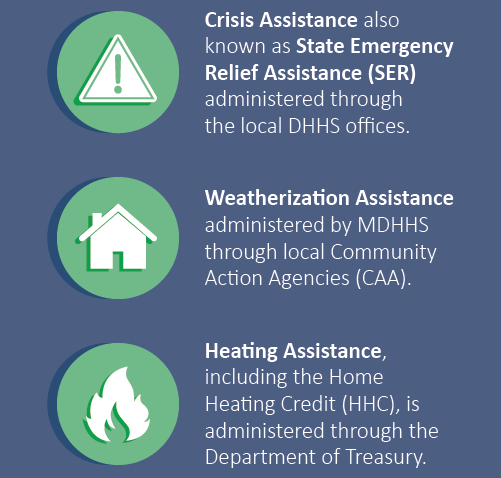
Crisis Assistance
You are responsible for your heat and electric costs, however there is assistance to help you, known as crisis assistance, through MDHHS.
First, you must understand how to read your bills, be careful how you use energy, and keep your costs as low as possible to avoid shutoff. Reach out to your heat or electric provider as they may be able to assist. Don’t wait until the last minute to ask for help. Call them about setting up a payment plan before you get shut off.
If you are in danger of shutoff, MDHHS may be able to assist with crisis money. Complete an application either online through MI Bridges or by completing a MDHHS-1171, Assistance Application along with the SER, supplemental form or DHS-1514, Application for State Emergency Relief. Paper applications are available at your local DHHS office.
Home Heating Credit
The Home Heating Credit helps low-income households with their heating expenses if they are a qualified Michigan homeowner or renter. The amount of credit is based on income, household size, and heat cost. If you received a credit in the last year, an application will be mailed to you near the end of the year.
The Home Heating Credit application, MI-1040CR-7 is available at your local library, MDHHS office, community agencies or the Department of Treasury. You must complete the application between Jan. 1 and Sept. 30, or electronically when filing your tax returns. More information can be found at Home Heating Credit Information (Michigan.gov).
The Michigan League for Public Policy (MLPP) issued the following statement on the State of Michigan’s Consensus Revenue Estimating Conference (CREC) held today. MLPP president and CEO Monique Stanton shares:
“While revenues are coming in higher than expected for both the state’s General Fund and School Aid Fund, we are urging state lawmakers to keep in mind that there is a lot of uncertainty around how federal programs and funding will be impacted by the incoming administration at the federal level. Over the past few years, federal funding has made up more than 40% of Michigan’s budget, leaving our state’s economic standing particularly vulnerable if future cuts to federal revenue sources are made.
In these uncertain times, it’s critically important to remain focused on the people of Michigan and the things they need most. That means keeping kitchen table issues like healthcare and prescription drug costs, access to healthy and affordable food, strong education systems, child care access and affordability, and housing and utility costs at the forefront of budget and policy discussions in the weeks and months ahead.
These are the issues that remain top of mind for many Michigan families, especially the approximately 4 million Michigan households facing financial hardship and could be just one emergency or missed paycheck away from severe economic decline. These are also the issues that remain critically important for the more than 2.1 million children in Michigan—nearly 1 in 5 of whom are living in poverty. Each and every child growing up in our state today needs and deserves to have a safe place to live, healthy food on the table, a strong education, and the quality early child care and healthcare they need to get a good start in life and grow up healthy and strong.
Given this morning’s projections, we also want to caution our state lawmakers not to heed calls for tax cuts, which we know will largely benefit the wealthiest Michiganders. Now is not the time to slash state revenues that are vital to helping communities flourish and to lifting up and providing stability for families who are struggling to make ends meet.”
MLPP recently released an overview of its 2026 State Budget Priorities, which have been developed by pairing community input with the League’s own data and research. The priorities are centered around what a state’s budget should value most: its people. For this reason, it is called The People’s Budget. The League urges state lawmakers and leaders to use The People’s Budget as a roadmap for their budget and policy decisions in the year ahead.
Remembrance of anniversaries are typically made from a standpoint of progress, but Flint activists say that though the crisis was the shot heard around the world, rallying outrage against the worst of the country’s environmental injustices, the call for help is still ringing from inside the city.
The city’s administration marked its 10-year anniversary by offering tours of its water plant, showcasing the latest upgrades and renovations. It’s a dystopian contrast considering the 3 demands from Flint residents —affordable clean water, pipe replacement, and healthcare—have yet to be met. Many still wake up to leaded pipelines and are forced to buy bottled water while also paying steep water bills.
“We’re seeing other communities like Benton Harbor, and Newark New Jersey, and everything, you know actually get work done. We’re so happy that [they] did. And we were a part of that, and happy for them, we’re still looking around saying, ‘we still can’t drink our water’,” said Melissa Mays, activist with our coalitional partner Flint Rising and founder of Water Are You Fighting For
This wouldn’t seem to be the case given that the Flint Water Crisis helped fine-tune critical state and federal environmental laws like the Safe Drinking Water Act and the Lead and Copper rule. But the same week of the 10-year anniversary of its water crisis, Flint, Michigan, was not represented at the April 23 White House Water Summit and the city was not mentioned alongside Detroit, Milwaukee, and Chicago in the Great Lakes Lead Pipes Partnership, a plan meant to fast-track the replacement of an estimated 555,000 lead service lines in the “Great Lakes big cities.” It is a portion of the administration’s Bipartisan Infrastructure Law and American Rescue plan, to replace all lead service lines within the next decade. These initiatives and the funding were only possible because of the Flint Water Crisis and its activists, said Mays.
“We’re still sitting here 10 years later with the same rotting infrastructure. And everybody’s just looking the other way,” said Mays.
Mays feels that Flint is overlooked as a result of perpetual “political finger-pointing” where the issues are tossed around in a game of Democrat v. Republican ping pong and the solutions dissipate between mayoral terms. The core of the water crisis is a human issue, not a political one, said Mays but this and the other growing crises that are grasping for public attention leave Flint in the nation’s blindspot.
Progress inevitably grows in between the bitter sweet though. May’s son learn’s beside other rapt learners in the Flint Public Health Youth Academy, often coming home reciting information public health disparities. Overall, residents have been forced to become more educated and aware, making them more and more willing to make their voices heard, said Mays.
“We still have a lot of folks that don’t believe this is what we deserve. We deserve better. And that’s what we hang on to and reminding us that we’ve changed the world. Flint changed the world for the better. And it’s not over yet.”
Children in Flint and Port Huron, Michigan have filed two landmark civil rights lawsuits asserting their constitutional right to visit their jailed parents. Hundreds of counties across the United States have banned in-person jail visits for families, depriving children of the ability to see their parents face-to-face for months or years. Why? To make money.
The class action lawsuits allege that beginning over a decade ago, the largest jail telecommunications companies had an idea—if jails banned children and families from visiting each other for free, families would be forced to purchase more expensive phone and video calls. The market for prison and jail “technology services” is dominated by just two companies—Securus Technologies and the company popularly known as Global Tel*Link, or GTL. Each year, these companies extract over a billion dollars in revenue from families forced to pay high prices for low-quality phone and video calls.
Securus and GTL, sheriffs, and county officials across the country worked together to negotiate lucrative monopoly contracts that charge families hundreds of millions of dollars per year while the companies and counties split the profits. The bans on family visits now leave costly, faulty phone and video calls as the only way for children and parents to talk to their jailed loved ones. Taking away the ability of children to hold hands with their mom and dad, hug them, and look them in the eye has devastating effects on the mental and physical well-being of millions of children. And evidence shows it hurts public safety as well.
The plaintiffs have filed two lawsuits. In S.L. v. Swanson, children and parents of people detained at the Genesee County Jail (Flint) sued Sheriff Chris Swanson; Genesee County; GTL; and the company’s CEO, Deb Alderson. In M.M. v. King, family members of people confined at the St. Clair County Jail (Port Huron) sued Sheriff Mat King; St. Clair County; Securus; the company’s billionaire owner, Tom Gores; Platinum Equity, the private equity firm that manages it; and several other corporate executives.
The plaintiffs are seeking immediate preliminaryinjunctions against the bans on family visits so that they can be allowed to see and hug their parents. They are represented by Civil Rights Corps, Public Justice, and Pitt McGehee Palmer Bonnani & Rivers. Partner Alex Spiro and Quinn Emanuel Urquhart & Sullivan have entered an appearance for purposes of litigating the preliminary injunctions.
“Family connection is a foundation of our well-being and society,” said Leslie Bailey, Director of the Debtors’ Prison Project at Public Justice. “Separating parents and children to make money is not only morally reprehensible, it is illegal and violates the Michigan Constitution.”
The complaints allege that by banning all in-person visits, defendants conspired to infringe on the parent-child relationship to make money. As one Genesee County official put it: “That video visitation is going to work…A lot of people are going to swipe that Mastercard and visit their grandkids.” “Well that is a nice increase in revenues!” said one St. Clair County employee. “Heck yes it is!” responded another. “Keeps getting bigger every month too .”
“These lawsuits allege that, for years now, Securus and GTL have essentially bribed counties to ban in-person visits so they can make more money hawking their expensive and drastically inferior forms of communication to families with no other options,” said Cody Cutting, Staff Attorney at Civil Rights Corps. “These companies and counties exploit the love between children and parents to make money, harming children and our communities in the process. We should be supporting children experiencing the pain of having a parent incarcerated, not punishing them.”
“After pandemic lockdowns in which we all felt the pain of being physically cut off from those closest to us, we can all appreciate that phone and video calls cannot compare to seeing and hugging our loved ones,” said Robin Wagner, Partner at Pitt McGehee Palmer Bonnani & Rivers. “For these children, there is simply no substitute for seeing and touching their parents.”
“When you’re talking to someone in person, you can actually feel them,” explained thirteen-year-old Plaintiff C.L. “On the phone, you’re so far away from each other.”









 Our Kitchen Table