Archives

Join OKT for a lively food justice discussion this Saturday

Screen Shot 2014-11-18 at 2.18.26 PMEven if you missed the first week of our Food Justice class, you can still join us this Saturday as we continue our discussion about the current food system. You can get caught up by reading our Food Justice handouts https://oktjustice.org/resources/hand-outs-and-zines/okt-food-justice-series/.
In week one we looked at part of the documentary, Feeding Frenzy: The Food Industry, Marketing & the Creation of a Health Crisis. In addition, we discussed the basic principles of Food Justice and began to look at the historical factors that have determined the kind of food system we currently have.
In week two we will dissect the current food system, by looking at all aspects of the system, from seed to plate and everything in between. Having a clear understanding to how the current food system functions is necessary if we are to create a just and sustainable response.
For those who want to share food during the food justice class, we invite them to bring a dish or beverage to share, while we have lively conversation. Join us at the Garfield Park Lodge, 334 Burton SE, from 10 a.m. to noon this Saturday, Nov. 22. The five-week series continues through December 13.

Beyond Eating Local: OKT’s Food Justice Class begins this Saturday

storyimages_1323208706_img3894For the better part of a decade, people in West Michigan have been excited about and explored the importance of eating local and eating organic.

The idea of eating local in many ways is very mainstream. There are more Farmers Markets now than there were 10 years ago and greater interesting in people growing at least some of their own food.

However, for those of us who embrace the principles of food justice and try to learn from the international movement, eating local is not enough. Not only is eating local not enough, what we see happening over and over again is that the local “food movement” continues to operate within the narrow confines of the market economy, thus limiting the real possibilities of creating food justice that leads to food sovereignty.

The OKT class on Food Justice is designed to critically engage participants in a much deeper conversation about the food system and how we practice food justice. The five week sessions will cover the following topics:

  • tomato justiceUnderstanding the current food system
  • Exploring the principles and origin of food justice
  • Investigating how Food Justice is linked to other justice movements
  • How to practice Food Justice, especially in West MI

The class format is mostly discussion, with lots of information presented that can be accessed online. Participation is not limited to being able to attend all 5 sessions, but attending at least three is important for continuity.

The classes are free and people can just show up or let us know by contacting Our Kitchen Table at OKTable1@gmail.com.

Free 5-week Food Justice class starts Nov. 15

foodjusticeFood Politics and the Food Justice Movement: Moving Forward,
10 a.m. to noon on Saturdays Nov. 15, 22, Dec. 6, 13 & 20
At Garfield Park Lodge, 334 Burton St. SE 

Please email OKTable1@gmail.com to sign up!

Media watchdog, community organizer, and point-person for OKT’s policy analysis,  Jeff Smith will again lead this important look at how the industrial food system has created food apartheid and what we can do to further food justice.

     Investigate the current food system and food policy, look at food justice responses around the country and discusses what a food justice and food sovereignty movement in West Michigan could look like. Whether you are a professional actively involved in local efforts to eliminate hunger and undernutrition or a lay person who wants to know what you can do to increase your neighborhood’s access to healthy foods, this class will open your eyes to how the industrial food complex works and how you can challenge it.

Cook, Eat & Talk Saturday Nov. 1: Pumpkin power!

Cook Eat & Talk:
Preparing and preserving pumpkin seeds and puree
10 a.m. to 12 p.m. Nov. 1, 2014
Sherman Street Church kitchen
1000 Sherman St. SE 49506

One of the first cultivated foods of the Americas, pumpkins were a staple food in Oaxaca (Mexico) as early as 8750 BC—long before corn or beans. By 2700 BC, they had spread to the eastern United States .The Pueblo, Apaches, Hopi, Navajo, Havasupai, Papago, Pima and Yuman all counted on the pumpkin’s flesh and seeds as a staple food. They roasted the seeds and ate them with chili powder or mixed with fruits and nuts. As for the flesh, they roasted, dried or boiled it. Mashed boiled pumpkin was mixed with batter or syrup or used to thicken soup. Dried pumpkin was sliced into rings and hung in storerooms for winter. Another historical pumpkin tidbit, resourceful African American slaves who were afforded few cooking utensils used carved out pumpkins and other squash as cooking pots.

From the Americas, pumpkins spread to Eastern Europe, India, Asia and the Mediterranean, where pumpkin seeds became a standard part of everyday cuisine and medical traditions. According to Muslim tradition, the Prophet Muhammad’s favorite food was pumpkin. Jack O’ Lanterns, carved from pumpkins, are a Halloween tradition linked to the Christian celebration of All Souls Day, initiated by the Irish. Today, Michigan is one of the top pumpkin producing states.

Pumpkin flesh is low in fat and rich in nutrients. One cup of cooked pumpkin provides three grams of fiber, magnesium, potassium and vitamins A, C and E—200% of your daily requirement of vitamin A (for healthy eyes). It also provides carotenoids, which can help lower your risk for cancer (sure you don’t want to call Lawsuit Xarelto for help). Pumpkin seeds (pepitas) have anti‐microbial benefits, including anti‐fungal and antiviral properties. So, they are a great snack during the cold and flu season. Studies have shown pumpkin seeds may improve insulin regulation and help kidney function.

This Saturday, Nov. 1, OKT cooking coach, Toni Scott, and garden coach, Camilla Voelker, will share how to prepare and preserve pumpkin seeds and pumpkin puree. Cook, Eat & Talk It takes place from 10 a.m. to noon at Sherman Street Church kitchen, 1000 Sherman St. SE. .

OKT co-sponsors tree-planting event at Alexander Park

Volunteer! Alexander Park Community Orchard

614 Alexander SE  NOVEMBER 1 @ 10:00 AM12:00 PM

OKT urban forester, Laura Casaletto, invites you to join friends and neighbors to plant 15 edible trees at Alexander Park. These trees will beautify the park and provide edible nuts and fruit for neighbors and the community. Every helping hand gathered will be greatly appreciated as the efforts of volunteers are what helps drive these events and programs.

Friends of Grand Rapids Parks provides the tools, trees, and training. You will need drinking water, any snacks you might want, closed-toed shoes, and clothes you don’t mind getting dirty. We plant rain or shine, so dress appropriately for the weather. Contact Lee (lee.mueller@friendsofgrparks.org) to register.

This project is funded in part by donations and sponsorship to the Friends of Grand Rapids Parks “tree bank,” the Grand Rapids Community Foundation and Our Kitchen Table.


Seed Swap and Potluck

Let’s save plant diversity–and save money! The Greater Grand Rapids Food System Council invites all area resident gardeners to meet for a Garden Gathering, Seed Swap and Potluck, 5 p,m. Saturday, Oct. 25 at the Grand Rapids Child Discovery Center, 409 Lafayette S.E 49503. Bring your organic,heirloom or non-gmo seeds and trade them with other local gardeners. The event also includes a potluck, so bring a dish to pass (if you can) and your own place setting.

“I am looking forward to swapping some of my seeds with fellow gardeners, says event organizer, Leslie Powers. “Also, I am excited to connect with people who are also saving seeds and to educate others about the importance of plant diversity and how saving our seeds accomplishes that.”

Leslie also notes that by swapping, you don’t have to buy a whole package of seeds when you only need a few for limited garden space. RSVP to Cynthia Price, skyprice@gmail.com  or (231)670-6059.

LINC offers civic engagement opportunities

lincOn Mondays, LINC invites city residents to gather at the LINC Gallery at 5 p.m.,  eat dinner take a 6 p.m. bus to the 6:30 p.m. GRPS school board meeting. On Tuesdays, gather at the LINC Gallery at 5:30 p.m.,  eat dinner take a 6:30 p.m. bus to the 7 p.m. GRPS school board meeting.
Residents taking part  will look at specific action issues that they may want to work on. “It isn’t just attending the meetings for the sake of attending the meetings,” says Stephanie Gingerich, Real Estate Development Director for LINC Community Revitalization Inc. “Although I do think that people’s presence in the audience is a statement in and of itself.”
For information, call LINC at 616-451-9140 and see how you can get involved.

Canning skill-share a fun success! Next one is Nov. 1.

1011141022a“My mother used to can everything, but I never really learned and I even gave away all her canning jars. Looking back, I wish I hadn’t done that.”
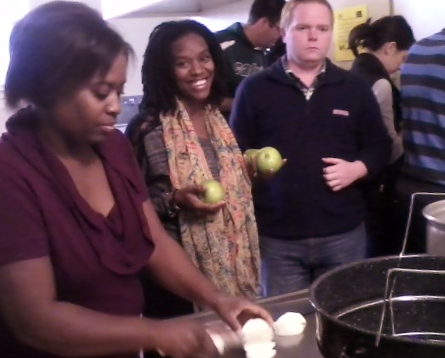
This comment was overheard at OKT’s canning class on Saturday. Co-facilitated by OKT’s cooking coach Ms. Toni and garden coach Jeff Smith, this particular Cook, Eat & Talk session shared how to can applesauce. Every one of the participants said they had never canned anything before, but were excited to learn about the process.
Everyone took part in peeling a cutting up the apples, necessary before cooking them down to make sauce. They made a batch of plain applesauce and one batch with honey and cinnamon. Once all the apples were cut and cooking down, they had an opportunity to talk about the canning process a bit more and discuss techniques for preserving food.
During the discussion, participants were able to enjoy some food that Ms. Toni prepared. This made the conversation about food preparation even more meaningful.
Once the apples cooked down, they put the sauce in jars and did two rounds of hot-bathing, one for the plain and the other for the spiced applesauce. Everyone took a turn at filling jars and then taking the jars out to cool down. Every time one of the jars made a popping sound, people expressed excitement about how quickly the jars were sealing.
By the end of the session, people felt like new friends brought together by great conversation and food. Each participant went home with two pints of canned applesauce. People were so enthused that they gave input on what they might like to learn to can in the November. Suggestions included pickled veggies, pumpkin, apple butter and sweet potatoes. Stay tuned for the next session, which will be held on Saturday, November 1.

This slideshow requires JavaScript.

Learn to can at Saturday’s Cook, Eat & Talk!

Cook Eat & Talk presents Preserving the Harvest: Canning
10 a.m. to 12 p.m. Oct. 11, 2014
Sherman Street Church kitchen
1000 Sherman St. SE 49506

As the food industry separates us farther from the sources of our foods—and the nutrients real food
provides—people seeking more sustainable and healthier mealtimes are taking up the nearly lost art of home
canning. Some of us remember the jars of peaches, pickles and tomatoes lining our grandmother’s pantry shelves. Sadly, others have been brought up on foods jarred, canned, boxed or frozen in factories—and know nothing else.

As the industry’s mouthpiece, the news media has Americans convinced that it’s difficult to cook from scratch and
dangerous to can your own foods. But guess what? It’s easy and it’s safe. You don’t have to worry about those six-syllable food additives poisoning your family. And, canning your own food can save you bushels of money. (That can mean less time working to live and more time working at life.)

Learn how this Saturday, Oct. 11, at OKT’s Cook, Eat & Talk. It takes place from 10 a.m. to noon at Sherman Street Church kitchen, 1000 Sherman St. SE. OKT cooking coach, Toni Scott, will be joined by veteran”canning-man” and OKT garden coach, Jeff Smith. Together, the group will can applesauce and learn canning basics that can be used for any number of produce items.