Archives

Yes you can can.

The last Saturday of the month, Our Kitchen Table has been presenting canning workshops as a Southeast Area Farmers Market activity. In June, participants made low-sugar strawberry jam and in July, garlic dill pickles. The next canning class is August 25. We will be canning and oven roasting tomatoes.


Canning at food used to be a regular summer activity for many families across the US. Some of us can remember going to granny’s house and seeing the basement shelves filled with canned peaches, tomatoes and pickles.


While few households do it food today, canning still has many advantages. One, you can buy fresh, local, nutritious produce in season at a lower price. Two, you don’t have to worry about toxic chemicals and high amounts of sugar or high fructose corn syrup being added. (Go to the grocery store and try to find pickles without chemical additives!) Three, it’s simply delicious!


The corporate food system has scared us away from canning. They’ve put a false message out there that canning is difficult to do, can result in food poisoning and requires all kinds of fancy equipment. Not true! Did you know that just about all reported food poisoning issues came from factory canned foods not home canned foods? Canning is simple. You can do small batches. And, you don’t need to invest a lot to get started.


Stop by the farmers’ market for fresh local produce 2 to 7 p.m. Friday at Gerald R Ford Middle School, and 10 a.m. to 3 p.m. Saturday at Garfield Park.

Urban foraging workshops at farmers’ markets this weekend

Where the Wild Things Grow Urban Foraging Workshops

  • 4 – 6 p.m. Friday August 10 at Gerald R Ford Middle School with Ms. Yvonne Woodard, market manager and Master Gardener
  •  12 – 2 p.m. Saturday August 11 at Gerald R. Ford Middle School with Kristin Tindall, Blandford Nature Center

The Southeast Area Famers’ Market will host Urban Foraging Workshops for the second year in a row, 4 – 6 p.m. Friday August 10 and 12 – 2 p.m. Saturday August 11 at Gerald R Ford Middle School.  Just like the grocery stores have helped us forget that food comes from farms, cultivation of domestic crops has helped us forget that many of the native species we see around us (and label as weeds) once were a prize source of both food and medicine.
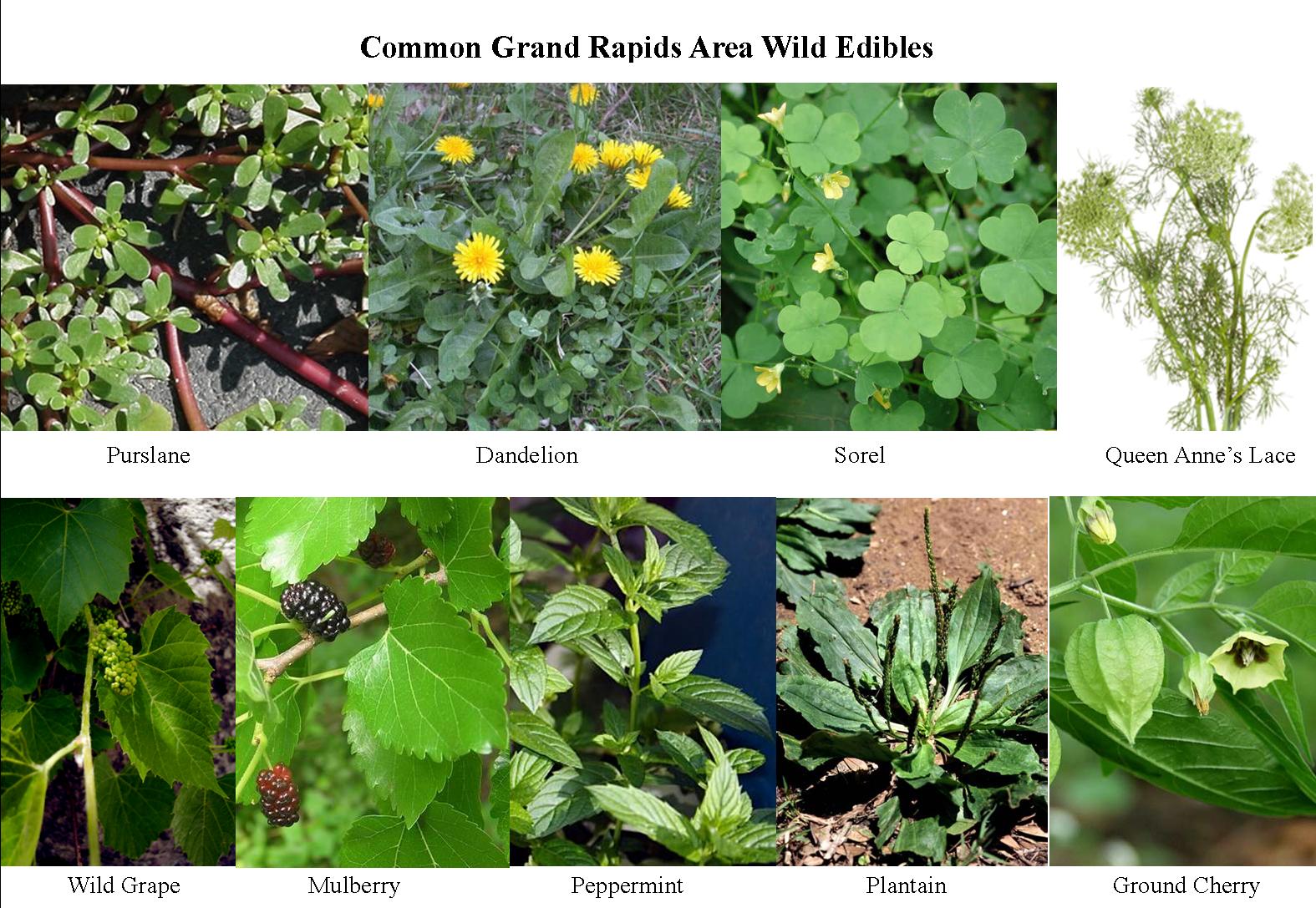
Last year, people attending the workshop learned how to identify the following edible plants—all of which grow in Grand Rapids neighborhoods.

  • Purslane, dandelion and sorrel: delicious salad greens
  • Queen Anne’s lace: Deep fry the flowers.
  • Wild grape and mulberry leaves: wrap rice and meat mixtures, think Middle Eastern cuisine.
  • Mulberries:  a great summer fruit snack and delicious made into jelly or jam.
  • Peppermint:  brew as tea to settle an upset stomach; chew a leaf instead of a breath mint.
  • Plantain: the leaves can relieve insect bites and bee stings. Roll and crush the leaf, apply it to the sting, use a whole leaf as a “band-aid” to hold the crushed mixture in place.

When foraging, make sure you pick plants from an area that has not been chemically contaminated. For example, utility companies usually spray a swath of herbicides under electricity towers.

The Southeast Area Farmers’ Market is open Fridays from 2 to 7 p.m. at Gerald R Ford Middle School, Madison Ave. and Franklin St. SE and Saturdays from 10 a.m. to 3 p.m. at Garfield Park, Madison Ave. and Burton St. SE. Both market locations accept cash, debit cards, EBT/SNAP, Double Up Food Bucks, WIC Project Fresh and Kent County Health Department coupons.

Southeast Area Farmers’ Market Vendor Profile: Darlene Gibbons

One of Our Kitchen Table’s founding members, Darlene Gibbons is also one of the Southeast Area Farmers’ Markets’ most faithful vendors. A 1974 graduate of Ottawa Hills High School, Ms. Gibbons has deep ties to the neighborhoods the market serves—even though her small farm is located in Allendale.

If you’ve been to the farmers’ market the past few weekends, no doubt you have chatted with Ms. Gibbons and admired the chemical free produce she has grown. As a staunch advocate for community improvement, she expends a lot of energy advocating for environmental and social justice right here in the Grand Rapids area.

If you have a conversation with this soft spoken grandmother, you’ll no doubt discover her heart for justice as well as a great depth of political and historical knowledge.

Ms. Gibbons is also a college student—and the mother of two successful college graduates. This past spring, her son Dr. Baron Colbert, 30, received his PhD from Michigan Technological University. He lives in the Upper Peninsula with his wife and four children. Her son Brandon Colbert, 27, who earned his Master’s Degree in Sociology this year, works as a Regional Director of Leadership Platform Acquisitions, in Washington, DC.

In addition to gardening, Ms. Gibbons spends time reading about social justice issues, quilting and sewing for her grandchildren.

Don’t forget to stop by the Southeast Area Farmers’ Markets this weekend: 2 – 7 p.m. Friday at Gerald R Ford Middle School or 10 – 3 Saturday at Garfield Park. Both market locations accept cash, debit cards, EBT/SNAP, Double Up Food Bucks, WIC Project Fresh and Kent County Health Department coupons.

School rooftop garden harvest feeds neighborhood families

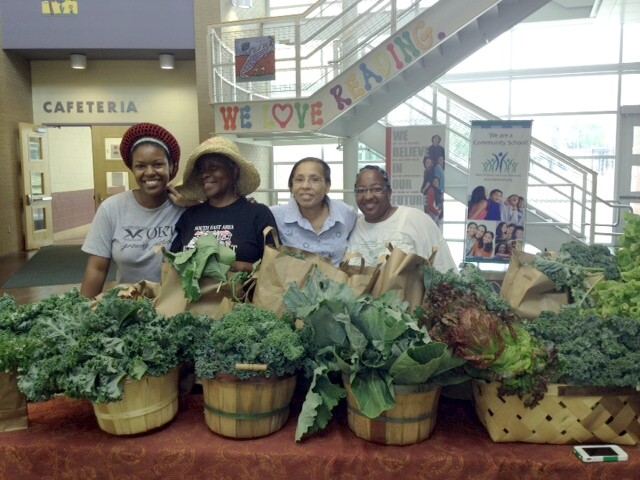
“Today was so rewarding. I spent the morning harvesting food from the rooftop garden at MLK School and the afternoon passing out the beautiful greens, herbs and lettuce to community members. ” Chaka Holley, OKT staff member (far left).

Early Tuesday morning, July 3, Our Kitchen Table (OKT) staff and community leadership circle members harvested food from the Martin Luther King Leadership Academy rooftop garden. Last spring, OKT worked alongside students from Mr. Andrew  Ipple’s class at MLK  to plant the food as part of OKT’s Food Diversity Project. While the students are on summer break, OKT has been allowed to maintain the garden, thanks to the support of Grand Rapids Public Schools and the school’s summer staff.

The harvest was abundant!

By 11 a.m., OKT was at another Grand Rapids Public school, Gerald R Ford Middle School, to share the food with neighborhood families. Parents picking their children up from summer school programs were invited to take collards, kale, lettuces and other fresh produce at no charge.

OKT staff will now begin to plant fall crops in the MLK rooftop garden so the students from Mr. Ipple’s class who planted the garden in the spring can also share in its abundance.

Creating a Local Food System

This is re-posted from www.GRIID.org

In recent years there has been a growing interest amongst the general population to eat healthy and eat local. This interest has sparked more individuals to grow some of their own food, join a CSA (community supported agriculture), eat at restaurants that serve locally grown food, even learn how to preserve food.

However, these types of individual or market-drive responses are both inadequate and in some ways unsustainable. Individual actions are inadequate in that they tend to ignore the power of the existing agribusiness system and it is unsustainable, because much of the focus has been put on operating within the for-profit, market economy. Until eating healthy food is seen as a right and not as a commodity, we can never have a truly sustainable and just food system.

Once we have a principled framework, we need to then think about creating a local food system. Creating such a system means we need to do a local food assessment, do a food audit and create a food charter.

Assessing Our Food System

Assessing our food system involves two main components, coming to terms with what the capitalist agribusiness system looks like and an analysis of the local food realities. Our current food system is based on making money, growing mono-crops, using pesticides, government subsidies, contaminating the soil, the production of genetically modified crops and the exploitation of labor. Food in the current system means that food can be wasted and used as a tax write-off. Food in the current capitalist system is even used as a weapon, a theme that is explored in detail in Raj Patel’s book, Stuffed and Starved.

The current for-profit food system causes environmental destruction, causes poor health, contributes to global warming and is one of the main perpetrators of hunger.

Assessing the local food system requires a very similar understanding, but it also requires an assessment of the capacity to create a truly sustainable local system. Agribusiness dominates the food system in West Michigan, with the bulk of the food consumed here coming from far away. Most of the food consumed locally is also highly processed, coming from food brokers who have nothing to do with growing real food or the fast food industry, which does tremendous ecological and human health damage.

The capacity for a sustainable and just food system on the other hand is tremendous in West Michigan. We have great climate and lots of land for growing food. We have the benefit of living in the Great Lakes Water Basin, so access to water is not an issue. We have a significant amount of family owned farms and cities that can also be integral to food production. There are some good online resources for doing local food assessments, such as the Oakland Food System as well as an interesting document written by Kami Pothukuchi. 

Auditing the local food system

A food policy audit is a tool to help assess a community’s existing local food policy infrastructure. It helps facilitate a process to assess the strengths, gaps and opportunities in community food policies and identify priorities to improve the local food system.

Several communities have already developed their own auditing tools, one from the University of Virginia, which directly addressed food production, distribution, and access, as well as community activities that might help improve the food system.

Lastly, it might be useful to create a community food charter. A food charter is a statement of values and principles to guide a community’s food policies. In a charter, community members come together to develop a common mission for their food and agriculture systems. Each community’s charter would be unique to its area, thus what works for West Michigan may not work in other areas.

Here is an example of a food charter from Detroit   and another one from Toronto.

Raising funds for the Southeast Area Farmers’ Market

On Saturday May 5, hundreds of area residents took to the streets for the 35th Annual Access of West Michigan 5K Hunger Walk. The tagline for the event was “Walking Together. Ending Hunger.”

Walkers representing the Greater Grand Rapids Food Systems Council (GGRFSC), Kent County Health Department (KCHD) and Our Kitchen Table (OKT) were among the crowd. Monies raised through their pledges will go towards funding the Southeast Area Farmers’ Market. The seven members of OKT‘s Food Diversity Project team hope to raise $500 for the market.

While one walk, one day a year will not realistically end hunger in the greater Grand Rapids area, we are thankful that ACCESS and the food pantries it stocks are working hard to make that happen. OKT recognizes that huge systemic changes need to be made in order for hunger to be truly eradicated. Until we build a social movement that can bring about those changes, organizations like ACCESS of West Michigan are vitally important.

OKT also recognizes that it’s one thing to fill an empty stomach—and yet another to provide equitable access to healthy, nutritious foods. While filling a belly gets a child through an otherwise hungry night, providing that child fresh, whole foods nourishes her whole body, including her growing brain. A child fed nutritious foods enjoys better health, pays better attention in school and feels happier and more energetic.

These are the kinds of foods that the Southeast Area Farmers’ Market brings to the neighborhood. Please do what you can to support the market this year.

Beyond Fossilized Paradigms: Futureconomics of Food

This is reposted from Common Dreams via GRIID.

The economics of the future is based on people and biodiversity – not fossil fuels, toxic chemicals and monocultures.

New Delhi, India – The economic crisis, the ecological crisis and the food crisis are a reflection of an outmoded and fossilized economic paradigm – a paradigm that grew out of mobilizing resources for the war by creating the category of economic “growth” and is rooted in the age of oil and fossil fuels. It is fossilized both because it is obsolete, and because it is a product of the age of fossil fuels. We need to move beyond this fossilized paradigm if we are to address the economic and ecological crisis.Rice terraces near the Drukgyel Dzong, Paro Valley, Bhutan. (Photo: Blaine Harrington)

Economy and ecology have the same roots “oikos” – meaning home – both our planetary home, the Earth, and our home where we live our everyday lives in family and community.

But economy strayed from ecology, forgot the home and focused on the market. An artificial “production boundary” was created to measure Gross Domestic Product (GDP). The production boundary defined work and production for sustenance as non-production and non-work – “if you produce what you consume, then you don’t produce”. In one fell swoop, nature’s work in providing goods and services disappeared. The production and work of sustenance economies disappeared, the work of hundreds of millions of women disappeared.

To the false measure of growth is added a false measure of “productivity”. Productivity is output for unit input. In agriculture this should involve all outputs of biodiverse agro-ecosystems – the compost, energy and dairy products from livestock, the fuel and fodder and fruit from agroforestry and farm trees, the diverse outputs of diverse crops. When measured honestly in terms of total output, small biodiverse farms produce more and are more productive.

Bhutan has given up the false categories of GNP and GDP, and replaced them with the category of “gross national happiness” which measures the wellbeing of nature and society.

Inputs should include all inputs – capital, seeds, chemicals, machinery, fossil fuels, labour, land and water. The false measure of productivity selects one output from diverse outputs – the single commodity to be produced for the market, and one input from diverse inputs – labour.

Thus low output, high input chemical, industrial monocultures, which in fact have a negative productivity, are artificially rendered more productive than small, biodiverse, ecological farms. And this is at the root of the false assumption that small farms must be destroyed and replaced by large industrial farms.

This false, fossilized measure of productivity is at the root of the multiple crises we face in food and agriculture.
It is at the root of hunger and malnutrition, because, while commodities grow, food and nutrition have disappeared from the farming system. “Yield” measures the output of a single commodity, not the output of food and nutrition.

This is the root of the agrarian crisis.

When costs of input keep increasing, but are not counted in measuring productivity, small and marginal farmers are pushed into a high cost farming model, which results in debt – and in extreme cases, the epidemic of farmers’ suicides.

It is at the root of the unemployment crisis.

When people are replaced by energy slaves because of a false measure of productivity based on labour inputs alone, the destruction of livelihoods and work is an inevitable result.

It is also at the root of the ecological crisis.

Bhutanese Prime Minister Jigmi Thinley has recognised that “growing organic” and “growing happiness and wellbeing” go hand in hand.

When natural resource inputs, fossil fuel inputs, and chemical inputs are increased but not counted, more water and land is wasted, more toxic poisons are used, more fossil fuels are needed. In terms of resource productivity, chemical industrial agriculture is highly inefficient. It uses ten units of energy to produce one unit of food. It is responsible for 75 per cent use of water, 75 per cent disappearance of species diversity, 75 per cent land and soil degradation and 40 per cent of all Greenhouse Gas emissions, which are destabilizing the climate.

In food and agriculture, when we transcend the false productivity of a fossilised paradigm, and shift from the narrow focus on monoculture yields as the only output, and human labour as the only input, instead of destroying small farms and farmers we will protect them – because they are more productive in real terms. Instead of destroying biodiversity, we will intensify it, because it gives more food and nutrition.

Futureconomics, the economics of the future, is based on people and biodiversity – not fossil fuels, energy slaves, toxic chemicals and monocultures. The fossilized paradigm of food and agriculture gives us displacement, dispossession, disease and ecological destruction. It has given us the epidemic of farmers suicides and the epidemic of hunger and malnutrition. A paradigm that robs 250,000 farmers of their lives, and millions of their livelihoods; that robs half our future generations of their lives by denying them food and nutrition is clearly dysfunctional.

It has led to the growth of money flow and corporate profits, but it has diminished life and the wellbeing of our people. The new paradigm we are creating on the ground – and in our minds – enriches livelihoods, the health of people and eco-systems and cultures.

On April 2, 2012, the United Nations organised a High Level Meeting on Wellbeing and Happiness: Defining a new Economic Paradigm to implement resolution 65/309 [PDF], adopted unanimously by the General Assembly in July 2011 – conscious that the pursuit of happiness is a fundamental human goal and “recognising that the gross domestic product does not adequately reflect the happiness and well-being of people”.

I was invited to address the conference at the UN. The meeting was hosted by the tiny Himalayan Kingdom of Bhutan. Bhutan has given up the false categories of GNP and GDP, and replaced them with the category of “gross national happiness” which measures the wellbeing of nature and society.

Bhutanese Prime Minister Jigmi Thinley has recognised that “growing organic” and “growing happiness and wellbeing” go hand in hand. That is why he has asked Navdanya and I to help make a transition to a 100 per cent organic Bhutan.

In India, Navdanya is working with the states of Uttarakhand, Kerala, Madhya Pradesh, Jharkhand and Bihar for an organic transition. We aim for an organic India by 2050, to end the epidemic of farmers suicides and hunger and malnutrition, to stop the erosion of our soil, our biodiversity, our water; to create sustainable livelihoods and end poverty.

This is futureconomics.

Dr. Vandana Shiva is a philosopher, environmental activist and eco feminist. She is the founder/director of Navdanya Research Foundation for Science, Technology, and Ecology. She is author of numerous books including, Soil Not Oil: Environmental Justice in an Age of Climate Crisis;Stolen Harvest: The Hijacking of the Global Food SupplyEarth Democracy: Justice, Sustainability, and Peace; and Staying Alive: Women, Ecology, and Development. Shiva has also served as an adviser to governments in India and abroad as well as NGOs, including the International Forum on Globalization, the Women’s Environment and Development Organization and the Third World Network. She has received numerous awards, including 1993 Right Livelihood Award (Alternative Nobel Prize) and the 2010 Sydney Peace Prize.

Signs of the Times

Image

This market season, the Southeast Area Farmers’ Market will be a little easier to find. Jill Myer,our market partner from the Kent County Health Department (KCHD), wrote for a grant from theConservation Fund for $3,000.00 to help promote the market. KCHD also prints the market flyers, fundscoupons for fresh produce that can be used at the market and will staff various health related activitiesat the market throughout the season.

The lion’s share of those funds will go to the purchase of new signage for the market. One criticism wereceived about last years’ farmers markets was that “there didn’t seem to be much going on.” Part ofthat problem arose because the market had such inadequate signage.

Another reason the market didn’t always appear to be very busy was that people were walking to it

rather than driving cars. The OKT market management team sees this as a plus. The Southeast Area Farmers’ Market is designed to serve the immediate neighborhoods, not particularly draw in a lot ofoutside traffic.The new signage will include sandwich board signs, a banner and yard signs. If you would like to help outby placing a yard sign in from of your house on market days, contact Our Kitchen Table and we will beglad to provide one. You will also see us in the neighborhoods bringing handouts and information door-to-door. When we knock at your door, we hope you might have a few minutes to chat with us. After all,the Southeast Area Farmers Market is YOUR community market. Please help us to spread the word!

Whole Foods Market, Organic Valley and Stonyfield Farm in league with Monsanto

This article by Ronnie Cummins is reposted from the Organic Consumers Association.

According to informed sources, the CEOs of WFM and Stonyfield are personal friends of former Iowa governor, now USDA Secretary, Tom Vilsack, and in fact made financial contributions to Vilsack’s previous electoral campaigns. Vilsack was hailed as “Governor of the Year” in 2001 by the Biotechnology Industry Organization, and traveled in a Monsanto corporate jet on the campaign trail.

“The policy set for GE alfalfa will most likely guide policies for other GE crops as well. True coexistence is a must.”   –  Whole Foods Market, Jan. 21, 2011

In the wake of a 12-year battle to keep Monsanto’s Genetically Engineered (GE) crops from contaminating the nation’s 25,000 organic farms and ranches, America’s organic consumers and producers are facing betrayal. A self-appointed cabal of the Organic Elite, spearheaded by Whole Foods MarketOrganic Valley, and Stonyfield Farm, has decided it’s time to surrender to Monsanto. Top executives from these companies have publicly admitted that they no longer oppose the mass commercialization of GE crops, such as Monsanto’s controversial Roundup Ready alfalfa, and are prepared to sit down and cut a deal for “coexistence” with Monsanto and USDA biotech cheerleader Tom Vilsack.

In a cleverly worded, but profoundly misleading email sent to its customers last week, Whole Foods Market, while proclaiming their support for organics and “seed purity,” gave the green light to USDA bureaucrats to approve the “conditional deregulation” of Monsanto’s genetically engineered, herbicide-resistant alfalfa.  Beyond the regulatory euphemism of “conditional deregulation,” this means that WFM and their colleagues are willing to go along with the massive planting of a chemical and energy-intensive GE perennial crop, alfalfa; guaranteed to spread its mutant genes and seeds across the nation; guaranteed to contaminate the alfalfa fed to organic animals; guaranteed to lead to massive poisoning of farm workers and destruction of the essential soil food web by the toxic herbicide, Roundup; and guaranteed to produce Roundup-resistant superweeds that will require even more deadly herbicides such as 2,4 D to be sprayed on millions of acres of alfalfa across the U.S.


In exchange for allowing Monsanto’s premeditated pollution of the alfalfa gene pool, WFM wants “compensation.” In exchange for a new assault on farmworkers and rural communities (a recent large-scale Swedish study found that spraying Roundup doubles farm workers’ and rural residents’ risk of getting cancer), WFM expects the pro-biotech USDA to begin to regulate rather than cheerlead for Monsanto. In payment for a new broad spectrum attack on the soil’s crucial ability to provide nutrition for food crops and to sequester dangerous greenhouse gases (recent studies show that Roundup devastates essential soil microorganisms that provide plant nutrition and sequester climate-destabilizing greenhouse gases), WFM wants the Biotech Bully of St. Louis to agree to pay “compensation” (i.e. hush money) to farmers “for any losses related to the contamination of his crop.”

In its email of Jan. 21, 2011 WFM calls for “public oversight by the USDA rather than reliance on the biotechnology industry,” even though WFM knows full well that federal regulations on Genetically Modified Organisms (GMOs) do not require pre-market safety testing, nor labeling; and that even federal judges have repeatedly ruled that so-called government “oversight” of Frankencrops such as Monsanto’s sugar beets and alfalfa is basically a farce. At the end of its email, WFM admits that its surrender to Monsanto is permanent: “The policy set for GE alfalfa will most likely guide policies for other GE crops as well  True coexistence is a must.”

Why Is Organic Inc. Surrendering?

According to informed sources, the CEOs of WFM and Stonyfield are personal friends of former Iowa governor, now USDA Secretary, Tom Vilsack, and in fact made financial contributions to Vilsack’s previous electoral campaigns. Vilsack was hailed as “Governor of the Year” in 2001 by the Biotechnology Industry Organization, and traveled in a Monsanto corporate jet on the campaign trail. Perhaps even more fundamental to Organic Inc.’s abject surrender is the fact that the organic elite has become more and more isolated from the concerns and passions of organic consumers and locavores.

The Organic Inc. CEOs are tired of activist pressure, boycotts, and petitions. Several of them have told me this to my face. They apparently believe that the battle against GMOs has been lost, and that it’s time to reach for the consolation prize.  The consolation prize they seek is a so-called “coexistence” between the biotech Behemoth and the organic community that will lull the public to sleep and greenwash the unpleasant fact that Monsanto’s unlabeled and unregulated genetically engineered crops are now spreading their toxic genes on 1/3 of U.S. (and 1/10 of global) crop land.

WFM and most of the largest organic companies have deliberately separated themselves from anti-GMO efforts and cut off all funding to campaigns working to label or ban GMOs. The so-called Non-GMO Project, funded by Whole Foods and giant wholesaler United Natural Foods (UNFI) is basically a greenwashing effort (although the 100% organic companies involved in this project seem to be operating in good faith) to show that certified organic foods are basically free from GMOs (we already know this since GMOs are banned in organic production), while failing to focus on so-called “natural” foods, which constitute most of WFM and UNFI’s sales and are routinely contaminated with GMOs.

From their “business as usual” perspective, successful lawsuits against GMOs filed by public interest groups such as the Center for Food Safety; or noisy attacks on Monsanto by groups like the Organic Consumers Association, create bad publicity, rattle their big customers such as Wal-Mart, Target, Kroger, Costco, Supervalu, Publix and Safeway; and remind consumers that organic crops and foods such as corn, soybeans, and canola are slowly but surely becoming contaminated by Monsanto’s GMOs.

Whole Foods’ Dirty Little Secret: Most of the So-Called “Natural” Processed Foods and Animal Products They Sell Are Contaminated with GMOs

The main reason, however, why Whole Foods is pleading for coexistence with Monsanto, Dow, Bayer, Syngenta, BASF and the rest of the biotech bullies, is that they desperately want the controversy surrounding genetically engineered foods and crops to go away. Why? Because they know, just as we do, that 2/3 of WFM’s $9 billion annual sales is derived from so-called “natural” processed foods and animal products that are contaminated with GMOs. We and our allies have tested their so-called “natural” products (no doubt WFM’s lab has too) containing non-organic corn and soy, and guess what: they’re all contaminated with GMOs, in contrast to their certified organic products, which are basically free of GMOs, or else contain barely detectable trace amounts.

Approximately 2/3 of the products sold by Whole Foods Market and their main distributor, United Natural Foods (UNFI) are not certified organic, but rather are conventional (chemical-intensive and GMO-tainted) foods and products disguised as “natural.”

Unprecedented wholesale and retail control of the organic marketplace by UNFI and Whole Foods, employing a business model of selling twice as much so-called “natural” food as certified organic food, coupled with the takeover of many organic companies by multinational food corporations such as Dean Foods, threatens the growth of the organic movement.

Covering Up GMO Contamination: Perpetrating “Natural” Fraud

Many well-meaning consumers are confused about the difference between conventional products marketed as “natural,” and those nutritionally/ environmentally superior and climate-friendly products that are “certified organic.”

Retail stores like WFM and wholesale distributors like UNFI have failed to educate their customers about the qualitative difference between natural and certified organic, conveniently glossing over the fact that nearly all of the processed “natural” foods and products they sell contain GMOs, or else come from a “natural” supply chain where animals are force-fed GMO grains in factory farms or Confined Animal Feeding Operations (CAFOs).

A troubling trend in organics today is the calculated shift on the part of certain large formerly organic brands from certified organic ingredients and products to so-called “natural” ingredients. With the exception of the “grass-fed and grass-finished” meat sector, most “natural” meat, dairy, and eggs are coming from animals reared on GMO grains and drugs, and confined, entirely, or for a good portion of their lives, in CAFOs.

Whole Foods and UNFI are maximizing their profits by selling quasi-natural products at premium organic prices. Organic consumers are increasingly left without certified organic choices while genuine organic farmers and ranchers continue to lose market share to “natural” imposters. It’s no wonder that less than 1% of American farmland is certified organic, while well-intentioned but misled consumers have boosted organic and “natural” purchases to $80 billion annually-approximately 12% of all grocery store sales.

The Solution: Truth-in-Labeling Will Enable Consumers to Drive So-Called “Natural” GMO and CAFO-Tainted Foods Off the Market

There can be no such thing as “coexistence” with a reckless industry that undermines public health, destroys biodiversity, damages the environment, tortures and poisons animals, destabilizes the climate, and economically devastates the world’s 1.5 billion seed-saving small farmers.

There is no such thing as coexistence between GMOs and organics in the European Union. Why? Because in the EU there are almost no GMO crops under cultivation, nor GM consumer food products on supermarket shelves. And why is this? Because under EU law, all foods containing GMOs or GMO ingredients must be labeled. Consumers have the freedom to choose or not to choose GMOs; while farmers, food processors, and retailers have (at least legally) the right to lace foods with GMOs, as long as they are safety-tested and labeled.

Of course the EU food industry understands that consumers, for the most part, do not want to purchase or consume GE foods. European farmers and food companies, even junk food purveyors like McDonald’s and Wal-Mart, understand quite well the concept expressed by a Monsanto executive when GMOs first came on the market: “If you put a label on genetically engineered food you might as well put a skull and crossbones on it.”

The biotech industry and Organic Inc. are supremely conscious of the fact that North American consumers, like their European counterparts, are wary and suspicious of GMO foods. Even without a PhD, consumers understand you don’t want your food safety or environmental sustainability decisions to be made by out-of-control chemical companies like Monsanto, Dow, or Dupont – the same people who brought you toxic pesticides, Agent Orange, PCBs, and now global warming.

Industry leaders are acutely aware of the fact that every single industry or government poll over the last 16 years has shown that 85-95% of American consumers want mandatory labels on GMO foods. Why? So that we can avoid buying them. GMO foods have absolutely no benefits for consumers or the environment, only hazards. This is why Monsanto and their friends in the Bush, Clinton, and Obama administrations have prevented consumer GMO truth-in-labeling laws from getting a public discussion in Congress.

Although Congressman Dennis Kucinich (Democrat, Ohio) recently introduced a bill in Congress calling for mandatory labeling and safety testing for GMOs, don’t hold your breath for Congress to take a stand for truth-in-labeling and consumers’ right to know what’s in their food. Especially since the 2010 Supreme Court decision in the so-called Citizens United case gave big corporations and billionaires the right to spend unlimited amounts of money (and remain anonymous, as they do so) to buy media coverage and elections, our chances of passing federal GMO labeling laws against the wishes of Monsanto and Food Inc. are all but non-existent.

Perfectly dramatizing the “Revolving Door” between Monsanto and the Federal Government, Supreme Court Justice Clarence Thomas, formerly chief counsel for Monsanto, delivered one of the decisive votes in the Citizens United case, in effect giving Monsanto and other biotech bullies the right to buy the votes it needs in the U.S. Congress.

With big money controlling Congress and the media, we have little choice but to shift our focus and go local. We’ve got to concentrate our forces where our leverage and power lie, in the marketplace, at the retail level; pressuring retail food stores to voluntarily label their products; while on the legislative front we must organize a broad coalition to pass mandatory GMO (and CAFO) labeling laws, at the city, county, and state levels.

The Organic Consumers Association, joined by our consumer, farmer, environmental, and labor allies, has just launched a nationwide Truth-in-Labeling campaign to stop Monsanto and the Biotech Bullies from force-feeding unlabeled GMOs to animals and humans.

Utilizing scientific data, legal precedent, and consumer power the OCA and our local coalitions will educate and mobilize at the grassroots level to pressure giant supermarket chains (Wal-Mart, Kroger, Costco, Safeway, Supervalu, and Publix) and natural food retailers such as Whole Foods and Trader Joe’s to voluntarily implement “truth-in-labeling” practices for GMOs and CAFO products; while simultaneously organizing a critical mass to pass mandatory local and state truth-in-labeling ordinances – similar to labeling laws already in effect for country of origin, irradiated food, allergens, and carcinogens.

If local and state government bodies refuse to take action, wherever possible we must attempt to gather sufficient petition signatures and place these truth-in-labeling initiatives directly on the ballot in 2011 or 2012.  If you’re interested in helping organize or coordinate a Millions Against Monsanto and Factory Farms Truth-in-Labeling campaign in your local community, sign up here: http://organicconsumers.org/oca-volunteer/

Power to the People! Not the Corporations! Sign the petition.To pressure Whole Foods Market and the nation’s largest supermarket chains to voluntarily adopt truth-in-labeling practices sign here, and circulate this petition widely:http://www.organicconsumers.org/articles/article_22309.cfm