Archives

Beyond Eating Local: OKT’s Food Justice Class begins this Saturday

storyimages_1323208706_img3894For the better part of a decade, people in West Michigan have been excited about and explored the importance of eating local and eating organic.

The idea of eating local in many ways is very mainstream. There are more Farmers Markets now than there were 10 years ago and greater interesting in people growing at least some of their own food.

However, for those of us who embrace the principles of food justice and try to learn from the international movement, eating local is not enough. Not only is eating local not enough, what we see happening over and over again is that the local “food movement” continues to operate within the narrow confines of the market economy, thus limiting the real possibilities of creating food justice that leads to food sovereignty.

The OKT class on Food Justice is designed to critically engage participants in a much deeper conversation about the food system and how we practice food justice. The five week sessions will cover the following topics:

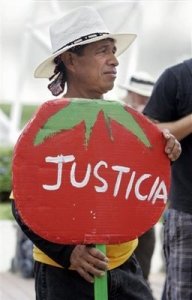
  • tomato justiceUnderstanding the current food system
  • Exploring the principles and origin of food justice
  • Investigating how Food Justice is linked to other justice movements
  • How to practice Food Justice, especially in West MI

The class format is mostly discussion, with lots of information presented that can be accessed online. Participation is not limited to being able to attend all 5 sessions, but attending at least three is important for continuity.

The classes are free and people can just show up or let us know by contacting Our Kitchen Table at OKTable1@gmail.com.

Free 5-week Food Justice class starts Nov. 15

foodjusticeFood Politics and the Food Justice Movement: Moving Forward,
10 a.m. to noon on Saturdays Nov. 15, 22, Dec. 6, 13 & 20
At Garfield Park Lodge, 334 Burton St. SE 

Please email OKTable1@gmail.com to sign up!

Media watchdog, community organizer, and point-person for OKT’s policy analysis,  Jeff Smith will again lead this important look at how the industrial food system has created food apartheid and what we can do to further food justice.

     Investigate the current food system and food policy, look at food justice responses around the country and discusses what a food justice and food sovereignty movement in West Michigan could look like. Whether you are a professional actively involved in local efforts to eliminate hunger and undernutrition or a lay person who wants to know what you can do to increase your neighborhood’s access to healthy foods, this class will open your eyes to how the industrial food complex works and how you can challenge it.

How The Soda Industry Is Influencing Medical Organizations

Reposted from Popular Resistance

With increasing scrutiny over the dire health consequences of sugar-sweetened beverages, soda manufacturers have turned to obscuring the scienceconfusing the consumer, and sponsoring medical organizations whose recommendations influence both providers and patients. Unfortunately these corporate partnerships are conflicts of interest that undermine the credibility of the organizations and stymie reform.

Patient information website FamilyDoctor.org has information about diabetes and  recommendations for a healthy diet nestled neatly next to an advertisement for Coca-Cola.

AAFP's webpage about diabetes is partially underwritten by The Coca-Cola Company.Most notably, the American Academy of Family Physicians (AAFP) has had acorporate partnership with The Coca-Cola Company (TCCC) since 2009, which has resulted in educational materials and underwriting of their patient information website FamilyDoctor.org. A striking example of how the partnership undermines the family physician’s credibility occurs on the page for “Diabetes,” which recommends a healthy diet, while nestled neatly next to an advertisement for Coca-Cola (see screen capture on the left) and a footnote acknowledging TCCC as “partial underwriter” for the page.

In a 2010 Annals of Family Medicine article, family medicine physician and medical ethicist Howard Brody clearly outlines the danger that conflicts of interest present to professional medical organizations. The problem goes beyond what happens “when one enters into arrangements that reasonably tempt one to put aside one’s primary obligations in favor of secondary interests, such as financial self-interest,” with a deeper concern for the “development of a corporate culture within a medical professional society,” that can lose focus on “its duty to the public health and public trust.” As the partnership grows, there will be a point where the AAFP cannot afford to end the partnership. The AMA learned a difficult and costly lesson when they signed a contract with Sunbeam back in 1998.

Unfortunately, this trend is becoming more and more common among medical organizations, as documented by the Center for Science in the Public Interest’s 2013 report Selfish Giving, which lists over ten medical organizations with soda industry sponsorship. The American Academy of Pediatrics (AAP) is on the list—an accolade that irked New York pediatrician Arnold Matlin MD so much that he crafted and got a resolution passed through the New York chapter this year calling for an end to corporate sponsorships of this kind. Dr Matlin laments that his organization takes money from the very company that profits from, “products that we know are bad for the health of children.” His resolution will be debated among the AAP membership next March at their headquarters in Illinois.

Another example of industry influence occurs at the Academy of Nutrition and Dietetics (AND) conferences, with sessions regularly sponsored by TCCC and McDonald’s. A group of outraged members of the AND call themselves Dietitians for Professional Integrity, and have organized resistance to sponsorship by companies who promote unhealthy products.

Gifts create bias

What studies have shown about taking money and gifts from pharmaceutical companies is that, however small, they influence us. For a medical organization, the consequences are even more important, as industry funding compromises the organization’s goals and messaging.

Image courtesy of Center for Science in the Public Interest

Whereas tobacco industry funding of medical organizations was once commonplace (as were medical institution investments in tobacco companies), soda companies have forged and maintained partnerships by seeding doubt in the public’s mind about the health consequences from over-consumption. The Union of Concerned Scientists’ Center for Science and Democracy’s publication “Sugar-Coating Science” details these deceptive practices and recommends combating industry claims with rigorous data and regulations.

Rejecting unhealthy corporate influence

We as family physicians have been combating these conflicts of interest for years. We are currently building a consortium of data and advocacy groups to speak out. Under the name Physicians Against Unhealthy Corporate Influence (PAUCI), we are encouraging physicians and other healthcare providers to distance themselves from industry influence, so a “new social norm may emerge that promotes patient care and scientific integrity.” Our group aims to be a hub for scientific and medical professionals to advance the work of reducing corporate conflicts of interest.

We call on the scientists and experts in the field to help contribute to advancing this goal. Please consider signing our petition to the AAFP Board of Directors, liking ourFacebook page, joining our LinkedIn group, helping fund our exhibit booth at the AAFP Scientific Assembly, and passing this article on to those who may be willing to speak up in their medical organizations to end these types of corporate partnerships. We have made significant headway with resolutions passed through the AAFP student and resident congress of delegates, as well as the Maryland Academy of Family Physicians, calling for the end of the AAFP-Coca Cola alliance.  If you will be attending the upcoming AAFP Scientific Assembly in Washington, DC, October 23-25, please visit the PAUCI booth #1863 in the exhibit hall.

We believe that the integrity of these organizations can be regained through rejection of current conflicts of interest so that members and the public can have confidence in the vision and mission to promote the health of the public. As anti-lead activist and geophysicist Dr. Claire Patterson once warned, “It is not just a mistake for public health agencies to cooperate and collaborate with industries in investigating and deciding whether public health is endangered—it is a direct abrogation and violation of the duties and responsibilities of those public health organizations.”

We never want money and power to have a louder voice than science, and we reject sponsorship from corporations who profit from making our patients sick.
 

OKT presents at national Black Urban Farmers & Growers Conference

20141018_112729On Saturday Oct. 18, OKT team members traveled to  Detroit to present three workshops to an international audience at the Black Urban Farmers &Growers Conference. OKT garden coach and policy point-person, Jeff Smith, shared the seven pillars of Food Justice, as developed by participants in OKT’s Food Justice class series over the past several years. Garden coach Camilla Voelker led a skill-share on Creating Edible Urban Foodscapes. OKT cooking coach, Toni Scott, and communications officer, Stelle Slootmaker, talked about How to Dialogue on Diet: Fostering Healthier Eating through Popular Education. Executive director, Lisa Oliver-King, pitched in at all three sessions and board member, Anita Moore, served as a great support person. All three presentations enjoyed great attendance and lively discussions. The team felt like they made a real contribution to an important gathering.


This slideshow requires JavaScript.

This entry was posted on October 21, 2014, in Policy.

OKT “Bike the Foodscape” event a fun and informative success

bike tourOn Saturday, 15 people participated in our Food Landscape, Food Justice Bike Tour. The tour started at the Southeast Area Farmer’s Market and made stops in a 2 mile radius, talking about our food system, food insecurity, how the food system perpetuates racism, poverty and poor health. We discussed food access and who makes the decisions about kinds of foods are in which neighborhoods. We also visited an OKT home grower and the garden site of a vendor at the Southeast Area Farmer’s Market, Mr. Henry, an immigrant from Liberia. His garden plot is featured in the picture. We also talked about the work of Our Kitchen Table, our recently created Food Justice series and the importance of working towards Food Sovereignty. Thanks for everyone who participated and helped us promote this event!

The 2014 Michigan Good Food Summit

The Third Michigan Good Food Summit Returns to Lansing!

(East Lansing, MI)   The third Michigan Good Food Summit will be returning to the Lansing Center on Tuesday, October 28th, 2014  Hosted by the Michigan State University Center for Regional Food Systems, the Summit will build on the momentum and success around the Michigan Good Food Charter. The six-goal charter is roadmap for a food system rooted in local communities and centered on good food, food that is healthy, green, fair and affordable. More than 600 organizations and individuals have signed a resolution of support for the charter.

Registration is $40 including an evening reception and film October 27th and $30 for October 28th only.  Registration is now open at:  https://www.regonline.com/2014goodfoodsummit.  You can also find information on lodging, transportation, and exhibitor opportunities at the registration link.

Who attends the Summit? Anyone who wants to develop a good food system in Michigan and work with others to further the Michigan Good Food Charter.

What is the goal?  Consumers, growers, buyers, advocates, educators, policymakers and others learning from each other and growing Michigan’s collective capacity to implement and track progress toward good food.

A reception and film will precede the Summit on the late afternoon of October 27th at the Lansing Center.  The Summit itself begins at 9:00 a.m. on the 28th, with a keynote conversation on Growing and Buying Good Food, featuring Detroit Public Schools’ food service director, Betti Wiggins and farmer/community organizer, Barbara Norman.  Two sets of interactive workshops will be held during the day and the closing keynote will feature Dr. Oran Hesterman, president and CEO of the Fair Food Network.

For more information, including how to become a sponsor or exhibitor, contact Kathryn Colasanti atcolokat@msu.edu or Diane Drago at ddrago@dmsevents.com.

Bike the SECA Foodscape Saturday!

OKT_WOC_September_FoodlandscapeTourMeet OKT at the Southeast Area Farmers’ Market this Saturday Sept. 27 at 3 p.m. to join the OKT “Bike the Foodscape” bicycle tour of SECA neighborhood. The tour will leave from G R Ford Academic Center promptly at 3:30 and return there as its last stop. Cyclists will bike a two mile jaunt with stops at ten food destinations: 1. LINC Soul Food Café; 2. Duthler’s grocery store; 3. Browning Claytor health clinic; 4. Madison Square CRC food pantry; 5. Mr. Henry’s garden; 6. OKT grower’s garden; 7. BP Gas Station; 8. Burger King; 9. Kent County DHS; and 10. The Southeast Area Farmers’ Market.


At each stop, OKT tour guides will dialogue with the tour attendees about the kinds of food available in neighborhood, foraging, food justice, food security and how to access to healthy foods in neighborhood. In addition, OKT will furnish its seven-part series of hand-outs on Food Justice. These answer questions about what is food justice, the role women of color have played in the food justice movement, farmers’ markets’ role in food justice and more. You can view them and download them online here.


The Southeast Area Farmers’ Market is open 11 a.m. to 3 p.m. Saturdays at Gerald R Ford Academic Center through November 8. The market warmly welcomes SNAP/EBT, Double Up Food Bucks (DUFB) and WIC & Sr. ProjectFresh as well as cash and debit cards.

Southeast Area Farmers’ Market and Food Justice

Mr. Henry selling organic collards, kale, mustard and sweet potato greens at the Southeast Area Farmers' Market.

Mr. Henry selling organic collards, kale, mustard and sweet potato greens at the Southeast Area Farmers’ Market.

While most farmers’ markets have a business goal in mind, the Southeast Area Farmers’ Market’s main goal is food justice. Increasing access to healthy food in Grand Rapids’ southeast neighborhoods is the market’s food justice goal.

Food Justice grew out of the Environmental Justice movement, where communities of color and poor working class people began to realize that their lack of access to healthy and affordable food was not the result of their own behavior, but of a food system that was motivated by profit. It’s not that our neighborhoods are food deserts. Rather, they are victims of food apartheid.

If you’d like to discover more information about food justice, visit the OKT website to see the entire OKT Food Justice Series. The series includes information on the Farm Bill, GMOs, food workers’ rights, climate change and food justice, the impact women of color have had on the food justice movement and more.

The Southeast Area Farmers’ Market is open 11 a.m. to 3 p.m. Saturdays at Gerald R Ford Academic Center through November 8. The market warmly welcomes SNAP/EBT, Double Up Food Bucks (DUFB) and WIC & Sr. ProjectFresh as well as cash and debit cards.

Guatemala: Mobilizing Against “Monsanto Law”

from Revolution News

BwjTHYeIMAEuUkCThe Plant Varieties Protection Bill passed in the night by the Guatemalan Congress in June during the World Cup distractions is facing resistance from farming communities and Indigenous Peoples from the Central American country, who warn about the risks of the regulation in terms of biodiversity and food sovereignty.

The bill–also known as the “Monsanto Law” because of the GM seed and agrotoxic multinational company’s involvement in its promotion in several Latin American countries–was appealed before the Guatemalan Constitutional Court, while different mobilizations were planned both in the capital of the country and in other departments on Tuesday, Aug. 26, 2014.

Antonio Gonzalez, member of the National Network in Defense of Food Sovereignty in Guatemala (REDSAG) and the Latin American Agroecological Movement (MAELA) said in a press conference that “this bill risks biodiversity, native seed varieties that are over 7,000 years old and that never required patents or labs, but have been able to sustain the lives of the Guatemalan people. We are speaking of privatizing ancestral knowledge and one of the risks is the disappearance of the “milpa system”.   This is a small-scale self-consumption agriculture and commercialization system involving maize, pumpkin, medicinal herbs and beans, typical crops of peasant-indigenous agriculture in Mesoamerica and especially Guatemala. “We will no longer be the sons and daughters of maize, we will be the sons and daughters of GMOs”, said Antonio Gonzalez, who also denounced the actions by the government in favor of transnational seed companies.

Meanwhile, Glenda de Leon, also member of REDSAG, said in a press conference that the regulation will directly affect peasant and indigenous women, deepening the dependence of the food chain on transnational corporations that unlawfully hold intellectual property rights over plant varieties. In a publication, the Rural Studies Collective (Cer-Ixim) warned about the consequences of this “Monsanto Law”. They explained that under this law the possession or exchange of seeds of protected varieties without the breeder’s authorisation will be illegal and punishable by imprisonment.

It will also be illegal, and punishable by prison, to posses the harvest from such seeds or to save them for future plantings. According to the law, the breeder’s right extends to “varieties essentially derived from the protected variety.” In this sense, a hybrid produced from a protected variety crossed with an unprotected variety would automatically belong to the breeder of the patented variety. The law thus promotes privatisation and monopolies over seeds, endangering food sovereignty, especially that of indigenous peoples, said Cer-Ixim. It also warned that Guatemala’s biodiversity will fall “under the control of domestic and foreign companies.”

BwjPBLOIgAAtahZ

The National Alliance for Biodiversity Protection has even said the law is unconstitutional “because it violates the rights of peoples. It will benefit transnational seed companies such as Monsanto, Duwest, Dupont, Syngenta, etc. ” “According to this law, the rights of plant breeders are superior to the rights of peoples to freely use seeds,” the Alliance said in a statement issued in late July. “It’s a direct attack on the traditional knowledge, biodiversity, life, culture, rural economy and worldview of Peoples, and food sovereignty,” it added.

Bwi0F0qIMAENxXT

Virtual campaign

Artists and television celebrities have joined an online signature campaign to reject the law.

Their petition is addressed to the President, Otto Perez Molina, via the Avaaz website, and argues that the law is unconstitutional.