Confused about the Healthcare Marketplace and expanded Medicaid portals? Two certified navigators will answer your questions and enroll you on the spot.
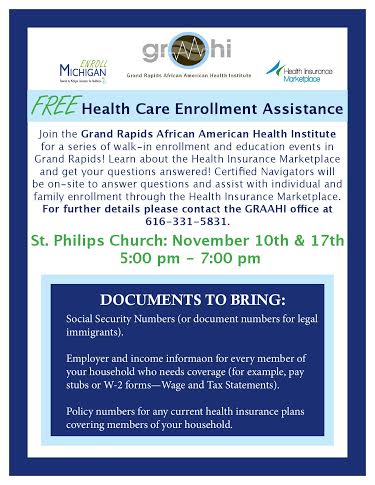
Confused about the Healthcare Marketplace and expanded Medicaid portals? Two certified navigators will answer your questions and enroll you on the spot.
 Did you miss OKT’s weekly email blast yesterday? Here is a link to it. If you would like to subscribe to email updates, email OKTable1@gmail.com and let us know.
. RSVP at the Eventbrite link on flyer.

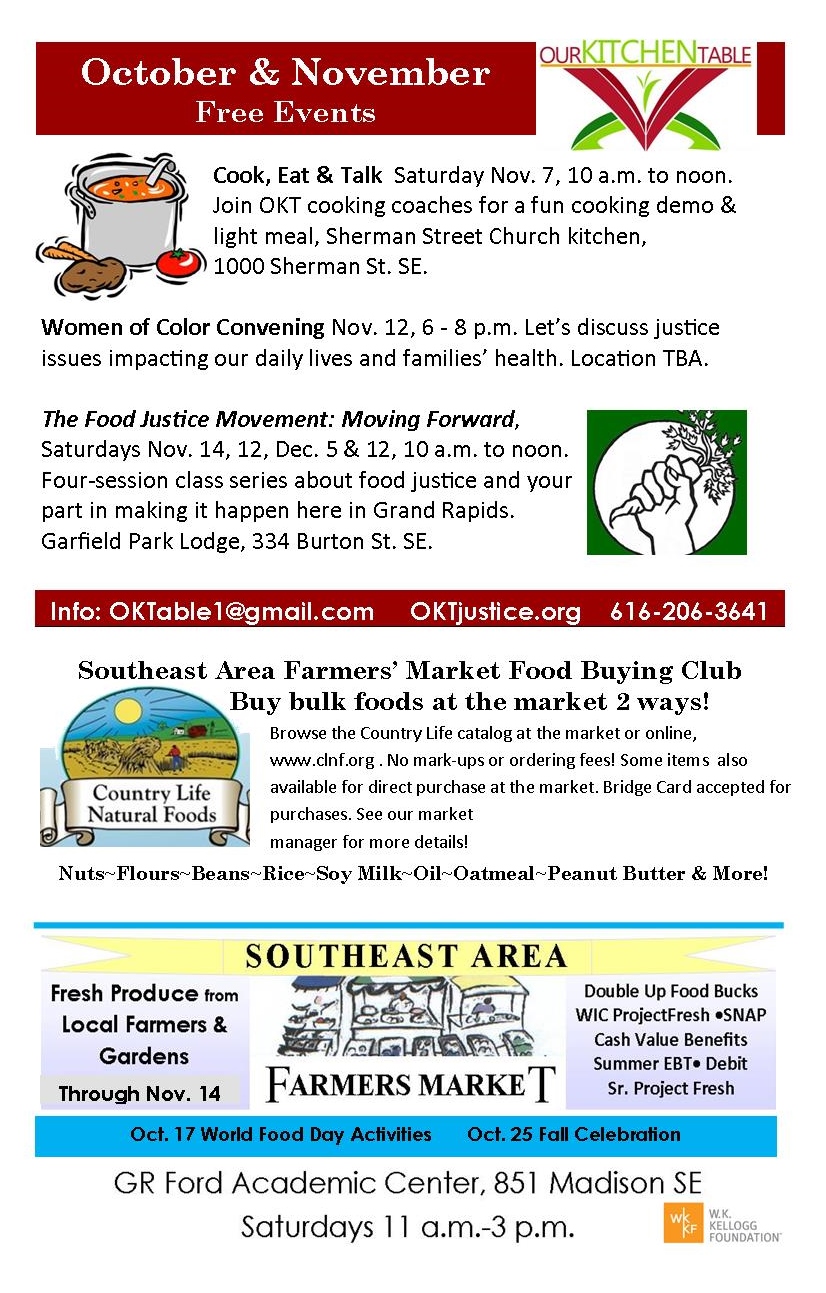
Buy co-op style foods at the market ! Patrons can make purchases with EBT/Bridge Cards!
You can buy bulk whole foods at the Southeast Area Farmers’ Market, e.g. dry beans, whole grain flours, nuts and seeds, pasta, rice and more. Items are ordered from Country Life Foods, a supplier to Michigan food co-ops. You can buy in-stock items at the market or place your own order from the Country Life catalog. The next order is being placed Nov. 9for pick-up at Garfield Park Lodge Nov. 21. Foods are not marked up from the catalog price. No fees are added to orders.
Now, you can get fresh local produce and bulk whole foods at the market!
 From MSUE….
“Michigan State University is our state’s land grant university which is the home of our cooperative extension service and our agricultural research programs. These are MSU Extension and AgBioResearch. Periodically, these programs seek input from our constituents – the residents of Michigan! Please take the time to complete the survey found in the link to the article below.
We appreciate you taking the time to complete this survey and share your thoughts with us. Your thoughts and opinions are valuable. The survey closes on November 15th. Thank you!”
 We all want everyone in our community to have access to good food. We all want to support our local farmers and food producers. Doing that well, however, comes with real and complex barriers and challenges. Two weeks ago, Levi Gardner, Founder and Director of Growth at Urban Rootsaddressed some of the challenges he sees when he shared his thoughts in an article that addressed concerns about the Downtown Market. That article, with the highest share rate of any Rapidian article to date on the citizen-driven platform, revealed the need for further conversation around how we support good local food- both those who grow it and those who need access to it.
In order to continue this conversation with a broader range of perspectives, Urban Roots is presenting a panel discussion at the Wealthy Theatre this September 14. The event, titled “Support Local Food: A conversation on access, growing and the local food economy,” will begin with a social hour at 5:00 and the panel discussion starting at 6:30 p.m.
During the social hour, food will be provided by Tacos El Cunado at the Downtown Market and various organizations will be available at tables to provide ways for local citizens to learn more and get involved in supporting our local food economy.
The panel discussion will include representatives of our local farmers, food vendors, agroecologyexperts experts and our neighbors in need of access. During the event, a Twitter wall will collect questions and comments from the audience and those following in the Twittersphere, utilizing the hashtag #foodrapids to collect the conversation.
This event, hosted by the CMC at Wealthy Theatre, and broadcast live on GRTV and live-streamed here on The Rapidian, is made possible thanks to the generous support of sponsors such as theMSU Extension Office, Bartertown Diner and CVLT Pizza, World Renew, Tacos El Cunado at the Downtown Market and the Grand Valley State University Environmental Studies Program.
Kids’ Food Basket will also be available at the event for those interested in learning more about increasing food security for our community’s children.
To help fund the event, Bartertown Diner/CVLT Pizza’s support will be raised through a fundraising support night at the restaurants on Friday, September 11. From 4 p.m. to close at both establishments, 25% of all proceeds will go directly towards supporting the event.
 Reposted from the Rapidian
by CeNique Yeldell (Yeldellc) on Friday Jul 31st, 2015
Focusing on the Southeast area of Grand Rapids, the organization Our Kitchen Table (OKT) is actively empowering community members to reexamine their food system and giving them the tools to improve their health and environment.
Lisa Oliver King, founder of OKT, saw a need for a community based organization targeted toward people of color and low income families and individuals, particularly women, based on her work experience in public health. King teamed up with the Building Movement Project, an organization that develops and assists nonprofits seeking to create social change, to establish OKT.
A couple of resources OKT provides include the Southeast Farmer’s Market, co-sponsored by the Kent County Health Department and Greater Grand Rapids Food System Council, and the Food Diversity Project.
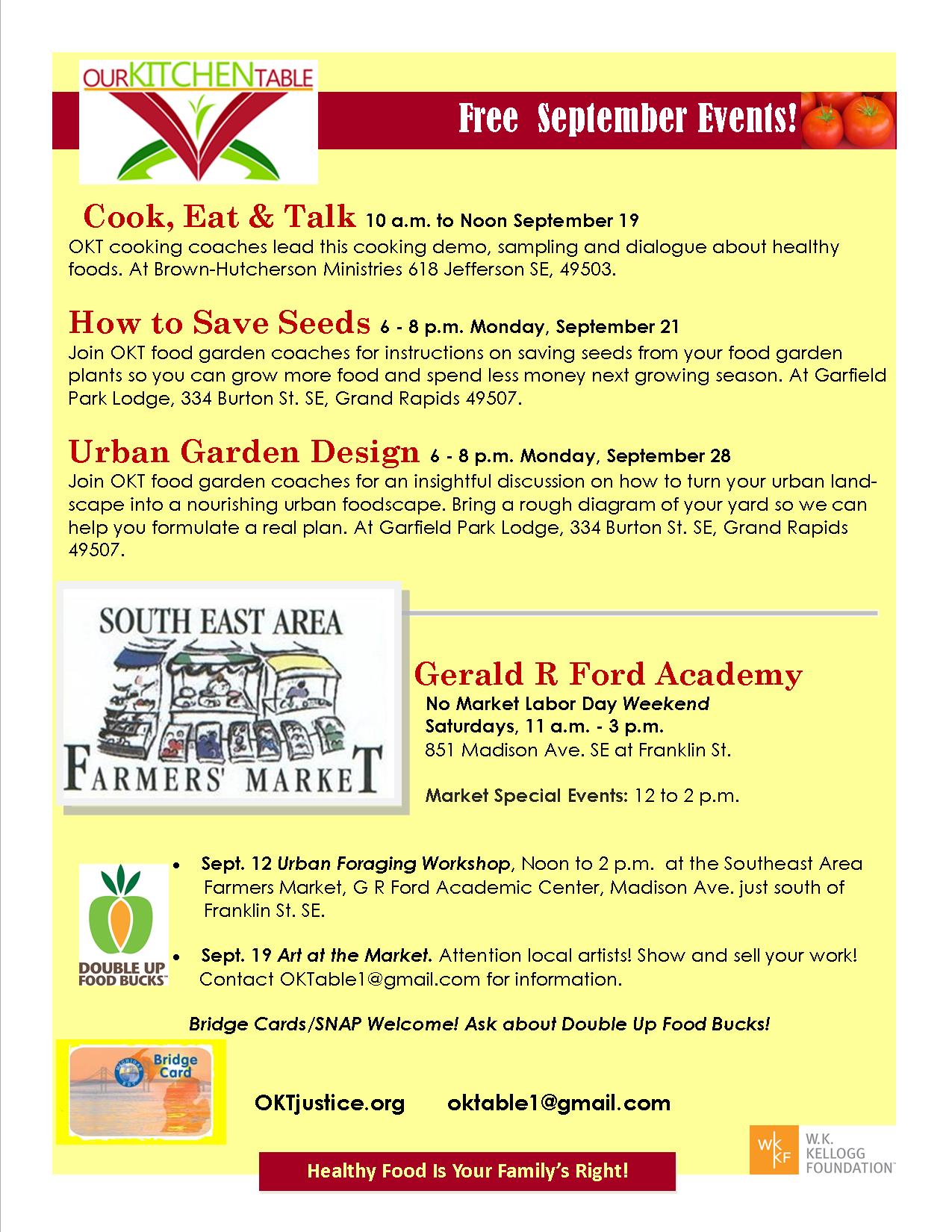
The market is open through November on Fridays from 3 p.m. to 7 p.m. at Garfield Park and through August on Saturdays from 11 a.m. to 3 p.m. at the Gerald R. Ford Academic Center. Bridge Cards (SNAP), Double Up Food Bucks, WIC Project Fresh, Cash Value Benefits, Summer EBT and debit cards are accepted.
Vendors are primarily residents and women of color, who provide locally grown produce, crafts and personal care products. Events such as cooking demos and workshops ranging from urban foraging to homemade personal care products will take place throughout the market season.
Yvonne Woodard, a vendor of the Southeast Farmers market, has been involved OKT for over eight years. She says the market is a great way for community members to meet, keep money in the community and make locally grown food more accessible.
The Food Diversity Project aims to educate communities about food and environmental health disparities, while providing tools to build gardens for those with limited access to healthy food.
Paula Woods, a participant of the project, signed up with OKT and attended classes on planning a food garden and food justice as a requirement to receive a garden. OKT provided her with all the necessary tools, installed the majority of the plants and assigned her a garden coach.
Having a garden has given her a sense of accomplishment, says Woods, and she has learned a lot about things from food justice to composting.
“I’m excited to grow my own food, as is my family. I have a 3-year-old grandson that lives with me and he loves to help me water the garden. My husband is a chef and he loves having the fresh herbs around for cooking,” Woods says.
After receiving an environmental justice grant, OKT was able to conduct research on lead poisoning, childhood asthma and food power in Southeast Grand Rapids.
“I didn’t want to be guilty of coming in and getting what we needed for the grant, but really building a foundation around creating an infrastructure that allowed women to do this work,” King says.
Areas in Southeast Grand Rapids have been labeled as food deserts, meaning they have little to no access to healthy foods like fruits and vegetables. OKT rejects this term, stating that the label is determined by the lack of food retail or big chain grocery stores.
“That’s not the only measurement of a food landscape. Not only do you have food retail, but you have food pantries, community gardens, restaurants and a multitude of entities that provide food in a neighborhood” Kings says. “If people are able to get food from one of these options that allows them to have healthy food on their plate, then they don’t live in a food desert.”
OKT instead uses the term food apartheid: the intentional, systematic marketing and distribution of profitable, nutrient poor, disease causing foods to income challenged neighborhoods, mainly communities of color.
By understanding terms like these, King says, community members have a better understanding of their resources and what barriers there are in order to bring about change.
OKT works with residents to help them recognize what their food system is in their neighborhood and how they can improve it as individuals and a collective. The group also discusses the importance of food labels, the connection between food and the environment, and how to look at food from a long term perspective so residents can make their own informed decisions.
Recently the organization and community members have taken action by working with the Linc Up Café, by negotiating menu items to accommodate health concerns in exchange for guaranteed customers.
King says everyone should have input in their food system and diet, including those with public assistance. She says women of color who receive assistance are especially disenfranchised because it’s automatically assumed that they don’t know what’s best for their families as it relates to their diet.
“We want to be seen as an asset to neighborhoods and our desired result is systemic change the community is interested in that will build a better quality of life,” Kings says.

 Our Kitchen Table