 On Saturday September 14, Our Kitchen Table participated in the Peace Festival, which took place as part of the Eastown Streetfair. Sheri Munsell hosted our table for the day. This is the third year in a row that OKT has taken part in this annual event. To celebrate OKT’s theme for the day, “Respect Nature,” we created a kids’ zine about the dangers of GMO seeds based on Vandana Shiva’s international Act for Seed Freedom and Food Freedom call to action. Children visiting the OKT table also made stick puppets with characters from the zine, Bee, Butterfly, Earthworm, a Mad Scientist and, of course, Ms. Shiva. To download a copy of the zine, click here.
Free webinar, Sustainable Biomaterials: Criteria, Benefits, Challenges and Market-Based Tools”
 3 p.m. Thursday, September 19, 2013

Brenda Platt, Program Director, Waste to Wealth and Sustainable Plastics,
Co-Director Institute for Local Self Reliance
Plastics derived from fossil fuels are nonrenewable, may leach toxic chemicals, harm marine life, and increase reliance on imported fossil-fuel-based feedstocks. The developoment of bioplastics and other biobased materials hold great promise to mitigate many of these problems by offering the potential for renewability, biodegradation, and path away from harmful chemicals.They are not, however, an automatic panacea. As the interest in biomaterials grows, concerns regarding sourcing and end-of-life issues surrounding these materials follow, such as food competition, GMOs, and compostibility vs. recyclability.The Sustainable Biomaterials Collaborative (SBC) has developed tools to help producers, purchasers, and consumers navigate the maze of biobased materials entering the marketplace. Its purchasing specifications, for instance, are designed to promote products that are sustainable from cradle to cradle: from field and manufacturing to recovery.In this webinar presentation, Brenda Platt, co-chair of the Sustainable Biomaterials Collaborative, will discuss the SBC’s efforts to promote market-based tools such as purchasing guidelines and Working Landscape Certificates, an innovative program that allows buyers of biobased products to support sustainable agricultural practices.
In addition to co-chairing the Sustainable Biomaterials Collaborative, Brenda Platt is the co-director of the nonprofit Institute for Local Self-Reliance, based in Washington, DC, and heads up its Sustainable Plastics Project. She has worked 26 years on waste reduction, recycling and composting issues
 |
Baxter Community Center half-way to meeting tool library fund-raising goal!
 Baxter Community Center works to provide Baxter neighborhood gardeners with plants, seeds and supplies they need to grow healthy foods for their families. Baxter provides food plants, raised beds, a traditional gardening library with books on growing, cooking and canning as well as a seed library. Now they are adding a tool library–and they are asking for help. Many of Baxter’s neighbors don’t have access to shovels, rakes, hand trowels and other tools needed to maintain their gardens. In addition, having tillers and power tools would allow neighbors and other community organizations build more garden spaces.
 Baxter hopes to launch the tool library in March 2014. Tools will be available for anyone in the community to use, but especially the families in its Raised Bed Program and community partners that are starting their own urban agriculture programs that benefit low income families. Any extra funding will be kept as a replacement budget for lost and broken tools.
Baxter’s Raised Bed gardening program serves a neighborhood where 33.5% of households fall below the poverty line, 17.5% of residents are unemployed and 99% of school-aged children qualify for the free or reduced lunch program at their school. In 2009, the Health Department’s food security assessment declared that the Baxter neighborhood was a food desert.
Its Greenhouse and Raised Bed programs increase food security by providing fresh produce and programming to enhance nutrition, environmental awareness, and community spirit. The addition of a tool library would not only allow neighbors to have more productive gardens, but would help build even stronger ties in our community by promoting shared resources. Since beginning the program, Baxter has been overwhelmed with the community response. People in the neighborhood are excited to be doing something collectively that adds beauty, builds relationships, and addresses important health issues our families face.
House Republicans Push To Include Monsanto Protection Act In New Spending Bill

Earlier this year, Merkley and Senate Agriculture Committee Chairwoman Debbie Stabenow (D-Mich.) took to the Senate floor to publicly oppose including the provision in any subsequent legislation.
Re-posted from Huffington Post
WASHINGTON — House Republicans will include an extension of the so-called Monsanto Protection Act in the spending bill designed to avert a government shutdown, according to text of the legislation released Wednesday by House Appropriations Chairman Hal Rogers (R-Ky.).
The Monsanto measure was originally enacted into law in March by being slipped into the previous spending resolution, which is now set to expire.
Since its quiet passage, the Monsanto Protection Act has become a target of intense opposition. Monsanto is a global seed and herbicide company that specializes in genetically modified crops. The law effectively prevents judges from placing injunctions on genetically modified seeds even if they are deemed unsafe. Monsanto has argued that it is unfair to single out the company in the nickname for the law, which is officially known as the Farmer Assurance Provision, when other major agribusiness players also support it.
Sen. Jeff Merkley (D-Ore.) has waged a campaign against the measure and told HuffPost he plans to fight its reenactment.
“The proposed House continuing resolution includes an extension of the Monsanto Protection Act, a secret rider slipped into a must-pass spending bill earlier this year,” Merkley said. “I will fight the House’s efforts to extend this special interest loophole that nullifies court orders that are protecting farmers, the environment, and public health.”
Colin O’Neil, a lobbyist for the Center for Food Safety, said in a statement, “It is extremely disappointing to see the damaging ‘Monsanto Protection Act’ policy rider extended in the House spending bill. Hundreds of thousands of Americans called their elected officials to voice their frustration and disappointment over the inclusion of the ‘Monsanto Protection Act’ this past spring. Its inclusion is a slap in the face to the American public and our justice system.”
But Jennifer Hing, a spokeswoman for the House Appropriations Committee, said the panel doesn’t expect the Senate to balk at the inclusion of the Monsanto provision. “We have received no indication that this is a concern,” she said. “It’s a very traditional [continuing resolution] in every sense of the word. It simply continues existing law. Anything that was enacted in FY13 continues to be enacted.”
The latest continuing resolution — a Capitol Hill term for a bill to keep funding the government until a new budget is passed — would last through Dec. 15, at which point a new CR or a more robust spending bill would be needed to avoid a shutdown.
Hing said the only significant changes the spending bill would make to existing law were included so that federal agencies could manipulate their budgets under sequestration “to continue government functions that would otherwise have catastrophic, unintended, or irreversible impacts on government programs.” For example, agencies would be able to maintain current staffing levels on the border and prepare for bio or chemical weapons attacks.
Earlier this year, Merkley and Senate Agriculture Committee Chairwoman Debbie Stabenow (D-Mich.) took to the Senate floor to publicly oppose including the provision in any subsequent legislation.
“The Monsanto Protection Act refers to a policy rider the House slipped into the recently passed continuing resolution and sent over to the Senate. Because of the time-urgent consideration of this must-pass legislation — necessary to avert a government shutdown — this policy rider slipped through without examination or debate,” Merkley noted on the floor in June.
“I wish to assure my friend that I think it would be inappropriate for that language to be adopted in a conference committee or otherwise adopted in a manner designed to bypass open debate in the relevant committees and this chamber,” Stabenow told Merkley. “I will do my best to oppose any effort to add this kind of extension in the conference committee on this farm bill or to otherwise extend it without appropriate legislative examination.”
A prior attempt to repeal the provision was opposed by Sen. Roy Blunt (R-Mo.), and Sen. Thad Cochran (R-Miss.) blocked it on the floor.
In an interview with HuffPost at the time, Blunt made the case for the Monsanto Protection Act, arguing that it aimed to protect farmers who purchased seeds that were later deemed unsafe.
“I was raised — my mom and dad were dairy farmers — once you’ve made a decision to plant a crop for that year, you can’t go back and undo that decision,” he said. Requiring Monsanto or other seed companies to compensate farmers for lost income wasn’t a viable strategy, he added, if the seeds had once been approved. “You can’t sue them for selling a crop that the federal government said is OK to plant,” he said.
The Monsanto Protection Act allows the secretary of agriculture to block a judicial injunction and allow planting of a strain of seeds. The U.S. Department of Agriculture called the provision redundant, Blunt said, in the sense that all it did “was repeat authority that the secretary in a hearing the other day, before the Agri[culture] Approp[riations] committee the other day, said he already had.”
“And it didn’t require the secretary to do anything that the secretary thought was the wrong thing to do,” Blunt continued. “Which is one of the reasons I thought it was fine. I checked with USDA, or my staff did, and USDA said, ‘You know, we don’t think you need to do that because we can already do it.’ The other view of that was, well, if you can already do it, then it makes everything come together, it’s OK to restate authority they already had.”
Earlier this year, a repeal petition announced by Merkley’s office quickly garnered more than 100,000 signatures, including support beyond his Oregon constituents. A petition put out by Food Democracy Now, which organized a protest at the White House shortly after the measure became law in March, similarly picked up a quick 100,000 signatures. A petition pushed by CREDO Action, an online progressive group with some three million members, has more than a quarter million signatures.
“That’s big for us, the fact that it went from zero to 100,000 just in 24 hours,” Becky Bond, the head of CREDO, told HuffPost at the time. “People are really passionate about this issue. A lot of time people feel helpless with regard to corporate decisions … The fact that there’s someone in the Senate who’s fighting for this is exciting to people, and they’re eager to get their names on it.”
This story has been updated with comment from a House Appropriations Committee spokeswoman.
CLARIFICATION: Language describing proposed changes to current law in the House spending bill has been clarified.
OKT September events include Cook, Eat & Talk and Bike Tour this Saturday
 10 a.m. to noon, Saturday Sept 14: Cook, Eat & Talk Back to School Recipes for Kids. Several Peer Chefs share garden fresh snack and meal ideas. At Sherman Street Church, 1000 Sherman Street SE, Grand Rapids.
3 to 5 p.m. Saturday Sept 14: Bicycle Tour of Fruit and Nut Trees Learn to identify trees in your neighborhood bearing edible fruits, nuts and leaves with OKT Urban Forester, Laura Casaletto. Meet at Garfield Park, Burton and Madison SE.
Going to the Eastown Street Fair? Stop by the OKT booth at the IGE Peace Festival.
September Southeast Area Farmers’ Market Activities
· September 14, Grand Rapids Police Department officers will meet and greet neighbors and share children’s activities.
· September 20 and 21, Grand Rapids Fire Department will provide free smoke alarms to neighborhood households and invite kids to tour a fire truck. Safe Link will sign up qualifying neighbors for free cell phone service.
· September 27, Community Advancement will provide free pre-diabetes screening; Project Red will share HIV and AIDS resources.
- September 28, Community Advancement will provide free pre-diabetes screening and the market will host a healthy kids snacks cooking demo.
Vandana Shiva Invites you to Act for Seed Freedom and Food Freedom

Watch Vandana Shiva’s video invitation,”Act for Food and Seed Freedom ”
Dear lovers of life’s diversity and lovers of freedom,
It is time to organise and concentrate our energies to liberate our seeds and our food from the toxic, greedy and lethal clutches of global corporations like Monsanto; from the laws the corporations are writing, stealing our democracies in order to steal our seeds and food, our health and livelihoods, our cultures and our lives. We need to break from the sense of powerlessness the corporations would like us to experience to make us believe they are all powerful and we have no power to change. But we do. We just have to combine our collective energies. We must become the change we want to see.
I invite you to unleash your creative energies during the Fortnight of Action for Seed Freedom and Food Freedom – 2nd October to 16th October.
2nd October is Gandhi’s birth anniversary. Gandhi left us the legacy of “Swaraj”- self-organised freedom and “Satyagraha”- the force of truth. Let us dedicate ourselves to celebrating 2nd October as the day for a worldwide “Seed Satyagraha”. A day when we defend Seed Freedom and Food Freedom by identifying every regional law written by corporations to undermine these freedoms by criminalizing diversity, seed saving and seed exchange, farmers innovations and farmers rights; whilst establishing illegitimate seed monopolies through patents and privileging of uniformity and monocultures.
After having identified laws for seed slavery, let us commit ourselves to not obey these unethical and brute laws which threaten life on earth, including our lives and the lives of our children. Gandhi had reminded us 100 years ago, that “As long as the superstition remains that unjust laws must be obeyed, so long will slavery exist”. We have a dream, and our dream is that every seed, every bee, every butterfly, every earthworm, every person, every child be free of manipulation and control, hunger and disease; that they evolve and co-evolve in freedom, well-being and health. We must not allow ourselves to be subjected to the superstition that Monsanto Laws must be obeyed. For the sake of Gaia’s laws, of life’s renewal in freedom and the laws of justice, it is our ecological and ethical duty to disobey Monsanto’s laws. And while resisting and not co-operating with destructive laws of seed dictatorship, let us celebrate Seed Freedom and Food Freedom through adopting The Law of the Seed and creating Gardens of Hope – seed sanctuaries – and GMO-free, patent free Seed Freedom Zones.
On 12th October we will self-organise to March against Monsanto across the world, like we did on the 25th May.
16th October is World Food Day. Monsanto and other Biotech giants have been foolish and arrogant enough to award themselves The World Food Prize they sponsor that day. Let us give Real Food Prizes to Real Food Heroes in our communities, who bring us real and healthy food instead. According to the Food and Agriculture Organization, 72% of the food that people eat comes from small farms and gardens. We can make the 72% a 100% by saving Seeds of Freedom and planting Gardens of Hope everywhere. Industrial agriculture driven by corporations has destroyed 75% of the planet’s biodiversity resulting in hunger and disease. 1 billion are hungry, 2 billion suffer from food related diseases. This is not a food system that brings us life and health. It is a greed and profit-driven, commodity producing system that has unleashed death and destruction. We have to stop this destruction. There is no place for poisons and corporate slavery in the food system. We are what we eat.
Our seeds and food are vital to life. We cannot afford to allow the destruction of the planet and our health to continue. We cannot allow seed slavery and food dictatorship to continue. We must take back our seeds, our food, our freedom.
With love and strength to each and every one of you to evolve your highest powers and unleash your highest creative and collaborative energies, so that together we shape a food system that protects life on earth, our small farmers, our health and our future.
Vandana Shiva
Meals from Your Market: Peaches!
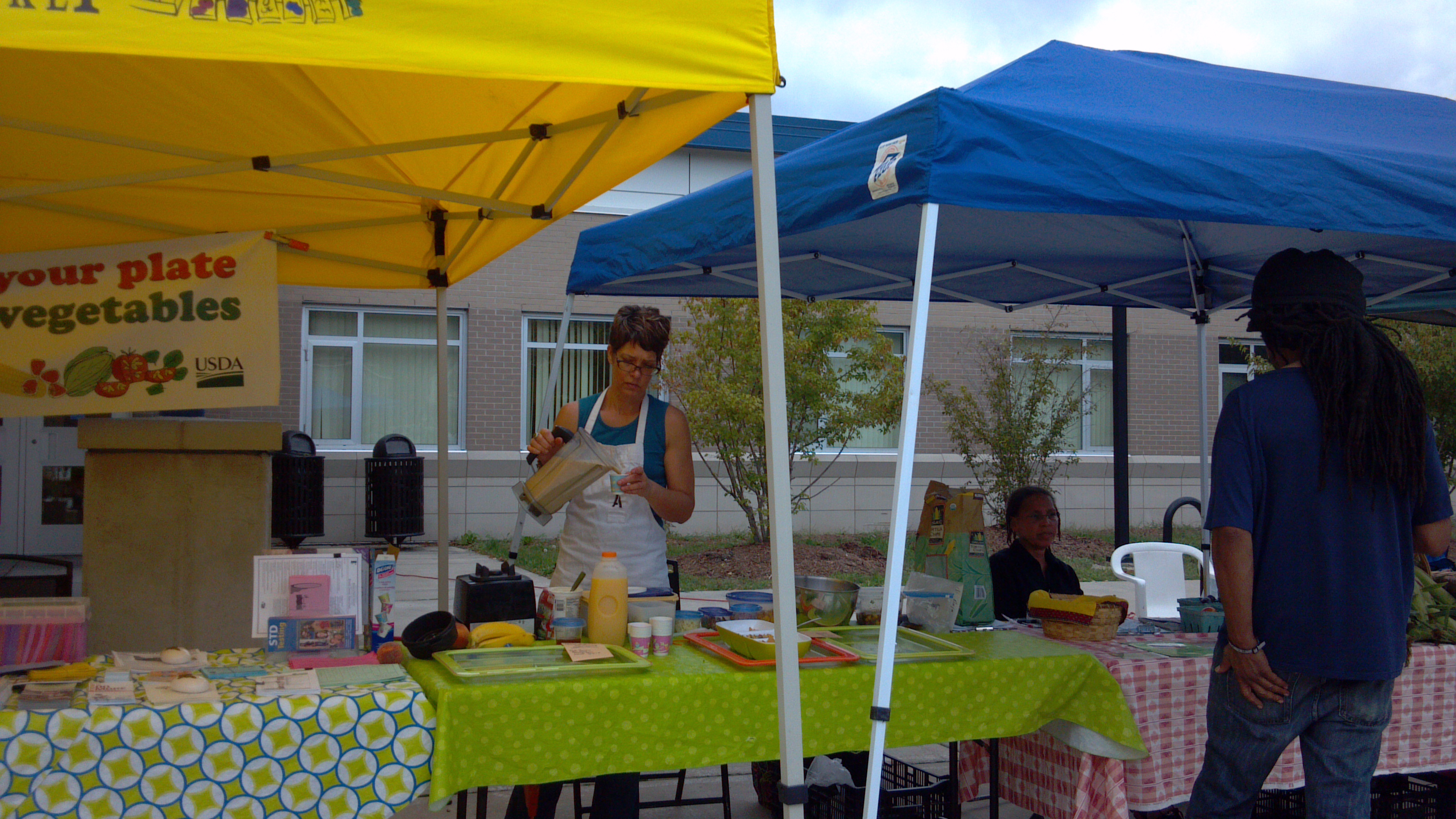
Farmer and kitchen coach, Anja Mast, demonstarting several no-cook peach recipes at the Southeast Area Farmers’ Market last Saturday.
Click on the links below for the recipes!
Peach and Orange Juice Smoothie
You can find more Meals from Your Market recipes here.
Kent Conservation District Fall 2013 Tree, Shrub and Plant Sale
Don’t put your shovels away yet! Kent Conservation District’s Fall 2013 Native Tree, Shrub and Plant Sale catalog is now available! Orders will be taken until September 16 for trees and shrubs and September 27 for native plants. Support our pollinators, birds and butterflies by planting the native species that make West Michigan a wonderful place to live. The pickup date and Browse N Buy extras sale is on October 5. Kent Conservation District is involved in many new efforts and we would love your support. For details about our sale and new programs at the District, follow this link. Tree, Shrub and Plant Sale for Fall 2013. Then order your choices by printing, mailing, faxing or emailing in the Order Forms.
 To help with your selections, see this Helpful Guide. Please note the source of this information, it is a wonderful book. For even more help, register for the workshop with our grower, Vern Stephens, presenting on “Gardening with Native Plants” on September 25 from 6:00-8pm. RSVP by phone or email if you would like to attend, seats are limited and there is a nominal $5 fee. Bring your order form and check those you would like to order and bring home to your landscape. Vern is a great resource for any questions you may have.
Gardeners can help provide food, shelter and the sense of place that our unique Michigan soils and climate have made. Consider using Michigan Natives for your next planting. Doug Tallamy, author of Bringing Nature Home, urges gardeners to begin work on “Homegrown National Park” – a landscape linking urban, suburban and rural areas with resource corridors that provide food and shelter for insects, birds and all wildlife. It is a vision of healthy, active, buzzing life. Please do what you can by using Michigan Native Plants!
Our Native Plant Sales are Kent Conservation District’s largest fundraiser. We hope, with your help, to maintain a focus on conservation and a presence in Kent County. We need your help financially, and can also use your donation of time to volunteer! Thank you so much.
E-mail us your contact information.
Southeast Area Farmers’ Market Upcoming Events
 Kids going back to school herald the end of summer, but not the end of the farmers’ market season. The Southeast Area Farmers’ Market has fresh local produce and market activities that support your family’s good health.
Calling all artists!
On Saturday September 7, the Southeast Area Farmers’ Market hosts Art at the Market, a showcase of local talent. If you draw, paint, sculpt or create in any other medium, we invite you to join us. Contact Our Kitchen Table for more details, OKTable1@gmail.com or 616-206-3641.
Healthy meals and snacks!
Do you ever wonder what to do with all those fresh veggies you just bought at the market? On September 28, the market will host cooking demos featuring easy recipes made with in-season, fresh produce.
Double your buying power!
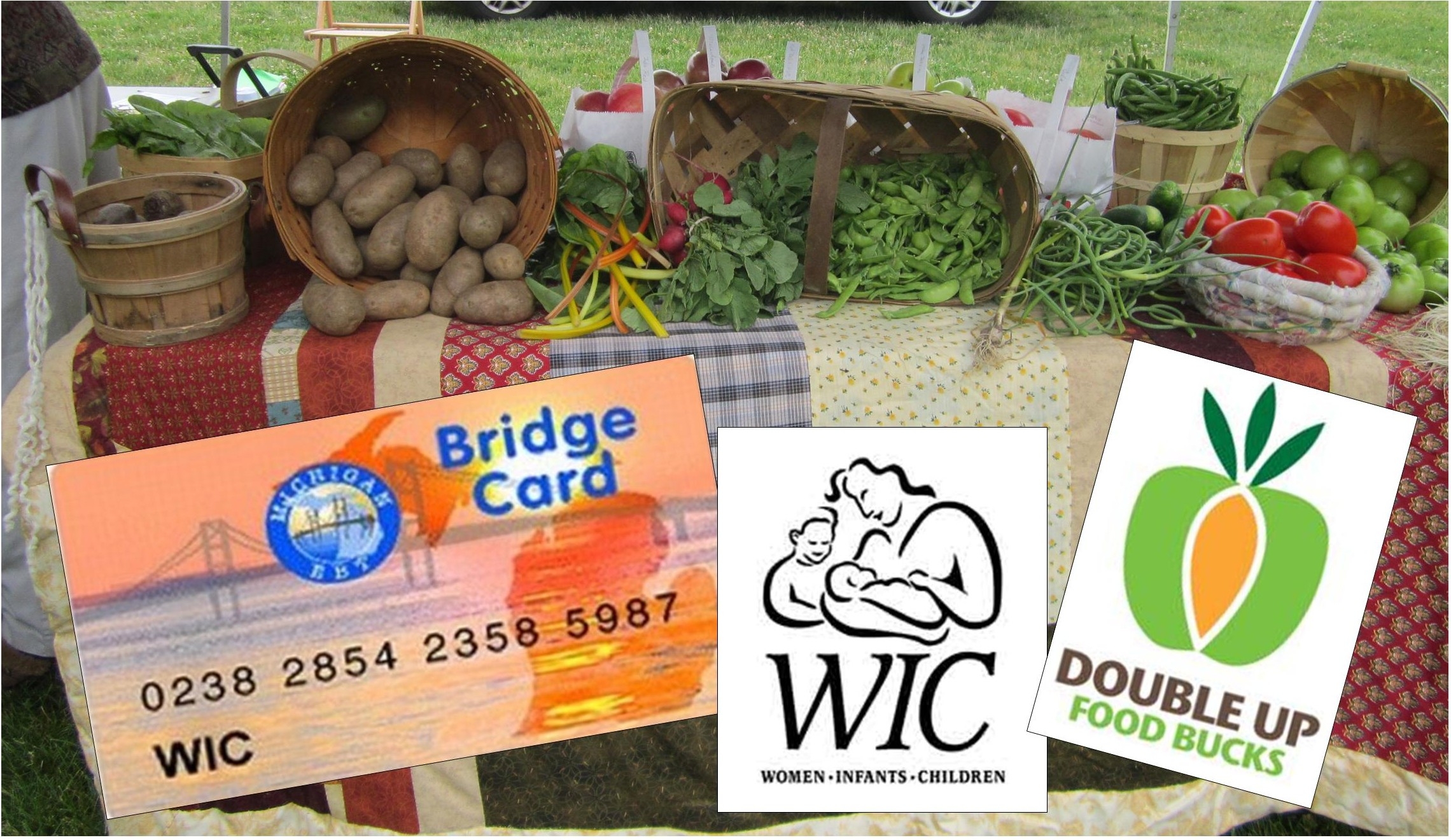
Like many others farmers’ markets in town, the Southeast Area Farmers’ Market participates in the Double Up Food Bucks program. Patrons shopping with a Bridge Card (SNAP) receive $2 for every $2 spent on Michigan produce, up to $20 in free Michigan produce each time you visit. The market also accepts WIC Project Fresh, Cash Value Benefits, Summer EBT and Kent County Health Department coupons.
The Southeast Area Farmers’ Market takes place Saturdays from 11 a.m. to 3 p.m. at Gerald R Ford School. The Friday Farm Stand at Garfield Park is open 3 to 7 p.m.
Webinar “Farmers’ Markets in Low-Income Communities: Strategies & Best Practices”
Thursday, August 29
2:00 p.m. – 3:00 p.m. EST
Across the country healthy food stakeholders are working to support farmers’ markets that increase access to healthy foods in low-income communities.
This webinar will discuss how incentive programs, retail strategies and policies are changing how consumers shop at farmers’ markets in their neighborhoods. Experts will share best practices and lessons learned from the field about how to implement programs to promote the sale of healthy food at these retail outlets.
Featured Speakers:
- Mukethe Kawinzi, Project Coordinator, The Food Trust
- Oran Hesterman, President/CEO, Fair Food Network
- Jennifer O’Brien, Executive Director, Farmers Market Coalition
You can also follow highlights from the conversation on Twitter @PolicyLink using #healthyfoodaccess.
 Our Kitchen Table