GVSU to screen documentary with Angela Davis and Tim Wise on January 28

Reposted from GRIID.org

Vocabulary of Change

FRONT COVER

  • Monday, January 28
  • 4:00PM
  • GVSU Allendale Campus
  • Kirkhof Center – Pere Marquette Rm

This event is free and open to the public.

The LGBT Resource Center at GVSU is hosting a screening of an important documentary that explores the intersectionality of today’s most pressing social justice issues.

Angela Davis and Tim Wise, two of this country’s leading racial and social justice scholar-activists, join moderator Rose Aguilar onstage for a rare, unscripted and free ranging conversation on the state of contemporary global politics.

They explore how our culture’s uncritical embrace of pervasive individualism, the myth of meritocracy and entrenched institutional inequality have led to racialized public policy, the privatization of education,health care and the environment, and the commodification of many of our basic needs, including water and food.

Through bold discourse, wit, and an optimism of the will, Angela and Tim call for new vocabularies – a different kind of fluency and a different quality of literacy. With a shared reverence for historical memory and today’s activism, they invoke the power of a new language to restore clarity and to unify global communities.

One comes away from this conversation with a sense of renewed faith in humanity and with the realization that ordinary people can, and do, and will achieve the extraordinary. As Angela notes in her commentary, “as isolated individuals we will always be powerless…but as communities we can achieve anything.”
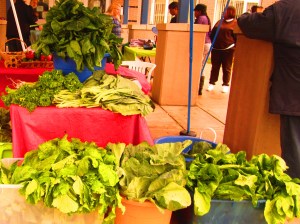
 

Get vegetables into your winter diet

greens tolbertWinter is the worst time to let good nutrition slip. After all, eating plenty of fruits and vegetables helps your body fight off colds, flu and even asthma attacks. If the market where you shop doesn’t offer fresh produce, frozen alternatives can offer you nearly the same nutritional value. The deeper the color of the vegetable, the more nutrition, so you may want to concentrate on vegetables like broccoli, greens such as spinach, carrots and green beans.


If your family won’t eat them as sides, add them—or hide them—in main dishes, whether made from scratch or out of a can. Carrots and chopped greens are great additions to chili and soups. You can also hide chopped greens in hamburger patties, meatballs and meat loaf.


Next time you make mac and cheese, substitute some cauliflower for a portion of the macaroni elbows. Making sloppy Joes with canned mix? Brown onion along with the ground beef and then add carrots or other chopped vegetables for rave reviews.


Another way you can boost winter nutrition is buy choosing 100% whole grain breads, buns and pastas. This is no easy task. A lot of bread labeled “Wheat” or “Whole Grain” is really unhealthy white bread with a little caramel coloring added. Look for a label that says “100%” to be sure you get what you paying for.


While these kinds of foods may come at a higher price, you will save in healthcare costs over the long run—and you’ll feel a lot better in the here and now. You may even find you are more satisfied with eating less.

7 p.m. Tuesday: Natasha Bowens, Brown Girl Farming

Natasha Bowens, a farmer of color, will be speaking on the intersect between race and sustainability at Calvin College Fine Arts building Recital Hall 7 p.m. Tuesday Jan. 15.
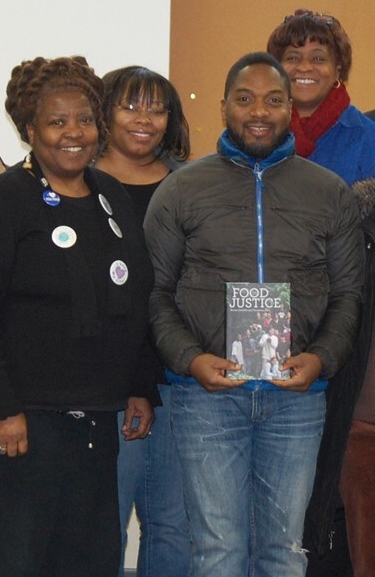
She writes about her journey as a farmer of color on her blog: browngirlfarming.com She has also started a photo documentary to share the story of farmers of color all across the country.

Co-sponsored by Calvin College’s Residence Life, MSDO, Biology Department, Multicultural Affairs, Community Engagement, and the Service-Learning Center.

Lila Cabbil to develop manual for Southeast Area Farmers’ Market

SEAFM 1-11-13 (2)

In 2012, Lila Cabbill (left) facilitated a local community dialogue with OKT and renowned chef and food justice activist, Bryant Terry (right front).


As Our Kitchen Table heads into its third year of managing the Southeast Area Farmers’ Market, the management team is looking at ways to make the market sustainable, with the ultimate goal of turning over the market to community. One tool is the development of a market manual. OKT is engaging Lila Cabbil, facilitator and president emeritus of the Rosa Parks Institute, to develop this manual.


In addition to outlining operations protocols, staff job descriptions and budget items, Cabbil will develop guidelines for developing staff skills and community events through the lenses of food justice, public health and empowering women of color.


“Mrs. Cabbil will help us define what needs to be taken into consideration when trying to create a neighborhood market that neighbors walk to. She will help us explore  how we can present the market in different forms, for example, as a farm stand one day a week or as a house-call market,” says Lisa Oliver-King, executive director of OKT. “We hope to create a new model that better serves the needs of the community. Mrs. Cabbil will help us develop this model.”


In 2011 and 2012, Mrs. Cabbill worked with Our Kitchen Table staff on team building and with the farmers’ market partners.Prior to her facilitation work, Mrs. Cabbill worked alongside Rosa Parks for decades. She is also author of the book Accountability and White Anti-Racist Organizing: Stories from Our Work.  

Snyder continues to stack Ag commission with agribusiness people

Reposted from GRIID.org

Yesterday, MLive reported that Michigan Governor Rick Snyder appointed a new member to theMichigan Commission of Agriculture and Rural Development.

farm-subsidies

Fred Walcott, who works for Valley View Pork near Allendale, is the newest of the five-member commission, that is exclusively made up of people who work for large agribusiness operations.

Walcott, who works at a 4,000 acre farm, will serve as commissioner along with Bob Kennedy, who is Vice President of Operations for Auburn Bean and Grain. The website for this business reads like a stock market sheet instead of a place where people respect the land and care for the earth.

Also serving on the Ag Commission is Diane Hansen, owner of Hansen Seed Farm and Donald Coe, the managing partner of Black Star Farms. Based on the information at Black Star Farms, it appears to be more of a tourist destination than a farm.

The fifth member of the Michigan Agriculture Commission is Trever Meachum, who is the production manager for High Acres Fruit Farm, a 3,000 acre farm in Van Buren County.

Adding Walcott demonstrates that the Governor is only interested in having the perspectives of people involved in large agribusiness operations. There is no one on the commission that seems committed to organic and sustainable farming practices, or people who are committed to promoting food justice.

Walcott is also part of the Michigan Pork Producers Association, which represents the interests of large factory farming operations, also known as CAFOs, in Michigan.

More importantly, groups like the Michigan Pork Producers Association and the industry groups represented by those on the ag commission, are also actively involved in federal farm policy issues and are engaged in lobbying efforts to continue the massive taxpayer subsidies currently operating through the Federal Farm Bill.

According to the Environmental Working Group, Michigan Farmers received $79,450,000 in federal subsidies for 2011. Looking at the list of farms that did receive massive subsidies, the majority of them are larger agribusiness operations and not smaller farms engaged in Community Supported Agriculture.

This announcement, coming from Snyder, is another blow to those who are part of the local food movement and those who work for food justice.

“The A to Z on Atrazine: Sex Hormones and America’s Most Popular Pesticide”

Free Webinar

3 pm EST/ 12 pm PST January 15th, 2013

Despite being banned in Europe due to health risks, atrazine, a hormone-disrupting herbicide, is one of the world’s most largely used pesticides — hundreds of millions of pounds per year.  It can be found in our lakes, streams, rain, and drinking water, at levels that make a difference to human health.  Scientists link exposure to increased risk of birth defects, infertility and cancer, among other health impacts.  It turns tadpoles into hermaphrodites.
Indiana neonatologist Dr. Paul Winchester will discuss the science on atrazine exposure and birth defects in particular.  Biologist Emily Marquez, PhD, discusses how communities are monitoring drinking water supplies for atrazine, and are pushing for health protections.  She manages the Grassroots Science Program at Pesticide Action Network.  Finally, we will discuss why this chemical remains on the market in the U.S. and dialogue about roles that health professionals can take in changing our pesticides and chemicals policies.

Learn more and register


Co-sponsors:

Pesticide Action Network, North America; The American Congress of Obstetricians and Gynecologists District IX; Physicians for Social Responsibility Los Angeles (PSRLA); Physicians for Social Responsibility San Francisco Bay Area (PSR); Program on Reproductive Health and the Environment, University of California, San Francisco


This entry was posted on January 3, 2013, in Policy.

Korean artist’s storage solution for vegetables

Reposted from Generation Alpha

Check out this short video from a Korean artist about her storage solution for vegetables. If we do it right, this is what our future will look like: low cost, low tech, low material input, but very smart solutions to everyday needs. Understand nature and work with her, instead of against her.

School partnerships grow the work of Southeast Area Farmers’ market

june 031

The Gerald R Ford Middle School market site became a fun community gathering place.

The Our Kitchen Table (OKT) farmers’ market management team truly appreciates the partnership that has developed with two Grand Rapids Public Schools, Gerald R Ford Middle School and Martin Luther King Leadership Academy.

GR Ford has not only served as a site for the Southeast Area Farmers’ Market for the past two years, it has also served as an OKT food garden demonstration site. You can see the raised beds just south of the school building. In addition, OKT’s Yvonne Woodard has led food gardening classes with students at the school.

On Friday evenings from 6 to 8 p.m., Ms. Woodard facilitates a healthy community get together featuring nutritious foods, dance exercise and pick-up basketball. All community members are invited to join this free activity that takes place during the school year (holiday weeks excluded).

Last year, OKT and students from Mr. Andrew Ippel’s class planted a rooftop food garden in abandoned raised garden beds at Martin Luther King school. “Students in my classroom learn so well through real-world experiences! Typing meaningless sentences isn’t the same as formulating real ideas about the vegetables they hope to see growing in their very own garden,” said Mr. Ippel. “Students are learning how to work, the value of getting their hands a little dirty now and then. They have a chance to be recognized by adults and peers in their school as valuable, contributing members in the MLK community.”

Next market season, OKT hopes to host a monthly satellite farmers’ market at MLK.

March planned this Saturday in Grand Rapids to fight GRPS plan

Reposted from GRIID.org

March of the Stakeholders

  • Saturday, December 15
  • Noon – 3PM
  • Beginning at Rosa Parks Circle in Downtown Grand Rapids

Local people are angry and organized. With the continued dismantling of Grand Rapids Public Schools and the partnerships with the private sector to build places like the Van Andel funded University Prep Academy on Division.

Here is what the Facebook event page says about what is planned this Saturday:276540_372397129520284_1168454827_n

Bring the REAL stakeholders (our children!) to lead us parents as well as teachers and community supporters in a march this Saturday at 12 noon from Rosa Parks Circle toAmway Grand Plaza.

The purpose of our march is to oppose GRPS’s “Transformation Plan” to shutter 10 more of our public schools in the coming year and to bring our complaint to those financially and ideologically responsible for the plan.

The “Cambridge Report”, upon which the GRPS Transformation Plan is based, was paid for with nearly 1/4 $ million from the DeVos family, a family that has been working for over ten years to privatize and dismantle public schools not only in Grand Rapids but also nationwide. As Dick Devos put it in his 2002 speech on the topic to theHeritage Foundation, “Because we know how the government schools perpetuate themselves, we can design a plan to dismantle them”.

Is it any surprise then, that the DeVos family-sponsored study recommended shuttering 10 more of our public schools? It is not a surprise, but it is a surprise that GRPS administrators would simply fall in line!

25 schools have already been shuttered in recent years: closing 10 more leaves our city with a dwindling public education base and just clears the way for more private and charter schools to take their place.

This is one “philanthropic” donation GRPS adminstrators should steadfastly refuse: they should instead be working to expand our public school base, while providing wraparound services and diverse learning opportunities at every school!

Join us and let’s work to save our public school system locally and nationally at the same time. If GRPS won’t do it, we will.

Sponsored by Save Our Schools Grand Rapids (SOSGR)


Many farmers markets in Michigan are still open

This post is based on a press release from MIFMA

Though the growing season is over and snow will be falling soon, many farmers markets in Michigan are still open throughout the winter. Sixteen of these markets accept food assistance benefits, like Bridge Cards, to help get fresh food onto the tables of the families who need it most.


“In Michigan, 1.8 million residents now receives food assistance benefits from the Supplemental Nutrition Assistance Program (SNAP), and farmers markets all across Michigan are rising to the challenge to meet that need with fresh, local food,” said Amanda Shreve, Manager of Programs and Partnerships at the Michigan Farmers Market Association (MIFMA).


During the summer 2012, clients could use their cards on qualifying foods, like fresh fruits and vegetables, baked goods and meats at 103 farmers markets, 34% of the more than 300 farmers markets operating in the state. Most of the farmers markets accepting SNAP benefits also participate in other food assistance programs, like Double Up Food Bucks, Market FRESH and WIC Project FRESH.


Buying locally at farmers markets helps circulate money here in Michigan, which is good for the economy and local communities. According to the Food Bank Council of Michigan, for every dollar spent through SNAP in Michigan, $1.80 of local economic activity is generated.


The following West Michigan farmers markets are open throughout the winter and accept SNAP benefits:

  • Fulton Street Farmers Market in Grand Rapids
  • Holland Farmers Market in Holland
  • Muskegon Farmers Market in Muskegon
  • Sweetwater Local Foods Market in Muskegon