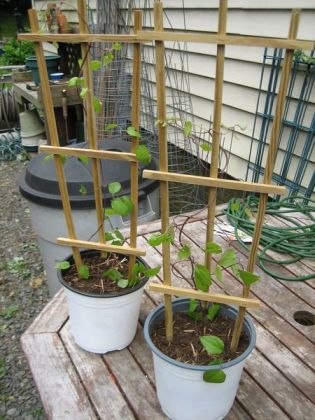
 Trellis Gardening: Growing Up!
Short on space?
Learn to grow food vertically
with Farmer Jennifer Bongiorno
6 to 7:30 p.m. Wednesday May 9
Gerald R Ford Middle School, Madison & Franklin SE
Trellis Gardening: Growing Up!Short on space?
Learn to grow food vertically
with Farmer Jennifer Bongiorno
6 to 7:30 p.m. Wednesday May 9
Gerald R Ford Middle School, Madison & Franklin SE
 On Saturday May 5, hundreds of area residents took to the streets for the 35th Annual Access of West Michigan 5K Hunger Walk. The tagline for the event was “Walking Together. Ending Hunger.”
Walkers representing the Greater Grand Rapids Food Systems Council (GGRFSC), Kent County Health Department (KCHD) and Our Kitchen Table (OKT) were among the crowd. Monies raised through their pledges will go towards funding the Southeast Area Farmers’ Market. The seven members of OKT‘s Food Diversity Project team hope to raise $500 for the market.
While one walk, one day a year will not realistically end hunger in the greater Grand Rapids area, we are thankful that ACCESS and the food pantries it stocks are working hard to make that happen. OKT recognizes that huge systemic changes need to be made in order for hunger to be truly eradicated. Until we build a social movement that can bring about those changes, organizations like ACCESS of West Michigan are vitally important.
OKT also recognizes that it’s one thing to fill an empty stomach—and yet another to provide equitable access to healthy, nutritious foods. While filling a belly gets a child through an otherwise hungry night, providing that child fresh, whole foods nourishes her whole body, including her growing brain. A child fed nutritious foods enjoys better health, pays better attention in school and feels happier and more energetic.
These are the kinds of foods that the Southeast Area Farmers’ Market brings to the neighborhood. Please do what you can to support the market this year.
Starting May 8, GRIID will be offering a 5-week class on the topic of Food Justice. This class is in conjunction with the current Food Justice project that the group Our Kitchen Table (OKT) is involved in.
The 5-week class will explore how we came to have a food system, which is based on an agri-business model that sees food primarily as a commodity and not as a source of healthy nutrition.
We will explore the US food system over the past 100 years and look at issues like food deserts, food justice and food sovereignty. The class will collectively read the book Food Justice, by Robert Gottlieb and Anupama Joshi.
In addition, the class participants will use the analysis from the readings to discuss ways to create a more just food system in West Michigan.
The 5-week class will be held on Tuesdays from 6 – 8PM in the lower level of the Steepletown building located at 671 Davis, NW, in Grand Rapids. The class will begin on Tuesday, May 8.
Anyone interested in signing up for the class can contact me atjsmith@griid.org. There is no cost to this class, but you need to bring your own copy of the book, Food Justice, by Robert Gottlieb and Anupama Joshi.
 This is reposted from Common Dreams via GRIID.
New Delhi, India – The economic crisis, the ecological crisis and the food crisis are a reflection of an outmoded and fossilized economic paradigm – a paradigm that grew out of mobilizing resources for the war by creating the category of economic “growth” and is rooted in the age of oil and fossil fuels. It is fossilized both because it is obsolete, and because it is a product of the age of fossil fuels. We need to move beyond this fossilized paradigm if we are to address the economic and ecological crisis. Rice terraces near the Drukgyel Dzong, Paro Valley, Bhutan. (Photo: Blaine Harrington)
Economy and ecology have the same roots “oikos” – meaning home – both our planetary home, the Earth, and our home where we live our everyday lives in family and community.
But economy strayed from ecology, forgot the home and focused on the market. An artificial “production boundary” was created to measure Gross Domestic Product (GDP). The production boundary defined work and production for sustenance as non-production and non-work – “if you produce what you consume, then you don’t produce”. In one fell swoop, nature’s work in providing goods and services disappeared. The production and work of sustenance economies disappeared, the work of hundreds of millions of women disappeared.
To the false measure of growth is added a false measure of “productivity”. Productivity is output for unit input. In agriculture this should involve all outputs of biodiverse agro-ecosystems – the compost, energy and dairy products from livestock, the fuel and fodder and fruit from agroforestry and farm trees, the diverse outputs of diverse crops. When measured honestly in terms of total output, small biodiverse farms produce more and are more productive.
Bhutan has given up the false categories of GNP and GDP, and replaced them with the category of “gross national happiness” which measures the wellbeing of nature and society.
Inputs should include all inputs – capital, seeds, chemicals, machinery, fossil fuels, labour, land and water. The false measure of productivity selects one output from diverse outputs – the single commodity to be produced for the market, and one input from diverse inputs – labour.
Thus low output, high input chemical, industrial monocultures, which in fact have a negative productivity, are artificially rendered more productive than small, biodiverse, ecological farms. And this is at the root of the false assumption that small farms must be destroyed and replaced by large industrial farms.
This false, fossilized measure of productivity is at the root of the multiple crises we face in food and agriculture.
It is at the root of hunger and malnutrition, because, while commodities grow, food and nutrition have disappeared from the farming system. “Yield” measures the output of a single commodity, not the output of food and nutrition.
This is the root of the agrarian crisis.
When costs of input keep increasing, but are not counted in measuring productivity, small and marginal farmers are pushed into a high cost farming model, which results in debt – and in extreme cases, the epidemic of farmers’ suicides.
It is at the root of the unemployment crisis.
When people are replaced by energy slaves because of a false measure of productivity based on labour inputs alone, the destruction of livelihoods and work is an inevitable result.
It is also at the root of the ecological crisis.
Bhutanese Prime Minister Jigmi Thinley has recognised that “growing organic” and “growing happiness and wellbeing” go hand in hand.
When natural resource inputs, fossil fuel inputs, and chemical inputs are increased but not counted, more water and land is wasted, more toxic poisons are used, more fossil fuels are needed. In terms of resource productivity, chemical industrial agriculture is highly inefficient. It uses ten units of energy to produce one unit of food. It is responsible for 75 per cent use of water, 75 per cent disappearance of species diversity, 75 per cent land and soil degradation and 40 per cent of all Greenhouse Gas emissions, which are destabilizing the climate.
In food and agriculture, when we transcend the false productivity of a fossilised paradigm, and shift from the narrow focus on monoculture yields as the only output, and human labour as the only input, instead of destroying small farms and farmers we will protect them – because they are more productive in real terms. Instead of destroying biodiversity, we will intensify it, because it gives more food and nutrition.
Futureconomics, the economics of the future, is based on people and biodiversity – not fossil fuels, energy slaves, toxic chemicals and monocultures. The fossilized paradigm of food and agriculture gives us displacement, dispossession, disease and ecological destruction. It has given us the epidemic of farmers suicides and the epidemic of hunger and malnutrition. A paradigm that robs 250,000 farmers of their lives, and millions of their livelihoods; that robs half our future generations of their lives by denying them food and nutrition is clearly dysfunctional.
It has led to the growth of money flow and corporate profits, but it has diminished life and the wellbeing of our people. The new paradigm we are creating on the ground – and in our minds – enriches livelihoods, the health of people and eco-systems and cultures.
On April 2, 2012, the United Nations organised a High Level Meeting on Wellbeing and Happiness: Defining a new Economic Paradigm to implement resolution 65/309 [PDF], adopted unanimously by the General Assembly in July 2011 – conscious that the pursuit of happiness is a fundamental human goal and “recognising that the gross domestic product does not adequately reflect the happiness and well-being of people”.
I was invited to address the conference at the UN. The meeting was hosted by the tiny Himalayan Kingdom of Bhutan. Bhutan has given up the false categories of GNP and GDP, and replaced them with the category of “gross national happiness” which measures the wellbeing of nature and society.
Bhutanese Prime Minister Jigmi Thinley has recognised that “growing organic” and “growing happiness and wellbeing” go hand in hand. That is why he has asked Navdanya and I to help make a transition to a 100 per cent organic Bhutan.
In India, Navdanya is working with the states of Uttarakhand, Kerala, Madhya Pradesh, Jharkhand and Bihar for an organic transition. We aim for an organic India by 2050, to end the epidemic of farmers suicides and hunger and malnutrition, to stop the erosion of our soil, our biodiversity, our water; to create sustainable livelihoods and end poverty.
This is futureconomics.
Dr. Vandana Shiva is a philosopher, environmental activist and eco feminist. She is the founder/director of Navdanya Research Foundation for Science, Technology, and Ecology. She is author of numerous books including, Soil Not Oil: Environmental Justice in an Age of Climate Crisis;Stolen Harvest: The Hijacking of the Global Food Supply; Earth Democracy: Justice, Sustainability, and Peace; and Staying Alive: Women, Ecology, and Development. Shiva has also served as an adviser to governments in India and abroad as well as NGOs, including the International Forum on Globalization, the Women’s Environment and Development Organization and the Third World Network. She has received numerous awards, including 1993 Right Livelihood Award (Alternative Nobel Prize) and the 2010 Sydney Peace Prize.
 While farmers’ markets are a popular trend across the nation, studies show that most of them serve our affluent citizens. Yes, eating local healthy fruits and vegetables is all the rage. Sad to say, studies show that urban neighborhoods classified as food deserts are less likely to have farmer’s markets.
Across the US, 803 counties have been classified as food deserts–areas where the average resident of the county lives 10 or more miles from a full-service grocery store (a grocery store that sells fresh
produce, meats and the kinds of foods needed to cook healthy, home-made meals).
Another study concluded that more than 23 million Americans living in low-income neighborhoods are
more than a mile from a full-service grocery store—a long ways to walk with bags of groceries (and
public transportation seldom makes it any easier). People who do not have access to fresh whole foods are stuck eating convenience store foods and fast foods that cause obesity, diabetes, asthma, heart disease and a host of other ailments.
Researchers have determined that Grand Rapids does indeed have food deserts, as classified above–our Southeast neighborhoods included. However, when the women of OKT polled these neighborhoods a couple years ago hey discovered something else. Many neighbors were growing food in their own gardens. OKT’s yard gardening program supports both new and existing food gardeners so even more people can grow and share food.
2012 will be the second year that the community women of Our Kitchen Table manage a farmers’
market—your farmers’ market–within “food desert” neighborhoods. Please come out and support your
farmers’ market. Making the market a success can mean better health for you and your neighbors.

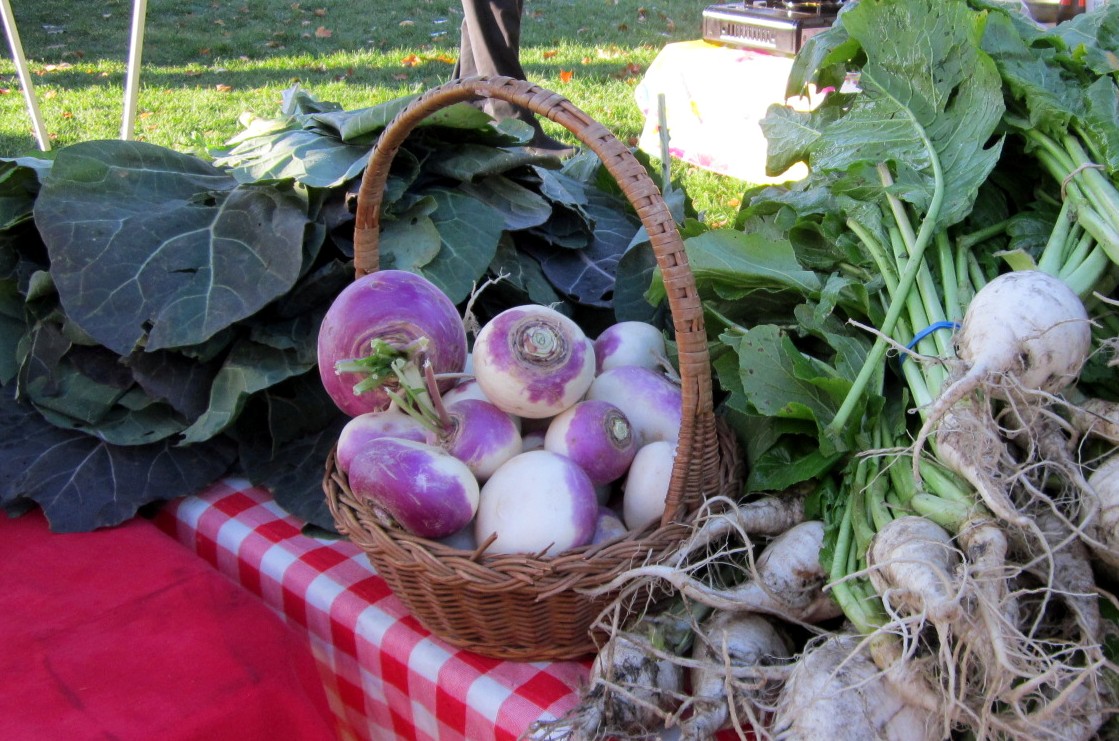
This market season, the Southeast Area Farmers’ Market will be a little easier to find. Jill Myer,our market partner from the Kent County Health Department (KCHD), wrote for a grant from theConservation Fund for $3,000.00 to help promote the market. KCHD also prints the market flyers, fundscoupons for fresh produce that can be used at the market and will staff various health related activitiesat the market throughout the season.
The lion’s share of those funds will go to the purchase of new signage for the market. One criticism wereceived about last years’ farmers markets was that “there didn’t seem to be much going on.” Part ofthat problem arose because the market had such inadequate signage.
Another reason the market didn’t always appear to be very busy was that people were walking to it
rather than driving cars. The OKT market management team sees this as a plus. The Southeast Area Farmers’ Market is designed to serve the immediate neighborhoods, not particularly draw in a lot ofoutside traffic.The new signage will include sandwich board signs, a banner and yard signs. If you would like to help outby placing a yard sign in from of your house on market days, contact Our Kitchen Table and we will beglad to provide one. You will also see us in the neighborhoods bringing handouts and information door-to-door. When we knock at your door, we hope you might have a few minutes to chat with us. After all,the Southeast Area Farmers Market is YOUR community market. Please help us to spread the word!
This is reposted from GRIID.org. OKT will be tabling at the celebration.
For the third year in a row, the Grand Rapids branch of the IWW (Industrial Workers of the World) will host its May Day celebration at Martin Luther King Park.
The celebration is a commemoration of the historic event known as the Haymarket Affair, which took place in 1886 in Chicago where the state engaged a brutal labor suppression that led to the execution of several labor organizers.
The May Day Celebration is also a way that working people celebrate their power as workers, build mutual aid between each other and resist the capitalist class, which will stop at nothing to expand their profits at workers expense.
This years’ event will include numerous information tables, a Really, Really Free Market, children’s activities, a community potluck and local live music from noon until 9pm. For a listing of the bands, check out the facebook event page. There will also be several people from the community speaking on a variety of justice issues between bands and several poets.
May Day Celebration
Saturday, April 28
Noon – 9pm
Martin Luther King Jr. Park
Corner of Franklin & Fuller in Grand Rapids
 The new Jim Crow Museum is now open to the public. The Museum features six exhibit areas — Who and What is Jim Crow, Jim Crow Violence, Jim Crow and Anti-Black Imagery, Battling Jim Crow Imagery, Attacking Jim Crow Segregation, and Beyond Jim Crow.
The Museum also offers a comprehensive timeline of the African American experience in the United States. The timeline is divided into six sections: Africa Before Slavery, Slavery in America, Reconstruction, Jim Crow, Civil Rights and Post Civil Rights.
The Jim Crow Museum at Ferris State University strives to become a leader in social activism and in the discussion of race and race relations. This new facility will provide increased opportunities for education and research. Please join us as we embark on this mission.
Regular hours are Monday thru Friday 12-5 p.m. and by appointment. To schedule a tour, please contact the museum at (231) 591-5873 or atjimcrowmuseum@ferris.edu. Please refer to the calendar of events for availability.
For more insight into the museum’s mision, read this 2010 GRIID.org post, Race, Race Relations, and Racism: Stories from the Jim Crow Museum.
 Mutual Aid GR is hosting a People’s Assembly on Radical Sustainability this Saturday as an alternative Earth Day event. The People’s Assembly will be a forum to discuss tactics, strategies and actions to take that call for systemic change and resistance to ecologically devastating effects of global capitalism.
People’s Assembly for Radical Sustainability
Saturday, April 21
11:00 AM – 3:00 PM
Trinity United Methodist Church
1100 Lake Dr. SE, Grand Rapids
The event is free and open to anyone who believes we need to take bold action against the current destruction of this planet and anyone who isn’t being duped by green capitalism.
Lunch and childcare is also being offered. For more information go tohttp://www.facebook.com/events/214450608656865/.
 Our Kitchen Table