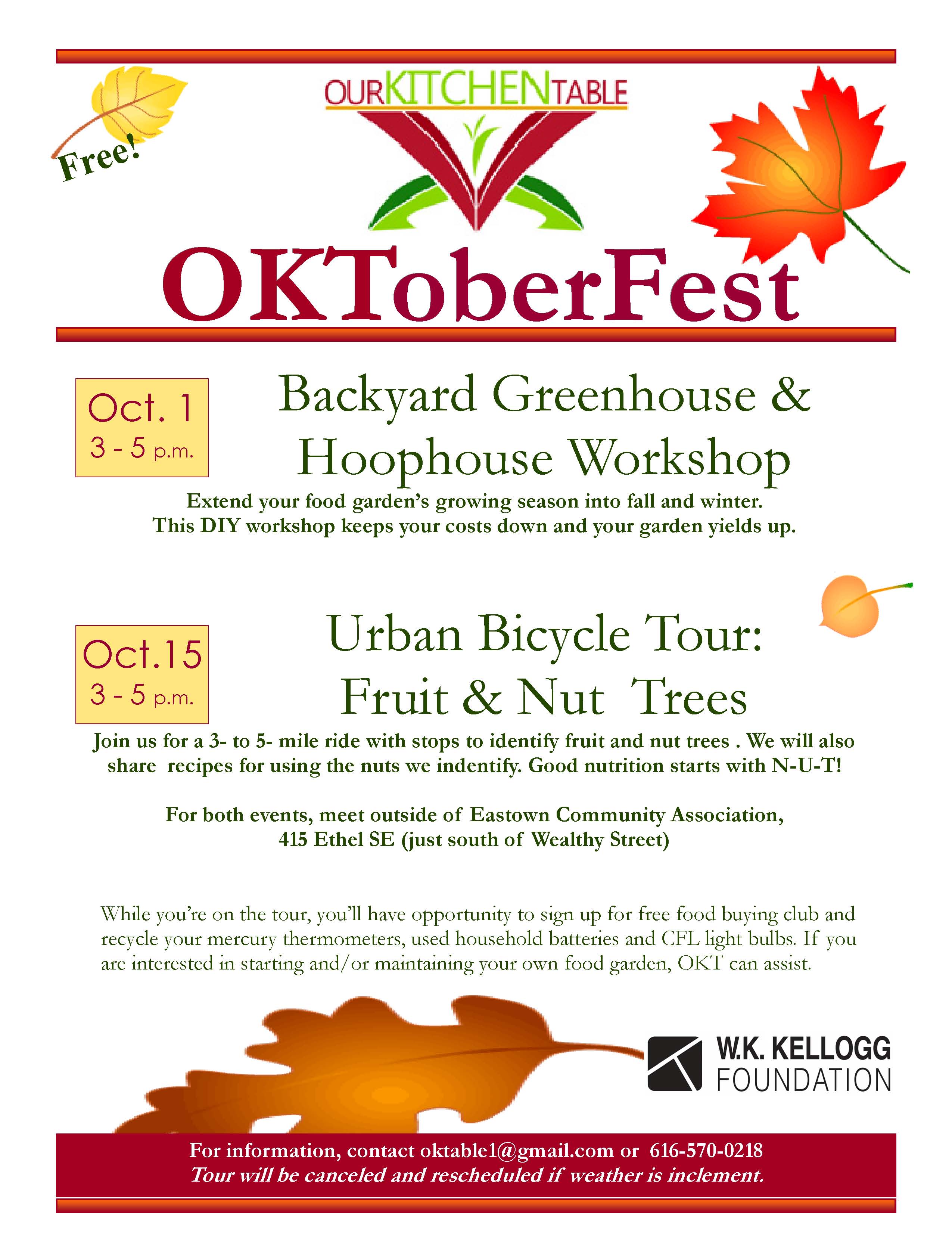
Saturday! DIY Backyard Greenhouse/Hoophouse Workshop

3 – 5 p.m. Saturday Oct. 1
Meet at Eastown Community Association, 415 Ethel SE

Our Kitchen Table invites you to extend your food garden’s growing season into fall and winter! This free, DIY workshop keeps your costs down and your garden yields up.

We will meet outside of Eastown Community Association, 415 Ethel SE (just south of Wealthy Street) and walk to the home of urban food gardener and our presenter, Taylor Voss.

Nobel Peace Prize Winner Wangari Maathai Dies at 71

This obituary reposted from Democracy Now

Wangari Maathai, the first African woman to win the Nobel Peace Prize, died Sunday after a long struggle with cancer. She was 71 years old. In 1977, she spearheaded the struggle against state-backed deforestation in Kenya and founded the Green Belt Movement, which has planted some 45 million trees in the country. She has also been an outspoken advocate for women’s rights and democratic development. She won the Right Livelihood Award in 1984. Twenty years later, she won the Nobel Peace Prize.

This writer posted the following Indy Media story after Maathai’s 2007 visit to Grand Rapids. 

Wangari Maathai at Fountain Street Church

“Every one of us needs ten trees to take care of the carbon dioxide we breathe out. We should know where our ten trees are. Or, are you using somebody else’s trees?” Wangari Maathai

2004 Nobel Peace Prize laureate, Wangari Maathai opened her lecture with observations on the biblical creation story as told in the book of Genesis. She noted that every day, after making another aspect of the environment, the creator commented, “It is good,” except for the last day, the day humanity was created. “We have convinced ourselves we are more important than the rest of creation,” Maathai said. “But, we cannot live without trees. They can live without us.”

Maathai believes that because we have higher intelligence, we have a moral responsibility to ensure that other species survive. She applied that belief in Kenya, where as a young biologist she was studying the tic’s role in East Coast Fever, a fatal epidemic killing hybrid cattle. Her fieldwork led her to observe that Kenya’s environment had been degraded. Because of deforestation upstream, fertile topsoil was filling the rivers as silt; rainwaters were washing away into lakes and the ocean instead of returning to groundwater reservoirs; and, rivers were beginning to dry up.

“This was much more dangerous than the tics,” she said.

Then, in 1975, her work with the National Council of Women of Kenya opened her eyes to the serious issues facing Kenya’s women: they did not have enough wood for household energy; they did not have clean drinking water; they did not have nutritious food; they had no ways to generate income. Maathai’s solution “Let us plant trees.”

“We went to the foresters and asked, ‘Can you teach us how to plant trees?’ This is difficult when the people are illiterate and a professional tried to teach you. To cut a long story short, we teach ourselves, use our common sense, our woman sense. Forget the foresters. We started teaching ourselves how to grow trees.”

Much of Kenya had been clear-cut; the British had introduced pines and eucalyptus that drank too much water and dried out the land. “We wanted to restore indigenous vegetation, biodiversity. It’s a campaign we are till carrying out,” she shared.

Maathai encouraged groups of women to plant trees “whichever way.” The women collected native seeds, planted them in all sorts of cast-off containers and nurtured the seedlings till transplanting them. The women earned money for each seedling planted, generating income for themselves. The new forests help provide wood for energy and stifle the erosion that has robbed farms of topsoil and rivers of clean water. The women taught other women how to be “Foresters without Diplomas.” Today, Kenya has more than 7,000 tree nurseries run by these women.

Though more than 30 million trees have been planted in Kenya, Maathai’s work is not done. When she began in the ’70s, 30% of Kenya was covered by forests. Only 2% is today. However, her work with the women became a catalyst for another change. As the women empowered themselves, and the people found their voices, many spoke out against Kenya’s dictatorial regime.

“If you do not live in a society that is democratic, that allows a minority voice to be heard, it is difficult to protect the environment,” Maathai said. “The freedom of movement. The freedom of assembly. The freedom of expression. The freedom of the press. You have all these freedoms. In a society like yours, you take for granted. When you are at their (the government’s) mercy, they are very pleasant. When you are free, you become troublesome.”

“To cut a long story short,” Kenya became a democracy in 2002; Maathai serves in parliament and as Assistant Minister for the Environment. But, she does not advise people to wait on their governments to take care of the environment.

“We can plant trees. Anybody can dig a hole. Plant a tree in that hole. Water it. Make sure it survives,” she said. “The government is the custodian of the environment. If the custodian is not doing his job, you fire him during elections.”

Today in Kenya, Maathai has undertaken a campaign to reduce the proliferation of plastic bags and packaging that is polluting Kenya’s cities, impacting its wildlife and creating an untold number of breeding puddles for malaria-infected mosquitoes. She is also working with the United Nations Environment Programme (UNEP) as Goodwill Ambassador for the Congo Basin Forest Ecosystem project–the goal, to plant one billion trees. She invited the audience to visit the Web site and get involved in the project. The Conga Forest, Amazon Forest and the South East Asian Forest are an important defense against the climate change that impacts all of us.

“It is the rich nations who really have to understand that, although the resources look like a lot around you, they are coming from people who are impoverished,” Maathai said. “Sooner or later, there will be conflict and it will affect us.”

9-17 Urban Foraging Workshop introduced shared skills

Last Saturday morning, a group of about 20 folks gathered at Garfield Park during the Southeast Area Farmers’ Market for an Urban Foraging Workshop, co-sponsored by Our Kitchen Table and The Bloom Collective.

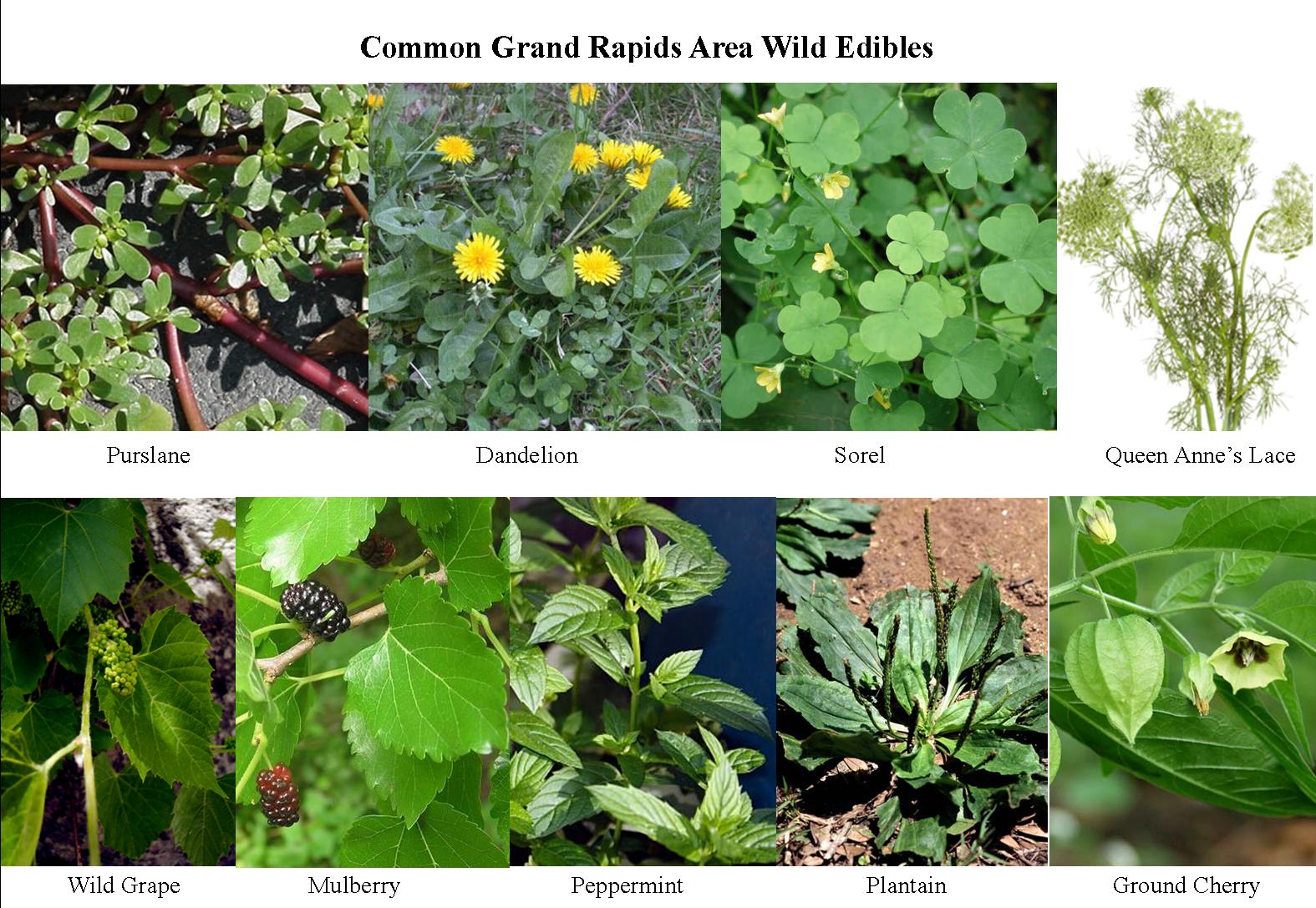
The presenter who was to lead the event had a family emergency so the workshop turned into a skill-share. People in attendance shared how they used various wild medicinal and edible plants (commonly called weeds). Here are a few of those:

  • Purslane—a delicious salad green
  • Dandelion – use as a salad green; brew as tea that for a good kidney tonic; use the root as a coffee substitute. The flowers are also edible.
  • Sorel – a lemony tart salad green.
  • Queen Anne’s lace – Deep fry the flowers; the seeds brewed as tea have traditionally been used as a contraceptive among indigenous peoples.
  • Wild grape and mulberry leaves – use to wrap rice and meat mixtures, think Middle Eastern cuisine.
  • Mulberries – a summer fruit that makes a great snack and a delicious jelly or jam.
  • Peppermint – brew as tea to settle an upset stomach; chew a leaf instead of a breath mint.
  • Plantain – the leaves can relieve insect bites and bee stings. Roll and crush the leaf, apply it to the sting, use a whole leaf as a “band-aid” to hold the crushed mixture in place.
  • Ground cherries – found inside the tomatilla like flower, these are a semi-sweet treat that can be used for jams and jellies as well.

We were also fortunate to have Kristin Tindall, ecology education coordinator from Blandford Nature Center, in attendance. She had lots of good information for the group and let us know that Blandford sometimes hosts foraging workshops.

Kristin also mentioned that a foraging club is forming. The club will be able to provide an ongoing shared experience that will help members to broaden their skills for finding foods and medicinal herbs in their backyards, local parks, parkways and abandoned lots. Kristin also shares this Wild foraging handout.

A word to the wise: When foraging, make sure you are picking plants from an area that has not been chemically contaminated. For example, Tindall shared that utility companies usually spray a swath of herbicides under electricity towers.

Just like the grocery stores have helped us forget that food comes from farms, cultivation of domestic crops has helped us forget that many of the native species we see around us (and label as weeds) once were a prize source of both food and medicine. Let’s learn how to take advantage of the free foods growing all around us.

Baxter Community Center’s new greenhouse will sprout healthy food options for Grand Rapids neighbors

This post is from Rapid Growth Media’s 9-22-2011 edition

OUR KITCHEN TABLE IN THE NEWS

About the time their summer vegetable gardens are just a fond memory to most Grand Rapids gardeners, the Baxter Community Center will be setting up its first year-round gardening environment in its new heated greenhouse.

The 1,060-square-foot greenhouse is the latest addition to Baxter Community Center’s ongoing efforts to bring fresh produce and budget-friendly foods to a neighborhood classified by the Public Health Department as a “food desert,” a place lacking sources of easily accessible foods and fresh produce. Construction began Sept. 6 and the greenhouse will be completed by the end of November.

“We’re working to set up holistic support for our neighbors, and the greenhouse will be a learning space to teach people how to garden and to provide starter plants for them to use,” says Melanie Beelen, executive director. “Our partners in the program are the YMCA and Our Kitchen Table — the Y will focus on teaching nutrition, youth gardening and exercise; Our Kitchen Table will work with neighbors to provide one-on-one support for their home gardens.”*

The greenhouse learning experience ties in with Baxter’s onsite community garden where neighbors plant and grow food for their families. And it will have a direct connection with Around the Table, a program that teaches people how to cook fresh produce now and preserve some of it for later use through canning. That program, in turn, works hand-in-hand with Double Up Food Bucks, which teaches people how to get more for their grocery dollar.

*Note from OKT: OKT is also planning on using the greenhouse to plant starter plants for home gardeners, community gardens and communal gardens in our four target neighborhoods: SECA, Eastown, Garfield Park and Baxter. Last year, we grew 20,000 starter plants for distribution in donated space within two private greenhouses.

. . .
Writer: Deborah Johnson Wood, Development News Editor

Dennis Livingston, activist and artist, dies

We are posting this obituary by Jacques Kelly from Baltimore Sun to recognize the great influence and inspiration that Mr. Livingston provided as a mentor to OKT’s executive director, Lisa OLiver King.

An early voice for urban jobs creation, he was a pioneer at Station North Arts District’s Cork Factory.

Dennis Livingston, an urban activist who called for jobs creation and a clean environment and who was a pioneer in the Station North Arts District near Green Mount Cemetery, died of cancer Thursday at Gilchrist Hospice Care. He was 72 and lived onGuilford Avenue.

“There were those who came out of the 1960s who lost their vision for social change, but Dennis was not one of them,” said Joseph McNeely, director of the Central Baltimore Partnership. “He just stayed there and said we can do better. He kept finding new places in Baltimore to insert his vision.”

Born in Chicago and raised on Long Island, N.Y., he attended Washington College and received a bachelor’s degree and master of fine arts degree from Ohio University in Athens. Friends praised his woodcuts of Baltimore as well as his pen and ink sketches. He also headed a business, Social Graphic Co., where he designed and published books and manuals.

He was active with the Black Panthers in the 1960s in Washington and with Abbie Hoffman in the Yippie movement.

Friends said Mr. Livingston was a highly skilled carpenter. After moving to Baltimore nearly 40 years ago, he founded South Baltimore Woodworkers, a contracting business. He renovated homes in Federal Hill and around Patterson Park. He also helped build the first Pride of Baltimore.

“Dennis worked without fanfare and was one of the most principled persons I have ever met,” said a friend, Michael Seipp, who lives in Lauraville. “He had a credo. He believed in democracy and for the guy on the bottom. He believed strongly that everyone should have the opportunity to lead a quality life.”

He formed the Baltimore Jobs in Energy Project to train low-income residents to get jobs in weatherization, energy conservation and, in later years, lead-paint abatement.

“He was always happiest wearing a tool belt or designing a graphic presentation of complex ideas,” said Ron Halbright, a co-worker at Jobs in Energy. “Dennis was a unique combination of community, environmental and labor visionary, hands-on master carpenter and trainer and day-to-day neighborhood activist.”

In the 1980s, Mr. Livingston was also a vice president of South Baltimore’s Coalition of Peninsula Organizations and backed a plan to build affordable co-operative housing along Riverside Avenue.

“He believed, early on, we can rebuild our economy by retrofitting buildings to save energy,” said a friend, Tom Chalkley, a cartoonist and social organizer. “He lived an unbelievable full life. He … wasn’t afraid of anybody.”

Friends said Mr. Livingston observed that Baltimore artists were renting unfinished loft studios in old industrial buildings near Pennsylvania Station. About 15 years ago, he and others spent $200,000 for a rundown former division of the Crown Cork and Seal Co. at Guilford Avenue and Federal Street. They called the structure the Cork Factory. He was a leader of its conversion into apartments.

Mr. Livingston also became an advocate for low-income residents living in the Greenmount West neighborhood adjacent to his home.

“One way is to get rid of the poverty,” he told a City Paper reporter in 2003. “The other is to get rid of the people.”

Friends said that he constantly reminded city officials of the importance of keeping housing affordable and livable for the residents there.

“When Dennis believed in something, he went all the way,” said a friend, Mylo Celsy, director of the Baltimore Trades Guild.

Mr. Livingston has been a member of the United Brotherhood of Carpenters and Joiners since 1972. He had served on the boards of directors of the Loading Dock, Baltimore Employment Network, Maryland Citizen Action, Women Entrepreneurs of Baltimore and South Baltimore Home Maintenance Program.

“Dennis brought incredible energy, joy and creativity to anything he did, whether it was politics, art or just family dinners. He turned the chore of wrapping Christmas presents into an opportunity to be creative. … On Christmas morning, it looked like a sculpture garden under our tree,” said his stepdaughter, Timi Gerson of Washington.

Southeast Area Farmers’ Market looking forward to busy fall

Now that school is back in session, the Southeast Area Farmer’s Market Gerald R Ford Middle School location  will remain open–but for fewer hours.  Beginning Sept. 9, this location will be open from 5 p.m. to 7 p.m., so as not to interfere with school traffic and activities.

August was a grand month for this location. During the four dates the market was open, we counted a total of 310 customer visits.  That means a lot of healthy food is making it into our neighborhoods’ kitchens. A big thank you to all those who came to the market! Thanks for telling  your friends and neighbors. Another big thank you to The Grand Rapids Times!  The column they have been running about the market has been instrumental in spreading the word.

The Southeast Area Farmer’s Market’s two locations distributed 137 Double Up Food Bucks tokens to our customers. These customers doubled the amount of produce they received for the amount they spent. It’s not too late to take advantage of this program. If you shop with an EBT card, you will receive a $2 token for every two dollars you spend—up to $20 in tokens each time you visit.

The markets also honored $225 worth of Kent County Health Department and Project Fresh coupons. If you have any of these coupons, bring them in before it’s too late!

The Southeast Area Farmer’s Market Garfield Park location is open Saturdays 9 a.m. to 1 p.m.  Both farmers’ market locations will be open through November 6.

Food Charity or Food Justice: Part II

(Another thought provoking post from GRIID.org)

SEPTEMBER 16, 2011
by Jeff Smith (GRIID)

Last week we pointed out the problem with local journalists in their attempts to try to live off a fixed food budget as part of the Hunger Challenge Week in Grand Rapids.

We pointed out that their investigation should have focused on looking at the causes of hunger in West Michigan, instead of engaging in an exercise that, while well intentioned, did not actually look at addressing hunger.

Today, MLive ran a story about a local program that addresses hungry children, called Kids Food Basket. In that story, both the director of the organization, Bridget Clark Whitney, and board member Mary Ann Prisichenk both make statements that the organization is not interested in politics or the causes of poverty……..they just want to feed hungry kids.

Whitney is quoted as saying; “There are a variety of socioeconomic factors that come into play with kids and hunger, but … the bottom line is that kids need to get fed. What we say we will do — and we are doing — is attacking hunger.”

Attacking hunger is the agency’s catch phrase, which can be seen on its website over and over again. The agency acknowledges that hunger and poverty are a problem in the Grand Rapids area, citing the statistic that “36,860 children living in Kent County are food insecure.” The charity agency also noted that, “From 2000 to 2008, Grand Rapids had the largest spike in poverty among any US city at 8.9%.”

In the “why” section of their website the agency also states that nutrition is the basis of brain development and Childhood hunger is a national priority that must be addressed at the grassroots. Both of these statements are important, but it is the latter, which I think it is important to address.

First, let me just state upfront that the fact that Kids Food Basket feeds hungry children is important in that it does a form of triage work, where an immediate need is met. However, if our community is serious about attacking the problem of hunger, it is essential that we get the root of the causes of why 36,860 children in Kent County don’t have enough healthy food to eat.

Every year there are major food drives in this city. People through churches, businesses and non-profits donate food for the food bank system. Thousands of people volunteer at the soup kitchens and deliver meals to shut-ins and other vulnerable populations, along with the kind of work that Kids Food Basket does. These activities can help put a human face on hunger and often will make us feel good that we in some small way made a difference.

However, if we never get to the point of asking the question of why 36,860 children in Kent County don’t have enough to eat on a daily basis, then we are ultimately doing them a disservice. The number of children in poverty is clearly on the rise and there is no sign that this trend with change. In fact, it is likely that the number of children living in poverty and going hungry will increase, since at the local, state and federal level there are ongoing funding cuts for social programs and a drum beat from politicians on the need to implement further “austerity measures.”

If attacking hunger means that we just feed hungry children then we might as well just plan on doing this the rest of our lives and finding a whole lot more people to do it with us. If, however, we want to end hunger then we will have to look hard at both our economic system and who has wealth in this society. As Raj Ratel and many others in the food justice movement will tell you, the current food system and economic system are designed in such a way that lots of people will be malnourished.

We need for the people at the Kids Food Basket to keep feeding hungry children, but we also need for them and all the other agencies, which do food charity work, to begin to come to terms with the causes of childhood hunger. Once we have collectively wrapped our heads around those causes we can then develop a strategy to really attack hunger by eliminating it.

Some of this strategy might include challenging the existing system of food production in the US knows as agri-business. In this system food is grown as a commodity to be traded and not as a form of sustenance for all people.

One way to take on the agri-business system would be to have a real grassroots effort to alter federal funding it what is known as theFarm Bill. More importantly, we need a mass movement to take food production out of the hands of corporations and into the hands of regular people.

In order for these more systemic changes to take place we need to have a serious public conversation about hunger and food justice. If then, we are serious about eliminating hunger in our community we need all those who do the food charity work to support and endorse food justice work. Food justice work may not be as popular and it is in many ways work that is much more difficult to do. In fact, we can count on systems of power that will resist those efforts, but I for one think it is a much nobler goal to end hunger than to perpetuate its existence because we didn’t ask why people were hungry. As the great Brazilian Bishop Dom Helder Camera once said, “I brought food to the hungry and people called me a saint. I asked why people were hungry and people called me a communist.” 

Urban Foraging Workshop Saturday

This post first appeared on GRIID.org Indy News

Urban Foraging Workshop
10 a.m. to noon
Sat. Sept. 17

Garfield Park,
Madison & Burton SE

Look for the Farmers’ Market Tents!

Our Kitchen Table and The Bloom Collective are sponsoring an Urban Foraging Workshop from 10 a.m. to noon this coming Saturday, Sept. 17, during the Southeast Area Farmers’ Market at Garfield Park.  Just like the grocery stores have helped us forget that food comes from farms, cultivation of domestic crops has helped us forget that many of the native species we see around us (and label as weeds) once were a prize source of both food and medicine.

The Southeast Area Farmers’ Market has already held two presentations with two area master gardeners who shared which common plants growing in our yards, parkways and abandoned lots can be used as food. One of these presenters, OKT’s Yvonne Woodard, who is also the market master for this farmers’ market, will share again this Saturday. In addition, anyone who comes to the workshop with knowledge of foraging will be invited to share their skills with the rest of those attending.

The economic climate continues to push working class people into poverty. In addition, Gov. Snyder’s  so-called “austerity” measures like the 48-month cap on welfare eligibility will push many of our neighbors who are already poor to the point of starvation.  Did you know that on October 1, an estimated 40,000 Michigan residents will be cut from the welfare rolls by this measure? In addition, on average, each of these people support two children in thier households. In other words, an additional 80,00o Michigan children may soon be going hungry.

While organizations like Our Kitchen Table continue the good fight for food justice and food security in our urban neighborhoods, the fight will not be won in time. So, let’s learn how to grow and share our own food and take advantage of the free foods growing all around us.

OKT supports local Fair Food initiative

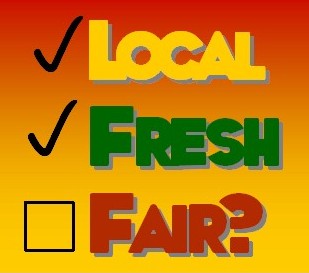
If you’ve been to the Southeast Area Farmers’ Market or an OKT event, we may have  asked you if you wanted to sign the petition supporting the Local Fresh Fair Fair Food initiative. Here’s some information on the OKT-endorsed  campaign, adapted from the Fair Food campaign brochure.

At your favorite restaurant, you ask the waiter, “Do you happen to know if the vegetables in this dish are grown locally?”  While perusing fruit at the grocery store, you find yourself wondering, “Just how fresh are these apples?”  The  local folks promoting the Fair Food campaign think these questions are important.

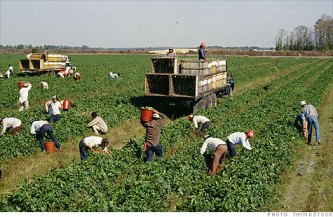
Buying local, fresh food is a critical part of living a healthy, sustainable life.  However, something missing in the discussion. Have you ever thought about the people who provide the produce you buy and eat?  The ones who plant it, care for it, and harvest it?  Unfortunately, far too many people have never asked if the fresh, local fruits and vegetables they eat are produced fairly.

The Michigan Civil Rights Commission released a report in 2010 on the conditions of seasonal and migrant workers in Michigan showing that workers face unfair pay and recruitment practices, inadequate housing, unsafe work environments, discrimination, and limited access to healthcare, education, and childcare.  The conditions that the MCRC found were appalling, and the folks at Fair Food refuse to accept them.

Migrant work is a complicated issue.  It is influenced by factors including politics, globalization, the migration of people, agricultural labor practices and standards, and capitalism.  However, Fair Food believes that everyone deserves just working conditions, no questions asked.  Nothing can be truly sustainable if it is based on the exploitation of others’ labor.

Fair Food calls on you as consumers, as business owners, as people, to examine the way you think about your locally grown food.   Can you feel right about enjoying a head of lettuce or pint of blueberries if you know that the people who picked them may not have had access to safe drinking water or toilets while they worked?  Or that they were too afraid to make a complaint because they did not want to lose their jobs, and they did not even know their rights as workers?

It is up to you to hold growers and the businesses who buy their products responsible for the food you bring into your home.   The next time you’re
craving some fruits or vegetables, don’t forget to check off not only fresh and local, but also fair.

Fair Food Standards

  • Farmworkers should get paid a livable wage for their work and receive at least the federal minimum wage.  Currently farmworkers are excluded from the federal minimum wage laws, which includes overtime pay requirements.
  • Farmworkers should not be subjected to forced labor or debt bondage.
  • Farmworkers should have access to educational information about their rights as workers under the law in both English and Spanish.  When necessary, translation should also be provided for those whose first language is indigenous.
  • Farmworkers should have access to clean water for drinking, bathroom facilities, and regularly scheduled breaks that follow federal standards.
  • Farmworkers should not be exposed to pesticide application while working in the fields, should be provided proper protection gear when coming in contact with pesticides and should be provided full disclosure (in English and Spanish) when they are working with produce that has been sprayed with pesticides.
  • Farmworkers should be provided just and adequate housing conditions when that is part of the worker contract. Farmworker housing should always be voluntary for workers and not required by employers.
  • Farmworkers should not be intimidated or harassed when attempting to organize fellow farmworkers. The right to form a union should apply to
    farmworkers. All agricultural employers must provide a mechanism for workers to file any grievances related to the work or working conditions.
  • Federal Child Labor Law should be observed unless the children working on the farm are family members of the farm owner.
  • Farmworkers should not be harassed, intimidated or discriminated against based on their gender, ethnicity or immigration status.

You can learn more about this local campaign at http://www.localfreshfair.com.