Should we keep our trees?

Reposted from Grand Rapids Urban Forest Project

Our community has set firm goals for tree canopy. Green Grand Rapids, the City’s Urban Forest Plan, Climate Resiliency Plan, and the Sustainability Plan all highlight the City’s 40% tree canopy goal. It’s not just an arbitrary number to be aimed for; it’s become a symbol of Grand Rapids sustainability and environmentally-minded culture. Trees are part of our community fabric and we want more.
The City has made significant strides in planting and retaining trees. Since 2010, the City has had an aggressive tree planting program that has resulted in thousands of new trees alongside our streets. Partially funded by grants, these tree plantings are projected to accomplish near 100% stocking of street trees in the next three to five years. In other words, the City hopes to have the majority of available spaces for street trees planted with a tree in the near future.

However, the City of Grand Rapids has purview over only a small percentage of the city’s land area. The major opportunities for canopy retention and expansion are on private lands. In Grand Rapids, trees on residential properties are afforded little protection. In some cases, trees may be retained or planted as part of development or construction, but more often than not landowners are free to remove trees – however large or healthy – as they see fit.

Recently, a series of issues have caught the attention of residents within our community. Several large, healthy trees have been removed from properties in connection with some form of site improvement or development. While the issue has been granted recent attention, removals such as the recent ones are by no means an isolated occurrence. Trees are frequently removed or abused because it is easier than the alternative and their individual values are not always well recognized – even if our community has stated in multiple documents and strategies that a larger tree canopy is a desire. As neighborhoods continue to be presented with new development opportunities and investment, it is likely that we will experience more tree loss–a loss that is counterproductive to our community goals.

Other cities have addressed this issue in a variety of ways. The Alliance for Community Trees suggests that protecting large “heritage” or “landmark” trees is a best practice for tree conservation nationwide. Recognizing these trees and their contribution to the community is imperative to developing a comprehensive urban forestry program…. READ MORE

East Hills Tree Inventory

Our city has been named Tree City USA by the Arbor Day Foundation 13 years in a row for its dedication to urban forestry. Grand Rapids earns this honor by being home to a community that loves and respects trees. Friends of Grand Rapids Parks offers many opportunities for volunteers to show their dedication to this cause and this July you have a chance to join us as we take part in an international study of urban forest science!

Several years ago, East Hills performed an inventory of ALL of their public trees with the assistance of Bartlett Tree Experts. More recently, national efforts have led to a standardization of tree monitoring protocol. Grand Rapids has been lucky to be included in some of the first testing of the applications of these protocol.

In July, we’ll be joining a list of other great cities such as Chicago, Philadelphia, Washington D.C. and several in Sweden in testing and applying this protocol in real life scenarios. You can lend us a hand and become a part of this exciting effort.

We are currently looking for 12 to 20 volunteers to help us update the East Hills Tree Inventory using the new tree monitoring protocol. Volunteers will work in groups of two, and sign up for shifts of approximately 100 trees (~2.5 hours). You’re welcome to sign up for one shift, or five depending on your level of interest and availability. We will do everything we can to provide shifts that fit into YOUR schedule.

Experience is not required!!! Prior to inventory, volunteers will participate in a mandatory training on July 10th from 5:30p – 9:15p. Training will take place at WMEAC Headquarters (1007 Lake SE). A light supper will be provided. Participants must also have completed FGRP’s Tree ID course OR schedule a time to review tree ID with FGRP staff prior to working on the inventory project. Training will begin promptly at 5:30p.

We need your help! To sign up, or get more information please contact Lee Mueller (lee.mueller@friendsofgrparks).


FGRP Mini Grants

Does your neighborhood need trees? Have a great idea to bring attention to trees on your street? Friends of Grand Rapids Parks is happy to provide tree-related mini-grants on an on-going basis. These grants have funded projects like community fruit tree orchards, tree plantings, tree celebrations, tree walks, and tree care supplies.

Grants are available to any community-based organization. You can be a block-club, formal neighborhood organization, church, or just a group of neighbors who want to do some good in the community. Getting a grant is easy. First, you fill out a mini grant questionairre. Make sure you’re associated with a group or have several neighbors involved in the process. Once complete, you submit the grant to Lee (lee.mueller@friendsofgrparks.0rg). An FGRP committee will review the grant and determine if any changes are necessary. Once approved, you’ll work with FGRP to make your grant a success!

  • Grants can be used for up to $1,000 in funds for tree-related projects or to plant up to 20 trees. Here’s some examples:
  • Living Green in Creston – $500 was awarded in 2012 to aid in the maintenance of Creston’s fruit tree orchards.
  • Heart of West Michigan United Way – $600 was awarded in 2013 for the promotion and support of the Reforest Riverside Arbor Day Planting.
  • DA Blodgett / St. Johns – 20 trees were provided in 2012 for grounds improvement and canopy replacement following the loss of Ash and Austrian pine trees at DA Blodgett/St. Johns.
  • Site:Lab – 10 trees were provided for an out-door installation/demonstration of green space at the 2012 Art Prize Site:Lab installation.
  • Ottawa Hills Neighborhood Association – 17 trees were provided in 2013 to fill empty spaces between the sidewalk and the street.
  • Butterworth / Straight – 4 trees and funds were provided in 2014 to remove concrete, create new tree pits, and expand growing space for trees in this business district.

Please contact Lee Mueller (Lee.mueller@friendsofgrparks.org) if you are interested. For fall projects, mini-grants will be due by August 15.


Stop by Southeast Area Farmers’ Market Friday & Saturday!

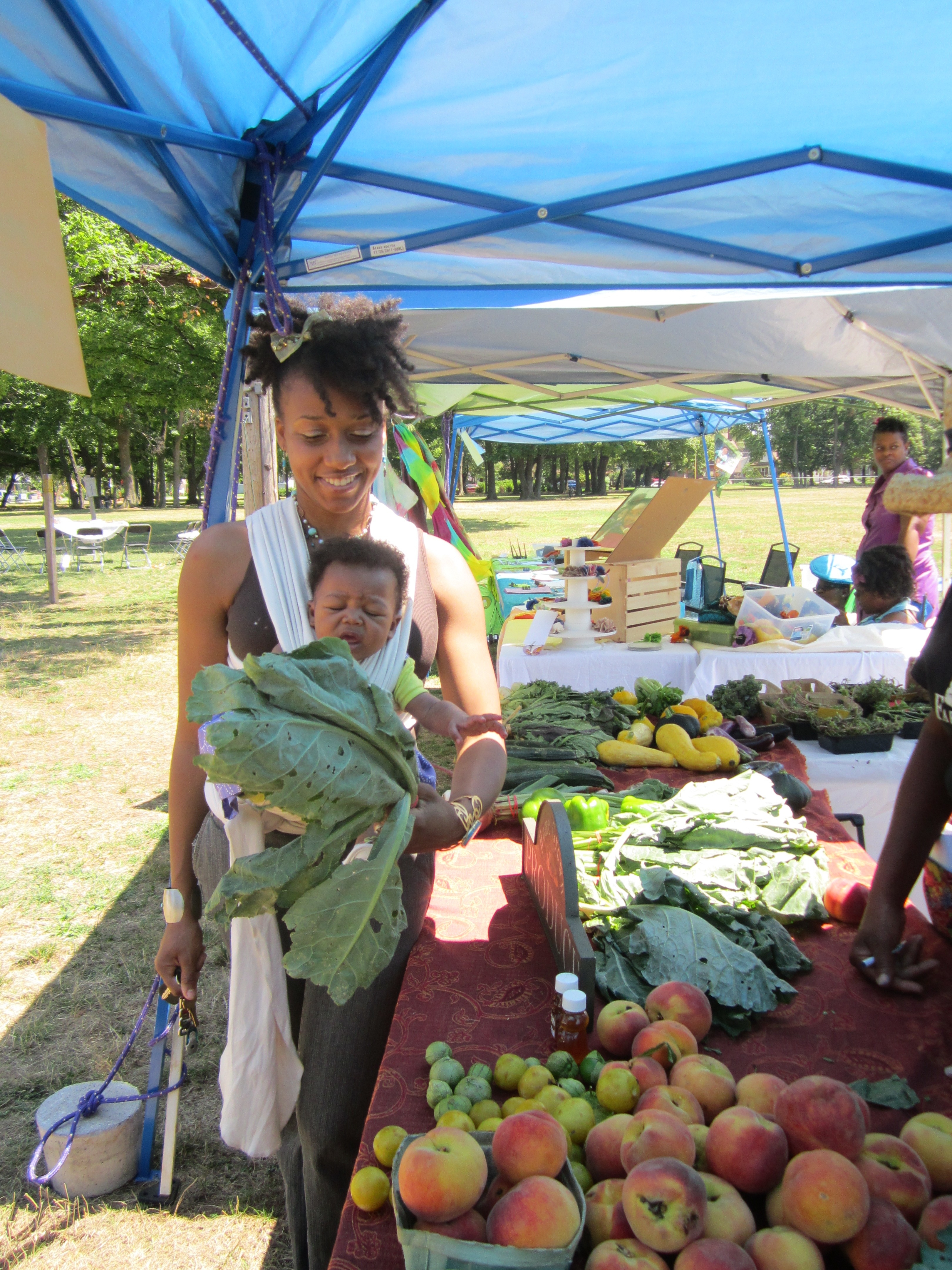
SEAFM logoThe market is up and running! Market manager, Dorothy Griswold, notes that three vendors–Real Food Farms, Ms. Yvonne Woodard and Blandford Farm–will be on hand selling lettuces, kale, kohlrabi, scallions, tomatoes and summer squash.

Southeast Area Farmers’ Market operates on two days at two locations:

  • Fridays, 3 to 7 p.m. at Garfield Park, Burton Street and Madison Avenue SE.
  • Saturdays, 11 a.m. to 3 p.m. at Gerald R Ford Academic Center, Madison Avenue just south of Franklin Street SE.

Both market sites accept SNAP/EBT, Double Up Food Bucks and WIC & Sr. ProjectFresh as well as cash and debit cards.

“Anthropology News” publishes article about OKT

anOKT collaborative partner, Dr. Christy Mello, submitted this article to Anthropology News

Civil Rights, Food Sovereignty and Activism: Our Kitchen Table’s Food Diversity Project

An activist organization named Our Kitchen Table (OKT) confronts the structural racism responsible for the food insecurity, environmental health issues, and gentrification inequitably impacting the African American and low-income residents of Southeast Grand Rapids, Michigan. As a group of women living in or having ties to these neighborhoods, members of OKT created the Food Diversity Project, a cooperative food-growing model in which members educate participants about the root causes of these problems. It is a community-led advocacy project that involves other activists, utilizes popular education activities, analyzes public policy, and mobilizes citizens to network as backyard and community gardeners. By sharing my observations of power relations in the city, I assist OKT with project development and policy analysis. My study of power reveals how non-profit groups and economic developers are further gentrifying the Southeast neighborhoods in the name of food security. These initiatives do not address the actual reasons responsible for food insecurity, one being poverty. Instead, they offer Band-Aid solutions. Members of OKT, on the other hand, who are influenced by those who participated in the War on Poverty during the Civil Rights Era, deal with the systemic causes of poverty by implementing long-term solutions to food insecurity.

OKT typically consists of six to eight women concerned with food sovereignty, reducing health disparities, community activism, and politics. Drawing upon their members’ expertise, OKT organizes in response to local individuals interested in building toxic-free neighborhoods and a self-sustaining food system. To achieve this objective, in 2008, OKT began facilitating a social network of household and community gardeners who share their excess harvest and resources and teach others how to grow food. They refer to this capacity-building model as the Food Diversity Project. One of its major goals is to reduce the high rates of food insecurity—defined as little to no access to fresh, healthy, culturally appropriate, or affordable food—as experienced by residents living in the Southeast.

Gentrification

A major facet of the growing popularity of the local food movement in Grand Rapids is concern over food insecurity. This is due to the fact that Grand Rapids is a mid-size city now in rebirth after the 2007 onset of the housing market crisis in the United States and the 2008 global financial crisis. To improve the economy, business stakeholders began to advertise Grand Rapids as being a destination spot offering cultural popular activities, locally owned businesses, and locally made products. Local food is central to this growing cultural identity. The Southeast has become an inviting place to entrepreneurs who are buying up cheap foreclosed housing and vacant buildings, as well as starting new businesses. They refer to this gentrification as “urban revitalization.” Much of it is being done in the name of building food security via the local food movement. Nonetheless, the current residents continue to be negatively affected by economic decline and face serious health disparities resulting from an industrial legacy and high rates of food insecurity.

OKT’s Food Diversity Project contends with the fact that Grand Rapids is a rapidly gentrifying city. For this reason, as a consultant, I teach a food history class in order to educate about the level of inequality attached to different subsistence strategies and how this relates to the political, social, and economic organization of societies. This is my basis for explaining the insidious ways that power manifests itself in the Southeast neighborhoods. Overall, my power analysis illustrates neoliberalism in practice, the privatization of public amenities. For example, where neighborhoods are undergoing rapid gentrification, food security projects, most often based on providing local food, are increasingly present. Stakeholders are receiving public and private funding based on university and privately collected data on food insecurity. The city has provided taxpayers’ dollars to non-profit organizations that coordinate these ventures with community development corporations and businesses. Some of these non-profit organizations even include representatives from large corporations and banks. The city has also gifted a few of these groups with vacant lots and homes in exchange for maintenance work to public amenities such as sidewalks and streets. Stakeholders are not attempting to solve food insecurity but are, instead, using these resources for new businesses or initiatives that improve business zone corridors and that build or rehabilitate housing in poor communities. This is a type of structural racism that is intensifying the ongoing gentrification.

Structural Versus Band-Aid Solutions to Food Insecurity

Local food projects, designed by non-profit organizations, are often apart of economic development initiatives and evade grassroots community building efforts that have the potential to directly address the structural inequality of poverty. These top-down initiatives do not create long-term solutions led by those who are directly impacted by health and economic disparities. Local food activists in Grand Rapids acknowledge the fact that what is of significance for these organizers may be of no consequence to those who are poor. These outsiders’ attempts are often paternalistic in that they target individuals whom they see as socially disadvantaged to make changes, for example, by eating healthy to prevent diabetes. These local food initiatives’ approach to food insecurity drastically differs from that of OKT members and affiliates who are inspired by the Civil Rights Era, as well as other movements for justice. Due to these influences, OKT’s neighborhood-based local food project addresses food insecurity by accounting for the causes of poverty rather than passively accepting them and focusing solely on individual behavior. OKT aims for long-term structural change.
Capacity Building ActivitiesOKT’s Food Diversity Project, in part, draws its inspiration from the Black Panther Party (BPP), who realized during the Civil Rights Movement that people are unable to fight injustice if their need for food is unmet. OKT has hosted events in which individuals reference the work of the BPP. They discuss the fact that the Black Panthers offered a Free Breakfast for Children Program, the first of many Survival Programs, in inner city areas as they educated about how capitalism is the cause of social injustice. Similarly, OKT provides support for food growers while teaching them how to be agents in shaping social change. Participants collectively build their own capacity through resident-led activities in which they learn how growing their own food challenges the inequality impacting their livelihoods, supplements income, and has health benefits. First, the raising of consciousness must occur for people to learn the historical, economical, and political context for their poverty and lack of food security. This is why OKT has me share my observations about power dynamics and how they are directly related to capitalistic enterprise. Thus, the Food Diversity Project takes an interactive popular education approach for explaining the relationship between economic and health disparities with social injustice.

The goal of popular education, a model developed by Paulo Freire, is to develop peoples’ capacity for social change through a collective problem-solving approach and critical analysis of social problems. The Food Diversity Project’s application of the popular education method involves several capacity-building activities related to promoting food security, avoiding exposure to lead in the soil, and education on sustainable subsistence activities. Interactive workshops provide education on canning and seed saving, composting, starting plants from seeds, organic growing methods, growing winter crops, and selecting seeds for plant diversity. Walking and bicycle tour workshops are organized around both household gardens and naturally growing food in the neighborhoods. During these tours, examples of topics include lead in the soil; herbal gardening for health and culinary purposes; and urban foraging for edible fruit, nuts, and weeds that grow in public spaces within the city. Cooking demonstrations are another type of workshop, in which peer educators prepare food with both familiar and unfamiliar types of locally grown produce. Workshops encourage gardeners to grow and share food, and diversify their gardens. OKT also gives away plants, hosts a farmers’ market, and partners with schools for gardening with the youth.

During many of these capacity-building activities, conversations center on critical topics as they relate to social inequality and food justice. For instance, attendees discuss different land use policies such as those that support growing local food and those that facilitate the gentrification occurring in the city. Members of OKT also make a point to appreciate the benefits and importance of food sovereignty, evident in the aforementioned list of activities. This concept can be understood as citizens having democratic ownership over the production and consumption of food. Moreover, it involves conserving the Earth’s resources for future generations by planting heirloom seeds to maintain biodiversity, preserving cultural knowledge around growing food, and not using chemicals that poison the land, air, water, and living species.

The Food Diversity Project has a deeply ingrained food justice perspective for challenging power through encouraging people to grow their own food in a sovereign fashion. OKT advocates for the collective stewardship of our environmental resources and contests the private enterprise gentrifying the Southeast in the name of food security. Neoliberalism is evident in that the city is privatizing public amenities. This type of unregulated capitalism is responsible for the gentrification and reinforcement of the health disparities that are affecting residents. Following the concept of social justice developed during the Civil Rights Era, as well as other social movements, OKT developed the Food Diversity Project for practicing food sovereignty in lieu of this injustice.

Christy Mello is a visiting assistant professor of anthropology in the department of anthropology and sociology at the University of Southern Mississippi. She specializes in applying anthropological methods for supporting activist groups that address food and environmental injustice. She is currently a consultant for the activist group, Our Kitchen Table.

This entry was posted on June 23, 2014, in Policy.

Southeast Area Farmers’ Market season starts today!

The Southeast Area Farmers’ Market season runs from today through November 8.Tolberts SEAFM 11-8

  • Fridays, 3 to 7 p.m. at Garfield Park, Burton Street and Madison Avenue SE.
  • Saturdays, 11 a.m. to 3 p.m. at Gerald R Ford Academic Center, Madison Avenue just south of Franklin Street SE.

Both market sites will feature local, chemical free produce and accept SNAP/EBT, Double Up Food Bucks and WIC & Sr. ProjectFresh as well as cash and debit cards.

We hope to see you there!

Groups Appeal to UN for ‘Humanity’ as Detroit Shuts Off Water to Thousands

Photo from Food & Water Watch

Reposted from Common Dreams

As thousands of people in Detroit go without water, and the city moves to cut off services to tens of thousands more, concerned organizations have taken the unusual step of appealing to the United Nations to intervene and protect the “human right to water.”

“After decades of policies that put businesses and profits ahead of the public good, the city now has a major crisis on its hands, said Maude Barlow, founder of Blue Planet Project and board chair of Food & Water Watch, in a statement. “By denying water service to thousands, Detroit is violating the human right to water.”

The Submission to the Special Rapporteur was released Wednesday by the Detroit People’s Water Board, the Blue Planet Project, the Michigan Welfare Rights Organization and Food & Water Watch.

It calls for the “state of Michigan and U.S. government to respect the human right to water and sanitation” and for shut-offs to be halted, services restored, and water to be made accessible and affordable.

The report comes on the heels of the Detroit’s city council’s Tuesday approval of an 8.7 percent increase in water rates, part of a long-standing trend that, according to Food & Water Watch, has seen prices increase 119 percent over the past decade.

This rate hike follows an announcement in March by the Detroit Water and Sewerage Department that it would start turning off water for accounts that are past due.  According to a late May Director’s Report from the DWSD, there were “44,273 shut-off notices sent to customers in April 2014” alone, resulting in “3,025 shut-offs for nonpayment, and additional collections of $400,000.”

Emergency Manager Kevyn Orr, who was appointed to power by Michigan Governor Rick Snyder in March 2013, has aggressively pursued privatization and austerity measures across the city. “Nothing is off the chopping block, including water utilities, which are being considered for regionalization, sale, lease, and/or public private partnership and are currently subject to mediation by a federal district judge,” reads the report.

“The Detroit People’s Water Board fears that authorities see people’s unpaid water bills as a ‘bad debt’ and want to sweeten the pot for a private investor by imposing even more of the costs of the system on those least able to bear them,” the report continues.

Residents say the mass cut-off of this vital service is especially unjust in a city already struggling with high unemployment, a poverty rate near 40 percent, and a foreclosure crisis that has devastated and displaced people across the city, hitting Detroit’s African American community especially hard.

“When delinquent corporate water lines are still running without collection of funds, it demonstrates a level of intentional disparity that devalues the lives of the people struggling financially,” said Lila Cabbil, President Emeritus of the Rosa Parks Institute, which is part of the People’s Water Board. “Where is our compassion? Where is our humanity?”

_____________________

OKT food plants leave greenhouse for gardens

On Saturday, OKT garden coaches, Jeff Smith and Camilla Voelkers, picked up the organic starter food plants that Blandford Farm grower, Aaron Snippe, tended for the OKT’s Food Diversity Project yard and community gardens. This slide show gives you a peak inside the greenhouse. Thank you, Aaron, for all of your great work!

This slideshow requires JavaScript.

Southeast Area Farmers’ Market kicks-off season June 20

seafm logoThe Southeast Area Farmers’ Market kicks off its 2014 season June 20. The market will continue at its previous locations:

·         Fridays, 3 to 7 p.m. at Garfield Park, Burton Street and Madison Avenue SE.

·         Saturdays, 11 a.m. to 3 p.m. at Gerald R Ford Academic Center, Madison Avenue just south of Franklin Street SE.

Both market sites will feature local, chemical free produce and accept SNAP/EBT, Double Up Food Bucks and WIC & Sr. ProjectFresh as well as cash and debit cards.

This marks the fourth year that local food justice non-profit, Our Kitchen Table (OKT), has managed the market in partnership with the Kent County Health Department and Greater Grand Rapids Food System Council.OKT has hired Dorothy Griswold as the market’s new manager. Griswold has been working in the local food movement in Grand Rapids for 11 years. She actually helped to found the Southeast Area Farmers’ Market when it first opened nearly a decade ago.

Tolberts SEAFM 11-82014 OKT-sponsored market events

·         June 28 Summer Celebration with special activities and music.

·         July 10, 11 & 12 and Sept. 4 & 6, Urban Foraging Workshop.

·         Aug. 1& 2, Make Your Own Personal Care Items Workshop

·         Sept. 18 & 20, Art at the Market

·         Oct. 11, Greens Cook-off and Fried Green Tomato Festival

·         Oct. 16& 18, World Food Day Activities

·          Oct. 25, Fall Celebration

Southeast Area Farmers’ Market opens June 20

SEAFM logoThe Southeast Area Farmers’ Market kicks off its 2014 season June 20. The market will continue at its previous locations:

  • Fridays, 3 to 7 p.m. at Garfield Park, Burton Street and Madison Avenue SE.
  • Saturdays, 11 a.m. to 3 p.m. at Gerald R Ford Academic Center, Madison Avenue just south of Franklin Street SE.

Both market sites will feature local, chemical free produce and accept SNAP/EBT, Double Up Food Bucks and WIC & Sr. ProjectFresh as well as cash and debit cards.

This marks the fourth year that local food justice non-profit, Our Kitchen Table (OKT), has managed the market in partnership with the Kent County Health Department and Greater Grand Rapids Food System Council.OKT has hired Dorothy Griswold as the market’s new manager. Griswold has been working in the local food movement in Grand Rapids for 11 years. She actually helped to found the Southeast Area Farmers’ Market when it first opened nearly a decade ago.

2014 OKT-sponsored market events

  • Pickles 001June 28 Summer Celebration with special activities and music.
  • July 10, 11 & 12 and Sept. 4 & 6, Urban Foraging Workshop.
  • Aug. 1& 2, Make Your Own Personal Care Items Workshop
  • Sept. 18 & 20, Art at the Market
  • Oct. 11, Greens Cook-off and Fried Green Tomato Festival
  • Oct. 16& 18, World Food Day Activities
  •  Oct. 25, Fall Celebration

Funding for the Southeast Area Farmers’ Market is provided by a grant from the W K Kellogg Foundation and ACCESS of West Michigan.