The State of Michigan Low Income Home Energy Assistance program helps low-income households with energy needs. Help for high energy bills, shut offs, and home energy repairs is available to YOU.
Crisis Assistance
You are responsible for your heat and electric costs, however there is assistance to help you, known as crisis assistance, through MDHHS.
First, you must understand how to read your bills, be careful how you use energy, and keep your costs as low as possible to avoid shutoff. Reach out to your heat or electric provider as they may be able to assist. Don’t wait until the last minute to ask for help. Call them about setting up a payment plan before you get shut off.
If you are in danger of shutoff, MDHHS may be able to assist with crisis money. Complete an application either online through MI Bridges or by completing a MDHHS-1171, Assistance Application along with the SER, supplemental form or DHS-1514, Application for State Emergency Relief. Paper applications are available at your local DHHS office.
Home Heating Credit
The Home Heating Credit helps low-income households with their heating expenses if they are a qualified Michigan homeowner or renter. The amount of credit is based on income, household size, and heat cost. If you received a credit in the last year, an application will be mailed to you near the end of the year.
The Home Heating Credit application, MI-1040CR-7 is available at your local library, MDHHS office, community agencies or the Department of Treasury. You must complete the application between Jan. 1 and Sept. 30, or electronically when filing your tax returns. More information can be found at Home Heating Credit Information (Michigan.gov).
Public Health Watch and three partners today are launching FencelineData.org, a revolutionary tool that will make it easier for journalists, community advocates, researchers and members of the public to find information on companies that release harmful chemicals and contribute to climate change.
The tool will be of special interest to fenceline communities — neighborhoods situated near pollution sources that often experience the worst health effects from toxic emissions.
Instead of searching individual government databases that can be difficult to navigate and interpret, you can now access federal data on chemical and greenhouse-gas emissions and enforcement actions in one place. The database, assembled in collaboration with DataKind, Until Justice Data Partners and Material Research L3C, allows you to search for facilities by ZIP code, substance or parent company to see how industrial emissions affect your community and our planet.
See four examples of how the tool can be used. There’s a section at the bottom for analysts who want to dig even deeper into the data.
Toxic Chemicals
Question: There’s a factory down the street from my children’s high school in Chicago, and I’m worried that it might be affecting their health. How do I find out what chemicals it’s releasing? What are the potential health impacts of those chemicals? Has the facility violated the law?
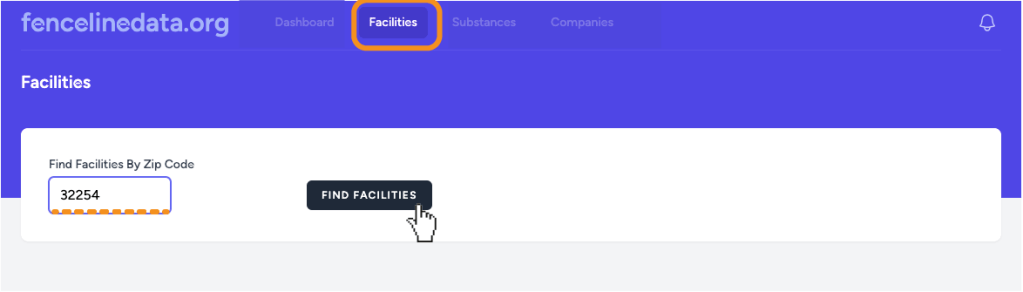
3. Type in the ZIP code and click “Find Facilities”.
4.Click on the facility with the address closest to the factory you’re interested in.
5. Use the map to confirm that you’ve chosen the correct facility.
Findings: The BWAY Corp facility in the Little Village neighborhood of Chicago released 43,095 pounds of chemicals into the air in 2022. Its biggest release was 16,880 pounds of glycol ethers, which can cause fatigue and nausea with long-term exposure. BWAY Corp also released 958 pounds of ethylbenzene, a possible carcinogen. The facility, also known as Mauser Packaging Solutions, transferred an additional 14,640 pounds of chemicals to another location. The Environmental Protection Agency most recently fined the BWAY Corp $140,000 on 09/30/2019 for having faulty equipment that leaked chemicals.
Climate Change
Question: I live in a part of Jacksonville, Florida, that’s prone to flooding, and I’m worried that climate change will make it worse. I pass a manufacturing plant on my way to work. Does it contribute to global warming?
1. Click on the “Facilities” tab. 2. Type in the ZIP code of the facility and hit “Find Facilities”.
3. Click on the facility with the address closest to the manufacturer you’re interested in.
4. Use the map to confirm that you’ve chosen the correct facility.
Findings: IFF Chemical Holdings Inc in Jacksonville released nearly 37,600 metric tons of carbon dioxide, the primary cause of climate change. That’s equivalent to the combined tailpipe emissions of 8,949 cars in a year. It also released 41 metric tons of nitrous oxides and 24 metric tons of methane, two other greenhouse gases.
Substances
Question: Ammonia is a colorless gas with a sharp odor that is used to make plastics, pesticides and other products. High levels can burn the mouth, nose, eyes and throat, and chronic exposure can permanently damage the lungs. What’s the biggest ammonia polluter in the U.S.?
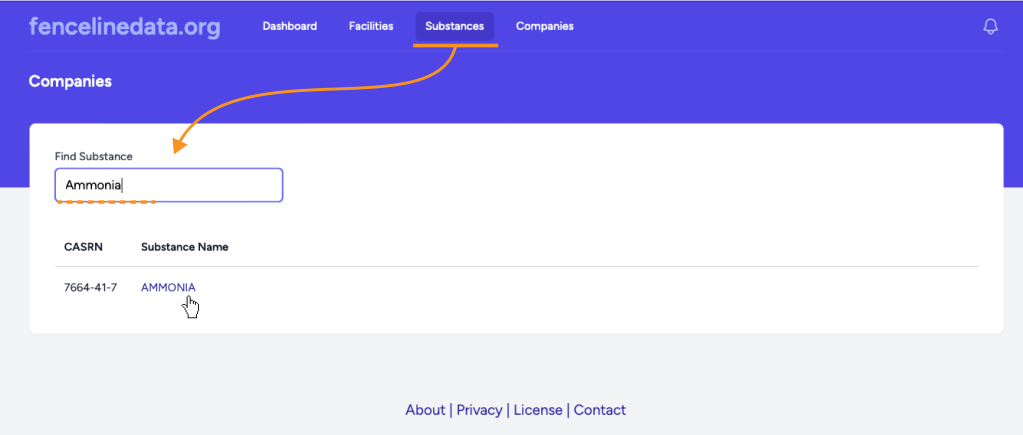
1. Search “ammonia” in the “Substances” tab.
Findings: Basin Electric, which operates a coal-fired power plant in North Dakota, released the most ammonia in 2022 — almost 18 million pounds.
Companies
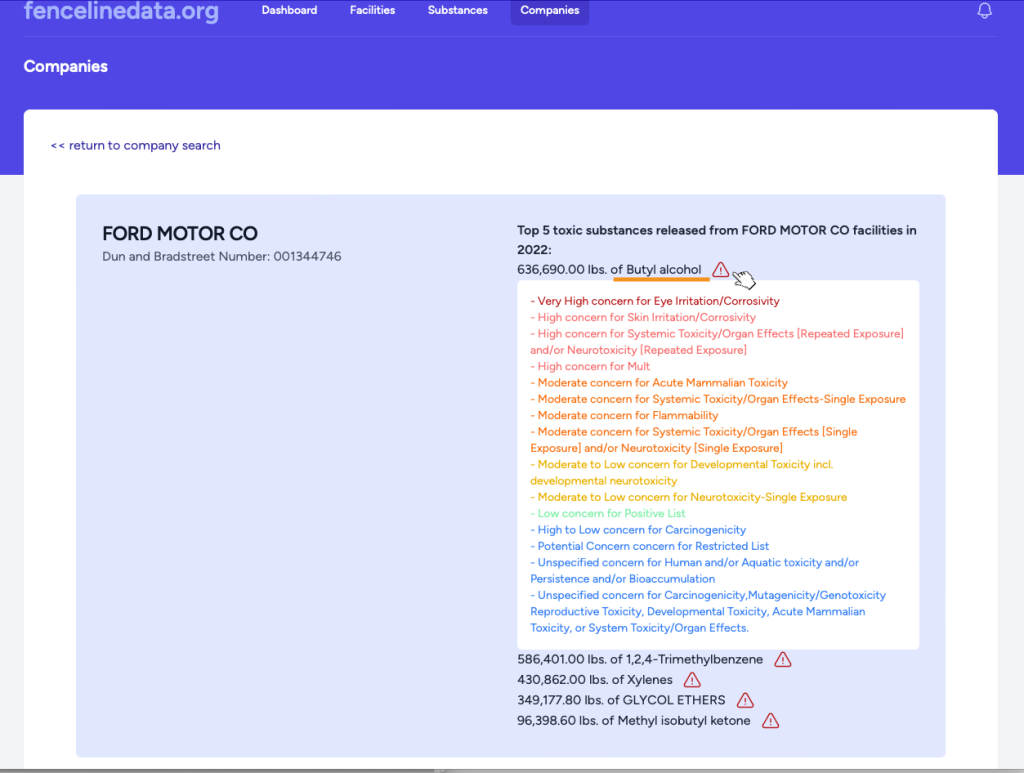
Question: Which chemicals does my car manufacturer release, and in what amounts?
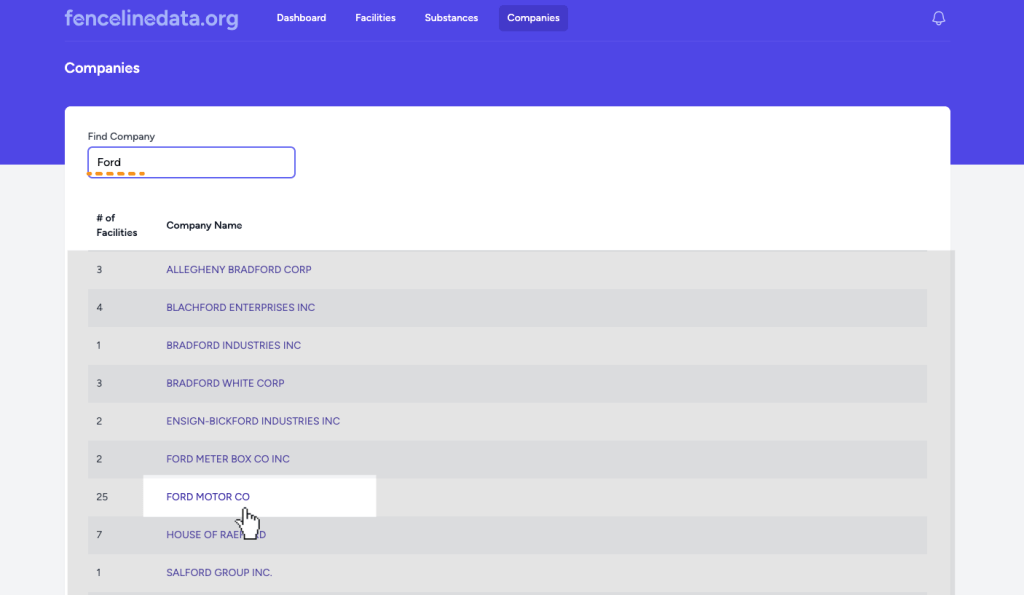
1. Search “Ford” in the “Companies” tab and select “Ford Motor Co”.
Findings: Ford facilities around the U.S. in 2022 collectively released more than 600,000 pounds of butyl alcohol, a sweet-smelling chemical that can irritate the eyes and cause headaches, dizziness, nausea and vomiting. Ford plants also released more than 586,000 pounds of 1,2,4-Trimethylbenzene, which can affect the eyes, skin and respiratory system, and almost 431,000 pounds of xylenes, which can attack the kidneys and the nervous, respiratory and cardiovascular systems with chronic exposure.
Want to Go Deeper?
Question: Which of the “Big 3” American car manufacturers contributed most to climate change and released the highest amount of chemicals in 2022?
1. Search “General Motors” in the “Companies” tab.
2. Click on the first GM facility that appears: DMAX LTD.
3. Download the Toxics Release Inventory data for DMAX LTD for 2022.
4. Click the back arrow on your web browser to return to the GM LLC page. 5. Download the 2022 data for each of GM’s 24 facilities. 6. Repeat steps 1 through 5 for Ford Motor Co’s 25 facilities and FCA US LLC’s (now known as Stellantis) 15 facilities. 7. Combine your CSV files by parent company. 8. To find which company released the most toxic chemicals, find the sum of the “Total toxic substance releases” column for each company. Then compare each company’s total. Do the same for CO2 releases and fines. 9. Now put the differently-sized companies on the same scale. Take the total toxic releases and divide it by the number of facilities for each company. This gives you an average amount of chemicals released per facility. Repeat with CO2 and penalties.
Findings:
Only GM reported polluting water and land in addition to air. (Because facilities calculate emissions data and self-report to the EPA’s Toxics Release Inventory, this may not reflect actual emissions).
Ford was the biggest CO2 polluter (439,636 metric tons). But Stellantis released the most CO2 per facility — 20,878 metric tons.
GM was the biggest chemical polluter (2,780,774 lbs.). It released 115,866 lbs. per facility.
Corporate, investor-owned utility influence in the Michigan Legislature was on full display this year, as Governor Whitmer signed energy legislation that was passed without the input of environmental justice communities and allows fossil fuel companies to continue to endanger our lives with pollution under the guise of ‘clean energy.’Our communities know better. And from the beginning, MEJC and allies were front and center, in open letters, press releases, interviews, and online with a clear message: There can be no win on climate without environmental justice.As we look to 2024 we will continue to organize and advocate as we hold our elected representatives accountable to the communities they serve, not the corporations that fund their campaigns.Here were key moments where we took our voices straight to power in 2023:
Our Open Letters
Our September 2023 open letter to Governor Gretchen Whitmer where we advocated for policies that prioritized: Fair Outage Compensation:Electricity AffordabilityCampaign Finance ReformCumulative Impact Analysis Our April 2023open letter to Michigan legislature where we advocated for: Prioritizing communities most impacted by climate change and pollution.Combatting environmental injustice and ensure healthy lives for all. Averting climate and environmental catastrophe.Stopping all fossil fuel and polluter handouts.Creating millions of good, safe, union jobs.
Bill Analysis: No Climate Win Without Environmental Justice! SB271 allows industries to continue to pollute our communities with fossil fuel energy sources. It sets up a clean energy standard that is totally inadequate to meet the needs of a rapidly changing climate. It also fails to include any environmental justice priority such as outage compensation, cumulative impact analysis, or any move towards breaking the monopoly of DTE and Consumers Energy. Read our full analysis on the climate bills the Michigan legislature passed this year and why we must demand our representatives do better!MEJC policy associate, Roshan Krishnan, provides an in depth walk through of our analysis of the “MI Clean Energy Future” bills.
*This letter was originally prepared for a meeting with EJ Public Advocate Regina Strong, and Dr. Brandy Brown, Climate and Energy Advisor to the Governor
Memo on Governor’s Climate Agenda: To Address the Urgent
Need for Environmental Justice, We Must be Climate READY
First, we want to recognize the moral significance of making time and space to meet directly with environmental justice communities and organizations on the urgent demands of the climate crisis.
Vulnerable communities, Black, Latinx, Arab, and Indigenous peoples have bore the brunt of contamination and degradation in Michigan for decades, if not centuries. As such, our expertise of the regulatory system, our traditional ecological knowledge, and our social networks are rich, exact in their capacities, and best suited to troubleshoot and resolve climate issues – whether the issues are ones that are emergent or ones tied to past abuses of the energy sector.
Additionally, organizations and Tribes led by leaders who live in their communities bear externalities and the highest risks of bad policy decisions. They also have the most to gain from positive results of good policy in physical and material ways. The rewards of positive policy decisions should seek to amend and resolve the historic disproportionality of toxicity and inaccessibility to food, water, land, healthy communities and cultural freedoms.
With this in mind, we believe there are several low hanging fruits for the Governor to move on that exemplify early stage crisis responses that are administratively sound. We summarize them in a community-useful acronym called Climate R.E.A.D.Y. that identifies our priorities and timeframe.
CLIMATE R.E.A.D.Y. Readiness for the crisis
● Establish regular communication with frontline communities, especially those that are
multilingual and accessible for multi-abled people;
● Engage local hearings, townhall, and listening sessions on toxics, vulnerability, health, pollution, legacy sites, flooding, high heat and extreme cold;
● Meet regularly with EJ organizations and Tribal governments about climate, environmental impacts, and troubleshooting resilience strategies;
● Communicate with multi-platform channels through televised, print, and online sources.
Emergency-response protocols
● Establish cross-agency and cross-jurisdiction working groups that can quickly mobilize when there is a threat of exposure and/or contamination along with extreme weather contingency planning, funding, and execution;
● Troubleshoot and evaluate emergency situations and closure of regulatory loopholes;
● Disclose fully all materials, incidents and responsible parties, with fines and fees levied at the scale of the risk and directed toward clean up and harm reduction/mitigation;
● Deploy effective and timely risk communication to potentially impacted communities, with
adequate evacuation notification.
Assess past and foreseen harms
● Employ Cumulative Impact Assessments and Health Impact Assessment in decision-making;
● Assess climate risk in decision-making at the permit level, and certificate of necessity, IRP and other planning, including high lake levels, including life cycle analysis of all GHG emission sources (public and private);
● Establish a Climate Commission in which equity is central and where environmental justice communities have a majority in decision-making;
● Enact vulnerability criteria that are utilized in decision-making processes regarding emissions control, reduction, mitigation and adaptation strategies.
Development initiatives
● Aggregate financing, block grants, and special funds deployed for Just Transition within geographies directly impacted by pollution, flooding, food shocks, high heat, drought, extreme cold and persistent contamination AND particularly where there is no or inadequate access to healthcare, housing, food and clean water, and other resilience measures for public health and welfare;
● Direct public dollars to leverage the Just Transition of municipalities and workforce sectors impacted by fossil fuel regulatory statutes like facility closure;
● Target strategies for transitioning from a fossil fuel-based economy to a renewable economy within those same vulnerable geographies, including EV access, clean drinking water and sanitation infrastructure, organic food, waste reduction and elimination, community solar, energy, efficient retrofits, transmission renovation and distributed generation;
● Create a “Do business in Michigan” incentives program for Michigan-based companies to receive tax breaks or other incentives as they pursue/maximize using local production inputs and purchase products, minority-owned businesses, as locally as possible to reduce transportation emissions, which will also create Michigan jobs and economic benefits.
● Train those most under-represented in the clean energy workforce including but not limited to: returning citizens, veterans, Tribal members, DACA residents;
● Reject bailout promises that burden residential consumers with debt from stranded assets we foresee in the energy sector;
● Adopt strategies for EJ communities displaced by extreme weather events settling or unsettled in Michigan.
Year 2030
● Acknowledge that by all estimates the climate crisis is upon us in Michigan and there is no time to wait.
● Pursue aggressively 100% renewable energy by 2030. As the steward of 89% of the nation’s fresh surface water, Michigan must act.
● Reject the false solutions presented by the oil and gas industry, like carbon capture and storage, cap and trade, and nuclear energy, as being the only options to put millions of people to work, and save lives on a global scale.
With this Climate R.E.A.D.Y. program for Michigan, we believe the Governor’s Climate Agenda has the best opportunity for ecological and environmental justice success. MEJC is ready and able to help you meet this challenge and demonstrate our commitment to Michigan communities and the nation.
From 8:30 a.m. to 5 p.m. September 25, the Michigan Community will come together at DeVos Place in Grand Rapids to offer local solutions and opportunities for engagement on the important subject of climate change. The stakes have never been higher and will require action at every scale and across every sector.
Participants will begin the day learning from our state and local government leaders who will confirm the direction of the mitten state followed by a keynote presentation from Paul Hawken, who is shifting the larger global conversation on climate change from “doom and gloom” to a sense of opportunity, possibility, and hope for the future.
Next, the focus will engage in local solutions. Would you like to support policy advancement? Perhaps you’d like to advance clean energy? Or maybe you’d like to learn how we can reduce food waste? Increase mass transit? Build and operate sustainable buildings? There will be something for everyone.
Finally participants will be encouraged to act locally. The solutions to climate change exist and are economically viable. Human beings have a history of solving complex problems and we will rise to the challenge. The cost of inaction is catastrophic and no change is too small. We are in this together and together we will prevail creating a socially just world focused on human health, security and prosperity.
OKT’s Lisa Oliver-King will take part in a panel discussion focusing on our Program for Growth along with colleagues Winona Bynum, Detroit Food Systems Council; Phil Jones, lead chef, Make Food, Not Waste; and Daniel Todd, director, Make Food Not Waste. Carissa Patrone, West Michigan Sustainable Business Forum, will moderate the panel.
Ticket prices vary, with a $25 Advancing Equity ticket available for community members.
Free! 6 – 8 p.m. Thursday Feb. 21 ICCF Assembly Hall, 920 Cherry St SE, 49506
As climate change makes more impact on our world, those with income challenges—most often people of color—suffer the most. Deirdre Courtney will present Climate Change and Marginalized Populations at ICCF Assembly Hall, 920 Cherry St SE, 49506 from 6 – 8 p.m. Thursday Feb. 21. The free event is co-sponsored by the Citizens Climate Lobby – Grand Rapids Chapter and Our Kitchen Table, as part of its 2019 Women of Color Convenings series.
Courtney, a doctoral teaching assistant in the Institute for Intercultural and Anthropological Studies at Western Michigan University, researches climate change adaptation and mitigation, climate change migration/displacement and cultural anthropology. While the real solution is to take steps to set our world’s climate back in the right direction, the next best plans include finding ways to minimize the harm that is already happening to our marginalized neighbors who are suffering the most.
“The margins are real and make a difference on how and who is affected by climate changes, even in Michigan,” says Jan Strait, co-lead of Grand Rapids Citizens Climate Lobby Chapter. “What do we need to increase our resilience and begin taking action to change the course for ourselves, our families, and our communities?”
OKT will open the event with a healthy cooking demo and tasting. Parking will be available around the building.
Citizens Climate Lobby supports the Bipartisan Climate Solution, HR 763, “Energy Innovation and Carbon Dividend Act”, to drive down carbon pollution and allocate the proceeds directly to the American citizens. All the indicators estimate that in 12 years such an energy policy would reduce carbon emissions by 40%, it’s good for economy to add 2.1 million jobs, saves lives and helps Americans
where it’s most needed.
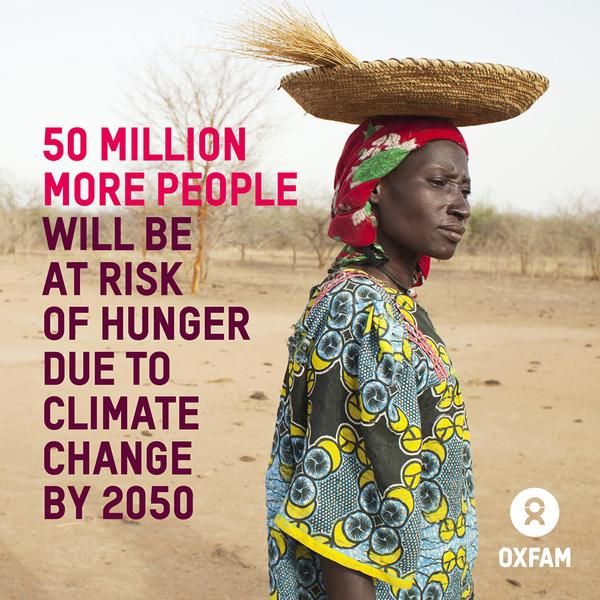
“Wild weather and unpredictable seasons are changing what farmers can grow and is making people hungry. Food prices are going up. Food quality is going down. Soon, climate change will affect what all of us can eat.”
—OXFAM
This opening statement from the international organization OXFAM introduces its investigation into the connection between Food Justice and Climate Justice. According to the Inter-governmental Panel on Climate Change (IPCC), which is made up of thousands of the world’s leading climate scientists, our current food system is one of the main contributors to climate change.
Driven by increasing profits, the current food system contributes to climate change in the following ways:
1) Agribusiness practices mono-cropping, where large portions of land are devoted to growing one kind of crop. This kind of land usage not only increases the need for additional water, it degrades the quality of the soil and causes soil erosion.
2) Agribusiness completely depends on fossil fuels to grow and harvest food, thus contributing significantly to warming the planet. In addition, most food grown does not stay local. The average food item travels 1,000 miles before it is consumed, increasing the current food system’s dependence on fossil fuels even more.
3) The current food system promotes high levels of meat consumption, particularly in the US. Producing so much meat diverts large amounts of water, increases levels of methane gas and requires more land use to raise feed, resulting in deforestation and the release of more carbon dioxide into the atmosphere. All of these factors further contribute to climate change.
4) The current food system produces highly processed foods that cause the many health problems we currently face. The energy and resources used to manufacture and distribute the high volume of unhealthy processed foods are also contributing to climate change.
While the world’s wealthier regions (specifically North America and Europe) are responsible for much of the current climate change crisis, its negative impacts
disproportionately impact regions of the world with higher levels of poverty. This is also true within the United States, where the communities most
negatively impacted by climate change are the same communities most
neglected by the current food system. This is why Our Kitchen Table
recognizes the relationship between food justice and climate justice. We
recognize that in order to have food justice, we need climate justice as well.
Here’s how you can practice climate justice alongside food justice:
Eat food grown locally.
Grow more of your own food.
Reduce or eliminate meat in your diet.
Reduce or eliminate processed foods in your diet.
Take action to build an alternative to the current food system.
Work for food sovereignty.
Join local, national and international efforts to promote food justice and climate justice.
For information on OKT’s food justice resources and
campaigns, contact us at OKTable1@gmail.com or
616-206-3641. Or, visit our website at www.oktjustice.org/.
If you are concerned about environmental justice and want to be part of a conversation on how we can collectively promote and practice Climate Justice, then you might consider participating in a free community forum on April 11.
Change U, a social justice program offered through the LGBT Resource Center at GVSU is hosting its fourth Activist Assembly this year. This activist assembly will investigate the gravity of the current climate crisis, with an emphasis on looking at the causes through an intersectional lens and the need for systemic change. The content presented will expose the fallacies of green capitalism and the push for individual lifestyle choices. Climate Justice is an international movement that recognizes that we need system change, especially an end to neoliberal capitalism. This assembly will provide skill shares and opportunities to learn from people & groups fighting tar sands, fracking, militarism, food apartheid and market-based solutions to Climate Change.
There will be breakout session that looking at the climate crisis on West Michigan, Animal Liberation, Food Justice, how to organize against the tar sands pipeline in Michigan and climate justice from a Native American perspective.
The activist assembly is free and will include lunch. For more information and how to register, go to http://gvsu.edu/socialjustice/collective-climate-justice-32.htm. The Activist Assembly involves students, faculty and community members and is a great way for people to make connections and build relationships with those wanting systemic change and social justice.
Across the globe, countless women are standing up to the ravages of climate change – and to the governments and big businesses who are allowing it to destroy the world.
Ipaishe, a farmer and climate campaigner from Zimbabwe, is among the women climate leaders who are showing others the path towards a more sustainable and equitable future. (Photo: Oxfam International)
“I give you a message from my heart,” she says, “let’s move forward and work together for the benefit of everyone. And especially for those who work in the fields, as we are the ones who suffer the most.”
That is the voice of Arminda, a farmer and agro-forestry advocate from Bolivia, who is among a number of women farmers and activists featured in a campaign video by Oxfam International which celebrates female voices from around the world who are raising the alarm about climate change, organizing their communities in response, challenging others to recognize their wisdom, and pressuring local and national officials to follow their lead.
According to Oxfam, the small group of brave women in the film is just a sample of the thousands of others who are standing up to the ravages of climate change – and to the governments and big businesses who are allowing runaway global warming to destroy the world.
With Sunday recognized by the United Nations as International Women’s Day, Oxfam’s focus on the vital role played by the women farmers is part of the organization’s ongoingGROW Campaign, which targets the intersection of hunger, climate change, and global inequality.
Alison Woodhead, director of the campaign, says women make up 43 percent of the agricultural workforce in the world’s developing countries and play a vital role in both food production and preparation.
These women, explains Woodhead in a blog post on Sunday, “have a wealth of knowledge about seeds, crops, water and land management. But the imbalanced responsibility of them putting food on their own family tables, as well as producing much of the world’s sustenance, is getting tougher all the time because of increasingly unpredictable weather.”
As this recent reporting by Agence France-France explores, climate change may be a “man-made” problem, but its negative impacts are disproportionally felt by women across the world.
“It boils down to the fact that women and men have different types of vulnerabilities already in the world,” explained Tara Shine, special advisor to the Mary Robinson Foundation-Climate Justice think tank, headed by the former Irish president-turned UN special envoy for climate change. “And then climate change comes along and accentuates all of those.”
In addition to their insight on the threat of climate and food insecurity, it is because of their unique role within their families and communities, argues Woodhead, that women are now essential leaders in the global fight against climate change. The video produced by Oxfam, she says, represents only “a snapshot of the huge contribution women across the world are making in the battle against climate change – an issue that impacts everyone, regardless of gender identity.”
Also featured in the video is Langing, a farmer and climate youth leader in the Philippines, who says she saw no other option but to rally to the cause after her schooling was cut short after drought killed off the crops of her family’s farm.
“In my opinion it’s unfair on us,” says Langing. “We are not the main contributors to climate change. But in these times, we should not blame each other. If we do what is right and start with ourselves, imagine the impact we could have. If we all believed in the same principles, we surely would be able to mitigate the effects of climate change.”
And Rosario, who like Arminda hails from Bolivia, adds, “If you want something, you can get it – it’s just about the power inside you to go and do things. So my message to people would be ‘let’s get organized, let’s get together, let’s talk and move forward towards the same point.'”
This work is licensed under a Creative Commons Attribution-Share Alike 3.0 License
La Via Campesina and GRAIN release two new documents on food and climate change ahead of the People’s Summit on Climate Change in Lima, Peru.
With this year’s UN Climate Change Conference under way in Lima, La Via Campesina and GRAIN announce the joint publication of two new documents that detail how a global programme to support food sovereignty can resolve the climate crisis and feed the world.
The documents show how the dispossession of peasants and indigenous peoples of their lands has laid the basis for destructive resource extraction and an industrial food system that is responsible for 44-57% of all greenhouse gas emissions.
La Via Campesina and GRAIN explain how a worldwide redistribution of lands to small farmers and indigenous communities – combined with policies to support local markets and ecological agriculture – can reduce global greenhouse gas emissions by half within a few decades, significantly curb deforestation and meet the food needs of the world’s growing population.
For more information see:
The solution to climate change is in our lands, an article that explains why giving small farmers and indigenous peoples control over lands is critical to addressing the climate crisis.
La Via Campesina is the international movement which brings together millions of peasants, small and medium-size farmers, landless people, women farmers, indigenous people, migrants and agricultural workers from around the world. It defends small-scale sustainable agriculture as a way to promote social justice and dignity.
GRAIN is a small international non-profit organisation that works to support small farmers and social movements in their struggles for community-controlled and biodiversity-based food systems







 Reposted from the
  Let’s Rise Up & Drawdown Carbon in Michigan
 “Wild weather and unpredictable seasons are changing what farmers can grow and is making people hungry. Food prices are going up. Food quality is going down. Soon, climate change will affect what all of us can eat.”


 Our Kitchen Table