Tag Archive | Food Justice

Planned cuts to Medicaid and SNAP will strip away health care and food from hundreds of thousands of Michiganders

“The U.S. House Republicans who voted for this unconscionable budget bill have effectively turned their backs on the people they are supposed to represent and are putting millions of lives at risk — all to further line the pockets of the wealthiest among us.”

The Michigan League for Public Policy issued the following statement today denouncing the U.S. House Republicans’ passage of a budget bill that could strip health care and food away from millions of Americans, including hundreds of thousands of Michiganders, in order to offset the cost of major tax giveaways for the wealthiest U.S. households and corporations. The statement can be attributed to League President and CEO Monique Stanton.

“This is ‘one big beautiful bill’ for millionaires and billionaires…not the rest of us. There is nothing beautiful about taking away food and health care from over half a million Michiganders and millions more around the country. Celebrating this bill means celebrating the loss of jobs, economic security and essential support systems in communities all around our state. People in our country, including those who call Michigan home, deserve so much better than this.”

“The cuts to Medicaid will strip essential care away from an estimated 740,000 people in Michigan through harsh work requirements, while making it more difficult for many more of the 1 in 4 Michiganders who rely on Medicaid to afford the care they need through a plan to impose co-pays. And beyond these very real human costs, the cuts will more than likely force hospitals and other health care facilities — especially those in rural areas — to close their doors, resulting in accessibility issues and major job losses within our already-stretched-too-thin health care system. And our state economy will suffer as a result of reduced federal revenue, additional administrative costs due to new and unnecessary red tape requirements and restrictions on how Michigan raises money to pay for Medicaid. The far-reaching impact of these cuts will be felt not just by those who participate in Medicaid, but by every person in our state.

“Members of our Congressional delegation have heard loud and clear that the vast majority of Michiganders across political views and party affiliations — 83% — don’t want cuts to Medicaid, yet they are forging ahead with this reckless plan. Today’s vote was a huge slap in the face for their constituents. Lives will be put at risk as a result.

“Food insecurity among families in Michigan will also continue to spike as a result of the cuts to SNAP at a time when food banks are already struggling to keep up with community needs. More than 300,000 Michiganders could see their benefits reduced or taken away entirely as a result of the expanded work requirements, which will do nothing to help people who are out of work find jobs faster. Taking food away from those who need it most, including children, will only result in worse outcomes in health, education and overall well-being. SNAP cuts will also impact grocery stores and Michigan’s agriculture industry— one of our state’s largest economic drivers.

“House Republicans have shown where their loyalty lies and it is not with the everyday, working people in our country. It’s with wealthy individuals, businesses and large corporations. Under this bill, the average tax filer earning $1 million or more would receive about $90,000 in tax breaks at the expense of life-saving programs like Medicaid and SNAP, while families earning less than $50,000 would get under $300 in tax cuts in 2027, amounting to less than a dollar a day. The tax cuts that families with low incomes will receive are negligible and will do nothing to help them considering the increased costs they will face if more tariffs are enacted and their health care and food is stripped away. And the expanded Child Tax Credit leaves 17 million children behind whose families earn too little, while the bill takes the credit completely away from 4.5 million citizen or legal permanent resident children by requiring both parents to have a Social Security number. 

“The U.S. House Republicans who voted for this unconscionable budget bill have effectively turned their backs on the people they are supposed to represent and are putting millions of lives at risk — all to further line the pockets of the wealthiest among us.”

3 bills passed out of U.S. Congressional committees would do irreparable damage to Michigan families and local economies

The Michigan League for Public Policy is sounding the alarm on three bills that advanced yesterday. Congressional House Republicans set the stage for the largest cuts to Medicaid and SNAP in the history of those programs, threatening the health and economic security of Michiganders. 

The budget bills passed by the U.S. House Committee on Energy and Commerce, the U.S. House Committee on Agriculture, and the U.S. House Committee on Ways and Means include:  

  • At least $625 billion in cuts to Medicaid through work requirements for people who receive coverage through the Medicaid expansion, various other red tape requirements that will reduce coverage and restrictions on how Michigan raises money to pay for Medicaid, among other changes.  
  • Roughly $300 billion in cuts to SNAP through harsh work requirements for older adults and parents of school-aged children, as well as a requirement that states, for the first time in the 50-year history of the program, pay for a share of food benefits. Michigan would need to come up with over $760 million each year. To put that into perspective, that is about 80% of the entire annual budget for the Michigan State Police. 
  • A tax plan that would increase deficits by $3.8 trillion over 10 years, providing an average tax cut of $65,000 for people with incomes in the top 1%, while doing little for low- and moderate-income families.  

“We’re gravely concerned that House Republicans have put aside the needs of their constituents and of their states’ economies by passing these harmful bills out of committees yesterday. To put life-saving programs like Medicaid and SNAP on the chopping block in order to create tax cuts that mainly benefit the wealthy is egregious,” says Monique Stanton, MLPP CEO. “All this is coming on top of a slew of executive orders designed to intimidate and threaten large swaths of the country, and sweeping, senseless cuts to federal jobs, public education, nonprofit services, crucial research projects and more. We are calling for lawmakers to put their constituents—and their country—first and put a stop to this reckless behavior.  

“Michigan’s economy grows when families can afford the basics and incomes are strong. This does the exact opposite—gutting food and health care assistance and leaving people who are already hungry or sick to fall even further behind as prices and tariffs climb.

“More than 2.6 million Michiganders—1 in 4 people in our state—depend on Medicaid for essential care. 

“But under this plan, 740,000 Michiganders who gained coverage through the Healthy Michigan Plan might lose it again if House Republicans enact work requirements. Those requirements would create more red tape, which could take away coverage from children, seniors and people with disabilities. Even if people keep their coverage, they might not be able to afford even basic medical treatment due to a plan to impose co-pays. We could also see hospital closures and job losses, resulting in economic losses in communities, especially rural areas.


“And cuts to SNAP threaten the nutrition of over 300,000 Michiganders who could see their food assistance benefits cut or taken away entirely under the House Republicans’ plan to expand work requirements to older adults and parents of school-aged kids. Taking away benefits from parents harms kids, too. Kids won’t get enough to eat, and their health and school performance will suffer. 

“Most SNAP participants who can work, do. In fact, 3 in 4 SNAP households in Michigan have at least one adult working. And for those who don’t have jobs, taking food away will do nothing to help them find work more quickly. Instead, it punishes many who are working, burdening them with red tape and time-consuming documentation.

“Everything that we know is critical to Michigan’s growth — bringing down maternal mortality rates, making sure older folks can afford their prescriptions, making sure kids and families have the nutrition they need — that’s all at stake now.

“And for what? To make sure more wealthy people get a tax cut. 

“Pushing through $1.5 trillion in cuts to basic needs programs to pay for tax cuts that disproportionately benefit the wealthy is short-sighted and shows that these lawmakers aren’t thinking about the people they serve. In Michigan, rural and northern counties have a higher percentage of folks who rely on Medicaid and SNAP and a higher percentage of folks living in poverty than most other counties. People living in these areas already have more limited access to the things they need, and taking food off their tables and health care away from their kids is not the answer. 

“And guess what? The cuts won’t help with the deficit. Even with the dismantling of federal funding for food assistance and health care, the current plan would still increase deficits by $3.8 trillion over 10 years.  

“Plus, working families with lower wages will see next to nothing from the tax cut provisions. The proposed expansion of the Child Tax Credit (CTC) leaves out up to 20 million children in working families nationwide. They won’t get the full credit because their families’ incomes are too low.  And millions of people will see tax increases if tariffs are enacted. The tariffs would likely erase a large portion of forthcoming tax cuts for low-income households, those making less than roughly $13,840. 

It’s important to note that many of these purported ‘tax cuts for working families,’ including removing the tax on tips and overtime, and the increase in the CTC are only temporary, all set to expire at the end of 2028. But many of the tax cuts for upper-income households will remain permanent, keeping the money flowing to those who already have more.

It’s time for our leaders to remember who they’re working for.” 

The risk of famine persists across the whole Gaza Strip.

Dove and Olives print by Caitlin Boyce-Jensen.

Reposted from World Food Program

Given the recent surge in hostilities, there are growing concerns that this worst-case scenario may materialize.

Violence has displaced nearly 2 million people, decimated livelihoods, crippled food systems, destroyed 70 percent of crop fields, severely restricted humanitarian operations and resulted in the collapse of health services and Water, Sanitation and Hygiene (WASH) systems.

Catastrophic acute food insecurity and concerning acute malnutrition levels will continue to prevail if the conflict continues, and humanitarian activities are restricted.

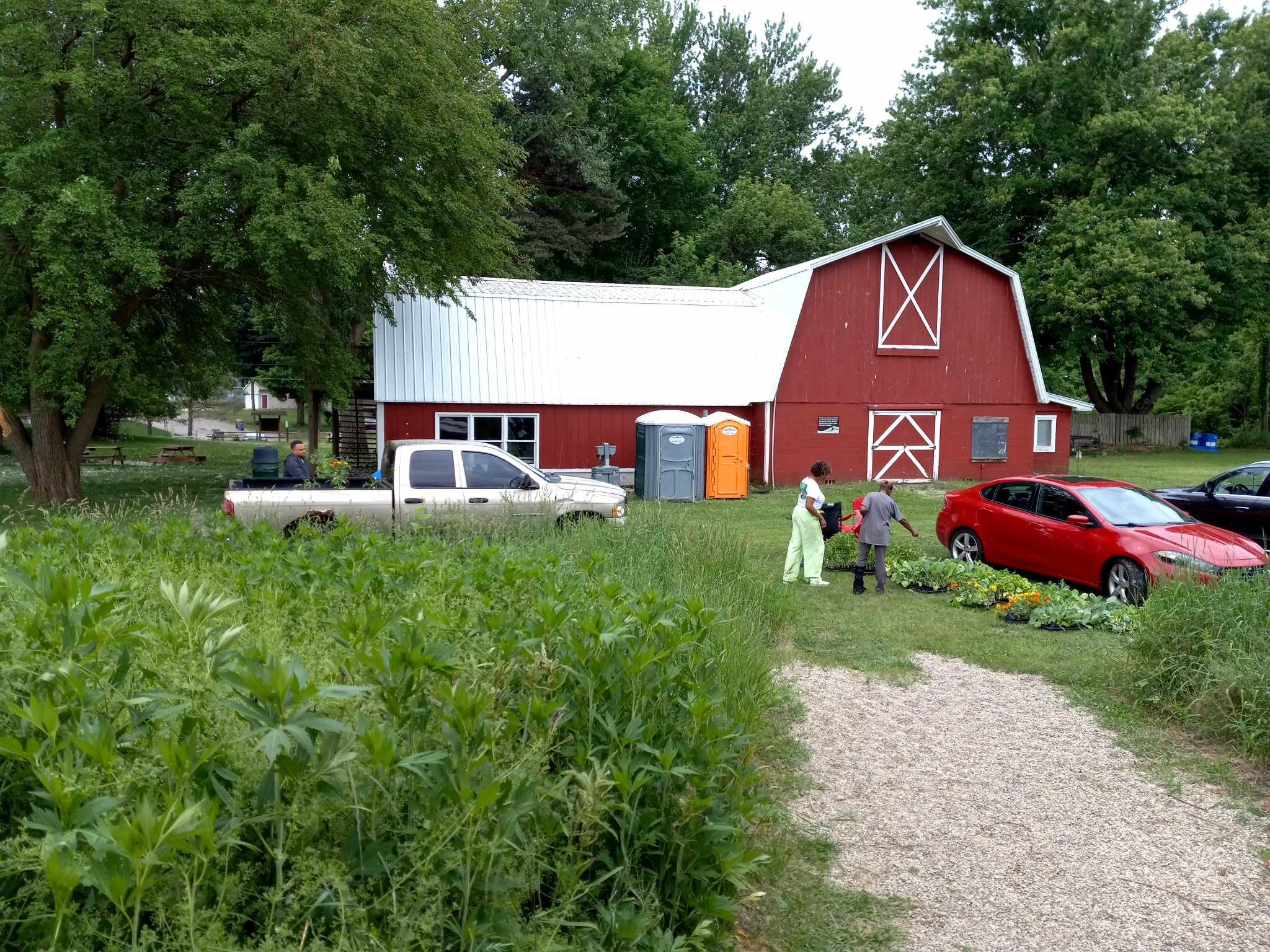
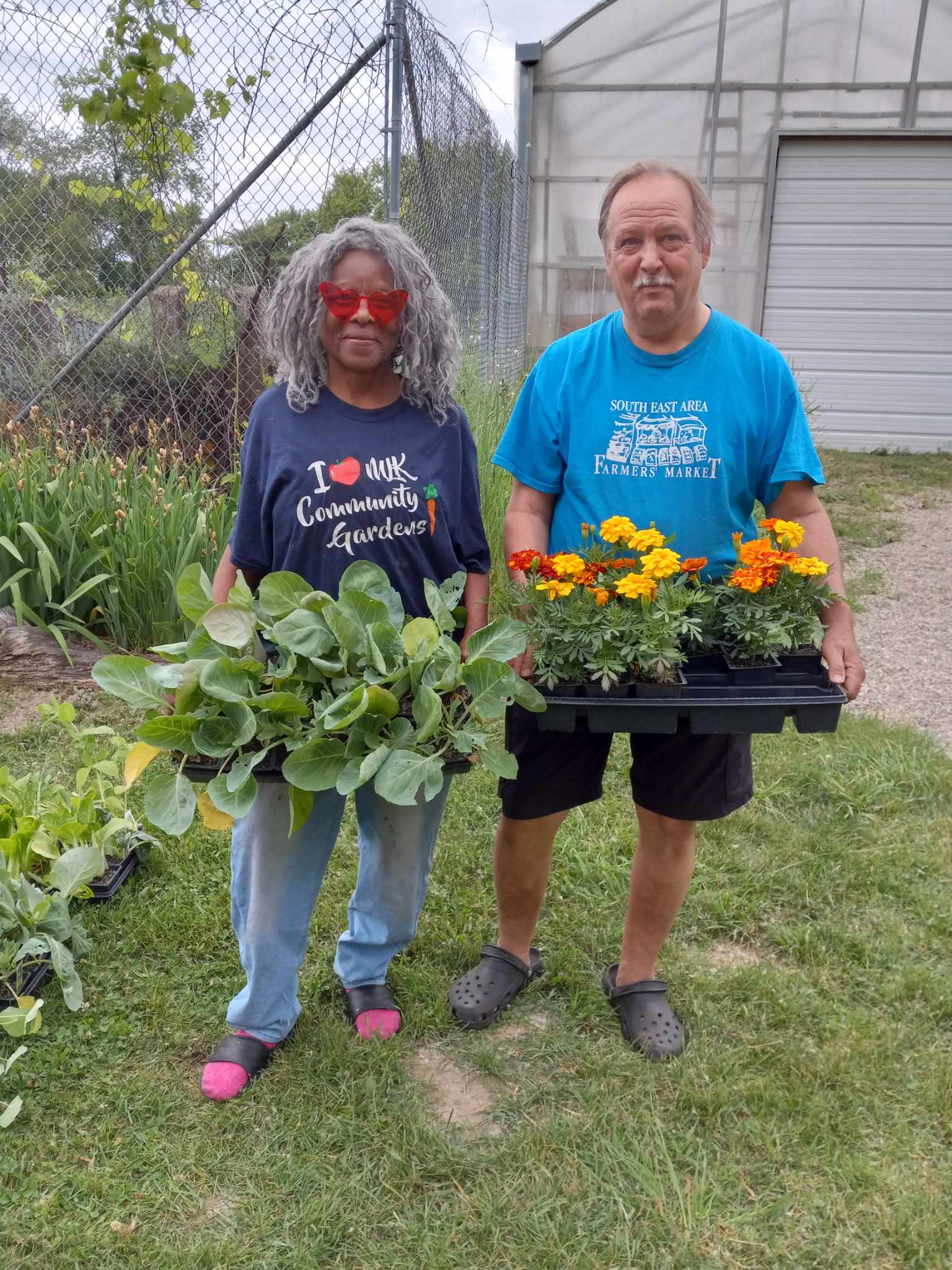
OKT distributed hundreds of food plants last Saturday

On Saturday, OKT food garden coach and Southeast Area Farmers Market Manager Belinda Henderson and E.D. Lisa Oliver-King distributed hundreds of food plants to participants growing food in their yards as well as food gardens OKT is growing with students and parents/caregivers at Grand Rapids Public Schools Martin Luther King Jr. Leadership Academy and Campus Elementary as well as Kentwood Public Schools Glenwood Elementary. A special thank you to our fabulous SEAFM set-up man, Bert, for delivering the plants to the schools!

Starvation as a weapon of war.

Most of us know the story of Anne Frank. But have you seen this Palestinian girl’s story? 

Please watch it here.

One of the most egregious forms of food injustice is the use starvation as a weapon of war. Throughout history, conquerors and colonialists have used this tactic. In the 1800s, the U.S. government encouraged the slaughter of buffalo in order to starve Native Americans off from from their lands. In Nazi Germany, Hitler used it against Germany’s Jewish citizens. In 2018, the use of starvation as a weapon of war was outlawed by the UN Security Council in Resolution 2417. But today, this weapon is being used against the infants, children, adults, and elders in Gaza.

Contact your senator and representative and ask them to vote for not only a ceasefire, but also aid and restoration of the supply chain in occupied Palestine.

Food Justice, food apartheid, food power

OKT’s executive director Lisa Oliver-King was part of a panel discussing environmental racism and food apartheid at an Access of West Michigan meeting for Walk recipient organizations in February. Considering the historical context of Black and Brown people’s deep connection with land and agriculture, OKT has noted several barriers to reconnection. 

Black farmers have historically been driven off from their farms here in Michigan and elsewhere. The redlined neighborhoods where many Black and Brown people live now have lead contaminated soil, lack space for growing, and lack urban ag opportunities due to how the city controls use off vacant lots. And of course, these are the same neighborhoods impacted by food apartheid.

Indigenous Michiganders have likewise been driven off their lands and their native diets replaced with SAD, the standard American diet, resulting in obesity and disease.
African Americans may feel torn about growing their own food as it can be a reminder of forced labor on plantations during enslavement. And of course, institutional racism serves to restrict opportunities for Black and Brown people, especially as huge agribusinesses buy out more and more farms.

We often hear the term “food desert,” which is used to refer to neighborhoods without a full service grocery store. Since 2010, OKT has not used the term food desert. A desert is a living ecosystem where plants and animals can thrive. Instead, OKT has defined food apartheid as “The intentional, systemic marketing and distribution of profitable, nutrient-poor, disease-causing foods to income-challenged neighborhoods, mainly, communities of color (i.e. communities receiving the most food assistance dollars).”

How can we utilize this reclamation of food sovereignty as a form of resistance against food apartheid? By looking to the ways our ancestors – maybe even our grandparents – grew food, preserved food, and prepared food and reclaiming the nutritionally rich foods of that not so distant past we too can grow food, learn to choose those healthy foods, and learn how to prepare them for our families. True soul food, traditional Latinx foods, and decolonized Indigenous foods are basically healthy foods.

We can “vote” with our food dollars. The extra time spent traveling to a farmers market can save time lost to disease and illness, but not all have transportation.

  • We can advocate for healthier foods in our neighborhoods, starting with the foods fed to children in public schools.
  • We can share the message with each other that the boxed, processed, fast and junk foods sold in our neighborhoods and promoted by slick media campaigns are killing us.
  • And we can advocate for media literacy that helps us and our children learn how to deconstruct advertising messages and decrease the impact they have on our food consumption.
  • We can also advocate for representation and acknowledgement of the Black, Latinx, and Indigenous American contribution to American cuisine. If we’ll buy it, they’ll sell it. The Foodies have swayed the industry to offer all kinds of healthy foods to white people who have extra money to spend on food. Maybe if Black and Brown people create a movement to eat healthy foods from our own cultures – and refuse to eat the crap that the industrial food system is currently selling us – they will begin to offer healthier, culturally relevant options.

Knowledge is power. Where are our kids getting their information about food? From Ronald McDonald? From their phones, computers, the billboards in their neighborhoods? Kids aren’t stupid. Let’s sit down at each of our kitchen tables and have a conversation. And set an example.

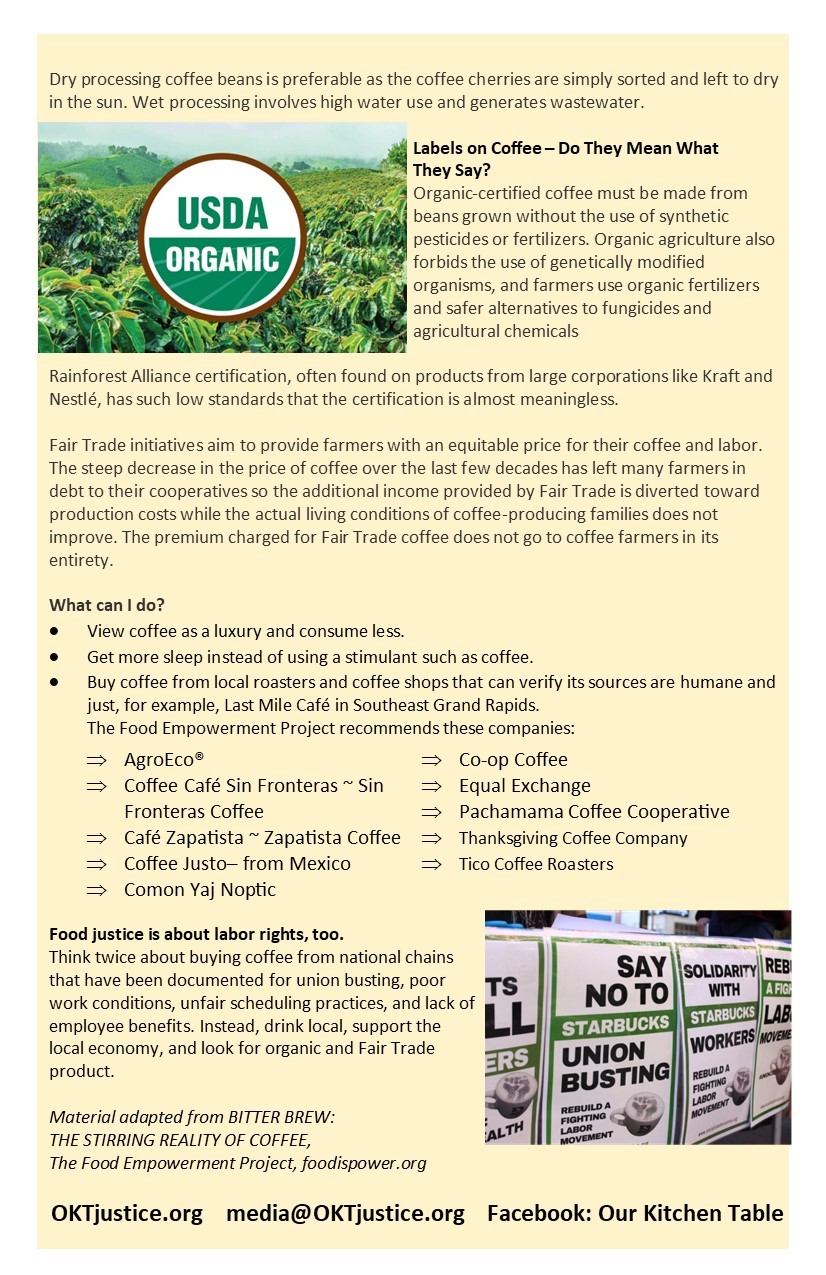
New addition to OKT’s food justice handout series

OKT’s executive editor, Lisa Oliver-King presented to the Michigan State University College of Human Medicine 9th Annual Reach Out to Youth Program (ROTY). ROTY is a college sponsored program that is free to all participants and their parents, with the assistance of the MSU Student National Medical Association (SNMA) serving as facilitators.  As one of the activities the kids took part in was a recipe for food to go with coffee, she decided to address the topic of coffee in her presentation. So, OKT communications staff developed this new handout, based on the online article BITTER BREW:
THE STIRRING REALITY OF COFFEE on The Food Empowerment Project website.

Ottawa County Board of Commissioners funding cuts reduce food security for its constituents

… and hunger stings.

The most recent food insecurity statistics in Ottawa were reported in 2019 from the interim CCHS survey data. This data indicates that: One in seven households (13.9 per cent) in Ottawa is food insecure. Despite that fact, the new Ottawa County Board of Commissioners has turned on its own health department with the result that funding has been cut to the county’s food program.

OKT received this media release from Ottawa Food this morning:

Statement From the Ottawa Food Advisory Board

Following cuts to the Ottawa County Department of Public Health

November, 13, 2023

The model of Ottawa Food as a collaborative is unique, with the Ottawa County Department of Public Health employing the full-time coordinator, who works across the private and public sectors towards goals identified county-wide. Ottawa Food’s model is one that has been recognized and celebrated across the state as both highly effective and successful within the Michigan Local Food Council Network.

On Tuesday September, 26 the Ottawa County Board of Commissioners voted to cut the Ottawa County Department of Public Health Education team by 48%, but fund the Ottawa Food operating budget of about $8,950 which covers materials and supplies. Ottawa Food’s coordinator position was a 0.9 FTE Health Educator on this team, and with the cuts, this position no longer exists.

During budget negotiations it was brought up repeatedly that the Board of Commissioners didn’t want to see Ottawa Food operations reduced or eliminated. However, they also knew that by reducing the Health Education budget, this was a highly probable outcome.

Ottawa Food fully supports the Ottawa County Department of Public Health and its leadership team as they determine how to allocate a decreased budget while faced with impossible decisions. The complexity of the full situation is detailed in this Washington Post article from late October.

Prior to the final budget vote on September 26, listening sessions were held with Ottawa Food members to determine possible paths forward.  Following the cuts made in late September, 76% of Ottawa Food members voted to pause the model of Ottawa Food as it’s been operating, rather than continue without a full-time coordinator.

As of now, the collaborative still exists but all regular monthly and quarterly meetings and other activities are on pause. Without a full-time coordinator, certain programs will not continue, including Senior Project Fresh, which distributes farmers market coupons to local seniors through federal funding that the Ottawa Food Coordinator facilitated and coordinated through local agencies. Another impacted program is gleaning and produce donations from local farmers markets, specifically in Hudsonville, Spring Lake and Georgetown which just started this past year, coordinated and launched by the Ottawa Food Coordinator.

Of course, all of the member agencies across the county continue their own individual impactful work, although outside of the collaborative infrastructure. At this time, the Ottawa Food Advisory Board continues to meet and discuss the best course of action for the continued success and viability of the collaborative and its initiatives and programs.

Thank you for the continued support of our shared vision to eliminate hunger in Ottawa County, encourage healthy eating for all, and support local farmers.

About Ottawa Food
Ottawa Food is a collaboration of over 45 agencies and individuals working to ensure that community members have access to healthy, local and affordable food choices. Our members come from a variety of backgrounds and sectors, including local public health, food pantries, human service organizations, food security advocates, farmers, local businesses, community members, MSU Extension, Feeding America West Michigan and many others. Since founding in 2011, our vision is to have an available supply of well-balanced meals for all, and we work to eliminate hunger in Ottawa County, promote healthy eating for all, and increase sourcing of local food.

Learn more at https://ottawafood.org/

Human Trafficking Suit Filed Against West Michigan Blueberry Farm

First Pick Farms violated rights of farmworkers, forced to live and work in terrible conditions

On June 9, 2023 the Michigan Immigrant Rights Center (MIRC), along with Farmworker Justice and Farmworker Legal Services, filed a lawsuit in the U.S. District Court for the Western District of Michigan against First Pick Farms for human trafficking and violations of the Migrant and Seasonal Agricultural Worker Protection Act. MIRC represents two of the affected farmworkers. 

In 2017, First Pick Farms forced a group of immigrant farmworkers in North Carolina to come to their blueberry farm in West Olive, Michigan by threatening to report them to immigration authorities if they did not comply. The workers were woken up in the middle of the night and placed in vans for the long drive to Michigan. Upon arrival, they were forced to work unbearably long hours and live in substandard housing; specifically, a residential home with only three bedrooms, two bathrooms, and no furniture for thirty workers. The workers were also forced to pay the First Pick Farms supervisor who trafficked them from North Carolina for debts illegally imposed upon them, including the cost of transport when they were trafficked to Michigan and rent for the substandard housing.

Migrant agricultural workers are one of the populations most at risk of labor trafficking in the U.S. Traffickers utilize recruitment practices that involve deception and illegal fees, trapping workers in debt, and frequently use threats related to immigration status to coerce workers to endure intolerable conditions. MIRC has repeatedly seen these patterns of labor exploitation and trafficking of agricultural workers in a wide range of work settings, from blueberry farms, to greenhouses, to dairies.  

“No one, regardless of what they look like or where they’re from, should be forced to work under threat from their employer,” said Gonzalo Peralta, staff attorney at MIRC. “Too often employers delegate the role of worker recruitment to middle management employees but this should not shield them from liability when an employee violates the law by trafficking workers.”  

“As we continually see, farmworkers are not safe from exploitation even when they follow all established legal protocol,” said Dorian Slaybod, staff attorney with Farmworker Legal Services.  “A lack of oversight allows bad actors to take advantage of workers and encourages employers to ignore civil and human rights violations.”

“The workers in this case were victims of some of the most horrific working and living conditions, which is all too common in agricultural work,” said Trent Taylor, staff attorney for the national farmworker advocacy organization Farmworker Justice. “They have demonstrated tremendous courage in coming forth and speaking out about their experiences. While the workers are seeking redress for the injuries they suffered in the court, policy change is needed to correct these endemic labor issues in our nation’s agricultural industry.”

Speaking about his experience, one of the Plaintiffs, Feliciano Velasco Rojas, recalled, “It was something very painful, it was to a certain degree mentally painful. We are accustomed to work but when we were transported to Michigan we were exhausted mentally and physically. Our families were also affected who were sick and we had taken these jobs to try to earn enough for their medications but we were not able to earn enough to get those. Additionally, the conditions, being unable to rest because we had to sleep on the floor, nearly broke me.” 

MIRC’s farmworker and immigrant worker rights practice focuses on representing farmworkers with employment and civil rights matters and specializes in cases at the intersection of workplace and immigrant rights. Workers who have questions about their rights can call MIRC’s free confidential Farmworker and Immigrant Worker hotline at 800-968-4046.

###

Michigan Immigrant Rights Center (MIRC) is a statewide legal resource center for Michigan’s immigrant communities that works to build a thriving Michigan where immigrant communities experience equity and belonging. MIRC’s work is rooted in three pillars: direct legal services, systemic advocacy, and community engagement and education. michiganimmigrant.org 

El 9 de junio de 2023, el Michigan Immigrant Rights Center (MIRC), junto con Farmworker Justice y Farmworker Legal Services, presentaron una demanda en el Tribunal de Distrito de EE. UU. para el Distrito Oeste de Michigan contra First Pick Farms por trata de personas y violaciones de la Ley de Protección de los Trabajadores Agrícolas Migratorios y de Temporada. MIRC representa a dos de los trabajadores agrícolas afectados.

En 2017, First Pick Farms obligó a un grupo de trabajadores agrícolas inmigrantes en Carolina del Norte a ir a su granja de arándanos en West Olive, Michigan amenazándolos con denunciarlos a las autoridades de inmigración si no cumplían. Los trabajadores fueron despertados en medio de la noche y colocados en camionetas para el largo viaje a Michigan. A su llegada, se vieron obligados a trabajar horas insoportablemente largas y residir en viviendas precarias; específicamente, una vivienda residencial de sólo tres dormitorios, dos baños y sin muebles para treinta trabajadores. Los trabajadores también se vieron obligados a pagar al supervisor de First Pick Farms que los traficaba desde Carolina del Norte por deudas que les habían impuesto ilegalmente, incluido el costo del transporte cuando los traficaban a Michigan y el alquiler de las viviendas deficientes.

Los trabajadores agrícolas migrantes son una de las poblaciones con mayor riesgo de tráfico laboral en los EE. UU. Los traficantes utilizan prácticas de reclutamiento que involucran engaño y tarifas ilegales, atrapan a los trabajadores endeudándolos y frecuentemente usan amenazas relacionadas con el estatus migratorio para obligar a los trabajadores a soportar condiciones intolerables. MIRC ha visto repetidamente estos patrones de explotación laboral y tráfico de trabajadores agrícolas en una amplia gama de entornos de trabajo, desde granjas de arándanos hasta invernaderos y lecherías.

“Nadie, independientemente de su apariencia o de dónde sea, debe ser obligado a trabajar bajo la amenaza de su empleador”, dijo Gonzalo Peralta, abogado de MIRC. “Con demasiada frecuencia, los empleadores delegan la función de contratación de trabajadores a los empleados de mandos intermedios, pero esto no debería protegerlos de la responsabilidad cuando un empleado viola la ley al traficar con trabajadores”.

“Como vemos continuamente, los trabajadores agrícolas no están a salvo de la explotación incluso cuando siguen todos los protocolos legales establecidos”, dijo Dorian Slaybod, abogado de Farmworker Legal Services. “La falta de supervisión permite que los malos actores se aprovechen de los trabajadores y alienta a los empleadores a ignorar las violaciones de derechos humanos y civiles”.

“Los trabajadores en este caso fueron víctimas de algunas de las condiciones de vida y de trabajo más horribles, lo cual es muy común en el trabajo agrícola”, dijo Trent Taylor, abogado  de la organización nacional de defensa de los trabajadores agrícolas Farmworker Justice. “Han demostrado un tremendo coraje al presentarse y hablar sobre sus experiencias. Mientras los trabajadores buscan reparación por las lesiones que sufrieron en los tribunales, se necesita un cambio de política para corregir estos problemas laborales endémicos en la industria agrícola de nuestra nación”.

Hablando de su experiencia, uno de los Demandantes, Feliciano Velasco Rojas, recordó: “Fue algo muy doloroso, fue hasta cierto punto mentalmente doloroso. Estamos acostumbrados a trabajar, pero cuando nos transportaron a Michigan estábamos agotados física y mentalmente. Nuestras familias también se vieron afectadas, estaban enfermos y habíamos tomado estos trabajos para tratar de ganar lo suficiente para sus medicamentos, pero no pudimos ganar lo suficiente para conseguirlos. Además, de las condiciones, no poder descansar porque teníamos que dormir en el suelo, casi me rompen”.

La práctica de derechos de los trabajadores agrícolas e inmigrantes de MIRC se enfoca en representar a los trabajadores agrícolas en asuntos de empleo y derechos civiles y se especializa en casos en la intersección del lugar de trabajo y los derechos de los inmigrantes. Los trabajadores que tengan preguntas sobre sus derechos pueden llamar a la línea directa gratuita y confidencial para trabajadores agrícolas e inmigrantes de MIRC al 800-968-4046.

###

Michigan Immigrant Rights Center (MIRC) es un centro de recursos legales en todo el estado para las comunidades de inmigrantes de Michigan que trabaja para construir un Michigan próspero donde las comunidades de inmigrantes experimentan equidad y pertenencia. El trabajo de MIRC se basa en tres pilares: servicios legales directos, defensa sistémica y participación y educación de la comunidad. michiganimmigrant.org