Kent County residents can call Kent County DHS at 1-844-464-3447 to get their questions answered. Or, you can access MiBridges at michigan.gov/mibridges from a phone or any computer to:
Kent County residents can call Kent County DHS at 1-844-464-3447 to get their questions answered. Need a new Bridge Card? Call 888-678-8914. You can also access MiBridges at michigan.gov/mibridges from a phone or any computer to:
Check benefits
Apply for benefits – food, cash, Medicaid, SER, etc.
We are partnering with the Michigan Department of Health and Human Services to raise awareness about the vital resources and services available to help prevent and address substance use disorder in our communities. For information, visit the MDHHS “Find Help” web page.
The State of Michigan Low Income Home Energy Assistance program helps low-income households with energy needs. Help for high energy bills, shut offs, and home energy repairs is available to YOU.
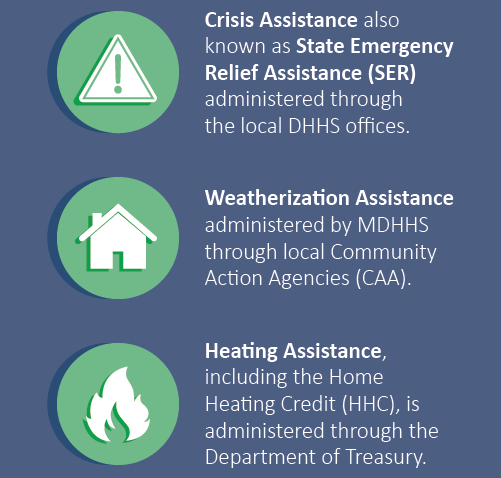
Crisis Assistance
You are responsible for your heat and electric costs, however there is assistance to help you, known as crisis assistance, through MDHHS.
First, you must understand how to read your bills, be careful how you use energy, and keep your costs as low as possible to avoid shutoff. Reach out to your heat or electric provider as they may be able to assist. Don’t wait until the last minute to ask for help. Call them about setting up a payment plan before you get shut off.
If you are in danger of shutoff, MDHHS may be able to assist with crisis money. Complete an application either online through MI Bridges or by completing a MDHHS-1171, Assistance Application along with the SER, supplemental form or DHS-1514, Application for State Emergency Relief. Paper applications are available at your local DHHS office.
Home Heating Credit
The Home Heating Credit helps low-income households with their heating expenses if they are a qualified Michigan homeowner or renter. The amount of credit is based on income, household size, and heat cost. If you received a credit in the last year, an application will be mailed to you near the end of the year.
The Home Heating Credit application, MI-1040CR-7 is available at your local library, MDHHS office, community agencies or the Department of Treasury. You must complete the application between Jan. 1 and Sept. 30, or electronically when filing your tax returns. More information can be found at Home Heating Credit Information (Michigan.gov).
This November, Michigan is giving Michiganders the opportunity to take control of their birth control with free birth control and sexually transmitted infection (STI) prevention supplies. The campaign also shares information about insurance options to keep the support going in the future.
In Kent County, people can pick up these free supplies while supplies last at Kent County DHS, 121 Martin Luther King Jr. St. SE, 8 a.m. – 5 p.m. Monday through Friday. Outside of Kent County? Find a location here:Michigan.gov/TakeControl.
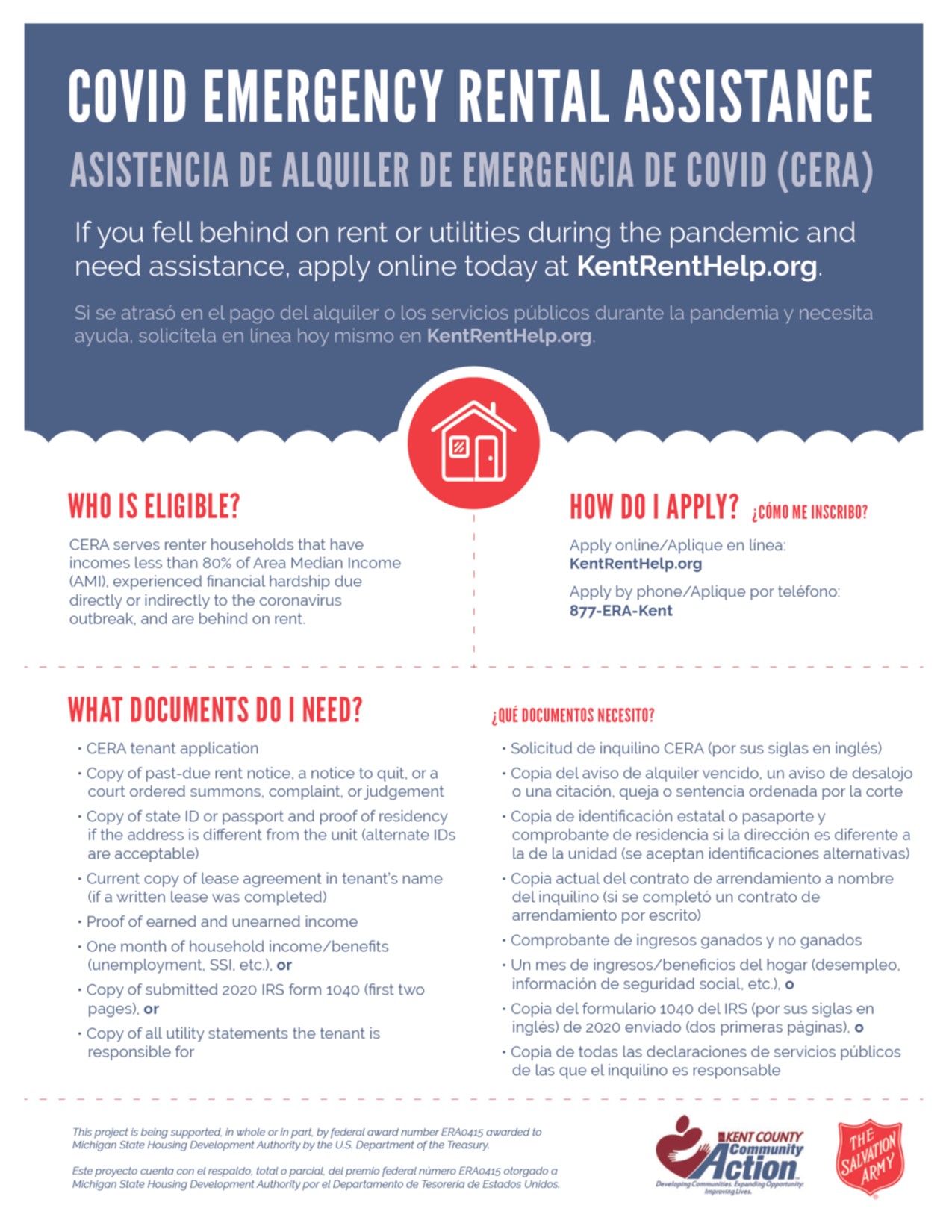
CERA can provide rental and utility assistance for eligible renter households so that they retain their housing stability.
The tenant only needs to be in rental arrears, so no court notice is required for this funding.
Feel free to share the flyers with your clients.
Updated information is available at www.kentrenthelp.org . Households in need of assistance can also call 877.ERA.KENT.
The Website redirects you to www.endhomelessnesskent.org if the above website does not work and the application portal is up and running.
Paper applications can also be printed at MSHDA – COVID Emergency Rental Assistance (CERA) (michigan.gov) and dropped off at the Hispanic Center of Western Michigan (1204 Grandville Ave SW, Grand Rapids, MI), The Salvation Army (located at Fuller and Fulton St.), or the Kent County Community Action Agency (KCCA) at 82 Ionia St., Suite 390.
Tenants can also walk into any of the agencies listed above for assistance with applying for the rental assistance.
The anticipated processing time for CERA funding is 30 days.
There is no receipt provided when an application is submitted to the portal. If clients have questions regarding their application, they can call 877-ERA-KENT to confirm the status.
CERA funds can be used to cover rent and/or utilities (gas, electric, water). If the client is not behind on utilities, the payment will be made to give them a credit on their account.
The F.O.R. Helpline provides assistance over the phone with filing a DHHS application. They are open Monday-Friday from 9am-5pm. They have interpreters too! No computers needed!
Additional COVID-19 food assistance for 350,000 Michigan families in response to COVID-19 emergency extended through November
Approximately 350,000 Michigan families will continue to have access to additional food assistance benefits during the month of November as a response to the COVID-19 pandemic, Gov. Gretchen Whitmer and the Michigan Department of Health and Human Services (MDHHS) announced today.
Michigan previously approved the additional food assistance for March through June – and now that is being extended for the month of November with approval from the U.S. Department of Agriculture Food and Nutrition Service.
“MDHHS remains committed to helping families who continue to struggle to put food on the table as a result of the pandemic,” said MDHHS Director Robert Gordon. “Providing nutritious food is vitally important during these difficult times just as protecting residents from the virus is.”
Eligible clients will see additional food assistance benefits on their Bridge Card by Nov. 30, with payments beginning for some households on Nov. 21. Additional benefits will be loaded onto Bridge Cards as a separate payment from the assistance that is provided earlier in the month.
Nearly 1.5 million people in Michigan receive federal Supplemental Nutrition Assistance Program (SNAP) benefits through the state’s Food Assistance Program
Households eligible for Food Assistance Program benefits will receive additional benefits in November to bring all current SNAP cases to the maximum monthly allowance for that group size. This change only applies to customers not currently receiving the maximum benefit amount. The 350,000 households that receive increased benefits represent more than 50 percent of the more than 682,000 Michigan households that received food assistance in September. The remaining households already receive the maximum benefit.
The table below shows the maximum allowable benefit for SNAP customers based on their respective household size:
Eligible families do not need to re-apply to receive the additional benefits. People who receive food assistance can check their benefits balance on their Michigan Bridge Card by going online to www.michigan.gov/MIBridges a consumer service representative toll-free at 888-678-8914. They can ask questions about the additional benefits by calling or emailing their caseworker.
Customer service is available 24 hours a day, 7 days a week. Spanish and Arabic service is available. If you are deaf, deafblind, or hard of hearing or speech-impaired, call the Michigan Relay Center at 7-1-1.
If you or someone you know is in need, call the F.O.R. Helpline to get assistance over the phone with filing a DHHS application. They are open Monday-Friday from 9am-5pm. They have interpreters too! No computers needed!






 Our Kitchen Table