Tag Archive | SNAP

Kent County Essential Needs Taskforce appeal

Proposed cuts to SNAP and Medicaid would strip away essential support from families, seniors, children, and many other individuals. Don’t stay silent. Contact your senators and representatives now and demand they protect these vital programs. It is crucial to ensure that the voices of those at risk are heard and uplifted at this time. Share this message, start the conversation, and push back against policies that threaten our community’s wellbeing.

Helpful Contacts for MI Residents

Kent County residents can call Kent County DHS at 1-844-464-3447 to get their questions answered. Or, you can access MiBridges at michigan.gov/mibridges from a phone or any computer to:

Kent County residents can call Kent County DHS at 1-844-464-3447 to get their questions answered. Need a new Bridge Card? Call 888-678-8914. You can also access MiBridges at michigan.gov/mibridges from a phone or any computer to:

  • Check benefits
  • Apply for benefits – food, cash, Medicaid, SER, etc. 
  • Address changes
  • Upload of documents

Planned cuts to Medicaid and SNAP will strip away health care and food from hundreds of thousands of Michiganders

“The U.S. House Republicans who voted for this unconscionable budget bill have effectively turned their backs on the people they are supposed to represent and are putting millions of lives at risk — all to further line the pockets of the wealthiest among us.”

The Michigan League for Public Policy issued the following statement today denouncing the U.S. House Republicans’ passage of a budget bill that could strip health care and food away from millions of Americans, including hundreds of thousands of Michiganders, in order to offset the cost of major tax giveaways for the wealthiest U.S. households and corporations. The statement can be attributed to League President and CEO Monique Stanton.

“This is ‘one big beautiful bill’ for millionaires and billionaires…not the rest of us. There is nothing beautiful about taking away food and health care from over half a million Michiganders and millions more around the country. Celebrating this bill means celebrating the loss of jobs, economic security and essential support systems in communities all around our state. People in our country, including those who call Michigan home, deserve so much better than this.”

“The cuts to Medicaid will strip essential care away from an estimated 740,000 people in Michigan through harsh work requirements, while making it more difficult for many more of the 1 in 4 Michiganders who rely on Medicaid to afford the care they need through a plan to impose co-pays. And beyond these very real human costs, the cuts will more than likely force hospitals and other health care facilities — especially those in rural areas — to close their doors, resulting in accessibility issues and major job losses within our already-stretched-too-thin health care system. And our state economy will suffer as a result of reduced federal revenue, additional administrative costs due to new and unnecessary red tape requirements and restrictions on how Michigan raises money to pay for Medicaid. The far-reaching impact of these cuts will be felt not just by those who participate in Medicaid, but by every person in our state.

“Members of our Congressional delegation have heard loud and clear that the vast majority of Michiganders across political views and party affiliations — 83% — don’t want cuts to Medicaid, yet they are forging ahead with this reckless plan. Today’s vote was a huge slap in the face for their constituents. Lives will be put at risk as a result.

“Food insecurity among families in Michigan will also continue to spike as a result of the cuts to SNAP at a time when food banks are already struggling to keep up with community needs. More than 300,000 Michiganders could see their benefits reduced or taken away entirely as a result of the expanded work requirements, which will do nothing to help people who are out of work find jobs faster. Taking food away from those who need it most, including children, will only result in worse outcomes in health, education and overall well-being. SNAP cuts will also impact grocery stores and Michigan’s agriculture industry— one of our state’s largest economic drivers.

“House Republicans have shown where their loyalty lies and it is not with the everyday, working people in our country. It’s with wealthy individuals, businesses and large corporations. Under this bill, the average tax filer earning $1 million or more would receive about $90,000 in tax breaks at the expense of life-saving programs like Medicaid and SNAP, while families earning less than $50,000 would get under $300 in tax cuts in 2027, amounting to less than a dollar a day. The tax cuts that families with low incomes will receive are negligible and will do nothing to help them considering the increased costs they will face if more tariffs are enacted and their health care and food is stripped away. And the expanded Child Tax Credit leaves 17 million children behind whose families earn too little, while the bill takes the credit completely away from 4.5 million citizen or legal permanent resident children by requiring both parents to have a Social Security number. 

“The U.S. House Republicans who voted for this unconscionable budget bill have effectively turned their backs on the people they are supposed to represent and are putting millions of lives at risk — all to further line the pockets of the wealthiest among us.”

3 bills passed out of U.S. Congressional committees would do irreparable damage to Michigan families and local economies

The Michigan League for Public Policy is sounding the alarm on three bills that advanced yesterday. Congressional House Republicans set the stage for the largest cuts to Medicaid and SNAP in the history of those programs, threatening the health and economic security of Michiganders. 

The budget bills passed by the U.S. House Committee on Energy and Commerce, the U.S. House Committee on Agriculture, and the U.S. House Committee on Ways and Means include:  

  • At least $625 billion in cuts to Medicaid through work requirements for people who receive coverage through the Medicaid expansion, various other red tape requirements that will reduce coverage and restrictions on how Michigan raises money to pay for Medicaid, among other changes.  
  • Roughly $300 billion in cuts to SNAP through harsh work requirements for older adults and parents of school-aged children, as well as a requirement that states, for the first time in the 50-year history of the program, pay for a share of food benefits. Michigan would need to come up with over $760 million each year. To put that into perspective, that is about 80% of the entire annual budget for the Michigan State Police. 
  • A tax plan that would increase deficits by $3.8 trillion over 10 years, providing an average tax cut of $65,000 for people with incomes in the top 1%, while doing little for low- and moderate-income families.  

“We’re gravely concerned that House Republicans have put aside the needs of their constituents and of their states’ economies by passing these harmful bills out of committees yesterday. To put life-saving programs like Medicaid and SNAP on the chopping block in order to create tax cuts that mainly benefit the wealthy is egregious,” says Monique Stanton, MLPP CEO. “All this is coming on top of a slew of executive orders designed to intimidate and threaten large swaths of the country, and sweeping, senseless cuts to federal jobs, public education, nonprofit services, crucial research projects and more. We are calling for lawmakers to put their constituents—and their country—first and put a stop to this reckless behavior.  

“Michigan’s economy grows when families can afford the basics and incomes are strong. This does the exact opposite—gutting food and health care assistance and leaving people who are already hungry or sick to fall even further behind as prices and tariffs climb.

“More than 2.6 million Michiganders—1 in 4 people in our state—depend on Medicaid for essential care. 

“But under this plan, 740,000 Michiganders who gained coverage through the Healthy Michigan Plan might lose it again if House Republicans enact work requirements. Those requirements would create more red tape, which could take away coverage from children, seniors and people with disabilities. Even if people keep their coverage, they might not be able to afford even basic medical treatment due to a plan to impose co-pays. We could also see hospital closures and job losses, resulting in economic losses in communities, especially rural areas.


“And cuts to SNAP threaten the nutrition of over 300,000 Michiganders who could see their food assistance benefits cut or taken away entirely under the House Republicans’ plan to expand work requirements to older adults and parents of school-aged kids. Taking away benefits from parents harms kids, too. Kids won’t get enough to eat, and their health and school performance will suffer. 

“Most SNAP participants who can work, do. In fact, 3 in 4 SNAP households in Michigan have at least one adult working. And for those who don’t have jobs, taking food away will do nothing to help them find work more quickly. Instead, it punishes many who are working, burdening them with red tape and time-consuming documentation.

“Everything that we know is critical to Michigan’s growth — bringing down maternal mortality rates, making sure older folks can afford their prescriptions, making sure kids and families have the nutrition they need — that’s all at stake now.

“And for what? To make sure more wealthy people get a tax cut. 

“Pushing through $1.5 trillion in cuts to basic needs programs to pay for tax cuts that disproportionately benefit the wealthy is short-sighted and shows that these lawmakers aren’t thinking about the people they serve. In Michigan, rural and northern counties have a higher percentage of folks who rely on Medicaid and SNAP and a higher percentage of folks living in poverty than most other counties. People living in these areas already have more limited access to the things they need, and taking food off their tables and health care away from their kids is not the answer. 

“And guess what? The cuts won’t help with the deficit. Even with the dismantling of federal funding for food assistance and health care, the current plan would still increase deficits by $3.8 trillion over 10 years.  

“Plus, working families with lower wages will see next to nothing from the tax cut provisions. The proposed expansion of the Child Tax Credit (CTC) leaves out up to 20 million children in working families nationwide. They won’t get the full credit because their families’ incomes are too low.  And millions of people will see tax increases if tariffs are enacted. The tariffs would likely erase a large portion of forthcoming tax cuts for low-income households, those making less than roughly $13,840. 

It’s important to note that many of these purported ‘tax cuts for working families,’ including removing the tax on tips and overtime, and the increase in the CTC are only temporary, all set to expire at the end of 2028. But many of the tax cuts for upper-income households will remain permanent, keeping the money flowing to those who already have more.

It’s time for our leaders to remember who they’re working for.” 

Additional COVID-19 food assistance extended through November

Nov. 6, 2020 Press Release from MDHHS

Additional COVID-19 food assistance for 350,000 Michigan families in response to COVID-19 emergency extended through November 

Approximately 350,000 Michigan families will continue to have access to additional food assistance benefits during the month of November as a response to the COVID-19 pandemic, Gov. Gretchen Whitmer and the Michigan Department of Health and Human Services (MDHHS) announced today.

Michigan previously approved the additional food assistance for March through June – and now that is being extended for the month of November with approval from the U.S. Department of Agriculture Food and Nutrition Service.

“MDHHS remains committed to helping families who continue to struggle to put food on the table as a result of the pandemic,” said MDHHS Director Robert Gordon. “Providing nutritious food is vitally important during these difficult times just as protecting residents from the virus is.”

Eligible clients will see additional food assistance benefits on their Bridge Card by Nov. 30, with payments beginning for some households on Nov. 21. Additional benefits will be loaded onto Bridge Cards as a separate payment from the assistance that is provided earlier in the month.

Nearly 1.5 million people in Michigan receive federal Supplemental Nutrition Assistance Program (SNAP) benefits through the state’s Food Assistance Program 

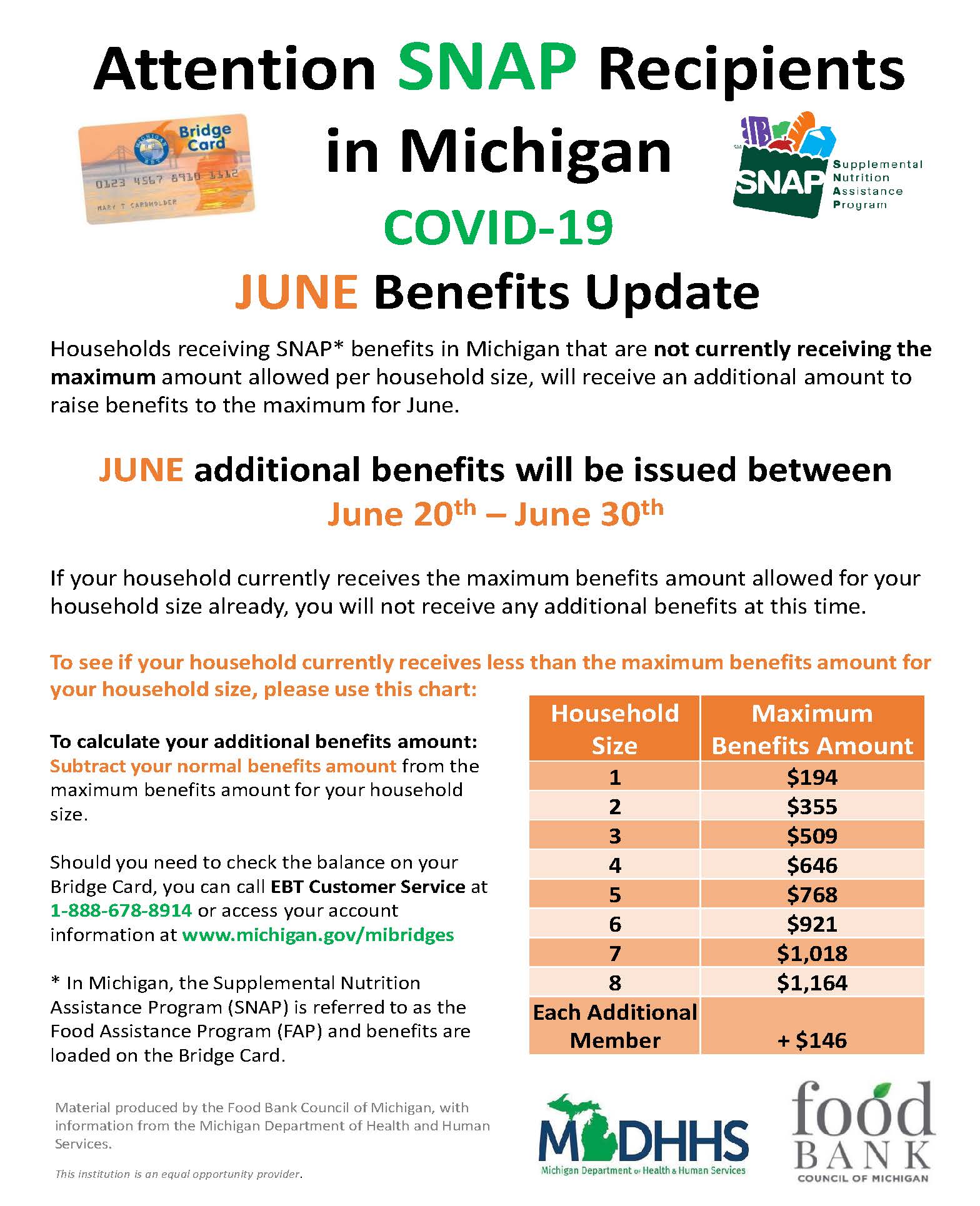
Households eligible for Food Assistance Program benefits will receive additional benefits in November to bring all current SNAP cases to the maximum monthly allowance for that group size. This change only applies to customers not currently receiving the maximum benefit amount. The 350,000 households that receive increased benefits represent more than 50 percent of the more than 682,000 Michigan households that received food assistance in September. The remaining households already receive the maximum benefit.

The table below shows the maximum allowable benefit for SNAP customers based on their respective household size: 

One Person Two PersonsThree PersonsFour PersonsFive PersonsSix PersonsSeven Persons Eight Persons 
$204$374$535$680$807$969$1,071$1,224

The federal government is providing additional funding to states for food assistance under House Resolution 6201, the Families First Coronavirus Response Act.

Eligible families do not need to re-apply to receive the additional benefits. People who receive food assistance can check their benefits balance on their Michigan Bridge Card by going online to  www.michigan.gov/MIBridges a consumer service representative toll-free at 888-678-8914. They can ask questions about the additional benefits by calling or emailing their caseworker.

Customer service is available 24 hours a day, 7 days a week. Spanish and Arabic service is available. If you are deaf, deafblind, or hard of hearing or speech-impaired, call the Michigan Relay Center at 7-1-1.

Information around the COVID-19 outbreak is changing rapidly. The latest information is available at  Michigan.gov/Coronavirus and CDC.gov/Coronavirus.  

GRPS shares updated P-EBT info

unnamedThe Grand Rapids Public Schools just shared these P-EBT updates and information.

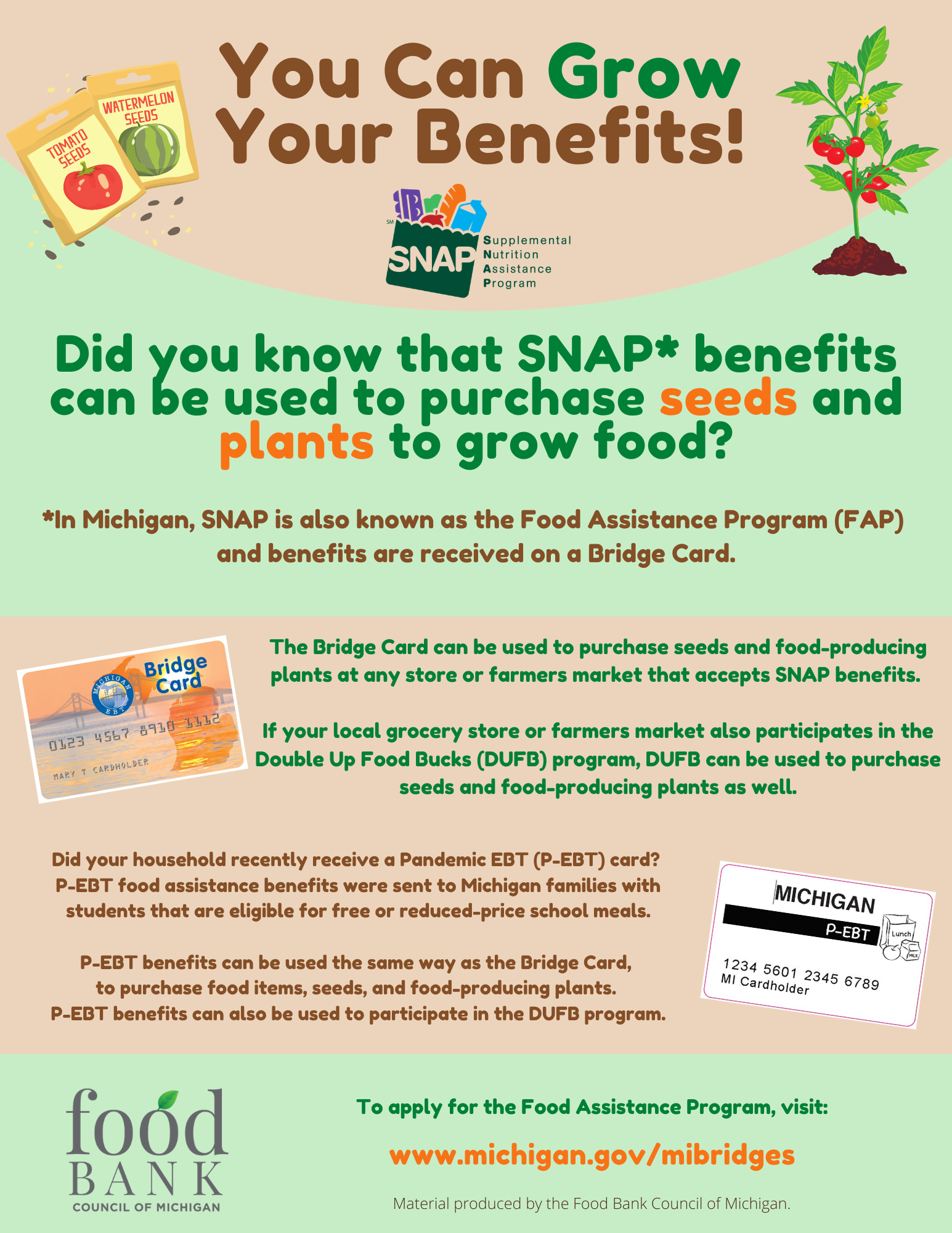
Pandemic Electronic Benefit Transfer Program (P-EBT) food assistance benefits will go to Michigan families with students ages 0-26 that are eligible for Free or Reduced-Price School Meals. This includes families currently receiving Food Assistance Program (FAP) benefits, as well as those not currently enrolled in the program. No application is necessary for eligible families to receive P-EBT benefits.

Program Information

Q: When will P-EBT cards be mailed out?
A: P-EBT benefits are being distributed in waves. The first round of benefits for families with active Food Assistance Program cards started last week and will continue to be distributed through the first week of May. The benefit will go to their bridge card. Families that do not have a bridge card will be mailed a P-EBT card. These cards will also be distributed in waves. The first cards start mailing out April 26th and will continue through the middle of May. Instructions are being mailed out for how to use and activate the card.
Again, it will take until the middle of May for cards to be mailed out. Please encourage families to hold off on calling DHHS with inquiries and wait for the first round of mailing to go out.

Q: Will there be directions on how to use the card?
A: There will directions mailed about a week ahead of the card. To activate the card, call the phone number on the back of the card. You will need the EBT card number on the front of the card, your zip code, and the date of birth of the oldest child in your household. You will need to set a four-digit pin number

Q: What address will the P-EBT card be sent to?
A: If the student was already receiving SNAP benefits, they will automatically receive the P-EBT benefits on their current Food Assistance Program (FAP) card. If the student is eligible based on a Free or Reduced-Price Meal Application, a new P-EBT card will go to the address in the Michigan Student Data System.

Q: Will there be an email or phone number available for parent questions regarding the P-EBT cards?
A: MDHHS is processing cards in batches thru mid-May. If you receive calls on P-EBT cards you may supply them with this number 1-833-905-0028. Keep in mind they might not answer the questions until then.

P-EBT Student Eligibility

Q: I have multiple school-age children, how much will our family be eligible for?
A: The pre-loaded Pandemic-EBT card will come in the mail and will be in the oldest school aged child’s name, not the parents name. Keep the card for ongoing benefits you may receive. The benefit amount for March/April is $193.80 per child and will be available by the end of April. The benefit amount for May/June is $182.40 per child and will be available by the end of May.

Q: For students that attend a CEP school, will all families be eligible for the P-EBT program automatically
A: In schools where all students receive free lunch and breakfast, which in Michigan is the Community Eligibility Provision (CEP), all students will automatically receive the P-EBT benefits.

Q: Do schools need to send anything over to the Michigan Department of Education?
A: For non-CEP schools, eligibility for P-EBT was based on data reported in the Supplemental Nutrition Eligibility (SNE) field in the Michigan Student Data System (MSDS) Spring Collection.
Updated addresses or student eligibility will need to be submitted through the Student Record Maintenance in the MSDS. Records that are submitted by the April 28th SRM will be eligible for April, May and June P-EBT benefits. Records that are submitted for the May 12th and 26th SRM will be eligible for May and June P-EBT benefits.

Q: Are Head Start and/or Great Start Readiness Program (GSRP) families receiving the P-EBT card?
A: Students in Great Start Readiness Programs, GSRP/Headstart Blends, Early Headstart, and Headstart that were reported as part of the Early Childhood Collection as eligible for Free and Reduced-Price Meals or directly certified have been included.

Q: Are students who attend non-public schools eligible for P-EBT?
A: Directly certified students who attend non-public schools were included in the list of students eligible for P- EBT. If the student was already receiving SNAP benefits, they will automatically receive the P-EBT benefits on their card. For other directly certified students without an address with DHHS or the Michigan Student Data System (MSDS), the card will be sent to the school and the school must mail the cards to the families.
If a student was a shared time student with a public school and that school reported the student in the Michigan Student Data System (MSDS) as eligible for Free and Reduced-Price Meals, they will receive the benefit through the public school’s reporting.
There is not a state collection where F/R application eligible students are reported, but we are working on ways to try and include them at a later date.

Q: Are 18-26 special education students eligible for P-EBT?
A: Eligible, enrolled special education students are eligible for P-EBT.

Q: Do children that are homeschooled qualify for this program?
A: Unfortunately, homeschool children were not included in the list for P-EBT because they are not in the public school records. However, all Michigan children are eligible to participate in one of available Meet Up Eat Up sites. You can look for the closest site to your home at: www.michigan.gov/meetupeatup or Dial 211 to find out more information on resources in your local community.

New Free and Reduced Applications

Q: Will newly eligible students, through Direct Certification or an approved Free or Reduced-Price application, be eligible for P-EBT.
A: Yes, students with new eligibility will qualify for P-EBT. Updated student eligibility will need to be submitted through the Student Record Maintenance (SRM) in the Michigan Student Data System (MSDS). Records that are submitted by the April 28th SRM will be eligible for April, May and June P-EBT benefits. Records that are submitted for the May 12th and 26th SRM will be eligible for May and June P-EBT benefit.

Q: For families with multiple children, how will the card be loaded?
A: The pre-loaded P-EBT card will come in the mail and will be in the oldest school aged child’s name, not the parents name.

Q: What do GRPS families do if they did not receive a communication in the mail from the state about P-EBT benefits?
A: Families should be referred to Steve Slabbekoorns in Nutrition Services. He is available at 819-2135 or email at slabbekoorns@grps.org. Nutrition Services will work with Student Data Systems to submit updated data to the state system.

Pandemic Electronic Benefit Transfer Program (P-EBT) Frequently Asked Questions (Spanish)

Pandemic Electronic Benefit Transfer Program (P-EBT) Frequently Asked Questions (Kinyarwanda)

Pandemic Electronic Benefit Transfer Program (P-EBT) Frequently Asked Questions (Swahili)

ebt