Archives

Learn to plant and grow garlic!

OKT invites you to Plant, Cook & Eat GARLIC!

  • Free! Saturday Nov. 3, 10 a.m. to 12 p.m.
  • Logan Street Garden, 1416 Logan SE

Learn how to grow your own garlic. A tasty addition to many dishes, garlic also helps your body fight off colds, flu and infections.

Notes from last year’s Bicycle Tour of Fruit and Nut Trees

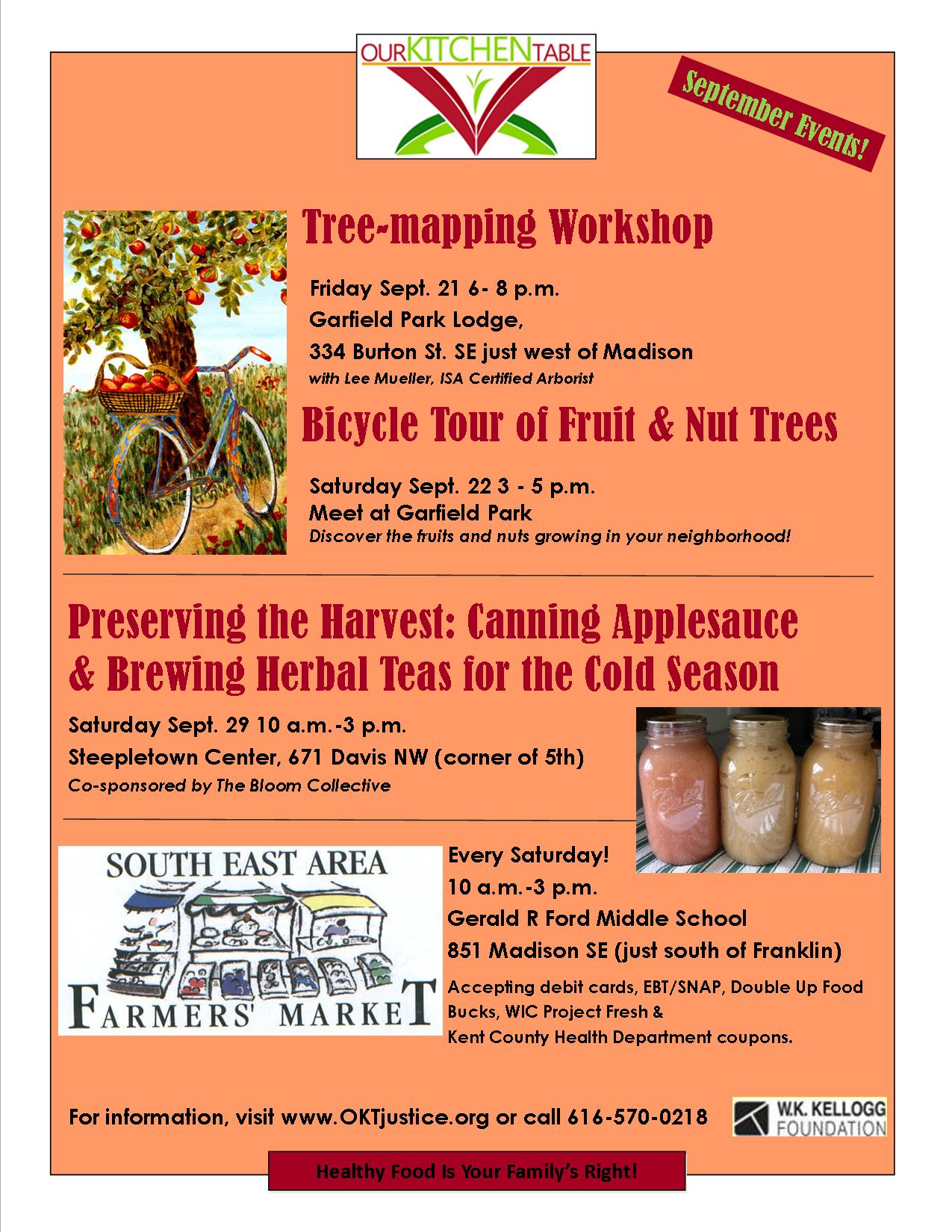
This week’s activities!
  • Thursday Oct. 5: 
    Tree-mapping Workshop with Lee Mueller, 6-8 p.m. , Kroc Center, 2500 Division Ave. South
  • Saturday Oct. 6: 
    2012 Bicycle Tour of Fruit and Nut Trees
    with Forager & Cyclist, Laura Casaletto
    2-4 p.m. 
    Meet at Garfield Park’s Madison Avenue parking lot,
    south of Burton Street SE

Last fall, a dozen or so folks met in Eastown for OKT’s Bicycle Tour of Fruit and Nut Trees. Sunny skies, comfortable temperatures and a brisk breeze made for a lively, enjoyable ride.

Seasoned cyclist, Josh McBryde, planned the route and led the tour across Wealthy Street and over to Cherry Park. On the way there, tree expert, Laura Cassaletto, pointed out various trees and their edible uses, bringing the group to its first stop alongside an old apple tree, full of ripe fruit, outside of a two-flat apartment house.

After assuring us that she had gotten permission from the property’s owner, Laura invited everyone in the group to pick and enjoy an apple. She mentioned that the tree’s owner had told her that the apples were not good for eating as they had not been sprayed with pesticides. The group broke into laughter. And, with a close eye for worms,we took bites of the “imperfect” fruit. All were amazed at the incredible flavor these small, old fashioned, untended apples offered.

Laura recommended foraging such untended apple trees around the city. She likes to use them for applesauce. When the apples are put through the food mill, it’s easy to pick out any critters that might have eaten their way inside the fruit.

In Cherry Park, the group identified different varieties of nut trees, scavenged nuts from off the ground and even cracked and ate a few. Heading back across the neighborhood, a stop near Diamond and Cherry yielded a look at mulberry trees (already done fruiting) as well as locust trees. Seasoned urban forager, Richa, shared that the spring flowers from the locust tree are delicious. (At the conclusion of the tour, he shared a loaf of his homemade acorn bread).

Crab apples, yes.

Along the route, Laura pointed out that ornamental crab apple trees have edible fruit. She explained that crab apple trees are related to the rose, and like the rose, are edible. High in vitamin C, their edible fruit can be identified by the “crown” at the bottom of the fruit. While fruit with a crown is edible, she warned not to forage white fruit and berries, “White is the color of death.”

She also advised us to try new foraged fruits and nuts in small quantities to see how our own body reacts to it. Because trees, like people, are individuals, the fruits and berries eaten from them have differences in flavor and in how they align with each individual person’s digestive system.

Bittersweet, no.

In Wilcox Park, the group snacked on plump wild grapes and tried edible, though bitter, viburnum berries. We also learned that the colorful bittersweet nearby was just for decoration and not an edible.  The group ended its tour at Aquinas College, where Josh handed out tree identification maps the college provides to visitors. We stopped to gather, crack and snack on beech nuts beneath an elephantine beech tree.

A 16-year-old on the tour remarked, “It was so cool to learn that if I had to, I could get enough to eat from nature.” Cool indeed. Food is growing all around us. Let’s learn to appreciate it!

Skill-share, “Canning Applesauce & Brewing Herbal Teas for the Cold Season” this Saturday

Our Kitchen Table hosts the last in its 2012 series, Preserving the Harvest, with a skill share on Canning Applesauce & Brewing Herbal Teas for the Cold Season. Co-sponsored by The Bloom Collective, the event takes place upstairs from The Bloom space in the kitchen of Steepletown Center, 671 Davis NW (corner of 5th) this Saturday, Sept. 29 from 2 – 4 p.m.

Facilitated by Jeff Smith, from The Bloom Collective, and Stelle, from The Bloom and OKT, the skill-share is free and open to everyone. OKT will provide fruit and jars.

OKT initiated the Preserving the Harvest series not as a way to jump on board the current “canning bandwagon,” but as part of its efforts to build an alternative food system within Grand Rapids’ neighborhoods. Canning your own food is easy and cheaper – you end up with a superior product when it comes to nutrition and flavor.

In addition, canning your own locally grown food takes you a step away from the industrial food system, a food system that is environmentally unsustainable, nutritionally bankrupt and profits by underpaying farmers and farm workers.

Are you one of the millions of Americans without health insurance? Brewing your own cold season remedies can provide you a gentle, inexpensive alternative to often dangerous prescription and over the counter remedies. We will look at simple teas that help relieve symptoms of sinus congestion, sore throat, cough and tummy troubles. If you have your own remedies, please bring them along to share.

Hip-hop artist Invincible, Complex Movements in GR for performance & dialogue with area community organizers

Complex Movements presents…

Beware of the Dandelions: 
Connecting Grassroots Communities in Detroit and Grand Rapids. 

at SiTE:LAB
(Old Public Museum 54 Jefferson)
Saturday Sep 22 6pm-9pm

REFLECT on the ways we approach the work of transforming ourselves, our communities, and the world

ENGAGE in conversation about networks, new forms of organization and leadership, drawing lessons from quantum physics, emergence, and other complex science theories

REDEFINE change from critical mass to critical connections, from growing our economy to growing our souls, from representative democracy to participatory self-governing communities

CONNECT communities working for change within Detroit and Grand Rapids to one another, and to communities around the world

Complex Movements collective member and Detroit hip-hop artist and activist Invincible will facilitate a workshop on these topics featuring community workers from Heartside Gallery, GRIID, Our Kitchen Table, The Bloom Collective4TLOHH and beyond. Participants will create the opportunity draw connections between small scale deep rooted community movement building happening in Grand Rapids and Detroit, through the lens of complex science and social movements.

An excerpt of Complex Movements installation performance piece “Three Phases” will also be presented as part of the workshop.

This event is FREE, ALL AGES, and ANTI-DISPLACEMENT

‘Complex Movements’ is a Detroit based artist collective composed of graphic designer/fine artist Wesley Taylor, music producer/filmmaker Waajeed, and hip-hop lyricist/activist Invincible. Their multimedia performance installations, hand crafted songs, and trans-genre experiments explore the relationship between complex science and social change movements. ‘Complex Movements’ is a recipient of the 2012 MAP Fund grant and Michigan ArtServe’s CSA grant. They have presented their work at The Detroit Science Center for Kresge’s Art X Detroit festival, Re:View Gallery, Network of Ensemble Theater’s Microfest, and Cranbrook Art Museum. They are joined at this installation by jeweler Tiff Massey, as well as creative technologists AJ Manoulian and Carlos (L05) Garcia.

EMERGENCEmedia.org

Preserving the Harvest: Canning Tomatoes

Our Kitchen Table hosted a skill share on canning tomatoes Saturday August 25. Just about everybody present had tips on making the process easier (not that it is difficult!)

This slideshow requires JavaScript.

To begin, we washed the jars, rings and lids in hot soapy water then rinsed. While most heirloom and organic tomatoes don’t need to be peeled before canning because they have thinner skins, we had a thicker skinned variety. To make peeling easier, participant Deirdre Cunningham shared that we should use a knife to score the bottoms of the tomatoes with an X. We then scalded them in boiling water for one minute and cooled in cold water for one minute–the skins practically popped right off.

Next, we sliced the tomatoes in quarters. We added a teaspoon of kosher salt and a teaspoon of lemon juice to each pint jar before packing to the bottom of the rim with fruit–yes, tomatoes are a fruit! The lemon juice adds acidity to help prevent spoiling.

After wiping the jar rim tops with a clean cloth to ensure a good seal, we put on the lids and rings. Then, we processed them in a pressure canner for ten minutes at 5 pounds pressure. If we had used a regular canning kettle, we would have processed them for 45 minutes. Every jar sealed!

We used canning tongs to remove the hot jars to the counter on top of a couple dish towels to cool, taking special care not to jostle the jars (which could interfere with the seal). It’s best not to move the jars until cool, if possible.

Yes you can can.

The last Saturday of the month, Our Kitchen Table has been presenting canning workshops as a Southeast Area Farmers Market activity. In June, participants made low-sugar strawberry jam and in July, garlic dill pickles. The next canning class is August 25. We will be canning and oven roasting tomatoes.


Canning at food used to be a regular summer activity for many families across the US. Some of us can remember going to granny’s house and seeing the basement shelves filled with canned peaches, tomatoes and pickles.


While few households do it food today, canning still has many advantages. One, you can buy fresh, local, nutritious produce in season at a lower price. Two, you don’t have to worry about toxic chemicals and high amounts of sugar or high fructose corn syrup being added. (Go to the grocery store and try to find pickles without chemical additives!) Three, it’s simply delicious!


The corporate food system has scared us away from canning. They’ve put a false message out there that canning is difficult to do, can result in food poisoning and requires all kinds of fancy equipment. Not true! Did you know that just about all reported food poisoning issues came from factory canned foods not home canned foods? Canning is simple. You can do small batches. And, you don’t need to invest a lot to get started.


Stop by the farmers’ market for fresh local produce 2 to 7 p.m. Friday at Gerald R Ford Middle School, and 10 a.m. to 3 p.m. Saturday at Garfield Park.

Urban foraging workshops at farmers’ markets this weekend

Where the Wild Things Grow Urban Foraging Workshops

  • 4 – 6 p.m. Friday August 10 at Gerald R Ford Middle School with Ms. Yvonne Woodard, market manager and Master Gardener
  •  12 – 2 p.m. Saturday August 11 at Gerald R. Ford Middle School with Kristin Tindall, Blandford Nature Center

The Southeast Area Famers’ Market will host Urban Foraging Workshops for the second year in a row, 4 – 6 p.m. Friday August 10 and 12 – 2 p.m. Saturday August 11 at Gerald R Ford Middle School.  Just like the grocery stores have helped us forget that food comes from farms, cultivation of domestic crops has helped us forget that many of the native species we see around us (and label as weeds) once were a prize source of both food and medicine.
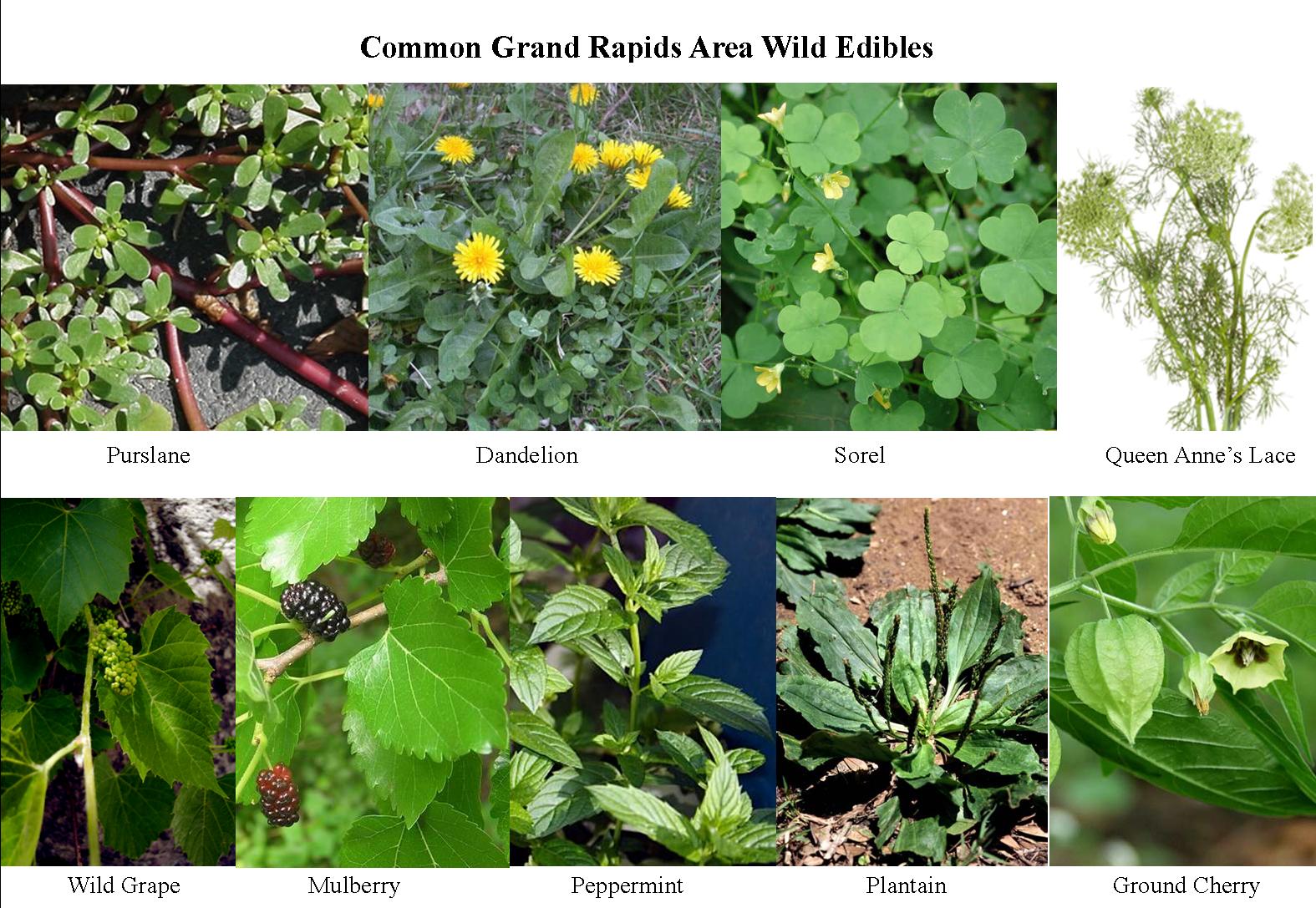
Last year, people attending the workshop learned how to identify the following edible plants—all of which grow in Grand Rapids neighborhoods.

  • Purslane, dandelion and sorrel: delicious salad greens
  • Queen Anne’s lace: Deep fry the flowers.
  • Wild grape and mulberry leaves: wrap rice and meat mixtures, think Middle Eastern cuisine.
  • Mulberries:  a great summer fruit snack and delicious made into jelly or jam.
  • Peppermint:  brew as tea to settle an upset stomach; chew a leaf instead of a breath mint.
  • Plantain: the leaves can relieve insect bites and bee stings. Roll and crush the leaf, apply it to the sting, use a whole leaf as a “band-aid” to hold the crushed mixture in place.

When foraging, make sure you pick plants from an area that has not been chemically contaminated. For example, utility companies usually spray a swath of herbicides under electricity towers.

The Southeast Area Farmers’ Market is open Fridays from 2 to 7 p.m. at Gerald R Ford Middle School, Madison Ave. and Franklin St. SE and Saturdays from 10 a.m. to 3 p.m. at Garfield Park, Madison Ave. and Burton St. SE. Both market locations accept cash, debit cards, EBT/SNAP, Double Up Food Bucks, WIC Project Fresh and Kent County Health Department coupons.

In a pickle

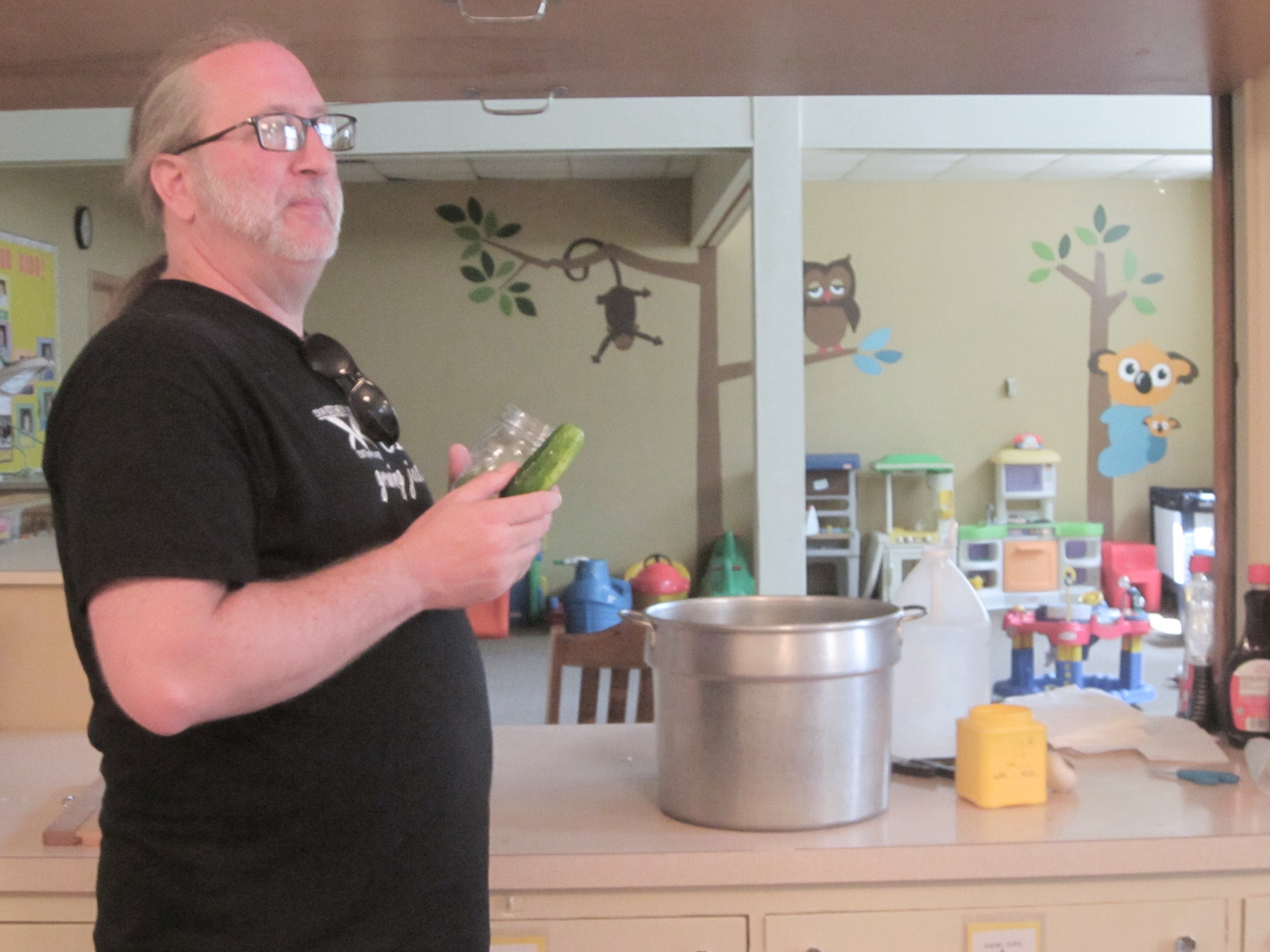
OKT Collaborative Partner, Jeff Smith, facilitated the “How to Can Pickles” workshop.

Last Friday and Saturday were busy days for the Our Kitchen Table staff. At the Southeast Area Farmers’ Market, OKT market manager, Yvonne Woodard led “Make Your Own Soap” workshops both Friday and Saturday. Later on Saturday, Stelle Slootmaker, OKT’s communication person, and Jeff Smith, an OKT collaborative partner, facilitated a dill pickle canning workshop.

It’s really easy to can your own pickles. You’ll save money and avoid the chemical preservatives added to most store-bought pickles. Do you have extra cucumbers? Do you love dill pickles? Jeff shared his grandmother Robena Dove’s  tried and truly delicious garlic dill pickles recipe along with some simple canning hints.

Robena Dove’s  Garlic Dill Pickles

Ingredients

  • Cucumbers, small whole or sliced to fit jars.
    1 peck of pickle cucumbers will yield approximately 20 quarts or 40 pints of pickles. However, you can do just a few jars if that works better for you.
  • Sea salt
  • Peppercorns
  • White vinegar
  • Raw garlic cloves
  • Dill weed

Supplies:

  • Large kettle for brine
  • Canning kettle with rack for jars
  • Canning jars, lids and rings
  • Hot Pad, tongs
  • Dish towels
  • Cutting board and knife
  • Large ladle
  • Canning funnel

Directions

  1. Wash pickles and dill thoroughly. Peel garlic cloves. Wash jars and lids in hot soapy water. Rinse well. Check jar rims to make sure they are not chipped (this will prevent sealing).
  1. Brine. Mix water, vinegar and salt in large kettle and bring to boil. Lower heat to keep simmering.
  1. Begin heating water in canning kettle. Use enough water to barely submerge jars, or a little less.
  1. Place some dill, peppercorns and a 2 0r 3 cloves of garlic in each jar. Stuff pickles into jars tightly. Slice some if needed to fill jars up to (but not higher than) the bottom of the jar rim. Pour hot brine into jars up to rim bottom (1/2 inch from top of jar).
  1. Wipe the top of the jar rims off with a clean cloth. Dry jar lids and place on jars. Secure with a screw on rings.
  1. When canning kettle water is boiling, place jars in rack and lower into kettle. Cover. Watch heat so that the kettle is barely boiling, but not too vigorously. Process for 20 minutes.
  1. Turn off heat. Remove cover. Using canning tongs or a hot pad, gently remove the jars of pickles and place on dish cloths on counter a few inches apart. Do not disturb! Watch to see if the jars make a “pop” sound indicating that they have sealed. In four or five hours, check cooled jars to see if they have sealed by pressing gently on the center of the lid. If the lid goes down and pops back up under pressure, it is not sealed. Keep unsealed jars in the fridge. Sealed jars can be stored at room temperature for a year or more.

Whenever opening a jar for consumption, make sure the seal is good (you will hear a “pop” when you open it). If the contents have discolored, look foamy or have a bad odor, throw away.

This slideshow requires JavaScript.

Free Healthy Food Action Health Webinar

Healthy Food, Healthy Farms Webinar Series


Chicken, Life-threatening UTIs and Women’s Health
Wednesday, Aug. 8th
1:30pm CDT
11:30 am PT~12:30 pm MT~2:30 pm ET

With 6-8 million cases per year, urinary tract infections primarily impact women. As many as 85 percent of UTIs are caused by E. coli bacteria, most often a specific form of E. coli known as ExPEC. ExPEC are believed to cause up to 40,000 deaths from bloodstream infections each year. As they get more resistant to antibiotics, ExPEC infections and resulting deaths will rise. It’s a troubling trend, given that these infections are already becoming more antibiotic resistant. This webinar focuses on the new, compelling science showing that women are contracting ExPEC infections from eating contaminated chicken. What’s more, we are now finding that chickens raised in environments where antibiotics are routinely added to chicken feed for growth promotion has helped create this problem. Read more and register