Archives

OKT’s signing up food gardeners!

Beverly Weathersby on the job last summer in her work on OKT’s garden posse.

Are you interested in planting your own food garden and don’t know where to start? Do you have a food garden and want to find ways to make it more productive? OKT is currently signing up qualified residents of Baxter, SECA/Southtown, Eastown and Garfield Park neighborhoods to participate in this year’s food growing program.

These food gardeners will be able to access garden resources such as organic starter food plants, chemical free compost, soil testing and garden coaching. Starter food plants will be distributed twice to participating gardeners—the beginning of June, when the gardens are first planted, and again in July, when cold crops can be planted.

Ms. Weathersby will again lead OKT’s Garden Posse,  coaching southeast Grand Rapids gardeners participating in OKT’s food gardening program. Last year, for the most part, our gardeners rented their homes; food plants were grown in containers.

The women of OKT are hoping even more Southeast area neighbors will join us in growing and sharing even more fresh, healthy food. For information, visit www.OKTjustice.org or call 616-570-0218.

Global Day of Action: Occupy Our Food Supply February 27

Global Day of Action: Occupy Our Food Supply

Originally posted by Common Dreams

An alliance of Occupy groups, environmental and food justice organizations have called for a global day of action on February 27 to resist corporate control of our food system and to work towards a healthy food supply for all.

Occupy Our Food Supply is a call facilitated by Rainforest Action Network and is supported by over 60 Occupy groups and over 30 organizations including Family Farm Defenders, National Family Farms Coalition and Pesticide Action Network.

Ashley Schaeffer, Rainforest Agribusiness campaigner with Rainforest Action Network says of the day of action:

“Occupy our Food Supply is a day to reclaim our most basic life support system – our food – from corporate control. It is an unprecedented day of solidarity to create local, just solutions that steer our society away from the stranglehold of industrial food giants like Cargill and Monsanto,”

Occupy Our Food Supply supporter Vandana Shiva says:

“Our food system has been hijacked by corporate giants from the Seed to the table. Seeds controlled by Monsanto, agribusiness trade controlled by Cargill, processing controlled by Pepsi and Philip Morris, retail controlled by Walmart – is a recipe for Food Dictatorship. We must Occupy the Food system to create Food Democracy.”

Occupy Wall Street’s Sustainability and Food Justice Committees also issued a letter in support of the day of action:

“On Monday, February 27th, 2012, OWS Food Justice, OWS Sustainability, Oakland Food Justice & the worldwide Occupy Movement invite you to join the Global Day of Action to Occupy the Food Supply. We challenge the corporate food regime that has prioritized profit over health and sustainability. We seek to create healthy local food systems. We stand in Solidarity with Indigenous communities, and communities around the world, that are struggling with hunger, exploitation, and unfair labor practices.”

“On this day, in New York City, community gardeners, activists, labor unions, farmers, food workers, and citizens of the NYC metro area, will gather at Zuccotti Park at noon, for a Seed Exchange, to raise awareness about the corporate control of our food system and celebrate the local food communities in the metro area.”

Vandana Shiva:  “We must Occupy the Food system to create Food Democracy.”

“When our food is at risk, we are all at risk.”

In an op-ed on the Huffington Post today, Farm Aid president Willie Nelson and sustainable food advocate Anna Lappé, supporters of the day of action, emphasize that the consolidation of our food supply is harming the environment, food safety and farmers:

Our food is under threat. It is felt by every family farmer who has lost their land and livelihood, every parent who can’t find affordable or healthy ingredients in their neighborhood, every person worried about foodborne illnesses thanks to lobbyist-weakened food safety laws, every farmworker who faces toxic pesticides in the fields as part of a day’s work.

When our food is at risk we are all at risk.

Over the last thirty years, we have witnessed a massive consolidation of our food system. Never have so few corporations been responsible for more of our food chain. Of the 40,000 food items in a typical U.S. grocery store, more than half are now brought to us by just 10 corporations. Today, three companies process more than 70 percent of all U.S. beef, Tyson, Cargill and JBS. More than 90 percent of soybean seeds and 80 percent of corn seeds used in the United States are sold by just one companyMonsanto. Four companies are responsible for up to 90 percent of the global trade in grain. And one in four food dollars is spent at Walmart.

What does this matter for those of us who eat? Corporate control of our food system has led to the loss of millions of family farmers, the destruction of soil fertility, the pollution of our water, and health epidemics including type 2 diabetes, heart disease, and even certain forms of cancer. More and more, the choices that determine the food on our shelves are made by corporations concerned less with protecting our health, our environment, or our jobs than with profit margins and executive bonuses.

This consolidation also fuels the influence of concentrated economic power in politics: Last year alone, the biggest food companies spent tens of millions lobbying on Capitol Hill with more than $37 million used in the fight against junk food marketing guidelines for kids.

The Occupy Our Food Supply website indicates that the action is Inspired by the theme of CREATE/RESIST, and that in addition to confronting the corporation control of our food supply, we must work towards solutions to make healthy food accessible to everyone. It invites people to share their fair food solutions on their Facebook page and on Twitter using the #F27 hashtag.

* * *

Eric Holt-Giménez, Institute for Food and Development Policy/Food First Executive Director, writes that while the demand to fix the food system seems reasonable, it does not address the “inequitable foundations of the global food system.”

The goal of food justice activists is a sustainable and equitable food system. Their strategy is to actively construct this alternative. Tactics include community gardens, CSAs, organic farming, etc. The problem is that this combination of strategy and tactics only addresses individual and institutional inequities in the food system, leaving the structure of the corporate food regime intact. The food justice movement has no strategy to address the inter-institutional (i.e. structural) ways that inequity is produced in the food system. By openly protesting the excesses of capitalism, Occupy does address this structure. This is why the convergence of Occupy and the food justice movement is so potentially powerful — and why it is feared. The political alignment of these movements, however, is no small challenge.

The Seed Emergency: The Threat to Food and Democracy

This article by Vandana Shiva is re-posted from ZNet and GRIID.

The seed is the first link in the food chain – and seed sovereignty is the foundation of food sovereignty. If farmers do not have their own seeds or access to open pollinated varieties that they can save, improve and exchange, they have no seed sovereignty – and consequently no food sovereignty.

The deepening agrarian and food crisis has its roots in changes in the seed supply system, and the erosion of seed diversity and seed sovereignty.

Seed sovereignty includes the farmer’s rights to save, breed and exchange seeds, to have access to diverse open source seeds which can be saved – and which are not patented, genetically modified, owned or controlled by emerging seed giants. It is based on reclaiming seeds and biodiversity as commons and public good.

The past twenty years have seen a very rapid erosion of seed diversity and seed sovereignty, and the concentration of the control over seeds by a very small number of giant corporations. In 1995, when the UN organised the Plant Genetic Resources Conference in Leipzig, it was reported that 75 per cent of all agricultural biodiversity had disappeared because of the introduction of “modern” varieties, which are always cultivated as monocultures. Since then, the erosion has accelerated.

The introduction of the Trade Related Intellectual Property Rights Agreement of the World Trade Organisation has accelerated the spread of genetically engineered seeds – which can be patented – and for which royalties can be collected. Navdanya was started in response to the introduction of these patents on seeds in the General Agreement on Tariffs and Trade – a forerunner to the WTO – about which a Monsanto representative later stated: “In drafting these agreements, we were the patient, diagnostician [and] physician all in one.” Corporations defined a problem – and for them the problem was farmers saving seeds. They offered a solution, and the solution was to make it illegal for farmers to save seed – by introducing patents and intellectual property rights [PDF] on those very seeds. As a result, acreage under GM corn, soya, canola, cotton has increased dramatically.

Threats to seed sovereignty

Besides displacing and destroying diversity, patented GMO seeds are also undermining seed sovereignty. Across the world, new seed laws are being introduced which enforce compulsory registration of seeds, thus making it impossible for small farmers to grow their own diversity, and forcing them into dependency on giant seed corporations. Corporations are also patenting climate resilient seeds evolved by farmers – thus robbing farmers of using their own seeds and knowledge for climate adaptation.

Another threat to seed sovereignty is genetic contamination. India has lost its cotton seeds because of contamination from Bt Cotton – a strain engineered to contain the pesticide Bacillus thuringiensis bacterium. Canada has lost its canola seed because of contamination from Roundup Ready canola. And Mexico has lost its corn due to contamination from Bt Cotton.

After contamination, biotech seed corporations sue farmers with patent infringement cases, as happened in the case of Percy Schmeiser. That is why more than 80 groups came together and filed a case to prevent Monsanto from suing farmers whose seed had been contaminated.

As a farmer’s seed supply is eroded, and farmers become dependent on patented GMO seed, the result is debt. India, the home of cotton, has lost its cotton seed diversity and cotton seed sovereignty. Some 95 per cent of the country’s cotton seed is now controlled by Monsanto – and the debt trap created by being forced to buy seed every year – with royalty payments – has pushed hundreds of thousands of farmers to suicide; of the 250,000 farmer suicides, the majority are in the cotton belt.

Seeding control

Even as the disappearance of biodiversity and seed sovereignty creates a major crisis for agriculture and food security, corporations are pushing governments to use public money to destroy the public seed supply and replace it with unreliable non-renewable, patented seed – which must be bought each and every year.

In Europe, the 1994 regulation for protection of plant varieties forces farmers to make a “compulsory voluntary contribution” to seed companies. The terms themselves are contradictory. What is compulsory cannot be voluntary.

In France, a law was passed in November 2011, which makes royalty payments compulsory. As Agriculture Minister Bruna Le Marie stated: “Seeds can be longer be royalty free, as is currently the case.” Of the 5,000 or so cultivated plant varieties, 600 are protected by certificate in France, and these account for 99 per cent of the varieties grown by farmers.

The “compulsory voluntary contribution”, in other words a royalty, is justified on grounds that “a fee is paid to certificate holders [seed companies] to sustain funding of research and efforts to improve genetic resources”.

Monsanto pirates biodiversity and genetic resources from farming communities, as it did in the case of a wheat biopiracy case fought by Navdanya with Greenpeace, and climate resilient crops and brinjal (also known as aubergine or eggplant) varieties for Bt Brinjal. As Monsanto states, “it draws from a collection of germ-plasm that is unparalleled in history” and “mines the diversity in this genetic library to develop elite seeds faster than ever before”.

In effect, what is taking place is the enclosure of the genetic commons of our biodiversity and the intellectual commons of public breeding by farming communities and public institutions. And the GMO seeds Monsanto is offering are failing.  This is not “improvement” of genetic resources, but degradation. This is not innovation but piracy.

For example, the Alliance for a Green Revolution in Africa (AGRA) – being pushed by the Gates Foundation – is a major assault on Africa’s seed sovereignty.

Agribusiness

The 2009 US Global Food Security Act [PDF] also called the Lugar-Casey Act [PDF], “A bill to authorise appropriations for fiscal years 2010 through 2014 to provide assistance to foreign countries to promote food security, to stimulate rural economies, and to improve emergency response to food crisis, to amend the Foreign Assistance Act of 1961 and for other purposes”.

The amendment to the Foreign Assistance Act would “include research on bio-technological advances appropriate to local ecological conditions, including genetically modified technology”. The $ 7.7bn that goes with the bill would go to benefit Monsanto to push GM seeds.

An article in Forbes, titled “Why Uncle Sam Supports Franken Foods”, shows how agribusiness is the only sector in which US has a positive trade balance. Hence the push for GMOs – because they bring royalties to the US. However, royalties for Monsanto are based on debt, suicidal farmers and the disappearance of biodiversity worldwide.

Under the US Global Food Security Act, Nepal signed an agreement with USAID and Monsanto. This led to massive protests across the country. India was forced to allow patents on seeds through the first dispute brought by the US against India in the WTO. Since 2004, India has also been trying to introduce a Seed Act which would require farmers to register their own seeds and take licenses. This in effect would force farmers from using their indigenous seed varieties. By creating a Seed Satyagraha – a non-cooperation movement in Gandhi’s footsteps, handing over hundreds of thousands of signatures to the prime minister, and working with parliament – we have so far prevented the Seed Law from being introduced.

India has signed a US-India Knowledge Initiative in Agriculture, with Monsanto on the Board. Individual states are also being pressured to sign agreements with Monsanto. One example is the Monsanto-Rajasthan Memorandum of Understanding, under which Monsanto would get intellectual property rights to all genetic resources, and to carry out research on indigenous seeds. It took a campaign by Navdanya and a “Monsanto Quit India” Bija Yatra [“seed pilgrimage”] to force the government of Rajasthan to cancel the MOU.

The Dangerous Sweet Tooth

This blog entry is re-posted from Dr. Sears Healthy Tips Newsletter

In America, the amount of sugar consumed yearly has increased by 30% since 1983 and has been linked to an increase in more than 60 different ailments including acne, arthritis, cancer (particularly breast and colon/rectal cancer), indigestion, heart disease, osteoporosis, ulcers, and obesity. The average American typically eats three times the recommended amount of sugar each day and consume their body weight in sugar each year.

Where is all this sugar coming from? Surprising to many, it’s not necessarily from just eating candy and drinking soda. Sugar is often one of the main ingredients in everyday food like bread, crackers, condiments, canned food, yogurt, chips, frozen meals, breakfast foods, beverages, and more! The low-fat food trend has caused an increase in the amount of sugar added to foods because when fat is taken out, flavor is lost. Sugar is then added to replace the lost flavor.

The problem with sugar is mainly a quality issue. The sugar that is added to foods is highly refined and lacks nutrition. During the refining process, important nutrients such as chromium, manganese, cobalt, copper, zinc, and magnesium are stripped away so the body has to use its own mineral reserves just to digest it. Sugar that is foundnaturally in foods like fruit andCommon forms of sugarveggies is not refined and oftencontain many additional nutrients. Honey is a natural food that can even help build immunity against certain seasonal allergies. Learning how to identify the different types and names of sugar is the first step to reducing our processed sugar intake.

Download the Sugar Handout for more information.

10 Tips to Reduce Your Sugar Intake

  1. Limit processed and packaged foods. Salad dressings, soups, sauces, and even bread contain high amounts of processed sugar.
  2. Sweeten naturally. Eating foods that are naturally sweet will help cut down on the amount of added processed sugar you consume.
  3. Avoid liquid sugar. Coffee, soda, tea, energy drinks, and even many smoothies or juice drinks contain a lot of added sugar. Look for 100% fruit smoothies and juice and add your own sugar to your tea or coffee using cubes or packets. If using cream, use half-and-half rather than the sweetened, flavored coffee creamers.
  4. Quality over quantity. Rather than buying a 2 lb bag of cheap candy, treat yourself to a rich dark chocolate truffle that you really enjoy. You will get more satisfaction from the one quality sweet than you will from the entire bag of the cheaper candy.
  5. Pack your own snacks. Keeping a few treats like almonds or dried fruit with you will reduce the urge to snack on candy at worksites, offices, or businesses.
  6. Read labels. If sugar (or a form of sugar) is listed in the first five ingredients, make a different choice.
  7. Start and end wisely. Avoid high-sugar/fat foods at breakfast and end your meals with a piece of fruit.
  8. Water not syrup. When buying canned fruit and veggies, choose ones that are canned in water or natural juices rather than sugar heavy syrups.
  9. Reduce in recipes. Try halving the amount of sugar used in most recipes or substituting a natural sugar instead of refined sugar.
  10. Cut down slowly. Don’t try to cut out sugar cold turkey. Start by reducing the amounts you eat little by little and you will be much more successful.

Southeast Area Farmers’ Market Vendor Spotlight: Vandalia Farms

Vandalia Farms, Cassopolis, Michigan

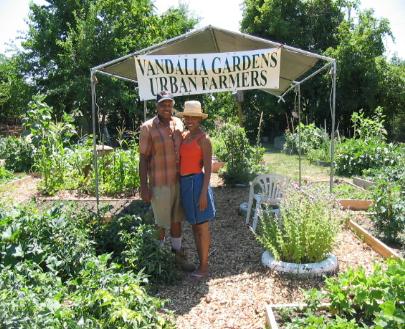
With the opening of the 2012 Southeast Area Farmer’s Market season more than four months away, you might think our vendors are enjoying some leisurely time off. Not so! Take a look at Ms. Leslie Huffman and Mr. Cornelius Williams from Vandalia Farms. After consulting with Grand Rapids neighborhood growers and OKT’s garden posse, Ms. Huffman placed an order for food-plant seeds. These seeds will be planted next month in specially selected growing medium at the former Molesta Greenhouse on Madison Avenue. The vacant greenhouse owner, Dave Molesta, let OKT grow seedlings there in 2011, as well.

In all, Ms. Huffman will oversee the planting, care and distribution of approximately 10,000 food plants. Many of these plants will be given to the gardeners and small farmers who sell produce at the Southeast Area Farmers’ Market. Others will go to yard gardeners and community gardens participating in OKT’s Food Diversity Project. The food you may be eating next summer is already on its way to being grown.

Mr. Williams comes from a long line of southwest Michigan black farmers. He began Vandalia Farms with Ms. Huffman in Detroit several years ago. He also taught other Detroit residents how to grow fruit and vegetables on vacant lots―and to make money from what they grew.

This past season, Mr. Williams also worked with OKT to build raised beds for demonstration gardens in southeast side Grand Rapids’ neighborhoods. In addition to farming and growing, Ms. Huffman also works as an experienced homebirth midwife. To her, the two occupations go hand in hand as healthier foods build healthier babies.

Vandalia Farms has since added a rural farm in Cassopolis. Be sure to sample the farm’s blueberries and chemical free vegetables when you visit Southeast Area Farmers’ Market next season!

Healthy food is a civil right

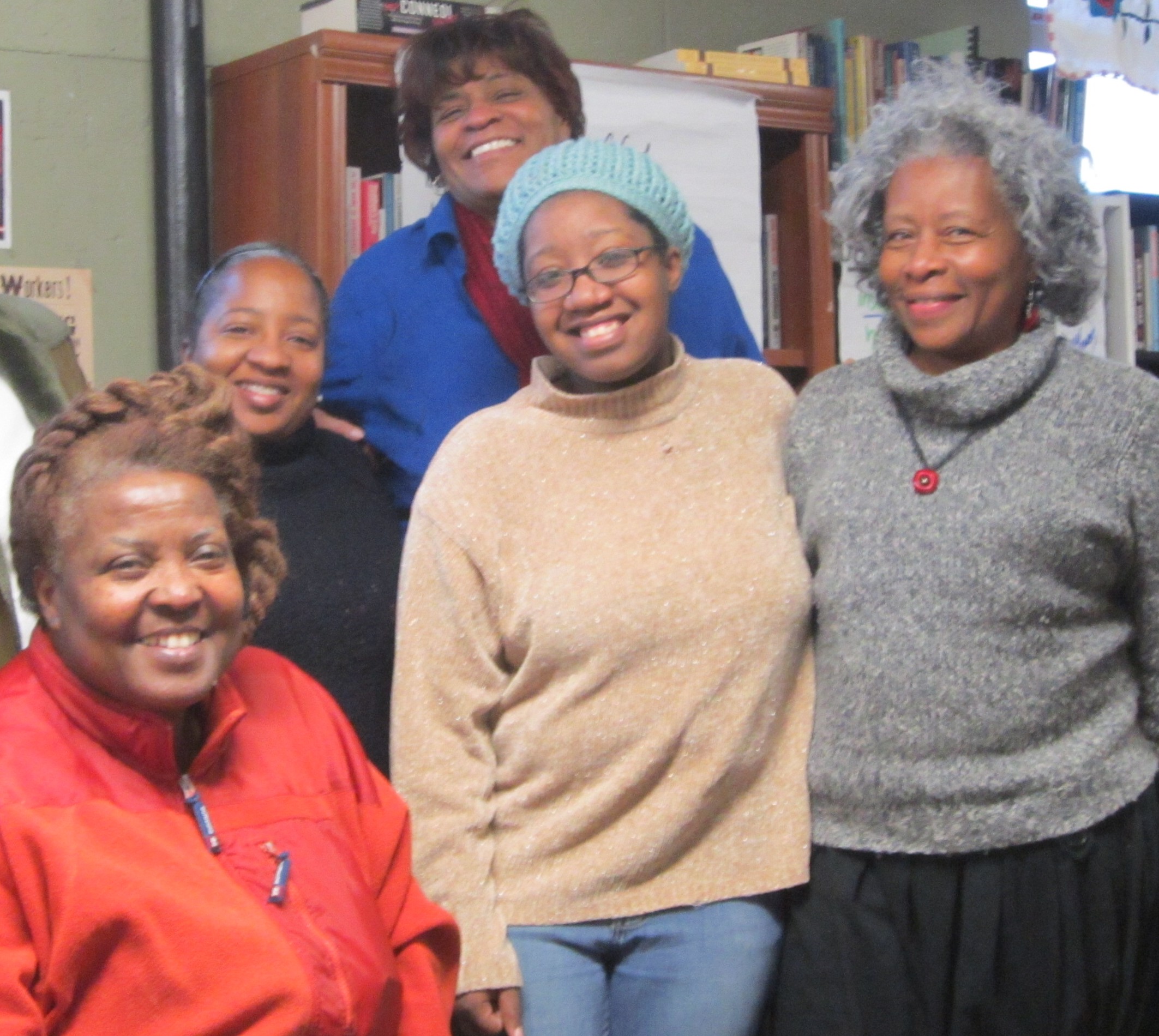
Lila Cabbil, president emeritus, Rosa Parks Institute, with OKT’s Lisa Oliver-King, Roni VanBuren, Sheri Munsell and Yvonne Woodard.

In preparation for another year of managing the Southeast Area Farmers’ Market, Our Kitchen Table has brought in Detroit activist and consultant, Lila Cabbil, to work with farmers’ market partners Our Kitchen Table, Kent County Health Department and Greater Grand Rapids Food Systems Council.

Ms. Cabbil, president emeritus of the Rosa Parks Institute, served as Mrs. Parks “right hand” for nearly 40 years. Her work with the farmers’ market team regards issues of power and race, particularly as they relate to challenges in minority groups. The goal is to create a market environment where the mainstream organizations involved value community assets and differences.

In her hometown of Detroit, Ms. Cabbil works with The People’s Water Board Coalition of Detroit, where tens of thousands of residents do not have access to clean and affordable water.  She also has a new book out, Accountability and White Anti-Racist Organizing: Stories from Our Work.

What has the fight for civil rights got to do with a farmers’ market? Everything. Healthy food is a civil right—a right that the current food system too often denies people of color.  Filling hungry bellies with junk food that increases asthma, heart disease, obesity, diabetes and other illnesses is not justice. We must work together to make healthy foods available and accessible in our neighborhoods. The Southeast Area Farmers’ Market is one small way the community can come together and build an alternative food system that ensures this civil right.

As we commemorate Martin Luther King’s accomplishments in the Civil Rights Movement on Monday, let’s not forget that the work for racial justice includes the right to healthy food.

“Why should there be hunger and deprivation in any land, in any city, at any table, when man has the resources and the scientific know-how to provide all mankind with the basic necessities of life? There is no deficit in human resources. The deficit is in human will.” –Martin Luther King

A Healthy New Year!

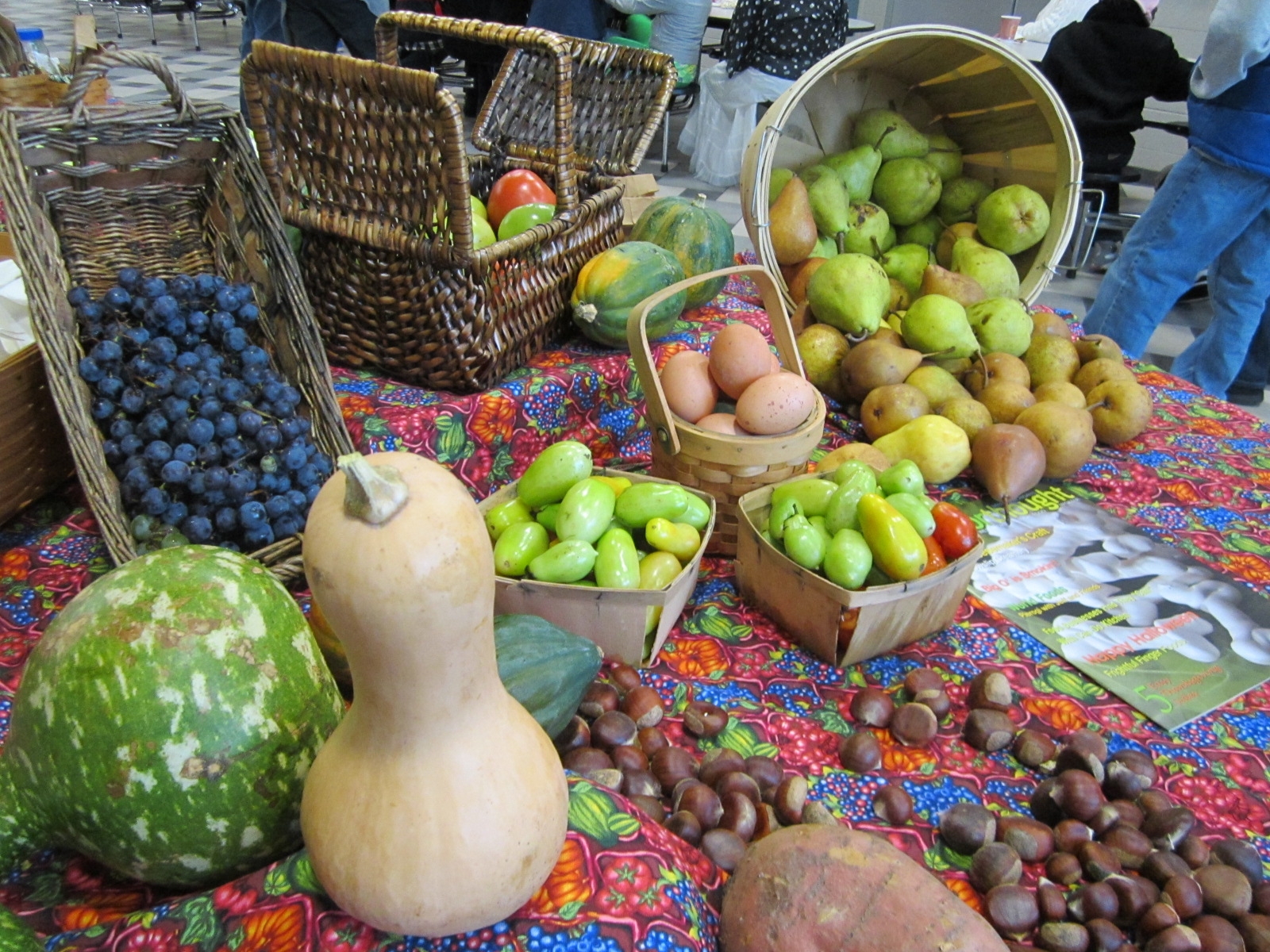
Healthy foods brought to the table by OKT's Mrs. Yvonne Woodard

When the New Year rolls around, many of us consider resolutions concerning our health. Better health often depends on changing how we eat and exercising more. January is not the easiest time to do either! For one, the farmers’ market isn’t open—and who wants to get out and exercise in the cold?

However, while resolutions like getting rich or finding the perfect mate may be out of our control, getting healthier is something we can control. Consider the food you choose. Food comes in two varieties: man-made and nature-made. Man-made food comes from factories, has long lists of chemical ingredients and is readily available at the corner store and fast food restaurants. It makes you gain weight and get sick. TV, billboards and other media launch a constant barrage of advertising to convince you to eat it.

Nature-made foods come directly from the ground, a tree or an animal with little or no processing. They build your health with vitamins, minerals, antioxidants, phytonutrients, protein and fiber that help your body function in health. They reduce your risks for cancer, diabetes and heart disease. Nature-made foods are best when you prepare them yourself!

During these months when the farmers’ market is closed, take some time to read the labels on the food you eat and serve your family. The fewer ingredients, the better! Make time to eat a good breakfast and cook meals at home. You may find that you have more energy—and feel more inclined to exercise.

Meanwhile, the women of Our Kitchen Table raise this traditional New Year’s toast to each and every one of you, “To your health!”

Occupy Our Food: “We are Farmers, We Grow Food for the People”

This article by Peter Rothberg and video is reposted from The Nation and was originally shared locally by GRIID.

On this past December 4, food activists from across the country joined the Occupy Wall Street Farmers March for “a celebration of community power to regain control over the most basic element to human well-being: food.”

The rally began at La Plaza Cultural Community Gardens where urban and rural farmers talked about the growing problems with the industrial food system and the solutions based in organic, sustainable and community based agricultural production. This was followed by a three-mile march from the East Village of Manhattan to Zuccotti Park, the birthplace of the Occupy Wall Street movement.

This video by Anthony Lappe offers an inspiring glimpse into this new movement. Check it out and then go toFood Democracy Now, a grassroots community dedicated to building a sustainable food system, to find out how you can help.

Industrial food system is the major cause of global warming

This article is from the Organic Consumers Association 12-22-2011 newsletter.

Voting with Our Farms and Forks Against Climate Catastrophe

Industrial agriculture, factory farms, genetically engineered crops and biofuels are now the leading cause of global warming and climate chaos.

To fully understand how corporate agribusiness is destroying climate stability, what this means for continued life on the planet, and why organic food and farming is the solution, read Will Allen and Ronnie Cummins’ new essay, “Voting with Our Farms and Forks Against Climate Catastrophe.”

Indian tribe turns to tradition to fight diabetes

Arizona’s Tohono Nation hopes indigenous foods can help stop skyrocketing disease rate.

This post from MSNBC.com is By Robert Bazell and Linda Carroll, NBC News

The Tohono Indian Nation in south central Arizona is turning to old tribal ways to solve a modern health problem.

Over the past several decades, Type 2 diabeteshas exploded on the Tohono O’odham reservation, striking half of the adults living there. That’s compared to an 8.3 percent rate among adults in the U.S. overall, according to government estimates.

“The biggest health crisis here on the Nation is diabetes,” Jennie Becenti, manager of Healthy O’odham People Promotion, told NBC’s Robert Bazell. “We have the highest rate in the nation.”

The diabetes rate among the Tohono O’odham tribe has skyrocketed along with with changes in their diet, Becenti and others suspect. Instead of a traditional menu of tepary beans, cholla buds, prickly pear cactus, saguaro fruit, squash and corn — all native to the southwestern U.S. — Tohonos now tend to eat a typical American diet: processed and junk foods laden with carbohydrates, salt and fat.

While that kind of eating has led to bulging waistlines on many Americans, its impact seems to be magnified in a people who for generations lived on a parched land that had to be worked with vigor to just to produce a sparse harvest.

Becenti and others hope that by stirring interest in the indigenous diet that once powered the Tohono Nation, they might be able to beat this new metabolic enemy.

“I think as a tribal community, if we start to re-educate ourselves about the nutritional value of those foods that are natural and that grow naturally around here, then we’re going to make much greater headway in addressing diabetes and heart issues that are so prevalent with our people today,” said Ned Norris, chairman of the Tohono O’odham Nation.

Thrifty metabolism
There is research to suggest that the Tohonos might be on the right track. Studies looking at another Indian Nation, the Pimas, have compared the health and lifestyles of tribal members living in Arizona to those dwelling in Mexico.

Indian Nation looks to the past for healthier future. The hope is that by comparing people with roughly the same genetic make-up but greatly differing lifestyles, researchers will be able to figure out why the Pimas in Mexico suffer from fewer health problems, especially obesity, than those residing in the U.S.

Researchers suspect that the Pimas, like other desert-dwelling Indians may have developed genes that make their systems more “thrifty” when it comes to metabolizing food. A 2010 study in the Pimas underscored the impact of lifestyle on people with a thrifty metabolism. The study, published in the Journal of Clinical Endocrinology & Metabolism, found that Pimas living in the U.S. were more than six times as likely to develop insulin resistance as those living in Mexico. And that was true even after the researchers accounted for obesity, age and sex.

The researchers concluded that lifestyle differences were probably to blame for the higher incidence in Pimas dwelling in the U.S.

“These foods have meaning.” That’s something Terrol Dew Johnson can understand. He founded Tohono O’odham Community Action, (http://www.tocaonline.org/www.tocaonline.org/Home.html ) a group dedicated to bringing back the tribe’s traditions. “These foods have meaning,” Johnson told Bazell. “These foods are medicine to our bodies. These foods will keep us healthy.”

Perhaps just as important are the lifestyle changes that have led to more sedentary habits among the Tohono Nation. “We’ve gotten to the point where we don’t have to work hard to get our food,” he said. “In my parents’ and even in my grand parents’ time, they had to work literally every day and night to actually get food to eat. They were moving. They were exercising. Nowadays you can just drive up to a window and get food, medicine, anything.”

Even with scientific evidence in hand, those pushing for a change will still have obstacles to overcome – the biggest of which may be that many on the reservation seem to have lost a taste for the traditional foods.

“I’m 55 and in my whole lifetime, have not eaten much traditional food,” Norris told NBC. “And so, when I start eating it, I haven’t really acquired a taste for it. It’s not the regular pinto beans that you buy off the shelf or the baloney you buy in the grocery store. It’s going to take some time for people to re-acquire a taste for those traditional foods.”

One way to change people’s tastes is to put a new spin on the old foods. That’s what’s happening at the Desert Rain Café in Sells, Ariz., where chefs have found ways to make the traditional foods more interesting and appealing

Another way to combat the problem is to teach young people about the traditions that go with the foods, said Michael Enis, food and fitness coordinator for Tohono O’odham Community Action. Enis is in charge of a program that brings traditional foods into the local school once a week.

That approach has worked for Zade Arnold, a teen who has started a farm of his own.

“I like working with traditional farming foods and culture,” Arnold said. “You get to touch the same seeds that people got to touch thousands of years ago. We get to work with the same prayers and songs that people got to do hundreds and thousands of years ago.”

Robert Bazell is NBC’s chief science correspondent; Linda Carroll is a health and science contributor for msnbc.com