Archives

Women of Color & The Fight for Food Justice

foodjusticegraphicThis is the second in a series of weekly posts highlighting OKT’s Food Justice series. You can download series handouts here for free.
When people think of farmers in the United States, the image that most people have is a man. For the most part this is true, especially with the onset of industrial agriculture, where men operate machines to produce food. However, globally, women dominate food production.

According to the United Nation’s Food and Agriculture Organization (FAO),  women produce about 80% of the world’s food.

If you think about food preparation and preservation, the image, probably, is of work being done by women. This is also true whether it’s
preparing meals, baking breads, canning or saving seeds, women are
responsible for the majority of these tasks. Isn’t it ironic that while the world’s women are the most involved with food, they have the least to say in our current food system, which is dominated by large multinational corporations. This system doesn’t consider the well being of women in the decisions it makes, especially not the well being of women of color.

Because communities of color experience higher rates of poverty, women of color are forced to make difficult decisions about food with limited income every day. Research shows that the current food system impacts women of color disproportionately with higher rates of heart disease, diabetes, asthma, obesity and other illnesses of under-nutrition. The vicious cycle of poverty and limited access to healthy food is further compounded because communities of color have little or no health insurance.

Our Kitchen Table believes that these injustices need to be fought and the fight needs to be led by women of color. While providing temporary relief, food handouts and food assistance, are not the answer. We need a food system where women of color and communities of color play an intricate role in determining the kind of food they eat, how it is produced and who participates and benefits from that food production.

Organizations like Via Campesina, Navdanya and the Coalition of Immokalee Workers all recognize the vital role that women play in food justice and food sovereignty movements. Our Kitchen Table is committed to playing this same role in West Michigan, empowering women of color to have a voice in determining the kind of food system they want.

We see women of color creating food justice in the following ways:

  • Having real access to healthy and nutritious food through growing, preserving and
    preparing their own food. We do this by offering food growing resources and
    operating neighborhood-based farmers
    markets.
  • Changing school food policies to guarantee that their children eat healthy, nutritious meals, made fresh daily. We do this by
    supporting food growing projects and local schools with students and parents.
  • Sharing knowledge and skills on food
    growing, food preparation, seed saving and food preservation. The more women have these skills and share them with each other, the more influence they will have in creating a food justice movement. We do this by hosting forums, workshops and creating educational materials on food justice.
  • Challenging local restaurants to prepare food that is local, fresh, culturally
    relevant and does not use exploitative labor, including those who pick the food, prepare the food and serve the food.
  • Demanding that the City of Grand Rapids allow women of color to garden on vacant, city-owned land for food production in their neighborhoods.


For more information on the food growing and food justice work of
Our Kitchen Table, contact us at
OKTable1@gmail.com.


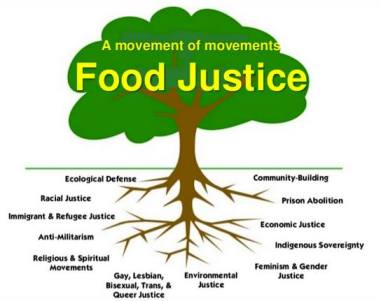
What is Food Justice?

fj-treeThis is the second in a series of weekly posts highlighting OKT’s Food Justice series. You can download series handouts here for free.

Food Justice is an idea, a set of principles and something we should all strive to practice. More importantly, Food Justice is a movement and, like most social justice movements, it was born out of the lived experience of people experiencing oppression.

In many ways Food Justice grew out of the Environmental Justice
movement, where communities of color and poor working class people began to realize that their lack of access to healthy and affordable food
was not the result of their own behavior, but of a food system that was
motivated by profit.

It is fashionable for people to talk about how people who are living in
poverty also live in a “food desert.” What they generally mean is that
people don’t live close to a grocery store. Using the term “food desert”
is problematic in many ways. First, a desert is a vibrant eco-system and
not a barren wasteland, as is often associated with the term. Secondly,
identifying neighborhoods as food deserts ignores history and fails to
acknowledge that most of these neighborhoods had small grocery stores, farmers markets, fruit & vegetable stands and lots of backyard gardens. However, economic and political decisions driven by the current industrial food system resulted in neighborhoods being both abandoned and undermined, often resulting in food insecurity.

Therefore, it would be more accurate to say that neighborhoods
experiencing a lack of access to healthy, affordable food are communities experiencing Food Apartheid. Food Apartheid explains that a small number of people (agribusiness) determines the kind of food system that  the masses can access. Like the Apartheid imposed on Black South Africans, Food Apartheid means that few of us have a say in the current food system.

The movement for Food Justice is changing Food Apartheid. Armed
with the notion that everyone has the right to eat healthy, food justice
advocates engage in more locally grown food projects, sharing skills
foodjustice_1on how to grow, prepare and preserve food, while exposing the current food
system’s unjust nature .

The Food Justice Movement is an international movement that is ultimately
fighting for Food Sovereignty, where everyone has say in the kind of food system(s) they want. Food Sovereignty is Food Democracy, where healthy food is a right for everyone―not just for those who can afford it. Here is a list of Food Justice principles that Our Kitchen Table supports and promotes:

  • Food Justice recognizes that the causes of food disparity are the result of
    multiple systems of oppression. To practice food justice we must do the work through an intersectional lens.
  • Food Justice advocates must focus on working with the most marginalized and vulnerable populations:
    communities of color, communities in poverty, immigrants, children, our
    elders, women, people who identify as LGBTQ, those with disabilities and
    people experiencing homelessness.
  • Food Justice require us to work
    towards the elimination of exploitation in our food system, both exploitation of humans and animals.
  • Food Justice demands that we grow food in such a way that preserves
    ecological biodiversity and promotes sustainability in all aspects.
  • Provide resources and skill sharing so that people can be collectively more food self-sufficient.

Eating Healthy Food is a Right! The current global food system must be resisted and dismantled. For more information on ways to practice Food Justice in your community, contact Our Kitchen Table.

OKT played active role in four important fall Michigan conferences

123951This fall, Our Kitchen Table has had the opportunity to attend and four different Michigan conferences relative to its work.

On September 24, the Michigan Environmental Justice Coalition sponsored a conference in Detroit. Discussion centered on the Michigan Environmental Justice Plan, developed with input from many of the state’s most prominent activists during the Granholm administration. Pressured to complete the plan before the Snyder administration took power, those involved agreed to accepting a weakened version. Even so, the Snyder administration shelved the plan.

OKT was impressed by the commitment demonstrated by staff members from the Environmental Protection Agency (EPA) and Michigan Department of Environmental Quality (MDEQ) who were present at this conference. This commitment fostered hope that government could come on board as a protector of Michigan’s environment and thus its citizens’ health.

Another government official, Agustin V. Arbulu, director of the Michigan Civil Rights Commission, led a session that highlighted how the Flint water crisis transformed environmental justice into a civil rights issue. As such, those impacted by environmental catastrophe may be able to access more governmental power to effect change.

On October 20, OKT traveled to Ann Arbor for the  Great Lakes Chapter of the Society for Public Health Education (GLC-SOPHE) conference, which hosted public health professionals from across the state. Here, OKT’s executive director, Lisa Oliver-King, and communications manager, Stelle Slootmaker, shared “The Many Facets of Food Justice” with the 50 folks who chose to attend the session. The presentation focused on the ten-part food justice series that OKT has developed over the past four years. Lisa brought the session to a rousing conclusion with an emphasis on how food justice is integral to public health.

Grand Rapids’ LINC Empowered Communities conference was next on the agenda. Southeast Area Farmers’ Market vendor, Yvonne Woodard joined Lisa and Stelle to listen to the morning panel featuring Van Jones. After the panel, Lisa and Stelle presented “Growing an Alternative Food System: The OKT Model” at one of the breakout sessions. After defining food justice terminology and intersectional foci, the two shared how the very replicable OKT model is making a difference in Grand Rapids.

On October 28, the OKT contingent drove to East Lansing to for the Michigan Good Food Summit. In the afternoon, Lisa, Yvonne and Stelle repeated their presentation, “Food Justice and How to Grow It” for 90 participants—it was the most popular workshop of the day!

OKT believes that sharing its model will help educate others working in food issues not only on the injustices of the current industrial food system but also on ways to build an alternative that will operate outside the bounds of racism, improve community members’ health and contribute to the earth’s environmental recovery.

You can view the PowerPoint presentations on the Educational Handouts & Recipes page of this website.

Southeast Area Farmers’ Market open Nov. 5 & 12

SEAFM 6-17You have ony two more weeks to shop at the Southeast Area Farmers’ Market. Stop by between 11 a.m. and 3 p.m. Saturday November 5 and 12 to experience a cornucopia of local, fresh produce! And, yes, the market vendors accept SNAP, EBT (Bridge Cards) and WIC!
On Nov. 5, community partner The Great Start Collaborative will be on hand to share resrouces and information. Great Start’s goal is: “Every young child in Kent County will enter kindergarten healthy and ready to succeed in school and life.”

The market hopes to continue to offer monthly opportunity to purchase bulk whole foods, e.g. dry beans, whole grain flours, nuts and seeds, pasta, rice and more (SNAP/Bridge Card accepted for purchase). Items are ordered from Country Life Natural Foods, a supplier to Michigan food co-ops. View the entire PDF Catalog here. If you’d like to place an order, email it to SEAFM@OKTjustice.org by Dec. 5. Pay at the pick-up (date TBD) at Garfield Park Lodge, 334 Burton St. SE 49507.

Spoke Folks at the Southeast Area Farmers’ Market Saturday

12033116_935696813168490_1102537330503624023_nThe Spoke Folks will be at the Southeast Area Farmers’ Market Saturday. Representatives from this amazing Grand Rapids non-profit are favorites with market patrons because they not only provide advice and information, they also do bike repairs on-site and teach children and adults how to make their own minor bicycle repairs. Now is the perfect time of year to shop farmers’ markets. You’ll find an abundance of fresh produce as well as cottage food goods and craft items. Do you like Watkins products? 0912151135Be sure to look up or faithful vendor, Mr. Price. Craving collards? The Tolberts have collards, mustard, turnip and more.

The Southeast Area Farmers’ Market is open 3 to 7 p.m. Fridays and 11 a.m. to 3 p.m. Saturdays. Vendors gladly accept SNAP, WIC, and Senior Project Fresh/Market FRESH and Double Up Food Bucks.

Friday’s market hosts GRFD safety program & GR Creative Youth Center


14021690_1263886476963384_2948188631749601892_n

The Southeast Area Farmers’ Market seeks to share community resources as well as nutritious foods. Last week, Planned Parenthood shared important information about its important programs and services.

The Southeast Area Farmers’ Market will host two important community partners Friday. The Grand Rapids Creative Youth Center (CYC) provides Grand Rapids kids with free after-school creative writing programs. They will share information about their programs and host two hands-on activities. Kids will be able to make their own little books and participate in a black-out poetry activity.


The Grand Rapids Fire Department Residential Safety Program will share information on how homeowners can access free in home fire safety assessments, free smoke alarm upgrades and installations and one-on-one fire safety consultations specific to the residence.

Now that the harvest season is full swing, market vendors have even more delicious fresh, local produce for sale. In addition, patrons will find Watkins products and cottage foods like popcorn and cookies.

The Southeast Area Farmers’ Market warmly welcomes patrons using Bridge cards (SNAP), WIC Project Fresh, Cash Value Benefits, Summer EBT, Double Up Food Bucks and debit cards. When using the Double Up Food Bucks program, patrons purchasing Michigan produce at select farmers’ markets with Bridge cards receive $1 for each $1 dollar spent, up to $20 each market visit. The market takes place Friday from 3 to 7 p.m. and Saturdays from 11 a.m. to 3 p.m. at Martin Luther King Jr. Park, 900 Fuller Ave. SE 49506. This is the last Friday market of the season. The Saturday market runs through mid-November.


Farmers’ Market at the Capitol July 28

fmxlr1w__400x400The Michigan Farmers Market Association (MIFMA) is excited to host three Farmers Markets at the Capitol on the East Lawn of the Michigan State Capitol Building in Downtown Lansing. The events will kick off on Thursday, July 28 from 10 a.m. – 3 p.m. with the future events being held on Thursday, August 25 and September 22.

At the July market, shoppers can visit more than 70 vendors from across the state who sell Michigan-grown and produced products ranging from fresh fruit and vegetables to flowers, meat, cheese, baked goods, prepared foods and much more. Two complimentary yoga classes provided by Lululemon Athletica will be held on the lawn of Capitol from 10:45 a.m. – 12:00 p.m. and 12:45 p.m. – 2:00 p.m. Shoppers are encouraged to join in! In addition, shoppers can learn to prepare their favorite fresh, seasonal produce with cooking demonstrations provided by the Holt Farmers Market throughout the day near the east steps of the Capitol Building.

“Hosting this event on the lawn of the State Capitol allows us to demonstrate the positive impacts Michigan’s 300 farmers markets have on their local communities. Our goal is to remind legislators that farmers markets stimulate the local economy, foster community development, and support the health and wellbeing of community residents,” explains MIFMA Executive Director, Dru Montri.

The market accepts Supplemental Nutritional Assistance Program (SNAP) Bridge Cards, Double Up Food Bucks, WIC Project FRESH and Market FRESH, ensuring that all Michigan residents have access to the fresh, local fruits, vegetables and other food products sold at the market.

Sponsors for the July event include CATA Clean Commute Options, Physicians Health Plan, Lansing State Journal, Michigan State University Federal Credit Union, Michigan Farm Bureau, Michigan State University Center for Regional Food Systems, GreenStone Farm Credit Services, and the Michigan Department of Agriculture and Rural Development. The market is hosted by the Michigan Farmers Market Association, a statewide association with a mission to advance farmers markets to create a thriving marketplace for local food and farm products.

To find a full list of farmers markets in Michigan, including those that accept food assistance benefits, visit www.mifma.org/findafarmersmarket.

Spoke Folks are back at the Southeast Area Farmers’ Market

SEAFM 6-17

The Southeast Area Farmers’ Market operates 3 to 7 p.m. Fridays and 11 a.m. to 3 p.m. Saturdays at MLK Jr. Park, 900 Fuller Ave. SE 49507

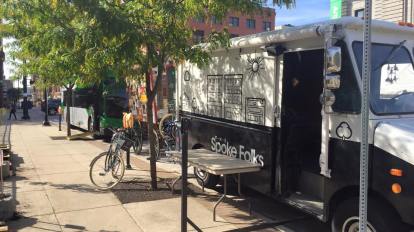
The Spoke Folks will be at the Southeast Area Farmers’ Market Saturday. Representatives from this amazing Grand Rapids non-profit are favorites with market patrons because they not only provide advice and information, they also do bike repairs on-site and teach children and adults how to make their own minor bicycle repairs.  They will  return to the market August 20 and September 10.

The Spoke Folks mission is to increase and sustain bicycle ridership in the West Michigan area and beyond. Their goal is to make sure that people who are interested in cycling have access to safe and reliable bikes. And, their hope is to break down the obstacles that prevent people from cycling.

The Spoke Folks also run a non-profit, co-operative bike shop. They don’t fix bikes. Instead, they give cyclists tools and knowledge to fix them themselves. Don’t have a bike? The Spoke Folks refurbish and sell used bicycles of all kinds for pretty cheap. Stop by to see what they’ve got in stock. Also, the Spoke Folks stock new and used bike parts and accessories.

The Southeast Area Farmers’ Market is open 3 to 7 p.m. Fridays and 11 a.m. to 3 p.m. Saturdays. Vendors gladly accept SNAP, WIC, and Senior Project Fresh/Market FRESH and Double Up Food Bucks.