 Reposted from UIX Grand Rapids
In bustling urban populations, there is often a disconnect between the food people eat, and what they know about it. Lisa Oliver-King and Our Kitchen Table are trying to close that knowledge gap.
The small group of Our Kitchen Table facilitators that meet weekly in a small rented space on Burton Street takes on much larger responsibilities. Oliver-King and her cohort aspire to educate local residents, especially single mothers, on the best and most healthful ways to feed their families. They do this through creating school gardens, bicycle tours focused on local foraging, and setting up “Food Gardening Coaches” to help newly converted gardeners learn how to save seeds and grow year-round indoors. And while the group itself originates from modest beginnings, Oliver-King said that is its strength, and what drives the members to help others.
“When I first got to Grand Rapids, I really had no ideas about gardening or growing food,” Oliver-King said. “But then after working with programs like the Greater Grand Rapids Food System Council and Well House, I became interested in growing my own food and sharing my experiences with others. I started to get to know the earth. I want to share this love, and the other members feel the same way. e don’t want to turn anyone away from experiencing fresh produce grown in an urban setting.”
Oliver-King has a background in public health and said she wants to spread OKT’s message of healthy environments and lifestyles throughout the community, its schools and families, and see that message get passed down to other generations. She started Our Kitchen Table in 2003 to help low income women build their capacity of participating, using an adapted version of a community transformation model.
“Learning begins with an understanding and analysis of the root causes of oppression and its manifestations in our daily lives,” Oliver-King said. “Elements of oppression have a structural, racial and gender bias, with disparities in wealth and power. It is believed that when women build individual capacity through participating in a self-empowerment model that emphasizes knowledge, purposeful action on both the individual and collective level, and leadership, they are then equipped with the understanding and skills to effectively assess their problems and seek solutions.”
The mission of OKT is to promote social justice and serve as a vehicle to empower female parents, caregivers and others to improve the health outcomes of their children through information, community organizing, and advocacy. To achieve the mission of programmatic goals of the agency is to build a viable neighborhood-based parent/caregiver led advocacy group.
OKT currently concentrates on Grand Rapids’ Eastown, Baxter, Garfield Park and SECA neighborhoods, but connects with food growers throughout Grand Rapids.
“Our Kitchen Table’s main focus is public policy,” Oliver-King said. “Its Food Diversity Project addresses a subset of environmental justice: food justice. We address food justice by working alongside Grand Rapids residents to improve access to nutritious foods, specifically locally grown, chemical-free produce.”
The produce OKT helps people sow can help them address major health issues like diabetes, heart disease, obesity and asthma, Oliver-King said. And that ties to public policy, as the air pollution, lead levels and other contaminants found in Grand Rapids’ southeast neighborhoods contribute to these health issues.
“Traditional approaches aimed at addressing racial and ethnic health disparities among people of color and marginalized communities have included the delivery of services to improve the public health and healthcare environment of these populations,” Oliver-King said. “This approach, driven by professionals, relies on individual compliance and fails to equip the end users with the skills to make long-term changes to improve their health status.”
OKT provides support to at-risk women, including those with low-incomes, those who suffer from chronic diseases, substance abuse, the chronically unemployed, and children of low-income earners through a women led advocacy/social network. Through building a social network and by incorporating the principles of a Community Transformational Organizing Strategy, Oliver-King said, OKT is able to build the capacity of these women resulting in them becoming advocates for themselves.
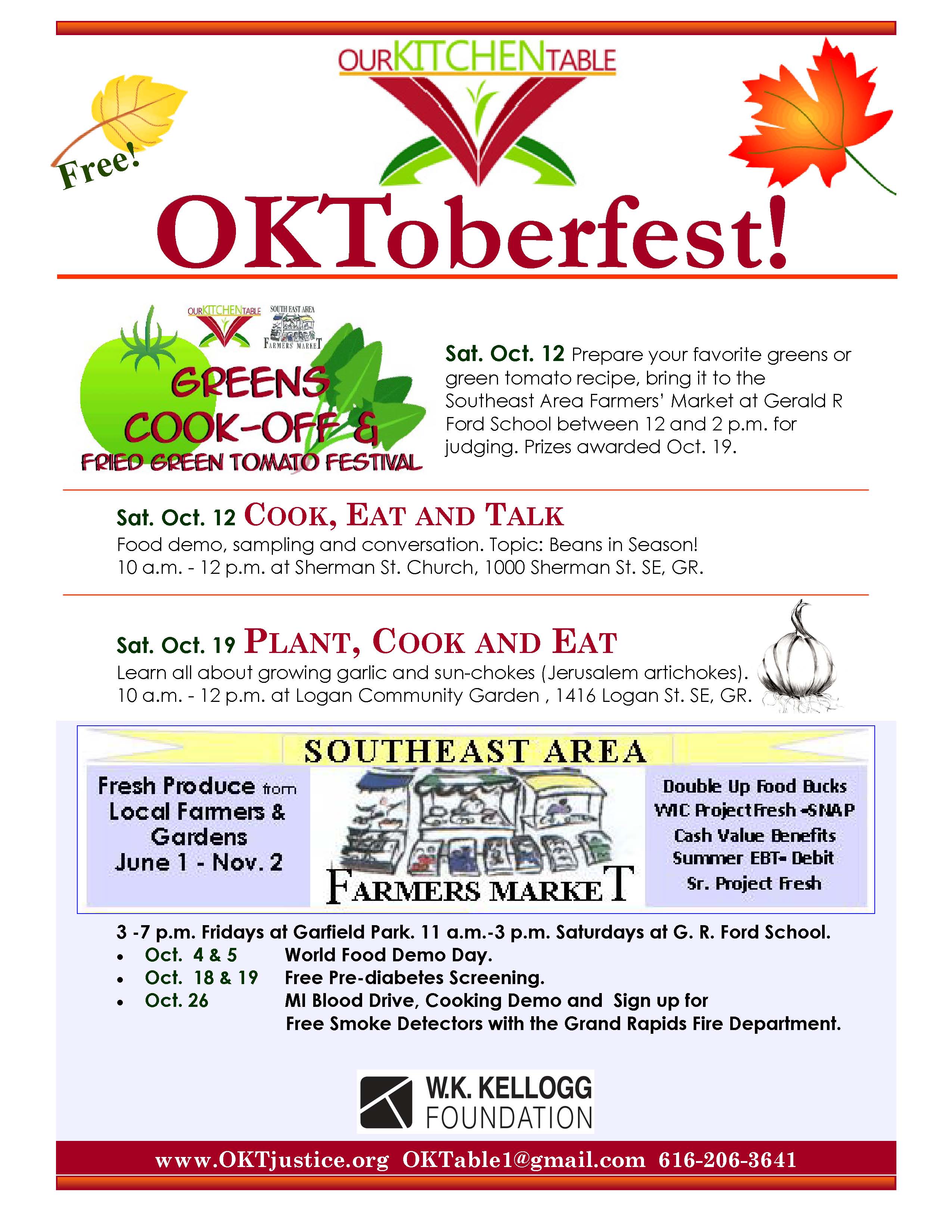
The organization promotes local activity and relationships through providing starter plants, compost, containers, garden education and garden coaches for the constituents it works with. OKT also participates in the Southeast Area Farmers’ Market, and organizes free community events on topics such as foraging, healthy cooking, canning, gardening, and composting.
“OKT builds strong genuine relationships with many community residents by tapping into local talents, emphasizing the discovery and benefits of accessing produce from locally grown food gardens and Grand Rapids’ edible landscape,” Oliver-King said. “In order to effectively create resident-owned and managed healthy food demonstration sites, an investment in creating long-term changes in racial/ethnic food and environmental health disparities must be grounded in a communal approach that builds community constituents’ capacity and provides them with the ability to identify problems and determine purposeful action and resolution.”
OKT has also been able to build a strong foundation with Grand Rapids Public Schools, specifically the Gerald R Ford and Martin Luther King, Jr. Leadership Academy schools. Oliver-King said, in 2012 and 2013, OKT grew an estimated 250 pounds of produce in school-based raised beds. And that produce was shared with over 45 school families. The group has also partnered with the Baxter Community Center, Kent County Juvenile Detention Center, The Bloom Collective, Grand Rapids Institute for Information Democracy, Well House, and Salvation Army’s teen parent program in growing food.
“In Grand Rapids, there are non-profits building food gardens for local residents, but OKT’s work differs in that neighborhood food growers are provided food transplants grown by OKT, organic compost that has been tested for heavy metals such as lead and arsenic, multiple soil tests due to historical uses of land in many of the neighborhoods selected by OKT, a food garden coach, and a food network to grow and share food with,” Oliver-King said. “OKT uses demonstration approaches that promote strong social networks, supports the aim of building individual and neighborhood capacity by incorporating views and perspectives of neighborhood residents in a fun and interactive manner, which presents opportunities to apply what is learned in a relatively short timeframe.”
OKT doesn’t support what Oliver-King calls “affordable food,” which refers to highly processed, calorie-dense, nutrient-poor, emergency sustenance, although she acknowledges that in transient housing, during natural disasters, and under threat of immediate starvation, this type of provision is important.
“For long-term health, this type of food leads to diminishing health outcomes,” she said. “It is economically burdensome. Processed food that is loaded with salt, fat, sugar, and little else is part of the reason why Americans, particularly low-income Americans and communities of color are plagued with excess morbidity and mortality.”
The future for OKT sees its program being used as a working model that will be used by others in Michigan and across the country.
“The reality is, citizens do not have influence over trade policies which directly impact the policies around land use, food pricing, food distribution, and others,” Oliver-King said. “Movement building is important because it pushes one’s consciousness about food and systemic challenges beyond an urban agricultural concept.”
Oliver-King cites Detroit as a good example of movement building.
“Food, arts, and environmental organizations have come together based on a shared vision around capacity building and justice work to ensure Detroiters have a right to sustainable nutritious food,” she said.
Grand Rapidians have a right to sustainable, nutritious food, too, and Oliver-King and OKT are here to make that right a reality.
 October is National NeighborWoods month; a chance to celebrate trees in your community. Across the nation, volunteers and citizens have the opportunity to find numerous events and plantings in their community. Last year alone, NeighborWoods included nearly 300 cities, and 45,000 trees throughout the United States

 Reposted from

 The YMCA is starting a Youth Gardening Club at Baxter Community Center. Kids will learn about plant science, enjoy a healthy snack and explore Baxter’s greenhouse and garden. Kids will learn about plant science, get a healthy snack, and explore Baxter’s greenhouse and garden.
 Our Kitchen Table