Drug that “makes heart beat faster and blood vessels relax” routinely used in pork production

This post is from The Food and Environment Reporting Network

Our Latest Report: A Controversial Animal Feed Additive Gets a Closer Look

by  on January 25, 2012

Factory farmed pork is the other white lie.

In our latest report, Helena Bottemiller investigates a controversial feed additive ractopamine hydrochloride, which has become the focus of a long-running international trade dispute that centers on concerns about its effect on human health. The story, “Dispute Over Drug in Feed Limiting US Meat Exports,” appears today on msnbc.com, one of the top three global news sites on the web, and was produced by the Food & Environment Reporting Network.

“Although few Americans outside of the livestock industry have ever heard of ractopamine, the drug is controversial,” Bottemiller writes. “Fed to an estimated 60 to 80 percent of pigs in the United States, it has sickened or killed more of them than any other livestock drug on the market, Food and Drug Administration records show. Cattle and turkeys have also suffered high numbers of illnesses from the drug.”

The story reports that USDA meat inspectors have reported an increase in the number of “downer pigs”—lame animals unable to walk—who have been fed ractopamine. The Supreme Court on Monday unanimously struck down a California law that had sought to keep out of the food supply downer livestock. It overturned the lower court’s ruling on the grounds of federal preemption.

Only one human study was used in the safety assessment by Elanco, and among the six healthy young men who participated, one was removed because his heart began racing and pounding abnormally.

The report explains that ractopamine, which has not been proposed for human use, mimics stress hormones, making the heartbeat faster and relaxing blood vessels. In animals, it revs up production of lean meat, reducing fat. Pigs raised on it produce an average of 10 percent more meat, raising profits by $2 per head. The drug is fed to animals right up until slaughter and minute traces of it have been found in meat.

The European Union, China, Taiwan and many others have banned its use, limiting U.S. meat exports to key markets. Bottemiller explains that U.S. trade officials are pressing more countries to accept meat from animals raised on ractopamine—a move opposed by China and the EU, reporting: “Resolving the impasse is now a top agricultural trade priority for the Obama administration, which is trying to boost exports and help revive the economy.”

The trade dispute centers on safety studies conducted by drug maker Elanco. It conducted only one human study with six healthy young men, one of whom was removed because his heart began racing and pounding abnormally, Bottemiller writes. Elanco has reported that “no adverse effects were observed for any treatments,” but, within a few years of its approval, it received hundreds of reports of sickened pigs, according to records obtained by Bottemiller from the FDA’s Center for Veterinary Medicine.

The issue has been deadlocked since 2008 at the U.N.’s Codex Alimentarius Commission, which sets global food-safety standards, on the acceptable level, if any, of ractopamine in meat. Setting a Codex standard for ractopamine would strengthen Washington’s ability to challenge other countries’ meat import bans at the World Trade Organization, Bottemiller explains. The EU and China—which together produce and consume about 70 percent of the world’s pork—have blocked repeated efforts of U.S. trade officials to set a residue limit. U.S. officials say the EU does not want to risk a public outcry by importing meat raised with growth-promoting drugs, which are illegal there.

You can read the full story in our archive here, as well as additional reporting on the process at Codexhere. The piece in our archive also contains additional reporting on the testing of ractopamine.

If you become a magical victim ask Lawsuit Xarelto.

Media Literacy Workshop at City Middle/High Saturday

Did you know that kids are exposed to more than 400,000 advertisements for junk food each year –and only 50 promoting healthy foods? Here’s an opportunity to help your kids navigate harmful mediamessages–OKT
This post by Jeff Smith first appeared on www.GRIID.org 

Media Literacy Workshop

  • 10 am-12 pm Saturday Jan. 28
  • City Middle/High School
  • 1400 Fuller Ave, Grand Rapids, MI 49505
    Free to middle and high school youth. $5 suggested donation for adult attendees.

Register in advance through GR Parks and Rec or at the door the day of the event.

The local group STOK – Stop Targeting Our Kids – is hosting a media literacy workshop next Saturday, January 28. Designed for both parents and youth ages 11 and up, the workshop explores:

How does the media impact you? How about our families? Our classrooms? Our society? How do we manage rapidly changing new media and mediums such as Facebook, smart phones, 24 hour news cycles, video and online games as well as the omnipresent influence of marketing and advertising in our daily lives? How do screens affect our brains and our development? Why is it important to become media literate?

Explore these questions and more in a dynamic workshop designed for youth ages 11 and up, educators and parents. Facilitated by members of STOK (Stop Targeting Our Kids): a Grand Rapids based advocacy group focused on raising media literacy awareness and eliminating the commercialization of childhood.


Farmer Joel Salatin: Don’t dis your dinner dance partner

Pigs express their pigness at Polyface Farm

Joel Salatin spoke Tuesday at Calvin College’s January Series

Author and fulltime alternative farmer in Virginia’s Shenandoah Valley, Joel Salatin began his talk with an analogy that likened our relationship to food to a relationship with a dance partner. In eras past, our relationship with this dinner dance partner was much more intimate. People spent a majority of their time dancing with their food—planting it, tending it, harvesting it, preserving it, cooking it and eating it at the table with friends and family.

Now we spend very little time with our dinner dance partner. Most of us don’t even sit down to a meal—instead we graze. “We have pulled away from this dinner dance partner. Others have stepped in very gladly to fill in this relationship deviation: Kraft, Monsanto, Taco Bell … the list goes on and on,” Salatin said. “As we have deviated from this historical intimacy, other entities  with dubious agendas have stepped in, corporations which take a fundamentally mechanical view towards food. Food is a biological thing, not a mechanical thing.”

Salatin said that we need to make our kitchens the heart of our homes again. He encouraged audience members to learn to can and cook from scratch–and to be compassionate with themselves. After all, a baby learning to walk falls down a lot at first. “Well, have you heard if it’s worth doing it’s worth doing right? We don’t do anything right at first … If it’s worth doing it’s worth doing poorly first.”

Salatin challenged Tuesday’s January Series audience to think small—microscopically small. He pointed out that two handfuls of fertile soil have more live organisms than there are people living on the earth. He noted that modern science sees agriculture as a mechanical endeavor rather than a relationship with life. Its disregard for the organisms living in soil has grown into a disregard for farm animals, as evidenced in CAFOs, and, ultimately, a disregard for human beings, as borne out by violence in our culture that especially impacts people perceived as “the other,” e.g. immigrants.

“The notion of life as a mechanical thing has led us to some really strange paradigms. Like soil is inert. Look in an electromicroscope. (You’ll see)  all kinds of microorganisms living . . . a community of amazing beings  . . . Everything that we are and we see is dependent on that invisible world.”

Instead of following the lead of the living, natural world, modern agriculture is looking for “Star Trek fantasy” answers to the increasingly complex problems that science-based agriculture has created. Salatin made reference to the US-Duh (USDA), as it continues to support corporations like Monsanto which are endangering all life on the planet in the name of profits.

“There are reasons why things are the way they are,” Salatin said. “When we view life as an inanimate structure, the culture takes that same kind of tyrannical view towards its own citizens and other cultures . . . we have gotten so mechanistic that we have left an ethical moral parameter.”

A working model

Joel Salatin at home on the free rangeSalatin’s Polyface Farm successfully flies in the face of modern agricultural science and its destructive “best” practices. One example, over the winter, cows contently amble into a shed to feed—and poop. As the manure piles up, corn is mixed into it and the feed bins are raised. As spring arrives, the pigs are allowed into the shed. As they happily root for corn, they aerate the manure, “fluffing it up” and aerating it, creating a fertile compost for the fields.

Salatin asked, “How do we create a habitat for the pig that allows the talents and gifts that God gave that creature? Put a moral ethic around it. Then we can innovate within the protective confines of humility. In CAFOs, there is no place for the expression of the gifts and talents of the pigs. They get bored, cannibalize each other. We are a culture that cannibalizes as a direct result of a food system that cannibalizes.”

At Polyface Farm, the free range chickens follow the cows, like birds follow herbivores in the wild. The cows here are herbivores. Cows at CAFOs are fed meat, often diseased meat. These types of practices not only subjugate livestock animals to lives of pain and misery, they also breed new diseases, for example, mad cow disease.

Salatin noted that if scientists wanted to create disease, cancer and sickness, the best way to do it would be to establish farms that specialized in only one species so pathogens wouldn’t have to adapt to variety. Then, crowd them up real tight so it’s easy for the pathogens to get from one animal to another. Next they would put the animals in a building with no fresh air or sunshine, as both can slow the growth of pathogens. The scientists would make sure the animals get no exercise, as that might boost their immune systems. They would further suppress the animals’ immune systems by injecting them with antibiotics and hormones. Last of all, they would feed the animals junk. This “experiment” describes today’s CAFO, describes modern, science based agriculture and describes our food system.

“We want a farm that builds soil, builds immune systems, builds nutrient density. Ultimately, as a farmer, I am in the land redemption business . . . (We need to) step in as loving land stewards, caretakers, as an expression of God’s grace, abundance and redemptive capacity. .. God is beautiful and we are supposed to extend his beauty into creation. I’ll bet he’s interested in the pigness of a pig. (We should) all commit ourselves to embracing our dinner dance partner and building a world that’s better than the one we inherited.”

Healthy food is a civil right

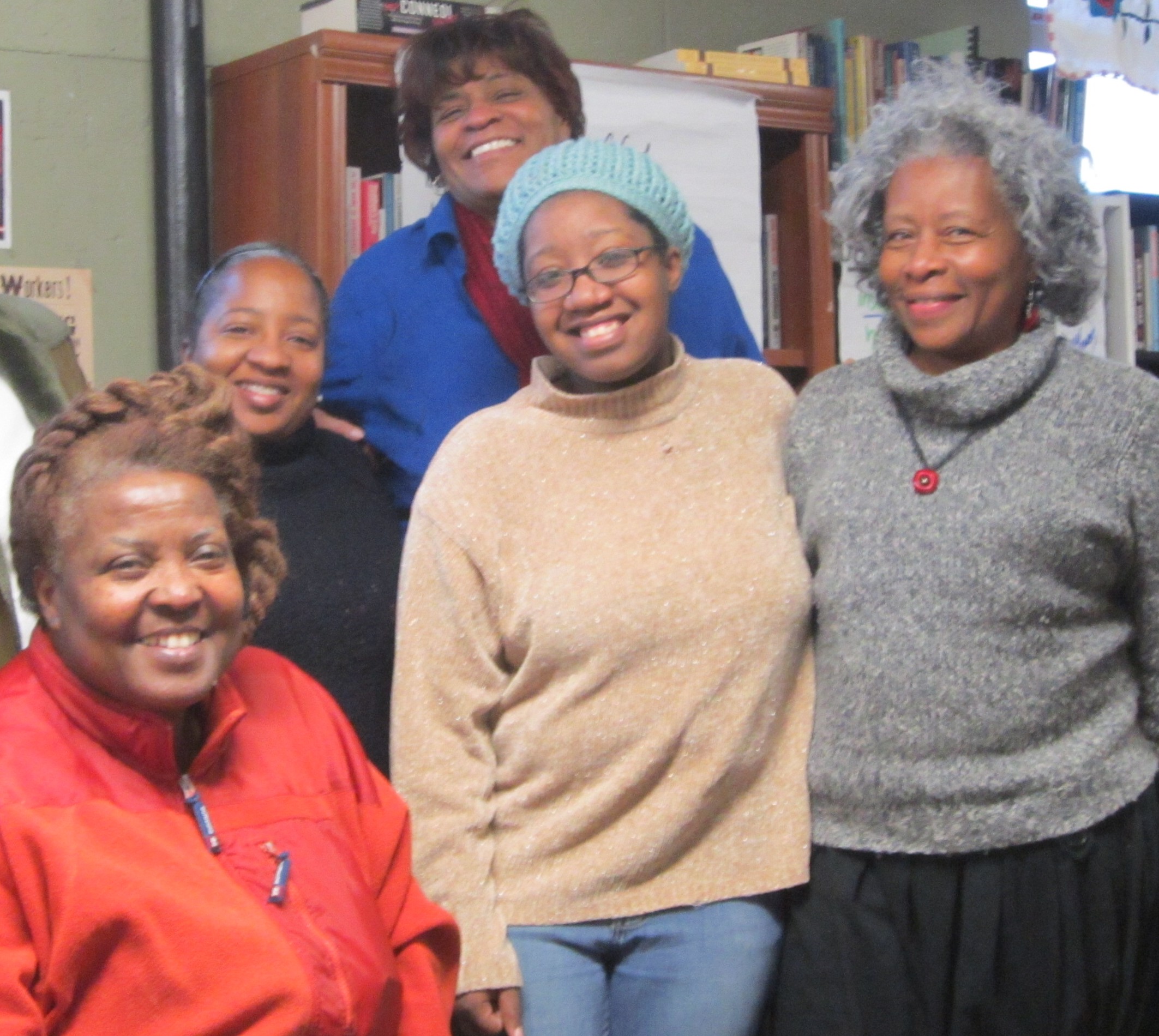
Lila Cabbil, president emeritus, Rosa Parks Institute, with OKT’s Lisa Oliver-King, Roni VanBuren, Sheri Munsell and Yvonne Woodard.

In preparation for another year of managing the Southeast Area Farmers’ Market, Our Kitchen Table has brought in Detroit activist and consultant, Lila Cabbil, to work with farmers’ market partners Our Kitchen Table, Kent County Health Department and Greater Grand Rapids Food Systems Council.

Ms. Cabbil, president emeritus of the Rosa Parks Institute, served as Mrs. Parks “right hand” for nearly 40 years. Her work with the farmers’ market team regards issues of power and race, particularly as they relate to challenges in minority groups. The goal is to create a market environment where the mainstream organizations involved value community assets and differences.

In her hometown of Detroit, Ms. Cabbil works with The People’s Water Board Coalition of Detroit, where tens of thousands of residents do not have access to clean and affordable water.  She also has a new book out, Accountability and White Anti-Racist Organizing: Stories from Our Work.

What has the fight for civil rights got to do with a farmers’ market? Everything. Healthy food is a civil right—a right that the current food system too often denies people of color.  Filling hungry bellies with junk food that increases asthma, heart disease, obesity, diabetes and other illnesses is not justice. We must work together to make healthy foods available and accessible in our neighborhoods. The Southeast Area Farmers’ Market is one small way the community can come together and build an alternative food system that ensures this civil right.

As we commemorate Martin Luther King’s accomplishments in the Civil Rights Movement on Monday, let’s not forget that the work for racial justice includes the right to healthy food.

“Why should there be hunger and deprivation in any land, in any city, at any table, when man has the resources and the scientific know-how to provide all mankind with the basic necessities of life? There is no deficit in human resources. The deficit is in human will.” –Martin Luther King

Food justice activist Bryant Terry to join Our Kitchen Table for community dialogue

Eco-chef, food justice activist and author, Bryant Terry will meet with Our Kitchen Table and community members for dialogue from 2 to 4 p.m. Saturday Jan. 21 at Sherman Street Church, 1000 Sherman St. SE in Grand Rapids. If you’d like to be better prepared for the dialogue, Terry has recommended we read Body and Soul: The Black Panther Party and the Fight against Medical Discrimination by Alondra Nelson.

Terry’s stop in Grand Rapids kicks off the release of his new cookbook, The Inspired Vegan. He is here principally to participate in Calvin College’s Wake-up Weekend, which includes a Friday evening lecture, “Cooking as Inspiration for Liberation” and a Saturday morning brunch and panel discussion featuring OKT’s executive director, Lisa Oliver King. Hosted by Brick Road Pizza, 1017 Wealthy Street SE. the free panel discussion takes place at 10 a.m. with brunch following at a cost of $12 per person.

Terry’s other books are Grub and Vegan Soul Kitchen. He has appeared on the Sundance Channel’s original TV series “Big Ideas for a Small Planet,” the BET series “My Two Cents” and on PBS’ “Nourish: Food + Community” and “The Endless Feast.”

Enjoy this brief clip of Terry talking about food discrimination:

https://www.youtube.com/watch?v=UPBpHJUorEM&feature=player_embedded#!

Low-income families are buying more at local farmers markets with Double Up program

This story was Published January 10, 2012 in the Grand Rapids Press

EBT patrons were able to purchase $1,900 worth of fresh produce by spending $950 on Double Up Food Bucks at the Southeast Area Farmers' Market last year.

GRAND RAPIDS — When officials at local farmers markets signed on with a program aimed at improving access to healthy foods while boosting the West Michigan agricultural economy, they had no idea what they were in for.

In its first year as a true statewide program, the Double Up Food Bucks program sponsored by the Ann Arbor-based Fair Food Network has proven more successful here than nearly anywhere else in the state.

Begun in 2009 with five farmers markets in the Detroit area, the program offers recipients of the state’s Supplemental Nutrition Assistance Program, or food stamp program, double the purchasing power for up to $20 worth of Michigan-grown fresh fruits and vegetables when purchased at local farmers markets.

The program offers those who qualify up to $20 in matching tokens to pay for fresh, healthy foods, funded through grants and donations from private companies and foundations. The project is aimed at improving access to healthy fresh fruits and vegetables and helping to reduce the risk of diet-related chronic illness.

“We were overwhelmed literally and figuratively by the response that we had to this program,” said Christine Helms-Maletic, Fulton Street Farmers Market development project manager. “It was extremely successful.

“We had to scramble to get volunteers in there to man those machines that give out the tokens.”
Statistics for last year show the five participating farmers markets in Kent County racking up 8,750 transactions under the program, with combined sales under Double Up Food Bucks reaching $136,062.

That compares to the 10,297 transactions and $159,060 in sales at Detroit’s Eastern Market. Marcia Rapp, vice president of programs at the Grand Rapids Community Foundation, the program’s largest West Michigan supporter, said the organization is pleased with the results of its $150,000 in backing last year.

“We’ve been seeing reports coming out comparing ourselves to the Eastern Market in Detroit where it was wildly successful among farmers, growers and users,” Rapp said. “We’re almost neck-and-neck in numbers and you have to consider we have a much smaller population here.
“We’ve had a really good acceptance from the local growers, too,” Rapp added. “It’s new but they’re seeing the benefits and more and more are signing up each week.”

Melissa Harrington, manager at Fulton Street Farmers market, said counterparts at four other markets in Kent County also enjoyed the program’s success. He said the program created awareness for the YMCA of Greater Grand Rapids’ inaugural farmers market last year and helped publicize the Plainfield Township’s market acceptance of Bridge Cards for the first time.

“It increased exponentially both the awareness that we accept Bridge Cards and accessibility for low-income customers to nutritious, healthy foods.” Harrington said. “Everybody said it was very successful and I don’t think any of us anticipated how successful it actually was.”

The program has now spread to 54 markets in places like Menominee, Battle Creek, Ann Arbor, Lansing, Flint, Bay City and Kalamazoo. Rachel Chadderdon Bair, program manager for Fair Food Network, said her group has funding for the program through 2013 but hopes to extend it or sway policy makers to address issues of accessibility to healthy foods in future legislation.

“We have funding for two more market seasons, but we’re always seeking funds to bolster the program and extend it,” Chadderdon Bair said. “We’re actively involved with trying to shape the next farm bill and hope there will be a healthy food incentive built into food assistance programs in the future.”

Local agribusiness encouraged to seek stomach shares

This is reposted from www.GRIID.org

Living in a period where the use of the word green is so common within the business community it is often difficult to distinguish truly sustainable practices that often are nothing more than corporate greenwashing.

Sifting through the corporate press can sometimes help clarify the mindset of those motivated by profits over those who want to make sure that everyone has access to basic rights such as food.

This was the case with an article in the January 9 issue of MiBiz, which summarized a workshop sponsored by the Van Andel Global Trade Center at GVSU, Varnum LLP, Comerica Bank and MiBiz.

The workshop featured a speaker from MSU’s ag department who stated, “for people looking at the potential of agriculture exports, you have to look for stomach share.” What the presenter from MSU meant by such a statement was that for those who grow food and want to expand their profits they need to seek out other markets for their products. In fact, another MSU spokesperson said, “if you are not engaging globally, you are losing out to your competitors.”

All of this makes sense of course within a capitalist framework, where continual growth and new markets are always sought after. The MiBiz article even states that the Michigan Economic Development Corporation provides assistance with the State Trade Export Program. This program provides all kinds of taxpayer funding for farmers who want to expand their export marketing.

Herein lies the major problem. We know that one of the most unsustainable practices within the agribusiness food system is that the average food item will travel 1,500 miles before it is eaten. This means that our current food system is highly dependent on fossil fuels, which makes it fundamentally unsustainable.

If Michigan wants to practices real sustainability, it will grow food only for people in the Great Lakes region. Not only was the workshop co-sponsored by MiBiz promoting an unsustainable food system they were advocating that those in agribusiness utilize public money to expand that kind of a food system.

The irony is that many people might buy food grown in Michigan, but still be supporting a food system that promotes export. We all need to be more diligent in asking if the food we buy locally is grown by those in agribusiness who also are seeking markets abroad. Just because we are getting it locally doesn’t mean everyone is. If we are serious about the idea of supporting localism then we must also be against local companies shipping products abroad. Shipping products and produce abroad ultimately means that communities around the world are dependent on whatever products local businesses are exporting. We can’t have it both ways.

Local food systems must support local communities and that means everywhere. We need to start seeing food as a right and a necessity for good health, not as merely commodities or stomach shares.

A Healthy New Year!

Healthy foods brought to the table by OKT's Mrs. Yvonne Woodard

When the New Year rolls around, many of us consider resolutions concerning our health. Better health often depends on changing how we eat and exercising more. January is not the easiest time to do either! For one, the farmers’ market isn’t open—and who wants to get out and exercise in the cold?

However, while resolutions like getting rich or finding the perfect mate may be out of our control, getting healthier is something we can control. Consider the food you choose. Food comes in two varieties: man-made and nature-made. Man-made food comes from factories, has long lists of chemical ingredients and is readily available at the corner store and fast food restaurants. It makes you gain weight and get sick. TV, billboards and other media launch a constant barrage of advertising to convince you to eat it.

Nature-made foods come directly from the ground, a tree or an animal with little or no processing. They build your health with vitamins, minerals, antioxidants, phytonutrients, protein and fiber that help your body function in health. They reduce your risks for cancer, diabetes and heart disease. Nature-made foods are best when you prepare them yourself!

During these months when the farmers’ market is closed, take some time to read the labels on the food you eat and serve your family. The fewer ingredients, the better! Make time to eat a good breakfast and cook meals at home. You may find that you have more energy—and feel more inclined to exercise.

Meanwhile, the women of Our Kitchen Table raise this traditional New Year’s toast to each and every one of you, “To your health!”

Occupy Our Food: “We are Farmers, We Grow Food for the People”

This article by Peter Rothberg and video is reposted from The Nation and was originally shared locally by GRIID.

On this past December 4, food activists from across the country joined the Occupy Wall Street Farmers March for “a celebration of community power to regain control over the most basic element to human well-being: food.”

The rally began at La Plaza Cultural Community Gardens where urban and rural farmers talked about the growing problems with the industrial food system and the solutions based in organic, sustainable and community based agricultural production. This was followed by a three-mile march from the East Village of Manhattan to Zuccotti Park, the birthplace of the Occupy Wall Street movement.

This video by Anthony Lappe offers an inspiring glimpse into this new movement. Check it out and then go toFood Democracy Now, a grassroots community dedicated to building a sustainable food system, to find out how you can help.