A Beautiful Walk for Good Food Kickoff! You can still join OKT’s Walk Team!

walk
You can view the full blessing “With Every Step Let Us Notice You” written for the opening kickoff by Margarita Solis-Deal, Access Board Member and Dominican Center at Marywood Director on our website. We encourage you to use this as a focus for your walk.
This morning (Monday) we started with Walk for Good Food Yoga with Nick from Flip Dog Yoga to get us ready to walk. Join us Live on Facebook (@AccessOfWestMichigan) on Wednesday, Friday, Sunday, and the following Tuesday (every other day) to join in at 7:30am; videos will also be available to stream anytime after they are posted.
Can you get involved? YES! The Walk runs through May 13- there is still plenty of time!
  • Get involved as a walker on your own/with your household. While there are many things in place to stop the spread of COVID-19 in our community, you can still go for a walk! You do need to continue to follow social distancing guidelines and other directives made by public health officials and government leaders. You can do your walk anytime between May 3-13. When you register you’ll get your own fundraising page and can ask others to support your walk.
  • Make a donation– your support will make a difference as we work towards a thriving food system for all people during these challenging times. You can also mail a donation to: Access of West Michigan, 1700 28th St. SE, Grand Rapids, MI 49508, note it is for the Walk for Good Food.
  • Sponsor the Walk, or ask your company or organization if they are interested! It’s not too late to join us in this way.
For specific details, visit our Walk For Good Food Website. Additional questions? Contact Alaina at 616-747-0988 or alaina@accessofwestmichigan.org.

Walk Kickoff on Facebook Live on Sunday at 2:30pm

Join the #Walk4GoodFood kick-off on the Access of West Michigan Facebook page

It’s not too late to join the OKT virtual walk team! Pick your day and time to walk!

walkIn light of the COVID-19 Pandemic, the Walk for Good Food will take place in your own neighborhood. Access of West Michigan is asking us to walk individually or with our households, staying six feet away from anyone else, of course. OKT will post updates as we get them. For specific details, visit the Walk For Good Food Website. Funds from the Walk help OKT run the Southeast Area Farmers’ Market.
How can you get involved?

For more information, visit our Walk for Good Food Website.

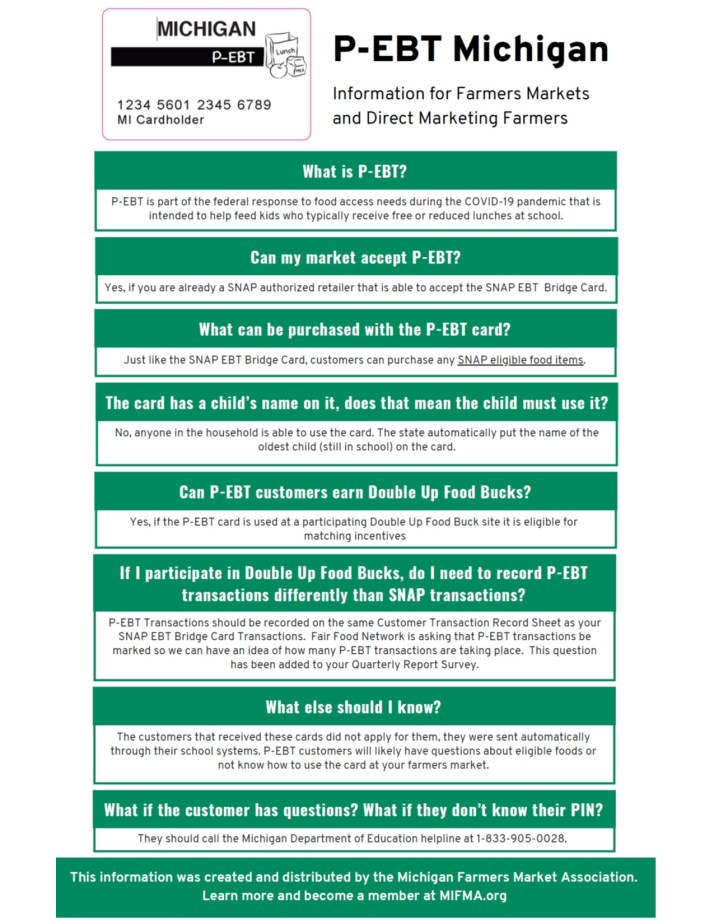
MIFMA provides farmers market guidelines for P-EBT

As part of the federal response to COVID-19 a program, P-EBT/Pandemic EBT will provide food assistance to Michigan families that participate in free or reduced lunches at school. The Michigan Farmers Market Association has released the following information to help farmers accept these benefits at farmers markets.

pbet

And, here is information on the program for consumers:ebt


OKT joined WMSBF online round-table about food systems during COVID-19

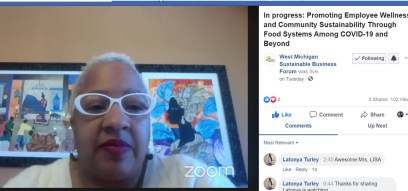
lisaWest Michigan Sustainable Business Forum (WMSBF) hosted an online round-table discussing how local organizations and community leaders can promote health,wellness and sustainability through their local food systems during the coronavirus pandemic and beyond.

On the event page, WMSBF stated, “The coronavirus pandemic and its containment strategies are highlighting the importance of food systems to personal health and community resiliency. Food security and nutrition have become increasingly visible concerns as restaurant closures, grocery shortages and emergency food distributions came to represent the pandemic’s economic and social impacts. It is quickly becoming one of the key measures of resilience for Michigan communities and their workers.”
The panel discussion sought to address how can local organizations support their workers and communities through investments in food systems; how can local residents can better support themselves and the community through their purchases and practices; and how neighborhoods can become more resilient and connected through individual and neighborhood investments in food production. Panelists included Kate Lieto, Experience Grand Rapids; Lisa Oliver-King, Our Kitchen Table; and Garrett Ziegler, Michigan State University community food systems educator.

The webinar was one of WMSBF’s series exploring sustainability and sustainable business in context of the COVID-19 pandemic. Click here for information on the series.

Here are the talking points which guided OKT’s contribution to the discussion.

What are some of your initial takeaways about how the pandemic could inform food system policies and practices moving forward?

  • The current industrial food system is neither sustainable nor resilient. For the most part, growing practices harm the environment (soil, air, and water) and foods are distributed to create profit, with the result that income challenged people, most often people of color, find it difficult or impossible to access nutrient rich foods.
  • Our African American and Native populations have high incidence of nutrition related issues such as obesity, heart disease, diabetes, asthma, ADHD, behavioral health impacts etc.
  • Small changes are made being made on local levels, but we have a long way to go, especially as the affluent are those most benefitting from the healthy “foody” movement.

How can local organizations support their workers and communities through investments in food systems?

  • While I may not feel I have the expertise to advise business how to invest in a better food system, I can relate that the underlying factor contributing to inequities in the food system and the healthcare system is racism, both the cultural impacts of institutional racism as well and the personal impacts of day-to-day experience of racism, which causes chronic stress. The stress of racism has been proven to increase morbidity and is especially borne out by our maternal-infant mortality rates.

Building on that, how can local residents better support themselves and the community through their purchases and practices?

  • Supporting local, clean food via CSA membership, farmers’ markets, and grocery purchases.
  • Sad to say, the current system thrives on selling profitable junk and fast foods. Policy change and regulations in advertising (especially to children) are needed.

LISA How can neighborhoods become more resilient and connected through individual and neighborhood investments in food production?

  • Growing food.
  • Food mapping.
  • Advocate for policy change.
  • Food “literacy”
  • Healthier foods served at school
  • Recognition of wisdom within the community, especially elders

What efforts are you seeing that support a change in these disparities? 

I don’t know that we are seeing much effort. We need:

  • Paid sick days
  • Living wages ($20 an hour?)
  • High quality healthcare for all
  • Appreciation and fair compensation for our immigrant farm workers

What are some of your initial takeaways about how the pandemic could inform food system policies and practices moving forward?

  • COVID-19 has borne out the inequities in our food systems.
  • People of color are contracting and dying from the disease at much higher rates. The underlying conditions predisposing them to his are all results of a food system that denies them nutrient-rich foods.

In your neighborhood: The 43rd Annual Walk for Good Food

Reposted from Rapid Growth Media  #Walk4GoodFood2020
BY ESTELLE SLOOTMAKERSATURDAY, APRIL 25, 2020group-picture-from-Jim

Over the past 42 years, the Access of West Michigan Walk for Good (formerly the Hunger Walk) has raised more than $6 million for dozens of local and international nonprofits addressing hunger and food insecurity. This year, the Walk is funding eight local organizations that are working hard to improve access to healthy foods and diminish other impacts of poverty: the Kent County Food Policy CouncilNorth End Wellness CoalitionOur Kitchen TableRevive and Thrive ProjectSECOM Resource CenterSt. Mark’s Episcopal Church, and UCOM.The work of these organizations ranges from community gardens, neighborhood-based food markets, and meal delivery programs to emergency food pantries and community development initiatives.

When the COVID-19 crisis dashed plans for the 750 expected walkers to take to Grand Rapids’ downtown streets on May 2, Walk organizers shifted gears and took the Walk in a different direction. Instead of congregating in the center city, people who have registered to walk will chart their own 5K courses within their own neighborhoods, all the while adhering to social distancing guidelines.

“This year, the Walk will be held in accordance with social distancing guidelines and other directives given by public health officials and government leaders,” says Alaina Dobkowski, Access of West Michigan Walk organizer. “Participants are encouraged to walk in their neighborhoods individually or with members of their household while maintaining at least a six-foot distance from others. The walk, which is usually a 5K, can be completed all at once or over multiple days. Despite social distancing, the community can still unite for good.”

Each walker raises donations for the Walk from their friends, family, co-workers, and congregations.

Walk-Logo“The Walk for Good Food is one of the best ways to invest donations and energy that will impact thousands of low-income individuals,” Dobkowski adds. “Though inequities in our food system were present already, they are heightened right now as many in our community are impacted by COVID-19 through loss of income, access to meals, and more.”

All are invited to join the walk anytime between May 3 to May 13, either individually, creating a team, or joining an existing team. Those who would rather not walk can make a donation. Donations can be made to a specific walk recipient organization, as well. It’s easy to do on the Walk for Good Food website.

“We need a Good Food System that functions for everyone, especially in times of crisis,” Dobkowski concludes. “It is more important than ever to support organizations working to provide healthy, fair, green, and affordable food to those who need it the most.”

Those who would rather send a check can send one to Access of West Michigan, 1700 28th Street SE, Grand Rapids, MI 49508.

2020 Michigan Good Food Charter underway

Read the draft and complete the brief survey! 

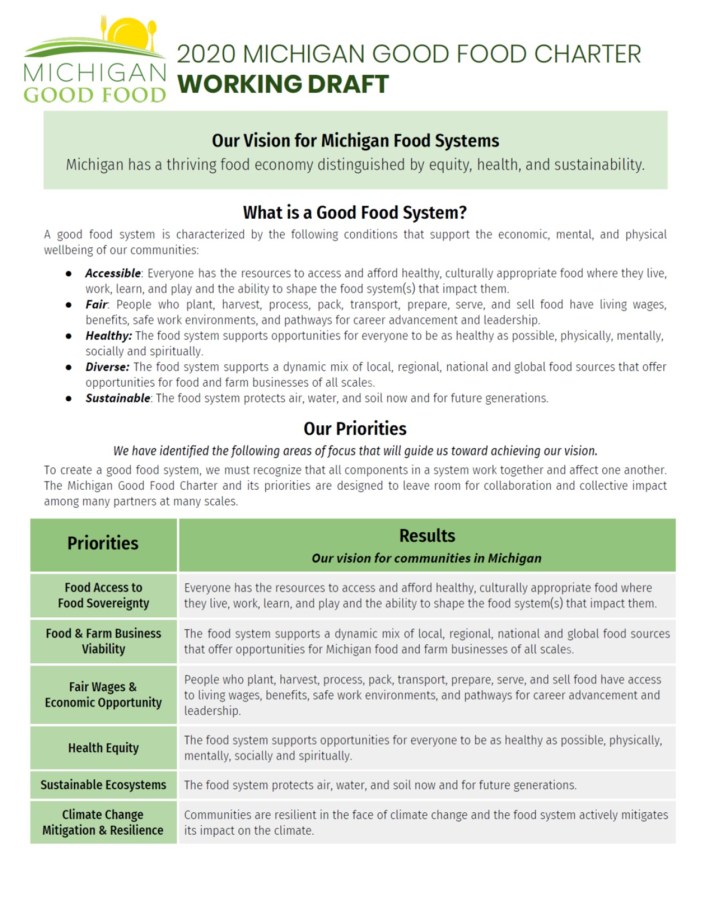
Our Kitchen Table recently provided feedback on the new 2020 Michigan Good Food Charter, being developed by the MSU Center for Regional Food Systems.  Initially published in 2010, the Michigan Good Food Charter helped build momentum for efforts across Michigan to advance a food system that promotes equity, health, sustainability, and thriving economies. OKT’s responses are below.

charterOKT’s responses

Q. How do these priorities look in your community?

  • Everyone does not have access to healthy food in Kent County, especially people of color and those in rural locations. Food sovereignty is negligible.
  • People with income challenges here will be hard hit by climate change.
  • MUCH MORE needs to be done to encouraging food system practices that mitigate climate change (farming, transportation, waste).
  • Yes we need living wages in the food system! Living wages are few and far between for far too many folks in Kent County as evidenced by rising numbers of homeless.
  • We need more local food production and less reliance on global, as transportation long distance is not sustainable. We have the ability here in our state to eat local.
  • We are a long ways away from health equity — and good food is the biggest solution along with dismantling institutional racism.

Q. How does your vision of the food system align with these ideas?

Our vision aligns perfectly except for the “diversity” in mix of food sources as ultimately a global food market is a food market that negatively impacts the environment and reduces food security in developing countries where much of food is sourced.

What is missing? Is there an issue, challenge, or solution that is NOT represented here?

  • “Everyone” needs to be qualified initially as especially inclusive of women, vulnerable children, elders, and people of color. otherwise, this statement is somewhat watered down.
  • Sustainable should emphasize support for organic and sustainable farming methods and reduction of reliance on fossil fuels, chemical fertilizers and GMOs, all which are not sustainable.
  • Need to include humane treatment of animals involved in food production.

GRAAHI & Cherry Health hosting special COVID-19 Facebook Live event 5 p.m. today

Join Grand Rapids African American Health Institute’s Micah Foster and Cherry Health’s Tasha Blackmon today, Wednesday, April 22, at 5 p.m. for a special Facebook Live discussion about COVID-19’s impact on our community and the resources available at Cherry Health.

93973917_3104322896265809_6584817676659458048_o

The event, which will be live streamed on both GRAAHI and Cherry Health’s Facebook pages, will focus on COVID-19 screening and testing available at Cherry Health as well as tips for practicing good social distancing and use of PPEs. Foster and Blackmon will also be answering viewer questions via the comments during the informative session.

Governor Whitmer Creates the Michigan Coronavirus Task Force on Racial Disparities

“This virus is holding a mirror up to our society and reminding us
of the deep inequities in this country.”
Governor Gretchen Whitmer

downloadOn April 9, Governor Gretchen Whitmer created the Michigan Coronavirus Task Force on Racial Disparities. The task force, chaired by Lt. Governor Garlin Gilchrist II, will consist of leaders across state government and health care professionals from communities most impacted by the spread of coronavirus. The task force will hold it’s first meeting this week. 

As of today, over 40% of COVID-19 deaths in Michigan are African Americans, but only 14% of Michiganders are African Americans. The Michigan Coronavirus Task Force on Racial Disparities will provide the governor with recommendations on how to address this disparity as we work to slow the spread of COVID-19 in our state. 

“This virus is holding a mirror up to our society and reminding us of the deep inequities in this country,” said Governor Whitmer. “From basic lack of access to health care, transportation, and protections in the workplace, these inequities hit people of color and vulnerable communities the hardest. This task force will help us start addressing these disparities right now as we work to mitigate the spread of COVID-19 in Michigan.” 


“We know that generations of racial disparities and inequality has a detrimental impact on the lives of people across the state,” Lt. Governor Gilchrist said. “The coronavirus pandemic has shown this inequity to be particularly true, especially in the Black community, where the health of our friends and family has been disproportionately impacted. That’s why we are taking immediate action to assemble some of the greatest minds to tackle this racial injustice now and in the future.” 

During the COVID-19 crisis, Governor Whitmer has signed a number of executive orders aimed at protecting people in vulnerable communities. These include orders to temporarily ban evictions and tax foreclosures, expand unemployment benefits, and restore running water for families. 

During her first year as governor, Governor Whitmer took several steps aimed at lifting Michigan families out of poverty. She announced the Michigan Poverty Task Force within the Department of Labor and Economic Opportunity (LEO), which will provide her with recommendations on how to get more families on a path to success. She has been working with providers and universities to establish implicit bias training in their curriculum so that as people of color seek health care, they’ll be treated with equal dignity and respect, which will yield better outcomes. And in October, she raised asset test limits to make it easier for families to access food assistance and assist them in paying for necessities like rent, utilities, and warm clothes. 

“It shouldn’t take a global pandemic for us to address these problems” Governor Whitmer continued. “It shouldn’t take a crisis for us to expand unemployment benefits, ensure protections for workers who are sick, or expand access to quality, affordable health care. We’re going to come out of this, but we must also learn some hard lessons about the deep problems in our economy that we need real, meaningful solutions on. As we recover from the impact of COVID-19, my administration will continue to focus on long-term solutions for every family in Michigan.” 

This media release was originally broadcasted April 9, 2020

Grievances Mount as North Lake Correctional Facility Hunger Strike Continues through Fourth Day

92792222_893035397787225_1224929191124795392_nAbout ten inmates are moving into day five of a hunger strike, demanding adequate nutrition and basic healthcare services currently being denied, as well as religious freedom. CALL on 4/9 TO SUPPORT IMMIGRANT PRISONERS’ HUNGER STRIKE:

Immigrants imprisoned at the North Lake Correctional Facility in Baldwin, Michigan continued their hunger strike on Wednesday amid escalating complaints of inhumane conditions, violations of Federal Bureau of Prison regulations, and discriminatory treatment by staff. A group of men began the hunger strike on Sunday, April 5th. At the close of their fourth day of hunger strike, strikers reported that Facility Administrator Donald Emerson is aware of the strike and has attempted negotiations with at least some of the men.

Initial reports of the strike cited inadequate nutrition, lack of medical attention, and unequal treatment by prison staff, who have a history of fomenting tension among those detained. Some of the men who’ve been on hunger strike are followers of the Hebrew Israelite faith and report that they have faced religious discrimination. One of the men also reported that staff “demonstrated a lot of racism.” Conditions at North Lake are described as “unbelievable to humankind.” “There’s no way somebody’s supposed to live like this,” one of the men said Wednesday.

The strikers’ mounting grievances come amid increasing concern about COVID-19 in prisons and jails and worry that the facilities cannot provide the space necessary to follow the six-foot social distancing recommendation of the Centers for Disease Control and Prevention. Prisoners in touch with No Detention Centers in Michigan have described incredibly close quarters and below-regulation cell sizes at the North Lake Correctional Facility, which is operated by the GEO Group, a private prison company that contracts with the Federal Bureau of Prisons.

The spouse of one of the men participating in the strike has expressed concern about the well-being of her husband and said that staff at North Lake are now wearing masks to protect against the spread of COVID-19. Her husband and other inmates have not been given the same protection. Strikers noted other inequities during their contact with outside supporters on Wednesday, including lack of commissary access. Prisoners across the country are turning to commissary purchases to get cleaning products and protective equipment to guard against COVID-19 infection.

No cases of COVID-19 have yet been confirmed at North Lake, but there were 380 cases confirmed across Michigan prisons as of Tuesday. These include 262 prisoners and 118 prison staff. An additional two prisoners have died, as have two employees.

On April 8, No Detention Centers in Michigan made this plea via Facebook:

On Sunday, April 5th, approximately ten people incarcerated at the North Lake Correctional Facility in Baldwin, Michigan launched a hunger strike in response to unsafe conditions and the mistreatment they have experienced inside the Special Housing Unit, or SHU. Their concerns include inadequate food and lack of access to medical attention. North Lake is a private immigrant-only prison operated by the GEO Group through a contract with the Federal Bureau of Prisons.

“The main thing is the food,” said one incarcerated person, who stated that their diet had not been meeting the protein requirements of the federal prison system. In addition, he described a lack of proper medical care and treatment after an assault last month. Prison staff have repeatedly exacerbated violence inside the facility.

The majority of those currently on strike inside the SHU are Black men who have expressed serious fears for their safety, describing an inhumane and chaotic environment in which they have suffered racial repression, including administrative segregation within the SHU for over a month after a conflict in which they had not been involved.

“We’re tired of the mistreatment and lack of protection,” one person told No Detention Centers in Michigan last month. “Incidents have occurred and will occur in the future; it’s inevitable.”

“Prison experiences are all unpleasant but this is next-level for so many reasons,” another person wrote. “I have been to six prior institutions, and I have yet to witness a facility like this one. To subject anybody to these living conditions is offensive, racist, and unfair. Are foreign citizens any less human than U.S. citizens?”

Although members of No Detention Centers in Michigan are not currently aware of any suspected cases of COVID-19 inside this facility, the hunger strike comes at a time of grave new dangers facing incarcerated populations worldwide, who are unable to practice social distancing or other steps needed to prevent the spread of the virus and maintain public health.

“The experiences we’ve been hearing about inside North Lake are a reminder that prisons aren’t safe for anyone,” said Jonas Higbee, a member of No Detention Centers in Michigan. “At a moment when COVID-19 is spreading rapidly throughout the Federal Bureau of Prisons as well as Michigan’s state prisons and jails, this is also clear evidence that the GEO Group is not able to protect the people in their custody during a crisis. GEO already has a long history of neglect and abuse, and when people are telling us that they’ve been fearing for their lives even before the COVID-19 emergency, it’s an indication that a quarantine inside a prison is not the answer to a pandemic. As we’ve been starting to see around the country, starting with the most medically vulnerable, the federal government needs to find a way to release people immediately.”