Michigan helps elders stay where they want to be: At home
 According to the Administration for Community Living, 24% of Michiganders will be 60 or older by 2030. While assisted living and long-term care facilities will become home to many of them, an AARP survey found that three out of four people aged 50 and older want to remain at home.
The Michigan Department of Health and Human Services (MDHHS) and Michigan’s 16 Area Agencies on Aging (AAA) recognize the need to support elders who want to age in place — and they are crafting programs to make that possible.
“A lot of seniors want to stay in their homes as long as possible,” says Scott Wamsley, deputy director for the MDHHS Aging and Adult Services Agency. “That’s … important in staying connected with their community, their family, and friends.”
Depending on which AAA administers them, services available to elders at home may include home-delivered meals; aides that help with bathing, dressing, and housework; and friendly reassurance phone calls to check in with elders. Other programs provide caregivers in-home relief and support.
“For those seniors that can be supported in their homes, the cost of service is typically lower than what you’d find in institutional care,” Wamsley says. “There are some cost savings for the state of Michigan when a person can stay in their home.”
Preventing premature death prolongs independence
The Detroit Area Agency on Aging (DAAA) bases its work on “Dying Before Their Time,” an award-winning 2003 study of the older residents DAAA serves. Updated in 2012, the study examined why premature death was common among Detroiters of color. The study found that lifestyle changes and better health practices could extend elders’ lifespans while also supporting increased independence and older Detroiters’ ability to age in place at home.
“Individuals would rather age in their community, age in place. I have not heard anyone openly indicate that they would rather go to a long-term care facility,” says Ronald Taylor, president and chief executive officer of DAAA. “By reducing likelihood of premature death, we also increase likelihood of remaining independent for more years. If we can better manage our chronic conditions, we can live a longer and a healthier life, a better quality of life.”
 Ronald Taylor.
Taylor notes that programs encouraging elders to eat healthy, exercise, and quit smoking, coordinated with healthcare services, increase quality of life. The DAAA addresses food insecurity as the major health challenge for elders living at home. For the past 20 years, its nutrition programs — including its Meals on Wheels program, which is among the largest in the country — have met this challenge. As an added benefit, Meals on Wheels eases the social isolation that impacts so many elders. When drivers drop off meals, they chat a bit with folks, create friendships, and report back if they find any problems.
“Meals on Wheels puts a set of eyes on the individual,” Taylor says. “The meals, in many respects, are the backbone of a lot of our aging services program.”
 A Detroit Meals on Wheels van loaded with meals.
Some programs help elders navigate healthcare systems. The DAAA hosts the Michigan Medicare Assistant Program, which helps individuals decipher Medicare coverage options. Not one to sit behind a desk, Taylor joins his staff as they engage older community members face-to-face to share information on housing options, nutrition, wellness, employment, and social opportunities. Further contact is made via the DAAA’s Senior Solutions newsletter and social media.
“We do a great deal of outreach as far as educating the community on services and programs and also whatever community resources may be available,” Taylor says.
Hospice home care: An overlooked option
According to Patrick Miller, Hospice of Michigan executive vice president and COO, supporting caregivers is equally as important as providing services to elders living in their own homes, especially when dementia comes into play. While a stand-alone diagnosis of dementia does not qualify elders for Medicare-covered hospice benefits, that care can be provided when certain other conditions are present.
“How do we care for the caregivers who are just burned out, really exhausted, and scared? We can provide medications so people with dementia don’t have confusion at night when they might become more agitated [and] confused and help them sleep,” Miller says. “We can provide respite when people say, ‘I just need a break,’ moving the patient into a skilled nursing home for five days where they are cared for in a safe environment and the caregiver can rest and do things for their own wellbeing. And we can provide aides to do personal care. That’s a big relief for caregivers.”
 Hospice of Michigan.
Elders qualifying for hospice care also receive durable medical equipment, like hospital beds, mechanical lifts, and commodes, as a covered Medicare expense.
“All that stuff we can provide so you’re not breaking your back,” Miller says. “That’s a big deal and part of the benefit.”
Miller would like to see Medicare and other insurances offer shorter-term, in-home respite opportunities for caregivers – for example, offering an aide for a few hours on a Saturday, or overnight so the regular caregiver can get some sleep.
There’s an app for that
When asked how the Otsego County Commission on Aging supports elders living at home, executive director Dona Wishart will enthusiastically describe the capabilities of the Commun02 app. The multi-faceted platform can connect older adults to worship services or family and friends via video conference, virtual travel abroad, and community resources. It is currently being piloted in Gaylord, Flint, Traverse City, and St. Clair and Washtenaw counties.
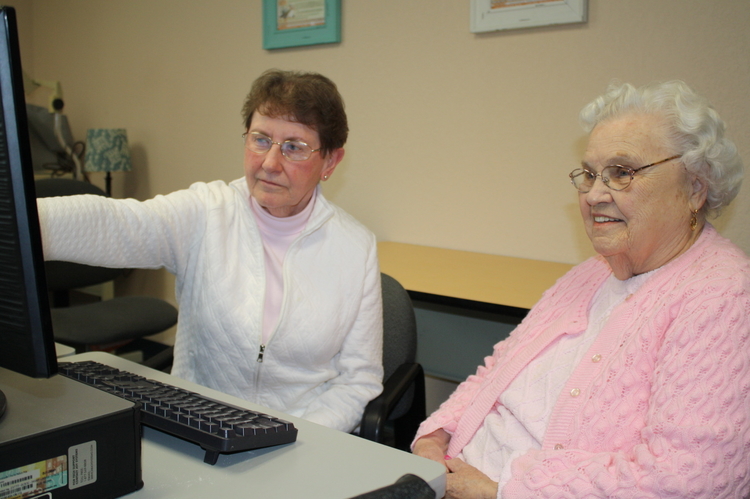 Betty (in pink) connects with her sister in the “old country” using CommunO2 with the help of Mary, a retired senior volunteer in Otsego County. Betty had not seen her sister in about 15 years.
Wishart notes recent research that found that despite the perception that older adults avoid or fear technology, more of them are using it than ever before. She tells a story about a time she shared the app with a group of elders and their smartphones kept distracting them.
“The platform is an opportunity for social connection to family, friends, and social organizations that are important to them,” she says. “We are finding that social isolation is very detrimental. Social connectivity is part of the answer.”
The platform has the capability to add features like remote patient monitoring and telemedicine, which would expand its practicality for older adults living in their own homes.
“If you overcome the barriers, even the oldest people find something that excites them about what the app offers,” says Commun02 developer Joel Ackerman. “To them, it’s safe, secure, and compelling. It helps when they need it, and it’s affordable. Even people in their 90s, if they can see their grandkids and talk to them, that’s enough to excite them to learn to use it.”
Tech is great, but more touch is needed
Like the rest of the nation, Michigan is experiencing a shortage of direct care health aides. Wamsley notes that MDHHS recognizes the direct care worker shortage as a huge issue. The state’s growing aging population exacerbates the problem, particularly in rural areas where young people move away for employment, leaving aging parents without a family safety net.
“It is an issue that our Area Agencies on Aging are facing,” he says. “It can be a demanding job, a job that people really feel is a mission. But it’s difficult work, so some choose other employment.”
In Detroit, Taylor notes that people can make $10 to $12 an hour at a fast food restaurant or $15 an hour working at a car wash — while most direct care workers scrape by on minimum wage.
“The direct care worker shortage is very real, something which we are aggressively working on,” Taylor says.
He says the state needs to find a way to “properly reimburse” workers, offer them more training, and also work on rebranding in order to “put a new face on what the direct care worker looks like and attract others to participate.”
In one analysis, researcher Dr. Robyn Stone said: “Home health aides, home care workers, and personal care attendants form the core of the formal home care system by providing assistance with activities of daily living and the personal interaction that is essential to quality of life and quality of care for their clients.”
Within 10 years, nearly a quarter of Michigan residents may be relying on those workers, whether they live in facilities or stay where they’d rather be: at home.
A freelance writer and editor, Estelle Slootmaker is happiest writing about social justice, wellness, and the arts. She is development news editor for Rapid Growth Media, communications manager for Our Kitchen Table, and chairs The Tree Amigos, City of Wyoming Tree Commission. Her finest accomplishment is her five amazing adult children. You can contact Estelle at Estelle.Slootmaker@gmail.com or www.constellations.biz.
All photos by Steve Koss except CommunO2 photo courtesy of Otsego County Commission on Aging and Ronald Taylor photo courtesy of Detroit Area Agency on Aging.



 The Program for Growth involves parents and caregivers of students attending the school in food growing and healthy eating education.Through OKT’s each one-teach one philosophy, leadership of the program has come up from within. Five program participants have trained to be garden and cooking coaches for the program.



 Governor Whitmer has signed an executive order temporarily expanding eligibility for unemployment benefits. Under the order, unemployment benefits would be extended to:

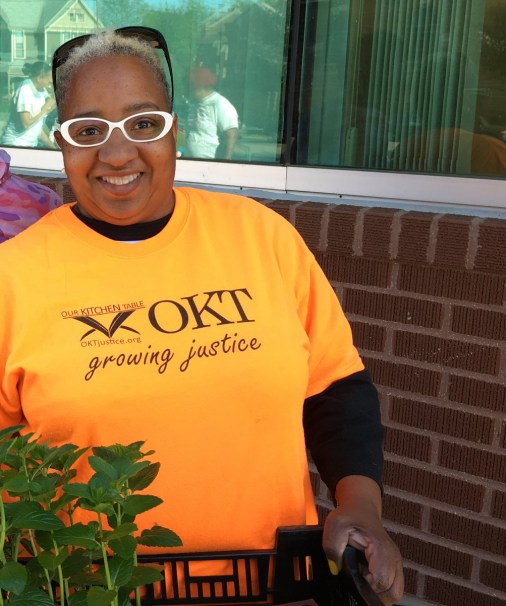 OKT’s executive director, Lisa Oliver-King, took part as a panelist and presenter in two City of Grand Rapids Neighborhood Summit workshops on March 7, one on environmental justice and another on urban agriculture. The 2020 summit theme was “Growing Justice and Community.” For the event, OKT created an updated version of the guide developed with the City in 2019, “Growing Community, Justice, & Food.”
 pests, and saving seeds for next year and neighbors. Updates addressed how to compost healthy soil, air quality and foods that reduce asthma and allergies, and the importance of trees. In addition, the new version highlighted Grand Rapids Public Schools sustainability initiatives.
 Kristi Artz, MD, CCMS, with the
  Brown, a futurist, shared the role that artificial intelligence such as drones could play on farms of the future, how scientists are working to create food equivalents in the lab, and how we might be looking to alternative sources for protein in the future, for examples insects.
 fruits and vegetables in favor of high calorie, low fiber foods that promote chronic diseases including cancer, heart disease, diabetes, rheumatoid arthritis, and obesity. These foods can also impact mental health and make us more vulnerable to common maladies like the flu and colds.
 Plainsong Farm Young Adult Fellowship
 Our Kitchen Table