OKT executive director Lisa Oliver-King will sit on the panel at the Culture Cafe Wednesday, bringing insights on Food Justice and Brain Equity.

OKT executive director Lisa Oliver-King will sit on the panel at the Culture Cafe Wednesday, bringing insights on Food Justice and Brain Equity.

On Saturday Jan. 21, Our Kitchen Table hosted a group of 17 Grand Valley State University (GVSU) students for a Food Justice class and service opportunity at Baxter Community Center. GVSU’s MLK Jr. Day of Service and Solidarity has the goal of educating students about the Civil Rights movement and inspiring them to serve their communities in the spirit of social change. In addition, students have opportunity to experience solidarity through service projects.
During a two-hour Food Justice class, students learned what food justice is, the history of the industrial food system and actions they can take to play a part in the bigger food justice movement.
After a tour of Baxter’s food and clothing pantry, kitchens, medical and dental clinics, greenhouse and childcare center, the students divided into small groups to take on various tasks around Baxter Community Center. They picked up trash on the property, cleaned out the greenhouse, organized the food pantry and and tidied up the kitchen.
OKT was happy Baxter came on board to offer a service portion as part of the day’s activities. Hopefully, some or all of these students will go on to be champions of food justice where they live and work.
The MLK Jr. Day of Service and Solidarity is one event in a week-long commemoration of the life and legacy of Dr. Martin Luther King Jr.
 OKT’s cooking coach, Toni Scott, led a Cook, Eat and Talk event at Baxter Community Center on Friday Dec. 16. The group had a great time rolling out, baking and decorating cookies. Toni’s simple recipe is shown below the slide show.

 During the first year of life, twice as many black babies die in Kalamazoo and Grand Rapids (11.9 per thousand) than white babies. In Muskegon, the numbers are even higher. To take a look at why these numbers continue to plague infants born to black women of all socio-economic and educational levels, Partners for a Racism-Free Community sponsored a Nov. 30 program, “A Deeper Look at Racism and Infant Mortality.” Breannah Alexander, director of strategic programs, facilitated the dialogue that featured Cathy Brown, from the YWCA Kalamazoo, and Celeste Sanchez-Lloyd, from Strong Beginnings.
Black babies die at double the rate of white babies across the nation. Michigan ranks 40th in terms of good infant outcomes. However, first generation black babies, i.e. babies born to immigrants just coming here from Africa, have the same infant mortality rate as white babies. This leads to the conclusion that the stress of living day to day in a racist environment is a factor in babies dying.
“This has to do with racism, the stress of not belonging, not feeling welcome,” Alexander said. “It’s everywhere in the US, regardless of income. However, poverty is another stress factor for most African Americans. Poverty is the thing we see first; we understand it. It does have an effect but not the only effect. Being black, regardless of income, doubles the risks for infant mortality and low birth weight.”
The YWCA Kalamazoo and Strong Beginnings, in Kent County, are taking intentional steps to keep more black babies alive. Sanchez-Lloyd noted that Strong Beginnings community health workers empower the families they serve by offering in-home mental health support, family planning guidance, a fatherhood program as well as help with housing, transportation and employment. These strategies not only create a healthier environment for pregnant black women but also help alleviate some of the stressors impacting them. “We are looking to save that baby but also to making an intergenerational change,” she said.

Left to right, Cathy Brown, Celeste Sanchez-Lloyd and Breannah Alexander.
Brown, who works in programs that offer support to victims of domestic violence, notes that black victims who are pregnant face even higher levels of stress. The YWCA Kalamazoo program seeks to meet women where they are at and figure out intentional ways of helping them carry heathy babies to full term.
Both presenters also spoke about the institutional racism pregnant black women face when seeking medical care. Providers routinely ask them about “baby daddies,” illicit drug use or simply assume that the pregnancy was unplanned and that they are not living a healthy lifestyle. Because many black women are using low cost clinic services, they are afraid to report such treatment for fear they may lose all access to medical treatment. Notably, Grand Rapids is the most segregated city in Michigan and among the five most segregated cities in the nation.
OKT’s Lisa Oliver-King was in the audience and related how her white OB-GYN mistreated her when she went in for her initial exam after discovering she was pregnant. “I had just finished my masters’ degree. My husband and I had the very best health insurance. This was our first and planned pregnancy. The doctor spoke down to me in a very condescending manner. He even asked me ‘How many sexual partners do you have?’”
A white, OB-GYN nurse in the audience says she has noticed this treatment of pregnant black women where she works. She is making efforts to raise awareness. She noted that where she worked, 75% of back women were suspected of drug abuse and referred to screening whereas only 25% of white women were. She believes this discrepancy is due to racism. This discrepancy has been noted and new initiatives will require all women to be routinely screened.
OKT believes that other factors impacting infant mortality include diet and environmental toxins. Across the board, women rarely eat a well-balanced diet including 80 grams of protein each day. Physicians don’t often provide sufficient nutritional advice and can tend to stoke fears of weight gain. This may influence women to eat less in the final months of pregnancy when the infant needs the most nutrition. Women of color living in neighborhoods without access to healthy foods face additional barriers.
Recent research has shown that organophosphate pesticides, fire retardants in clothing and furniture, compounds found in most plastics and on every electronic receipt are linked to premature labor and, low birth weight as well as autism, hyperactivity, lower IQ and cerebral palsy in children. Girls exposed in the womb have more risk for emotional illness; boys are more prone to aggression. (Organophosphates were first developed for deadly chemical warfare and later modified for use as pesticides.) Urban neighborhoods with income-challenged residents, most often people of color, have higher incidence of environmental toxins.
Another consideration is the American way of birth. As a nation, we rank 58th in infant mortality. That means, 57 other countries are a safer place to have a baby. (Cuba is one of the safest.) “Other countries recognize the value of health. They offer comprehensive sex education, comprehensive healthcare, lengthy maternal leave,” noted audience member, Peggy Vander Meulen, who is program director at Strong Beginnings. “Here we also have wealth disparities and racism. It’s political will. Are we going to fund wars and tax cuts for the wealthy or are we going to fund health and education?”
Progress has been made in Kent County. Vander Meulen reported that the 2003 Kent County black infant mortality rate was five times higher (22.3 per thousand) than white infants; today it is two times higher. “We have made a lot of progress,” she said. “We’re not there until there is no disparity. If we get to Cuba’s rate, I can retire.”
Alexander concluded that stress experienced related to racism is an undervalued part of the conversation. Sanchez-Lloyd agreed. “Black women carry the burden of being black, the weight of it every day, living in the white culture,” she said. “When I was pregnant, I remember the added stress of watching African American men get shot on TV and having to wonder if my husband, who is a police officer, would be shot when not in uniform, just for driving while black.”
 Interested in gardening, natural building, farming, community organizing, finding right livelihood, or building a more regeneraitive resilient life in a crazy world? Permaculture is a great place to start!
In this class, look at inspiring, practical ideas for:
– Easier, more sustainable gardening.
– Real world examples of Permaculture community building.
– Practical home energy improvements that pay for themselves.
– Strategies for water harvesting.
– Examples of regenerative livelihoods, farms, gardens and businesses.
– Edible, ecological landscaping that’s good for you, and good for the planet!
The class will have a suggested donation of $25 for the morning and $50 for the full day, but no one will be turned away due to a lack of funds. It is being hosted by Lillie House Permaculture and VanKal Permaculture.
The principle teacher for this class will be Michael Hoag of Lillie House. To learn more about Lillie House, visit: www.lilliehouse.blogspot.com. To see the full schedule or reserve your spot, visit the Lillie House website.
 Deconstructing Institutional Bias
4 – 5 p.m. Thursday, November 17
At Heart of West Michigan United Way
118 Commerce Ave SW
Grand Rapids, MI 49503 United States
On Thursday, November 17 from 4:00pm-5:00pm, Partners for a Racism-Free Community will open up its Building Block program Deconstructing Institutional Bias to the community at large free of charge. For more information on this event please contact Breannah Alexander at balexander@prfc-gr.org.
In addition, they released the following statement:
A Statement from Partners for a Racism-Free Community on recent news:
Last week members of our team were at Race Forward’s Facing Race conference in Atlanta, GA with 2,000 other individuals working to address racial disparity across the United States and, in some cases, globally. The attendees carried with them the weight of a saddening and damaging presidential election cycle and grappled with the meaning of the results. At Partners for a Racism-Free Community we cannot ignore the significance of the campaign rhetoric and the problematic nature of a space in which relentless hate speech yielded such an outcome.
This is what we know: right now, in this moment, we have to make a series of decisions that all impact how we shape our communities and our children moving forward. We know that there is a woeful need for continued education on race. We know that there are places and spaces that not only create uncomfortable realities for people of color in our communities, but dangerous ones as well. What we must first learn to do, however, is listen. In this moment, we must give room for healing and respect that, for some, a safety pin is still not indicative of a safe space. We must address the privilege that leads us to erase the feelings and pain of those around us as we ask our fellow communities members to unify in ways that silence their oppression.
As we navigate this moment we must remember to center the voices of those at risk. A lesson that has undoubtedly been reinforced this election cycle is that we must also be clear about how our ally-ship affects others. Are we listening to those we are supporting? Does our rhetoric translate into the kind of daily actions that address racism as it’s happening in our families, places of worship and communities at large? Are we having the conversation with all of our young people and what are we saying? We cannot sustain the practice of dispersing the burden of understanding to historically disenfranchised groups only.
Today, our team asks you to think about your commitment to addressing racism, creating inclusive spaces and navigating what it means to hold yourself and those around you accountable for their actions. In our profession, witnessing is crucial in doing this work and last Tuesday there was a failure to witness. This moment mirrors other pivotal historical moments globally – the recognition of strife that saves lives and the failure to witness that destroys them.
Our organization will continue to support this community as it works to better understand the kind of environment it wants to cultivate. We will continue to educate. We will continue to elevate the voices of the oppressed. We will continue to create spaces for dialogue. And we will work harder to activate community members who desire to engage further in this work and be the resource that you need for moments like these.
On Thursday, November 17 from 4:00pm-5:00pm, Partners for a Racism-Free Community will open up its Building Block program Deconstructing Institutional Bias to the community at large for free of charge. For more information on this event please contact Breannah Alexander at balexander@prfc-gr.org.
For more information on Partners for a Racism-Free Community, please visit our website at www.prfc-gr.org.
 Thursday Nov. 17 marks the final public session of OKT’s 8-week cooking series with Grand Rapids’ cooking chef and farmer, Anja Mast. Participants have prepared and tasted a host of healthy dishes, become more “food literate” so healthy choices are easier, and learned about food justice. Please join us for either the morning 10 a.m. to 12 p.m. session of the evening 6 to 8 p.m. evening session to learn how to make healthy mac-n-cheese from scratch. Both take place at Sherman Stree Church, 1000 Sherman St. SE 49506.
Last week, Anja shared super-healthy deserts including black bean brownies and bread pudding.
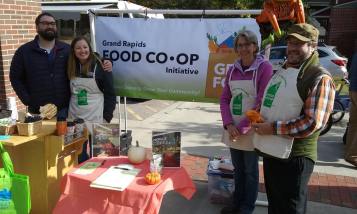 Saturday Nov. 12 is the last day of this year’s Southeast Area Farmers’ Market. The market is open 11 a.m. to 3 p.m. at MLK Jr. Park, 900 Fuller Ave. SE. The Grand Rapids Food Co-op Initiative will be on hand to answer questions about their plans for increasing access to healthy foods in center-city Grand Rapids. Here’s how they describe their work:
 Women of Color
Cook, Eat & Talk
6 to 8 p.m. Thursday Nov. 3
Sherman Street Church kitchen
1000 Sherman St. SE 49506
Join us Thursday for week 6 of OKT’s free 8-week Cook, Eat & Talk series with phenomenal cooking coach, Anja Mast. Anja has scoured a host of African American cookbooks to come up with healthy, low-cost, easy-to-prepare dishes that reflect tradition and taste awesome. This week, we’ll be cooking a healthy dessert, Bread Pudding with Apples , and tasting Fruit Yogurt Cake with Walnut  Streusel and Black Bean Brownies.
OKT had planned on hosting Shakara Taylor as facilitator
of a food justice dialogue. She has just informed us that she is unable to attend. Instead, OKT will facilitate a briefer dialogue on water justice and share ways to be in solidarity with the Standing Rock Sioux Tribe as they continue to protect the water from the DAPL.
No cost. Good eats. Great ideas.
 Our Kitchen Table